Gilang Muhammad
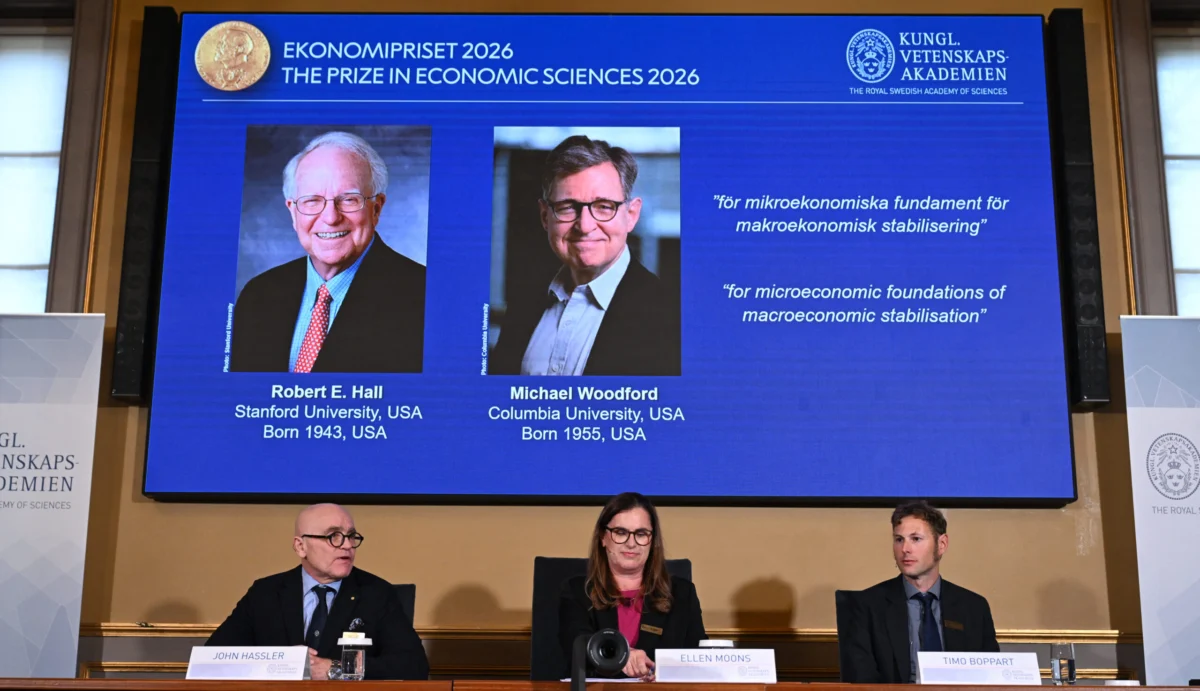
Robert E. Hall and Michael Woodford were on Monday, October 12, 2026, jointly awarded the Sveriges Riksbank Prize in Economic Sciences in Memory of Alfred Nobel for their groundbreaking work that has fundamentally reshaped the theoretical underpinnings and practical application of macroeconomic policy by central banks and governments worldwide. Their contributions are hailed as instrumental in developing models now crucial for "smoothing out" the often-volatile periods of economic boom and bust, providing policymakers with more robust tools to navigate complex economic landscapes.
The Royal Swedish Academy of Sciences, in its announcement, underscored the U.S.-born pair’s profound impact on integrating "microeconomic foundations" into macroeconomic analysis, a paradigm shift that has significantly enhanced the understanding of how individual decisions collectively drive national economic stability. This intellectual fusion has allowed for the creation of sophisticated models that account for the expectations and rational behavior of households and firms, moving beyond simpler aggregate analyses that often proved inadequate in times of crisis.
The prestigious award, established by Sweden’s central bank in 1968, comes with a substantial prize of 12 million Swedish kronor, equivalent to approximately $1.2 million, which the two laureates will share. Hall, a distinguished professor at Stanford University, born in California, and Woodford, an equally esteemed professor at Columbia University, hailing from Massachusetts, represent the pinnacle of modern economic thought.
John Hassler, Chair of the Committee for the Prize in Economic Sciences, emphasized the immediate practical implications of their research: "With them, we are better equipped to deal with shocks in the economy, such as energy crises or sudden changes in how much households consume." This statement highlights the adaptive nature of their models, which have proven resilient and informative in the face of unforeseen global economic disruptions.
The Crucible of the 1970s: Rethinking Economic Orthodoxy
The intellectual genesis of Hall and Woodford’s work is deeply rooted in the turbulent economic climate of the 1970s. This era was characterized by an unprecedented phenomenon known as "stagflation"—a debilitating combination of stagnant economic growth, high unemployment, and soaring inflation. Traditional Keynesian economic models, which had dominated policy prescriptions since the mid-20th century, seemed to falter in the face of this new challenge. Keynesian theory typically advocated for counter-cyclical policies: cutting interest rates and increasing government spending (budget deficits) to stimulate demand during recessions. However, applying these remedies during stagflation risked exacerbating inflation without resolving unemployment, leading to a crisis of confidence in existing economic frameworks.
The Royal Swedish Academy of Sciences noted that these widely accepted models "seemed to no longer work." This period of disillusionment spurred a critical re-evaluation among economists, creating fertile ground for innovative approaches. Hall and Woodford, working independently but converging on similar conceptual breakthroughs, were at the forefront of this intellectual revolution. They recognized the need to delve deeper than aggregate macroeconomic variables such as inflation, overall production, and total consumption. Instead, they championed a granular approach, demonstrating how the collective decision-making of individual households and businesses, crucially influenced by their expectations for the future, fundamentally shapes the broader economy.
Their research highlighted that economic agents are not passive recipients of policy but active, forward-looking participants. For instance, a household’s decision to save or consume, or a business’s choice to invest or hire, is not solely based on current conditions but heavily influenced by their anticipation of future prices, interest rates, and policy actions. This insight paved the way for a more sophisticated understanding of economic dynamics, where expectations themselves become a powerful economic force.
Microfoundations: Bridging the Individual and the Aggregate
The core of Hall and Woodford’s contribution lies in establishing robust "microeconomic foundations" for macroeconomics. Before their work gained widespread traction, much of macroeconomics operated on aggregate relationships without explicitly deriving them from the optimizing behavior of individual agents. This often led to models that were internally inconsistent or struggled to explain observed phenomena during periods of rapid change or crisis.
Robert E. Hall, through his pioneering work, particularly on consumption theory and the permanent income hypothesis, demonstrated how individuals smooth their consumption over their lifetimes based on their long-term income expectations, rather than solely reacting to current income fluctuations. His research on labor markets also highlighted how firms’ hiring and firing decisions are influenced by their expectations of future demand and labor costs, impacting aggregate unemployment and wage dynamics. Hall’s insights provided crucial building blocks for understanding how individual rational choices, aggregated across millions of agents, determine macroeconomic outcomes.
Michael Woodford, on the other hand, is widely recognized for his seminal contributions to New Keynesian economics, particularly his work on monetary policy. His 2003 book, "Interest and Prices: Foundations of a Theory of Monetary Policy," became a foundational text, providing a rigorous, micro-founded framework for analyzing how central banks should conduct policy. Woodford showed how optimal monetary policy can be designed by explicitly modeling the behavior of forward-looking households and firms under various market imperfections (like sticky prices and wages). His models demonstrated that central banks could effectively stabilize the economy by committing to clear, credible policy rules that influence private sector expectations about future inflation and output. This was a significant departure from earlier models that often treated expectations as exogenous or adaptive.
The convergence of their ideas underscored the importance of central banks and governments effectively communicating their policy plans. By doing so, policymakers can "influence this view of the future and move the economy in the right direction," as noted by the Academy. This concept, often termed "forward guidance," has become a cornerstone of modern monetary policy, where central banks explicitly communicate their intentions regarding future interest rate paths or asset purchases to anchor market expectations and enhance policy effectiveness.
The Revolution in Central Banking: From Rules to Expectations
The practical implications of Hall and Woodford’s theories for central banking have been profound. Prior to their work, monetary policy often relied on simpler rules or discretionary interventions. The New Keynesian framework, heavily influenced by their insights, provided central banks with a more sophisticated toolkit, leading to the widespread adoption of concepts like inflation targeting and the aforementioned forward guidance.
Inflation Targeting: Many central banks, including the U.S. Federal Reserve, the European Central Bank, and the Bank of England, now explicitly or implicitly target a specific inflation rate (typically around 2%). This strategy, deeply informed by micro-founded models, aims to anchor long-term inflation expectations, thereby reducing uncertainty for businesses and consumers and promoting price stability. Hall and Woodford’s work demonstrated that credible commitment to such a target can itself influence agents’ behavior, making the target more achievable.
Dynamic Stochastic General Equilibrium (DSGE) Models: The integration of microfoundations led to the development and widespread use of DSGE models by central banks and international financial institutions. These complex mathematical models simulate the entire economy by building up from the optimizing decisions of individual households, firms, and the government, incorporating various shocks (e.g., technology, preferences, monetary policy). While not without their critics or limitations, DSGE models have become standard tools for forecasting, policy analysis, and stress testing, allowing policymakers to evaluate the potential impact of different policy choices on inflation, output, and employment under various scenarios.
Forward Guidance: During and after the 2008 global financial crisis and the subsequent COVID-19 pandemic, central banks pushed interest rates to their effective lower bound (near zero). With conventional interest rate tools constrained, forward guidance became a critical instrument. By clearly communicating their intent to keep rates low for an extended period or until specific economic conditions were met, central banks aimed to lower long-term interest rates and stimulate economic activity by influencing future expectations, directly reflecting the principles espoused by Hall and Woodford.
The Academy summarized the practical impact succinctly: "On the basis of these models, well-timed fiscal and monetary policy measures can reduce the economy’s peaks and troughs. Since the new models’ introduction, they have been extremely helpful in dealing with the economic downturns that have affected us." This statement underscores the tangible benefits of their theoretical contributions in mitigating the severity and duration of economic crises.
Official Responses and Broader Academic Impact
The announcement of the 2026 Nobel Memorial Prize was met with widespread acclaim from the global economic community. John Hassler’s statement was echoed by numerous leading economists and central bank officials who lauded the laureates for their enduring influence.
"This award recognizes a profound intellectual journey that has transformed how we think about the economy," commented Dr. Sarah Chen, a former Federal Reserve economist now at the London School of Economics. "Hall’s meticulous work on consumption and labor, combined with Woodford’s rigorous formalization of monetary policy in a micro-founded setting, provided the analytical tools necessary to move beyond the limitations of earlier macroeconomic frameworks. Their legacy is evident in every central bank’s research department and every advanced economics textbook."
Officials at Stanford and Columbia Universities expressed immense pride in their distinguished faculty members. "Professor Hall has been a beacon of economic inquiry at Stanford for decades, constantly pushing the boundaries of our understanding of business cycles and labor markets," stated Dr. Emily Thorne, Provost of Stanford University. "His work has not only shaped academic discourse but has also had a direct, positive impact on policymaking."
Similarly, Columbia University President Dr. David Lee remarked, "Michael Woodford’s contributions to monetary economics are monumental. His ability to synthesize complex theoretical ideas into actionable policy frameworks has made him one of the most influential economists of his generation. This prize is a testament to his intellectual rigor and his unwavering commitment to advancing economic science."
Beyond the direct impact on policy, their work has spurred countless research endeavors, fostering new generations of economists who continue to build upon their foundations. The New Keynesian school of thought, where both laureates are central figures, remains a dominant paradigm in macroeconomics, constantly evolving to address new challenges and incorporate new insights.
The Sveriges Riksbank Prize: A Legacy in Economics
The Sveriges Riksbank Prize in Economic Sciences in Memory of Alfred Nobel, while often referred to colloquially as the "Nobel Prize in Economics," holds a unique position. It was established by the Swedish central bank in 1968 to celebrate its 300th anniversary, distinct from the original five prizes endowed by Alfred Nobel’s 1895 will (Physics, Chemistry, Physiology or Medicine, Literature, and Peace). Despite this historical difference, the prize is administered by the Royal Swedish Academy of Sciences, follows the same rigorous selection process as the original Nobels, and enjoys comparable prestige and recognition within the scientific community.
The prize has, at times, generated debate regarding its inclusion alongside the original Nobel Prizes, particularly from critics who argue that economics is not a natural science in the same vein as physics or chemistry. However, its half-century history has consistently recognized economists whose work has demonstrated profound scientific rigor and significant societal impact, firmly establishing its place as the highest honor in the field of economics. Past laureates have addressed a vast array of economic challenges, from poverty and development to market design and climate change, underscoring the broad relevance of economic science.
The 2026 Nobel Season: A Spectrum of Human Endeavor
The announcement of the economics prize traditionally concludes the Nobel season, which began earlier in the week with the unveiling of laureates in other fields. The 2026 awards have celebrated a diverse range of human achievements, reflecting Alfred Nobel’s vision of recognizing those who have conferred the "greatest benefit to humankind."
Among this year’s distinguished recipients was Navanethem "Navi" Pillay, who was awarded the Nobel Peace Prize on Friday, October 9, 2026, for her tireless work in promoting peace, justice, and international law, particularly through her advocacy for human rights. Her impactful career as a judge and human rights commissioner has left an indelible mark on global jurisprudence and humanitarian efforts.
The Nobel Prize in Literature was bestowed upon Canadian poet and writer Anne Carson, recognized for her "bold and inventive oeuvre." Carson’s unique blend of classical scholarship, poetry, and prose has captivated critics and readers alike, pushing the boundaries of literary expression and earning her a place among the most innovative voices in contemporary literature.
These announcements, spanning the realms of science, literature, and peace, collectively highlight the multifaceted ways in which individuals contribute to the advancement of human knowledge, welfare, and understanding, culminating with the recognition of Hall and Woodford’s pivotal contributions to economic stability.
The Enduring Legacy and Future Horizons
The contributions of Robert E. Hall and Michael Woodford have irrevocably altered the landscape of macroeconomics and central banking. Their work moved the field towards a more micro-founded, expectations-driven paradigm, providing policymakers with a deeper understanding of economic behavior and more effective tools for stabilization.
While their models have proven invaluable, especially in the context of inflation targeting and managing conventional business cycles, the field continues to evolve. Recent global financial crises, the challenges of persistent low growth, the rise of digital currencies, and the looming threat of climate change present new complexities that push the boundaries of existing models. Economists are continuously refining DSGE models, incorporating financial frictions, heterogeneous agents, and behavioral economics insights to better capture the nuances of the modern economy.
Nevertheless, the foundational principles laid by Hall and Woodford – particularly the emphasis on rational expectations, individual optimization, and the critical role of policy communication – remain indispensable. Their legacy is not just in the specific models they developed but in the intellectual framework they established, which continues to guide economic research and inform policy debates globally. As economies face unprecedented challenges, the rigorous, micro-founded approach championed by Hall and Woodford will undoubtedly continue to be a cornerstone for developing robust and adaptive policy responses, ensuring that their impact resonates far into the future of economic science and practice.