Lina Wu
SEOUL – South Korea’s economy demonstrated robust expansion in the third quarter of 2026, achieving a growth rate of 1.0 percent. This surge was primarily fueled by the continued artificial intelligence-led boom in the nation’s crucial technology sector, particularly in the manufacturing and export of advanced semiconductors and AI-integrated hardware. However, this impressive headline figure masks a concerning trend: a significant dip in private consumption, signaling a divergence in economic performance and raising questions about the sustainability of the current growth trajectory.

The Bank of Korea’s preliminary estimate, released on October 27, 2026, painted a picture of an economy powered by its technological prowess. The impressive 1.0% quarter-on-quarter growth surpassed many economists’ expectations, building upon the momentum established in previous quarters. This performance positions South Korea favorably within the global economic landscape, especially as many other developed nations grapple with more moderate growth rates or even stagnation.
The AI Engine: A Semiconductor Supercharge
The primary driver behind this economic acceleration is undeniably the burgeoning demand for artificial intelligence-enabled products. South Korea, a global leader in semiconductor manufacturing, has been at the forefront of this technological revolution. Companies like Samsung Electronics and SK Hynix have reported record sales and production volumes for high-bandwidth memory (HBM) chips and other advanced logic processors crucial for AI applications. This surge in demand from global tech giants developing AI infrastructure, from cloud computing providers to developers of AI-powered consumer devices, has translated into substantial export revenues.

Data from the Korea Customs Service indicates that semiconductor exports, which constitute a significant portion of the nation’s total outbound shipments, saw a year-on-year increase of over 35% in September 2026. This trend is projected to continue through the remainder of the year and into early 2027, according to industry analysts. The AI boom has not only boosted the output of these core components but has also stimulated related industries, including advanced manufacturing equipment, specialized software development, and logistics services.
The government has actively supported this sector through various initiatives, including research and development grants and tax incentives aimed at fostering innovation and maintaining South Korea’s competitive edge. Minister of Economy and Finance, Lee Min-jun, commented in a recent press briefing, "Our nation’s strategic investment in the AI ecosystem is yielding significant returns. The resilience and dynamism of our technology sector are not only driving economic growth but also securing our position as a leader in the global digital transformation."

The Shadow of Weakening Private Consumption
While the export-driven technology sector soars, a stark contrast is emerging in the realm of domestic demand. The same Bank of Korea report highlighted a contraction in private consumption, with household spending declining by an estimated 0.5% in the third quarter. This marks the second consecutive quarter of negative growth in consumer spending, a worrying sign for an economy that traditionally relies on a healthy domestic market to complement its export-oriented industries.
Several factors are contributing to this downturn in private consumption. Persistent inflation, although showing signs of moderation, has eroded household purchasing power. Rising interest rates, implemented by the Bank of Korea to combat inflationary pressures, have made borrowing more expensive, discouraging discretionary spending and increasing the debt burden for many households. Furthermore, a cautious sentiment among consumers, perhaps influenced by global economic uncertainties and a sense of economic precarity, may be leading to increased savings and a reduction in non-essential expenditures.

The retail sector has felt the pinch, with reports from the Korea Retail Association indicating a slowdown in sales for non-essential goods such as apparel, electronics (excluding those tied to AI development), and entertainment. Restaurants and hospitality services are also experiencing reduced foot traffic, particularly outside of major business districts that benefit from the tech industry’s activity.
Background and Timeline of Economic Shifts
The current economic landscape in South Korea has been shaped by a series of evolving global and domestic factors. The initial years of the 2020s were marked by the lingering effects of the COVID-19 pandemic, supply chain disruptions, and rising geopolitical tensions. South Korea, heavily reliant on international trade, experienced volatile growth patterns during this period.

However, the emergence of generative AI and its rapid integration into various industries in late 2024 and throughout 2025 provided a significant catalyst for the country’s tech sector. This led to a surge in investment and demand for advanced semiconductor capabilities, particularly memory chips designed to handle massive datasets. Companies responded by ramping up production and investing heavily in next-generation technologies.
Timeline of Key Developments:

- Late 2024 – Early 2025: Growing global interest and investment in generative AI technologies.
- Mid-2025: South Korean semiconductor giants announce significant R&D and production capacity expansions focused on AI-specific chips.
- Late 2025 – Early 2026: Initial signs of a strong export rebound driven by AI-related semiconductor demand.
- Q1-Q2 2026: Continued strong export performance, but early indicators suggest a softening in domestic consumer spending.
- Q3 2026: Official data confirms a 1.0% economic growth driven by exports, while private consumption declines by 0.5%.
This divergence highlights a critical challenge for policymakers: how to ensure that the benefits of the AI-led export boom are more broadly shared and do not exacerbate existing economic inequalities.
Supporting Data and Sectoral Analysis
To further illustrate the economic situation, several key data points are crucial:

- Gross Domestic Product (GDP) Growth: Q3 2026 registered a 1.0% quarter-on-quarter growth, translating to an annualized rate of approximately 4.0% if sustained. This is a significant improvement from the 0.7% growth recorded in the second quarter.
- Private Consumption: Declined by 0.5% in Q3 2026, following a 0.3% decrease in Q2 2026. This represents a concerning trend of contraction.
- Exports: Saw robust growth, estimated at over 6.0% in Q3 2026, primarily driven by a surge in electronics and machinery.
- Imports: While exports surged, imports also increased, albeit at a slower pace, reflecting demand for raw materials and capital goods needed for production. This resulted in a positive net export contribution to GDP.
- Investment: Business investment, particularly in the manufacturing and technology sectors, remained strong, indicating confidence in future growth prospects for these industries. Fixed capital formation is estimated to have grown by approximately 2.0% in Q3.
- Inflation: The Consumer Price Index (CPI) showed a year-on-year increase of 3.2% in September 2026, down from 3.8% in August, indicating a gradual easing of price pressures. However, core inflation, excluding volatile food and energy prices, remained sticky at 3.0%.
- Interest Rates: The Bank of Korea’s policy rate currently stands at 3.50%, a level maintained since earlier in the year to balance inflation control with economic growth support.
The sectoral breakdown reveals a clear bifurcation. The manufacturing sector, dominated by high-tech production, is thriving. In contrast, service sectors heavily reliant on domestic consumer spending, such as retail, hospitality, and personal services, are facing headwinds.
Official Responses and Expert Analysis
The Bank of Korea, in its quarterly monetary policy report, acknowledged the dual nature of the current economic expansion. Governor Kim Ji-hoon stated, "While we are encouraged by the strong performance of our export-oriented industries, particularly in the technology sector, we remain vigilant about the persistent weakness in private consumption. Our policy decisions will continue to aim for a balanced and sustainable growth path."

Economists are offering varied perspectives on the implications of this trend. Dr. Park Seo-yeon, a senior economist at the Korea Development Institute (KDI), commented, "The AI boom is a powerful engine for South Korea, leveraging its core strengths. However, relying solely on exports for growth can make the economy vulnerable to external shocks. A sustained recovery in private consumption is essential for long-term economic stability and inclusive growth."
Some analysts suggest that the government might consider targeted fiscal measures to stimulate domestic demand, such as temporary tax rebates for lower and middle-income households or increased public spending on infrastructure and social services. However, such measures would need to be carefully calibrated to avoid reigniting inflationary pressures.

Broader Impact and Future Implications
The current economic scenario in South Korea has several broader implications:
- Global Competitiveness: The sustained success in the AI semiconductor market reinforces South Korea’s position as a critical player in the global technology supply chain. This could lead to increased foreign direct investment and further technological advancements.
- Income Inequality: The widening gap between the booming tech sector and the struggling domestic consumption market could exacerbate income inequality if not addressed. Workers in export-oriented industries may see wage growth, while those in sectors affected by weak consumer spending might face stagnant incomes or job insecurity.
- Economic Diversification: The reliance on a single sector, however strong, presents a risk. Policymakers may need to re-evaluate strategies for economic diversification, fostering growth in other sectors that can contribute to domestic demand and job creation.
- Monetary Policy Challenges: The Bank of Korea faces a delicate balancing act. Tightening monetary policy too aggressively to curb inflation could further dampen consumption, while easing too soon could risk re-igniting price pressures.
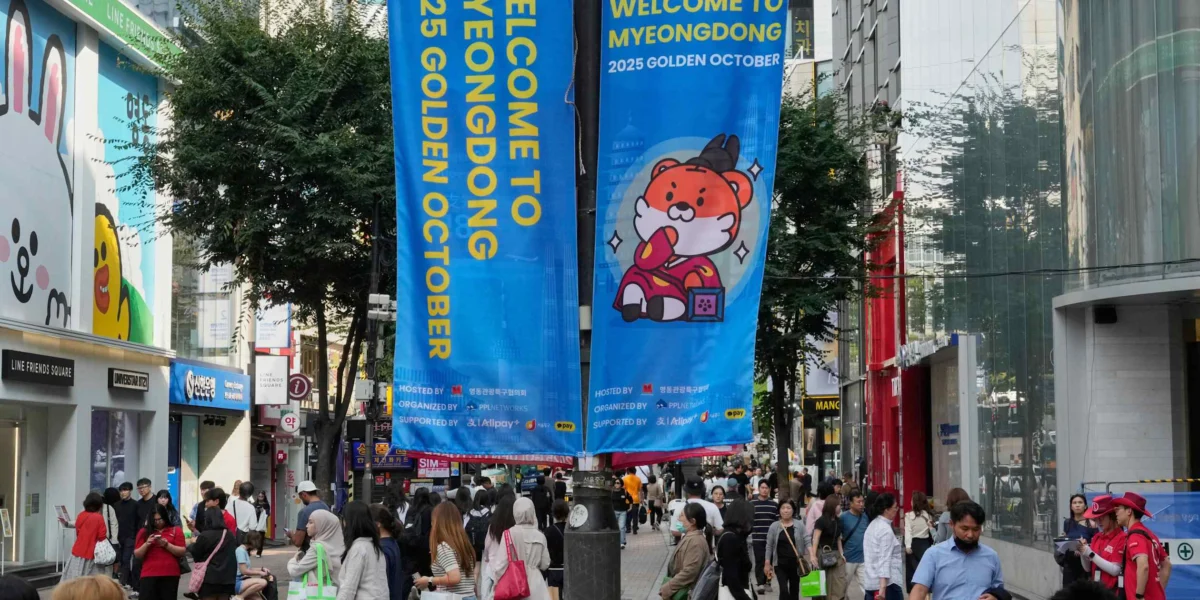
The coming quarters will be crucial in determining whether South Korea can successfully navigate these diverging economic forces. The ability to translate the dynamism of its AI-driven export sector into broader-based domestic prosperity will be a key determinant of the nation’s economic health and stability in the years to come. The photo of people walking in a Seoul shopping area, taken on October 1, 2025, serves as a poignant reminder of the consumer activity that underpins a healthy economy, activity that appears to be waning amidst the digital boom.