Clara Shinta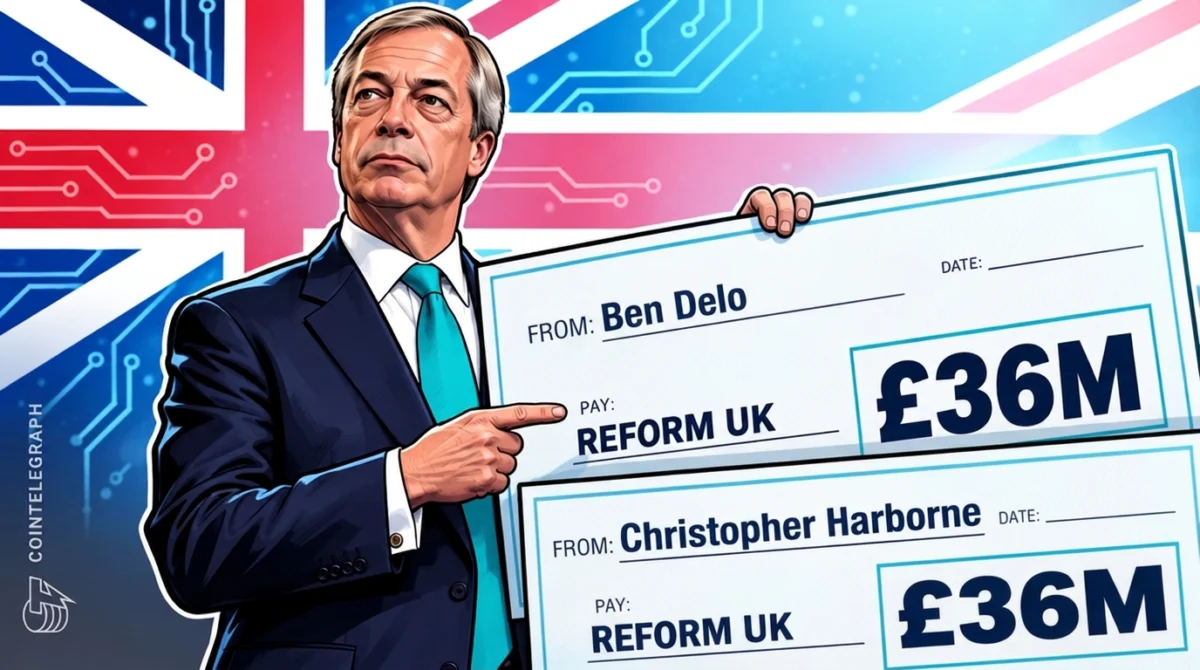
Nigel Farage’s Reform UK party has become the beneficiary of an unprecedented £72 million funding injection, following matching £36 million donations from cryptocurrency billionaires Ben Delo and Christopher Harborne. This colossal sum, jointly representing the largest political donation ever recorded in British history, has catapulted Reform UK into a new financial league, promising to reshape the landscape of the upcoming general election, expected in 2029. The donations, however, arrive amidst intensified scrutiny over the influence of digital assets in UK politics and the controversial past of one of the key benefactors.
The Landmark Donations: A Financial Game-Changer
The extraordinary funding announcement unfolded over a single weekend in September 2026. Ben Delo, co-founder of the prominent BitMEX cryptocurrency exchange, first declared his intention to donate £36 million to Reform UK on a Friday. His contribution was framed as a means to ensure a "fair fight" at the polls, a sentiment echoed by many smaller parties who often struggle to compete with the financial might of the two dominant political forces, the Conservative and Labour parties. Delo clarified in The Telegraph that while the £36 million represented £1 million per month until the projected 2029 general election, he made the entire payment upfront, explicitly stating this was to "prevent it from being blocked."
Barely 24 hours later, on Saturday, Christopher Harborne, another significant figure in the cryptocurrency sector and a long-time donor to Farage-affiliated entities, announced he would match Delo’s £36 million contribution. Writing in The Telegraph, Harborne stated that Delo’s generosity had directly inspired his decision to match the sum. He proactively addressed potential criticisms and expectations, asserting, "No peerage, no policy change, just a party that is ready for government." This statement aimed to preempt accusations of quid pro quo, a common concern surrounding large political donations in the UK. This latest donation brings Harborne’s total contributions to Reform UK to at least £45 million, having previously given £9 million to the party in August 2025.
Nigel Farage, the charismatic leader of Reform UK, wasted no time in welcoming both donations, articulating that the funding would enable Reform to contest the next general election on "a level playing field." This phrase suggests a perceived historic disadvantage in financial resources compared to the established parties, an imbalance that this £72 million influx now dramatically redresses.
To put this sum into perspective, the previous largest individual donation to a UK political party was reportedly around £10 million. The £72 million now available to Reform UK is a game-changer, potentially allowing the party to fund a nationwide campaign operation, invest heavily in advertising across all media, field candidates in every constituency, and establish a robust ground game, areas where smaller parties typically lag significantly. For context, the total declared spending by all parties in the 2019 general election was approximately £37 million. This single donation effectively doubles that entire figure for one party.
Nigel Farage and the Rise of Reform UK: A Political Journey
To understand the significance of this funding, one must trace the political trajectory of Nigel Farage and the evolution of Reform UK. Farage is one of the most recognizable and often controversial figures in modern British politics, having played a pivotal role in the UK’s decision to leave the European Union. He co-founded the UK Independence Party (UKIP) in 1993, which under his leadership, transformed from a fringe movement into a significant electoral force, culminating in the 2014 European Parliament elections where UKIP topped the polls.
Following the 2016 Brexit referendum, Farage resigned as UKIP leader, only to return to frontline politics in 2019, forming the Brexit Party. This new vehicle capitalized on public dissatisfaction with the Conservative government’s handling of Brexit, again topping the European Parliament elections that year. After Brexit was delivered, the Brexit Party was rebranded as Reform UK, positioning itself as a populist, right-wing alternative to the Conservative Party, advocating for lower taxes, reduced immigration, and significant reforms to public services.
Reform UK has consistently sought to appeal to disaffected Conservative voters and those feeling unrepresented by the mainstream. Despite Farage’s personal popularity among a segment of the electorate, the party has struggled to translate this into significant parliamentary representation under the UK’s first-past-the-post electoral system. The infusion of £72 million changes this dynamic fundamentally, providing the resources necessary to build infrastructure, recruit and train candidates, and significantly amplify its message across the nation, potentially making it a serious contender in a multi-party system.
A Chronology of Controversy and Funding
The path to these record donations has been punctuated by a series of events that highlight the increasing intersection of cryptocurrency wealth and political influence in the UK:
- March 2025: Ben Delo, along with his BitMEX co-founders Arthur Hayes and Samuel Reed, receives a presidential pardon from then-US President Donald Trump. This pardon came after they pleaded guilty to federal charges in the US related to violations of the Bank Secrecy Act and paid substantial fines.
- August 2025: Christopher Harborne makes an initial £9 million donation to Reform UK, signaling his early financial commitment to the party.
- March 2026: In response to growing concerns over crypto-related political donations, Labour MPs reportedly consider a moratorium on such contributions, pending the introduction of new legislation. This move indicates an existing unease within political circles about the source and nature of digital asset funding.
- July 2026: Nigel Farage finds himself under investigation by UK parliamentary authorities regarding donations and "gifts" from figures tied to the crypto industry, specifically Harborne and George Cottrell. Farage denies any wrongdoing. Amidst this scandal, he resigns his position as a Member of Parliament (MP), triggering a by-election.
- July 2026 (By-election): Farage contests and wins the ensuing by-election with a commanding 63% of the vote, defeating a field of candidates including the satirical figure Count Binface. This victory reaffirms his personal electoral appeal despite the ongoing controversies.
- August 2026: Cointelegraph reports on the ongoing investigation into Farage’s crypto-linked donations, maintaining the spotlight on the issue.
- September 11, 2026: Ben Delo announces his £36 million donation to Reform UK.
- September 12, 2026: Christopher Harborne matches Delo’s donation with an additional £36 million, bringing the total to £72 million.
This timeline reveals a pattern of Farage and Reform UK attracting significant funding from individuals connected to the cryptocurrency industry, often against a backdrop of regulatory scrutiny and ethical questions.
Scrutiny Over Funding and Regulatory Gaps
The substantial crypto-linked donations have inevitably intensified questions from lawmakers and the public alike regarding the influence of digital assets on UK politics. The UK’s political finance regime, overseen by the Electoral Commission, requires transparency for donations above certain thresholds, but the rapid evolution of digital assets has presented new challenges.
The investigation into Farage, stemming from "gifts" and donations from Harborne and Cottrell, underscored existing vulnerabilities in the system. While Farage has consistently denied wrongdoing, the controversy prompted Labour MPs to consider a permanent ban on crypto donations, an idea first floated in March 2026. This reflects a broader concern that the current regulatory framework, designed for traditional fiat currency donations, may not be adequate to track, vet, and regulate complex or internationally sourced digital asset contributions. There are fears that such donations could be used to circumvent existing rules, introduce opaque funding, or even be linked to illicit activities, despite the donors’ assertions of legitimate wealth.
The Electoral Commission, while not commenting on specific donations outside of its regular reporting cycles, is expected to meticulously scrutinize these unprecedented contributions. Its role is to ensure that donations comply with UK law, particularly regarding donor eligibility (e.g., being a permissible donor, such as a UK-registered company or an individual on the UK electoral register). Given the scale and the source of these funds, the Commission’s oversight will be under intense public and political focus.
The Donors: Profiles and Controversies
Ben Delo: Co-founder of BitMEX, one of the world’s largest cryptocurrency derivatives exchanges. In 2022, Delo pleaded guilty in a US federal court to violating the Bank Secrecy Act (BSA). The BSA is a cornerstone of US anti-money laundering (AML) efforts, requiring financial institutions to report suspicious transactions and maintain records. Delo and his co-founders admitted to "willfully failing to establish, implement, and maintain an anti-money laundering program" at BitMEX. This failure allowed the exchange to operate without adequate checks, potentially facilitating money laundering and terrorist financing. While he agreed to pay a $10 million fine, Delo notably did not serve prison time, a fact that drew criticism from some legal observers who argued for harsher penalties for such serious financial crimes. The subsequent presidential pardon from Donald Trump in March 2025 further complicated his public image, raising questions about the intersection of political power and justice. Pardons typically expunge the record of conviction, but the public memory of the charges and the pardon remains.
Christopher Harborne: A British businessman with significant interests in the technology and cryptocurrency sectors. Harborne has been a long-standing financial supporter of Nigel Farage and his political endeavors. His previous £9 million donation to Reform UK in August 2025, alongside his current matching donation, demonstrates a deep and consistent commitment to Farage’s political vision. Harborne’s wealth, like Delo’s, is largely derived from his involvement in digital assets, placing him at the heart of the debate surrounding crypto’s role in political finance. His explicit statement that he expects "no peerage, no policy change" seeks to distance his donation from the perception of transactional politics, a sensitive issue in British political culture where peerages for donors have occasionally sparked controversy.
Implications for UK Politics and the Electoral Landscape
The £72 million donation has profound implications for the UK political landscape:
-
Reform UK’s Electoral Prospects: This funding transforms Reform UK into a formidable financial force. It will enable the party to:
- Field More Candidates: Potentially contest all 650 constituencies across the UK, significantly increasing its national presence and visibility.
- Massive Campaign Spending: Invest heavily in national advertising campaigns (TV, digital, print, billboards) to reach a wider audience than ever before.
- Enhanced Ground Operations: Fund local campaign offices, hire staff, and organize grassroots efforts to mobilize voters.
- Professionalization: Attract experienced political strategists and communicators, elevating the party’s professional image and operational capacity.
This financial muscle could allow Reform UK to genuinely challenge the two-party dominance, potentially splitting the right-wing vote and impacting the outcomes in numerous marginal constituencies, particularly those traditionally held by the Conservatives.
-
Pressure on Mainstream Parties: The sheer scale of Reform UK’s funding will put immense pressure on the Labour and Conservative parties. They will face a better-resourced opponent, potentially forcing them to recalibrate their own campaign strategies and spending plans. It may also intensify their scrutiny of Reform UK’s funding sources and call for tighter regulations on political donations.
-
The Debate on Political Finance: The donations reignite the perennial debate about money in politics, specifically:
- Transparency: Calls for even greater transparency in donation reporting, especially for complex digital asset transactions.
- Source of Funds: Questions about the ethical implications of accepting large sums from individuals with controversial legal histories, even if pardoned.
- Foreign Influence: While Delo and Harborne are presented as permissible donors, the international nature of crypto wealth and the US pardon raise broader questions about the potential for indirect foreign influence in UK elections.
-
Regulatory Reform for Digital Assets: The ongoing controversies and the scale of these donations are likely to accelerate discussions about specific legislation to regulate crypto donations. A permanent ban, as proposed by some Labour MPs, or a stricter framework for vetting and reporting, seems increasingly probable. This could set a precedent for how other countries approach the intersection of digital assets and political funding.
-
Public Perception and Trust: While Farage welcomes the funding as a means to achieve a "level playing field," the optics of receiving such vast sums from crypto billionaires, one of whom was convicted of financial crimes, could be a double-edged sword. Some voters might view it as a necessary injection for a challenger party, while others may perceive it as further evidence of opaque influence and the problematic nature of modern political finance. Public trust in politics, already fragile, could be further eroded if these donations are seen as undermining democratic integrity.
Broader Discussion on Crypto and Politics
Globally, the intersection of cryptocurrency and political funding is a burgeoning area of debate. The decentralized and often pseudonymous nature of some digital assets presents unique challenges for regulators tasked with ensuring transparency and preventing illicit financing. While many in the crypto community advocate for financial freedom and innovation, political systems worldwide are grappling with how to integrate this new form of wealth into established regulatory frameworks without compromising democratic principles.
The Reform UK case serves as a high-profile example of how rapidly crypto wealth can alter traditional political dynamics. It underscores the urgent need for robust, internationally coordinated regulatory responses to ensure that political funding remains transparent, accountable, and free from undue influence, regardless of the asset class involved.
In conclusion, the £72 million donation to Reform UK is a watershed moment in British political history. It provides unprecedented financial firepower to a party seeking to disrupt the established order, but simultaneously intensifies the scrutiny on political funding, the role of cryptocurrency wealth, and the ethical considerations that underpin democratic processes. As the UK heads towards its next general election, the impact of these historic donations will undoubtedly be one of the most significant and debated factors shaping the political discourse.