Clara Shinta

The landscape of foreign exchange (FX) is undergoing a significant re-evaluation, particularly concerning its potential evolution within blockchain ecosystems. Michael Egorov, the influential founder of Curve Finance and Yield Basis, posits a compelling argument: rather than the long-held assumption of a "top-down" adoption by traditional financial institutions, on-chain FX is increasingly showing signs of developing from the "bottom-up." This grassroots emergence, he suggests, is propelled by the practical needs of everyday users and the burgeoning utility of stablecoins within decentralized finance (DeFi).
For years, the prevailing wisdom dictated that the pathway to widespread on-chain FX would begin with established banks tokenizing major currencies, followed by large financial institutions migrating their extensive FX operations onto blockchain rails. The anticipated outcome was a blockchain-based FX market that would eventually mirror the vast scale and complexity of its traditional counterpart. However, Egorov’s observations challenge this conventional narrative, pointing to growing evidence that the actual trajectory is unfolding in precisely the opposite direction.
The Paradigm Shift: From Institutional Hegemony to User-Driven Adoption
The traditional perspective on blockchain’s integration into FX markets envisioned a trickle-down effect. Central banks and commercial banks would be the primary movers, digitizing national currencies as central bank digital currencies (CBDCs) or tokenized deposits. This, it was believed, would pave the way for institutional players, already accustomed to high-volume, low-margin FX trading, to transition their activities onto permissioned or public blockchains. The expectation was that once these behemoths established their presence, institutional liquidity would naturally follow, eventually reaching a critical mass that would then cascade down to smaller entities and individual users.
However, the reality emerging from the crypto space tells a different story. The innovation cycle within decentralized finance has been largely driven by user demand and developer ingenuity, creating solutions that address immediate pain points. This has fostered an environment where practical applications, often starting small, can gain traction and scale rapidly. Egorov’s thesis underscores this dynamic, suggesting that the organic growth of on-chain FX is being fueled by individuals and businesses seeking more efficient, cost-effective, and accessible ways to manage cross-currency transactions.
Stablecoins: The Unsung Drivers of Early On-Chain FX
At the heart of this bottom-up revolution are stablecoins – digital assets designed to maintain a stable value relative to a fiat currency or other assets. Examples such as Brazilian Digital (BRZ) or Monerium’s EURe are not merely theoretical constructs; they are actively facilitating real-world economic activity. These stablecoins offer swift on-chain redemption and seamless movement between digital wallets and traditional bank accounts, creating a crucial bridge between the nascent digital economy and established financial systems.
The utility of these stablecoins extends into decentralized exchanges (DEXs), where they generate substantial trading volume as DeFi users swap them in liquidity pools. These markets are not abstract; they are developing in real-time, directly addressing a fundamental user need: the ability to move directly and efficiently between digital currencies and their fiat counterparts. This immediate utility bypasses the complex, often slow, and costly intermediaries of traditional FX.
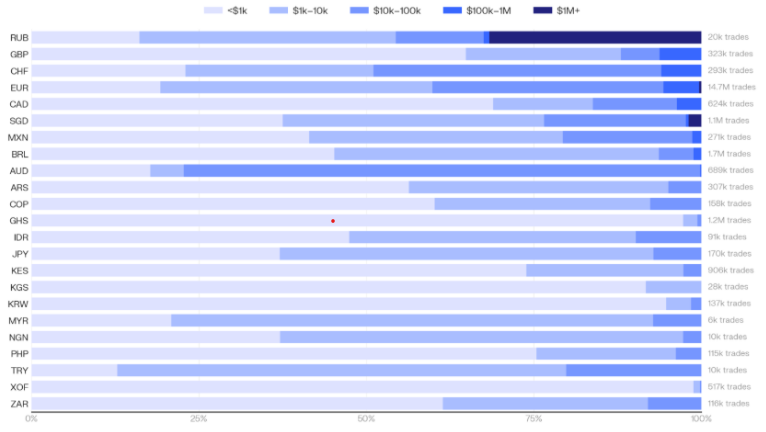
Supporting data highlights this trend. Research from Keyrock indicates that the majority of on-chain stablecoin trades tied to emerging market currencies fall within the $1,000 to $10,000 range. While these amounts may appear modest when compared to the gargantuan scale of institutional FX transactions, their significance lies precisely in their size. They represent the cumulative activity of numerous individuals and smaller businesses – a clear indication that the market is building towards on-chain FX to meet practical payment needs, rather than solely catering to large-scale traders. This user-centric adoption pattern demonstrates a market forming around utility, proving that "small" is not synonymous with "useless" in the context of emerging financial infrastructure.
The Evolution of Stablecoins: A Precedent for On-Chain FX Growth

The current trajectory of on-chain FX draws a compelling parallel with the historical growth of stablecoins themselves. Stablecoins initially emerged as a relatively niche, crypto-native use case, primarily serving as a means for traders to move in and out of volatile cryptocurrencies without converting back to fiat. Their early utility was largely confined to crypto exchanges and early DeFi protocols. Yet, over time, their functionality expanded dramatically. Today, stablecoins like USDT and USDC are recognized as integral components of a much broader financial infrastructure, facilitating everything from cross-border remittances to collateral in lending protocols.
This evolution is evidenced by robust data. Chainalysis recently reported a significant surge in cross-border stablecoin activity, which jumped to over $220 billion by mid-2026. This represents an almost 80% growth within a single year, unequivocally demonstrating the escalating demand and activity for these digital assets. Egorov contends that there is no inherent reason why on-chain FX cannot follow a similar growth trajectory, moving from niche utility to a more pervasive financial tool.
The underlying driver for this rapid adoption is straightforward: people and businesses require efficient means to move money across currencies, and they are increasingly unwilling to endure the delays and costs associated with waiting for major traditional finance (TradFi) institutions to migrate their extensive FX operations onto blockchain rails. The urgency of practical economic needs often outpaces institutional readiness for innovation.
Efficiency and Cost Savings: The User’s Perspective
From the user’s vantage point, the sheer scale of the global FX market (trillions of dollars daily) is less relevant than the immediate problems on-chain FX can solve. For individuals or entities already operating with funds on-chain, the ability to exchange a USD stablecoin for a EUR stablecoin (or any other alternative) directly and seamlessly offers profound advantages.
Consider the common scenario of international payments. Historically, converting currencies for cross-border transactions involved multiple intermediaries, each adding time and cost. Traditional international bank transfers, for instance, are notoriously slow and often incur significant fees. In contrast, performing a currency swap on-chain – for example, converting USDC to EURe – can be significantly faster and more cost-effective.
This efficiency is particularly attractive to fintech companies and crypto-card providers. These entities do not need to replicate the entire institutional FX market; their primary requirement is to efficiently move their customers’ funds between different currencies. When a customer uses a crypto-card for a purchase in a foreign currency, the conversion typically involves legacy payment networks like Visa or Mastercard, which often levy around 1% in processing fees. On-chain exchanges present a superior alternative. If user funds are already on blockchain rails, swapping stablecoins can be executed directly, bypassing these traditional intermediaries. This directness translates into both faster transaction times and reduced costs, providing a tangible benefit to the end-user.
It is crucial to acknowledge that banks will likely retain a vital role as entry and exit points for digital money, particularly where it intersects with the real world. Issuing and redeeming local fiat currencies, providing access to traditional bank accounts, and navigating complex regulatory compliance frameworks are areas where banks possess established infrastructure and expertise. However, once funds are actively on-chain, many of the traditional "in-between" steps and associated overheads can be eliminated, leading to a leaner, more efficient financial transfer process. For a user simply seeking to conduct a financial transfer with minimal complications, this streamlined approach represents a highly positive improvement, rendering the overall size of the market a secondary concern.
Addressing the Liquidity Challenge: The Role of Automated Market Makers (AMMs)
While genuine user demand is a crucial catalyst, it does not automatically resolve the complex challenge of liquidity. The core problem extends beyond merely creating a EUR/USD or CHF/USD liquidity pool; it lies in making these pools economically sustainable, especially in their nascent stages. This is where the innovative architecture of Automated Market Makers (AMMs) proves transformative.
Traditional market-making firms, which rely on actively managing bids and offers to profit from price discrepancies and volume, may find smaller FX markets unattractive. The operational costs associated with human traders, complex infrastructure, and regulatory overhead often outweigh the potential returns from low-volume, emerging markets. In such scenarios, there may simply not be enough trading volume to justify the substantial investment required.
Automated liquidity mechanisms, inherent to AMMs, fundamentally alter this equation. Software-driven protocols can provide continuous liquidity without the need for a market-making firm to manually manage every trade. These algorithms execute trades based on predefined mathematical formulas, ensuring that liquidity is always available, albeit at varying price points depending on pool depth and trade size. Each trade within an AMM pool generates a small fee, which is distributed to liquidity providers (LPs) who deposit their assets into the pool. This passive income stream incentivizes participation, even in markets that might not appear "exciting" to traditional firms.
Consider the seemingly mundane act of swapping between two dollar-pegged stablecoins, such as USDC and Tether (USDT). From a traditional exchange perspective, moving from one dollar stablecoin to another might seem like a "boring" business. Both assets are designed to maintain a rough peg to $1, meaning there is minimal price movement to arbitrage or trade around. However, there is a very real and persistent need for users to switch between these stablecoins for various reasons – perhaps one is preferred by a specific protocol, or a user wishes to diversify issuer risk. An AMM can create a pool specifically for these types of swaps, enabling users to execute them directly and efficiently. Each such trade, no matter how small, contributes a fee to the LPs, and when enough people require this conversion, a viable and sustainable market can exist, even without the active intervention of traditional market makers.
This form of adoption, while perhaps not "explosive" in the sensational sense, represents a steady, natural growth trajectory. New markets often begin by addressing specific, unmet needs for a relatively small group of users. If these users can collectively make the market economically viable through their trading activity, the liquidity within these pools can organically expand. This feedback loop – demand drives utility, utility attracts liquidity, and liquidity further enhances utility – is a powerful engine for bottom-up market development.
Broader Implications and Future Outlook
The bottom-up development of on-chain FX carries significant implications across the financial spectrum. For emerging markets, it offers a pathway to more affordable and accessible cross-border transactions, potentially reducing the exorbitant remittance costs that often burden migrant workers and their families. This democratizes access to global financial services, fostering greater financial inclusion and autonomy.
The potential for disruption within the multi-trillion-dollar global remittance market is substantial. Traditional money transfer operators, often characterized by high fees and slow settlement times, could face increasing competition from more efficient blockchain-based alternatives. Fintech companies that embrace on-chain FX could gain a competitive edge by offering superior user experiences and cost structures.
However, the journey for on-chain FX is not without its challenges. The evolving regulatory landscape for stablecoins and DeFi remains a critical factor. Governments and financial authorities worldwide are grappling with how to classify, oversee, and regulate these novel financial instruments and protocols. Clear, consistent, and robust regulatory frameworks will be essential to foster trust, mitigate risks, and enable the sustained growth and mainstream adoption of on-chain FX. Without such clarity, institutional participation, even if it eventually materializes, will remain constrained.
Technological hurdles also persist, particularly concerning blockchain scalability and interoperability. For on-chain FX to truly rival traditional systems, blockchains must be able to process a massive volume of transactions quickly and cheaply. Furthermore, seamless interoperability between different blockchain networks and various stablecoin ecosystems will be crucial to create a unified and efficient global on-chain FX market. Innovations in layer-2 solutions, cross-chain bridges, and more efficient consensus mechanisms are actively addressing these concerns.
In conclusion, Michael Egorov’s perspective offers a pragmatic and compelling vision for the future of on-chain foreign exchange. By observing the organic, user-driven growth fueled by stablecoins and the efficiency of DeFi protocols, he highlights a foundational shift. The market is not waiting for institutional giants to dictate its terms; instead, it is being built from the ground up, one practical transaction at a time. This bottom-up approach, centered on solving real economic problems for real users, suggests that on-chain FX is poised to carve out a significant and increasingly indispensable role in the global financial architecture, shaping the next era of currency exchange.