Lina Wu
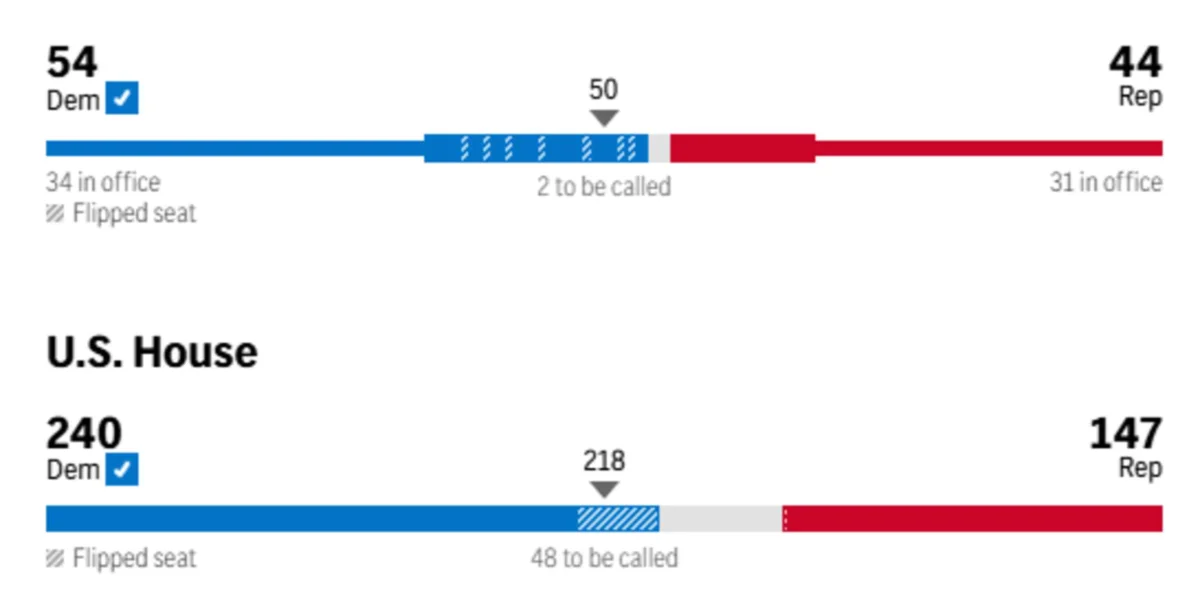
WASHINGTON/NEW YORK — The opposition Democratic Party has secured control of both the U.S. Senate and House of Representatives, according to widespread media projections. This significant political shift, occurring on November 3, 2026, marks a decisive rebuke of Republican President Donald Trump’s administration, driven by voter dissatisfaction concerning his policies on inflation, trade tariffs, the burgeoning artificial intelligence (AI) sector, and the protracted conflict in Iran.
The midterm elections, traditionally a referendum on the incumbent president, saw a surge in Democratic support that exceeded many pre-election forecasts. While forecasters had largely predicted a Democratic takeover of the House in the weeks leading up to the vote, the path to reclaiming the Senate was anticipated to be a more contentious and closely fought battle. However, as the night unfolded, a wave of Democratic victories across key states reshaped the political landscape, demonstrating a broad-based rejection of the Republican agenda.
A Swift and Decisive Democratic Victory
The Associated Press, a leading arbiter of election outcomes, began calling Senate races for Democrats within hours of polls closing. Key Republican-held seats in North Carolina, South Carolina, Ohio, Texas, Kansas, and Iowa flipped to Democratic control. This rapid succession of wins allowed Democrats to surpass the crucial 51-seat threshold in the 100-member Senate, establishing a clear majority. Later in the evening, the AP officially projected the Democrats would regain control of the House of Representatives, surpassing the 218-seat mark required for a majority. This decisive victory for the Democrats in both chambers contrasts sharply with the protracted vote counts of previous midterm elections, such as those in 2024 and 2022, where control of the House was not determined for up to eight days after Election Day.
Nikkei Asia provided comprehensive live coverage and in-depth analysis of the midterm elections throughout the election cycle and its aftermath on its dedicated platform at asia.nikkei.com/politics/u.s.-midterm-elections.
Market Turmoil and Investor Apprehension
The immediate aftermath of the election results triggered significant volatility in global financial markets, particularly impacting technology and semiconductor stocks.
Thursday, November 5, 2026
- 10:20 a.m. (Washington Time): The Nasdaq Composite Index experienced a sharp decline, shedding as much as 4% and reversing gains from the previous day. Investors reacted with caution, selling off shares in semiconductor and AI-related companies. Micron Technology saw its stock price plummet by over 12%, while Nvidia experienced a 7% drop. This sell-off was largely attributed to concerns that a Democratic-controlled Congress would likely implement stricter regulations on the rapidly expanding AI industry and its associated infrastructure.
- The repercussions were felt across Asian markets. Nikkei Stock Average futures in Chicago briefly dipped below the psychologically significant 60,000 level, trading around 59,300. The Nikkei average itself closed the day down 1,110 points, settling at 61,077.
Wednesday, November 4, 2026
- 11:40 p.m. (Washington Time): Stock markets in Japan and South Korea registered significant declines, with technology shares bearing the brunt of the sell-off. The emphatic Democratic victory fueled expectations of heightened scrutiny and potential regulatory action within the AI sector. Japan’s benchmark Nikkei Stock Average, after an initial surge, reversed course and fell over 1%. AI-related stocks, including memory maker Kioxia Holdings (down approximately 9%), were key detractors. South Korea’s KOSPI saw a drop of around 5%, led by a substantial decline in index heavyweight SK Hynix (down 9%) and Samsung Electronics (down 7%). Taiwan’s Taiex, heavily influenced by Taiwan Semiconductor Manufacturing Co. (TSMC), also fell by over 2%.
- 4:15 p.m. (Washington Time): In contrast, U.S. stock markets initially surged on Wednesday following a signal from President Donald Trump indicating a willingness to collaborate with Democrats. This eased immediate fears of prolonged political gridlock. The Dow Jones Industrial Average jumped over 1,500 points (3%), while the S&P 500 and Nasdaq Composite gained more than 1%. Oil prices also declined as investors anticipated that a shift in political power might accelerate efforts to de-escalate the conflict in Iran. The market’s initial reaction had been negative following stronger-than-expected Democratic gains, particularly in states like Texas and Georgia, which are hubs for data center development, raising concerns about potential restrictions on AI infrastructure. However, Trump’s conciliatory remarks quickly altered market sentiment. Companies like Amazon and Microsoft saw gains on the prospect that existing infrastructure might benefit from potential new regulations on data center construction. Conversely, Nvidia and some power producers experienced declines. Defense stocks, including Northrop Grumman, RTX, and Lockheed Martin, also saw a dip, while renewable energy shares saw an uptick.
Key Issues Driving Voter Decisions
The election outcomes were largely shaped by a confluence of persistent economic concerns and evolving geopolitical landscapes.
Inflation and the Cost of Living: A primary driver for voters was the rising cost of living and persistent inflation, issues that have impacted household budgets across the nation. The Republican administration’s economic policies, including its approach to trade and its handling of supply chain disruptions, were frequently cited as contributing factors by voters.
The Iran War and Foreign Policy: The ongoing conflict in Iran continued to be a significant point of contention. Public sentiment had increasingly favored a de-escalation or resolution, with many voters viewing the prolonged engagement as a drain on national resources and a source of instability. Vice President JD Vance explicitly identified the war as a key reason for Republican losses, stating that many former Trump voters had shifted their allegiance due to a desire to end the conflict.
Trade Tariffs and Economic Nationalism: President Trump’s "America First" trade policies, characterized by significant tariffs on goods from countries like China, remained a contentious issue. While intended to protect domestic industries, these tariffs had also contributed to rising consumer prices and strained international trade relationships. Nomura economists had anticipated a renewed focus on trade-related actions, including potential tariffs stemming from investigations into excess industrial capacity, regardless of the election’s outcome.
Artificial Intelligence and Data Centers: The rapid expansion of AI technology and the associated development of large-scale data centers emerged as an unexpected flashpoint. Widespread local opposition to these projects, fueled by concerns over energy consumption, potential increases in electricity rates, and the perceived lack of community benefit, shaped campaigns across the political spectrum. This grassroots opposition has implications for Asian suppliers of AI-related hardware and infrastructure.
Chronology of Key Developments and Reactions
The election night and its immediate aftermath unfolded with rapid developments and diverse reactions from political figures and international observers.
Tuesday, November 3, 2026
- 9 a.m. (Washington Time): Polls opened across the nation for the 2026 midterm elections, widely perceived as a critical referendum on President Donald Trump’s agenda. Early voting had already seen a significant surge, with over 59.1 million ballots cast nationwide, exceeding half the total ballots cast in the 2022 midterms. Key issues driving voter engagement included inflation, energy costs linked to the Iran war, trade tariffs, and growing backlash against AI data center projects.
- 10:45 a.m. (Washington Time): Oil prices saw an early rebound following reports of a U.S. strike on Qeshm Island in the Strait of Hormuz, rekindling supply concerns on election day. This tempered hopes for an immediate diplomatic breakthrough in the Iran conflict.
- 11 a.m. (Washington Time): Severe weather, including heavy rain and flooding in Florida and flash flooding in Arizona, Utah, and Colorado, forced the relocation of some polling centers and prompted emergency measures to ensure voter access. Concerns were also raised about potential impacts on voter turnout due to adverse weather conditions in the Midwest and Texas.
- 4:30 p.m. (Washington Time): U.S. stocks traded mixed as investors awaited election results, with AI-related shares rebounding and some cyclical and defensive stocks facing pressure.
- 8:40 p.m. (Washington Time): Democrats secured their first Senate pickup of the night as Roy Cooper won North Carolina’s open seat, defeating a Trump-backed Republican.
- 10:40 p.m. (Washington Time): Annie Andrews unseated Republican Darline Graham in South Carolina, marking the second key Senate pickup for the Democrats, bringing them closer to a majority.
- 11:10 p.m. (Washington Time): Democrat James Talarico achieved a significant victory in Texas, defeating Republican Ken Paxton. This win represented a major upset and the first time Democrats had won a statewide office in Texas since 1994.
- 11:20 p.m. (Washington Time): Sherrod Brown secured a crucial Senate seat in Ohio, defeating the Republican incumbent in a state that had recently trended Republican.
Wednesday, November 4, 2026
- 1:10 a.m. (Washington Time): The Associated Press projected Democrats had won control of the House of Representatives, solidifying their control over both chambers of Congress.
- 1:05 a.m. (Washington Time): Democrat Troy Jackson defeated incumbent Republican Susan Collins in Maine, another key Senate victory for the Democrats.
- 1:35 a.m. (Washington Time): With control of both the Senate and the House secured, President Trump faced a challenging final two years of his presidency. He posted an image of a "VETO" hat on Truth Social, signaling his intent to challenge legislation passed by the Democratic-controlled Congress.
- 1:10 a.m. (Washington Time): President Trump acknowledged the election results but deflected blame for Republican losses, asserting that his party would have won "in a landslide" had he been on the ballot.
- 2:40 a.m. (Washington Time): Abdul el-Sayed, a Democrat, won his Senate race in Michigan, becoming the first Muslim elected to the U.S. Senate.
- 2:15 a.m. (Washington Time): A spokesperson for China’s Foreign Ministry characterized the U.S. midterm results as an internal affair but expressed Beijing’s willingness to enhance communication with Washington.
- 9:45 a.m. (Washington Time): U.S. stocks opened significantly higher as President Trump signaled a willingness to work with Democrats, easing concerns about political gridlock.
- 11:50 a.m. (Washington Time): Vice President JD Vance attributed the Republican Party’s midterm losses directly to the U.S. war in Iran, stating that voters prioritized ending the conflict and addressing economic concerns.
- 1:45 p.m. (Washington Time): President Trump defended the decision to engage in the Iran war, stating it was necessary to prevent Tehran from acquiring nuclear weapons, despite acknowledging its role in the Republican party’s electoral setbacks.
Thursday, November 5, 2026
- 10:20 a.m. (Washington Time): The Nasdaq Composite Index experienced a significant decline, driven by investor concerns over potential AI regulation under Democratic control of Congress. This downturn impacted Asian markets as well.
- 1:26 a.m. (Washington Time): Executives at Toyota Motor expressed uncertainty regarding the impact of Democratic control on U.S. policy, with Chief Officer for External & Public Affairs Hiroyuki Ueda acknowledging the "huge impact" of the election outcome. Toyota reiterated its commitment to serving its customers by continuing to produce vehicles they desire.
Implications for U.S. and Global Policy
The Democratic Party’s ascendance to power in both houses of Congress heralds a significant shift in U.S. policy direction and carries substantial implications for both domestic and international affairs.
Legislative Agenda and Oversight: With control of both chambers, Democrats are poised to advance their legislative priorities, which are likely to include increased investment in social programs, climate initiatives, and potentially stricter regulations on large technology corporations. The party’s newfound oversight powers will enable them to conduct more rigorous investigations into the Trump administration’s actions and policies.
Economic Policy: The focus on inflation and cost of living suggests a potential shift towards policies aimed at economic relief for consumers. This could involve measures such as targeted tax adjustments, investments in affordable housing, and potentially a re-evaluation of the impact of tariffs on consumer goods. The market’s reaction to potential AI regulation indicates that the tech sector will face increased scrutiny, impacting investment and innovation in that space.
Foreign Policy and Geopolitics: The Democratic victory signals a potential recalibration of U.S. foreign policy. The emphasis on de-escalating the Iran conflict suggests a renewed push for diplomatic solutions. Furthermore, the potential for a more collaborative approach with international allies could lead to shifts in trade relations and global security strategies. The impact on U.S.-China relations remains a key area of focus, with a Democratic-controlled Congress potentially introducing new measures concerning trade and technology.
Checks and Balances: The Democratic control of Congress establishes a crucial check on President Trump’s executive authority for the remainder of his term. This dynamic is likely to lead to increased legislative battles, with the potential for frequent vetoes and intense negotiations over policy. The stated willingness of President Trump to work with Democrats, however, offers a glimmer of hope for bipartisan cooperation on certain issues, though the deeply polarized political climate suggests that such collaboration may be challenging.
The election of Abdul el-Sayed as the first Muslim senator also represents a significant moment in U.S. political history, reflecting the nation’s evolving demographics and increasing diversity in its representation. His presence in the Senate is expected to bring a new perspective to legislative debates.
In summary, the 2026 U.S. midterm elections have fundamentally altered the balance of power in Washington, setting the stage for a period of significant policy shifts and political negotiation as the nation navigates domestic economic challenges and a complex global landscape.