Gilang Muhammad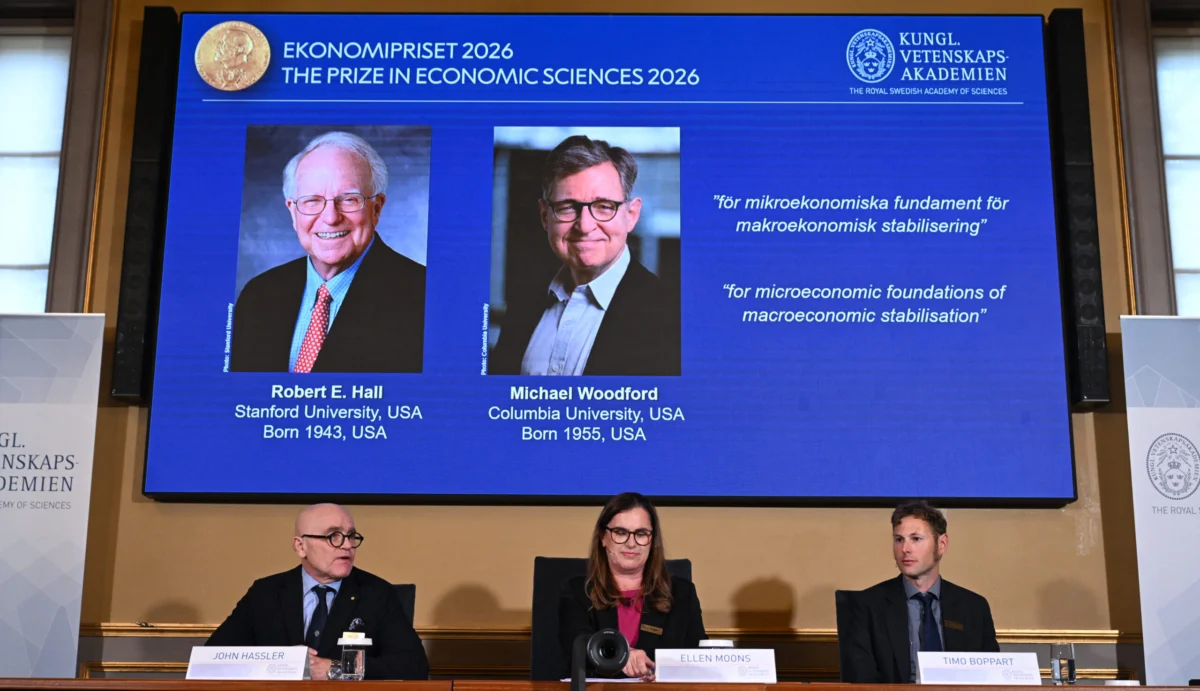
Stockholm, Sweden – In a pivotal announcement that reverberated through the global economic community, U.S. economists Robert E. Hall and Michael Woodford were jointly awarded the 2026 Sveriges Riksbank Prize in Economic Sciences in Memory of Alfred Nobel. The prestigious accolade, announced on Monday, October 12, 2026, recognizes their profound and complementary contributions to the "microeconomic foundations" of macroeconomic stability, work that has become indispensable to the models utilized by central banks and governments worldwide in their perennial efforts to mitigate the volatility of economic cycles.
The Royal Swedish Academy of Sciences, with Secretary General Ellen Moons, Prize Committee Chair John Hassler, and expert member Timo Boppart presiding, highlighted the laureates’ independent yet convergent research as foundational to understanding how individual decisions, driven by expectations, collectively shape the broader economy. This groundbreaking perspective has fundamentally reshaped how policymakers approach challenges like inflation, unemployment, and economic growth, particularly in navigating periods of boom and bust. The esteemed professors will share the prize sum of 12 million Swedish kronor, approximately $1.2 million, underscoring the immense value placed on their intellectual legacy.
The Laureates: Pioneering Minds in Economic Theory
Robert E. Hall, born in California, holds a distinguished position as a professor at Stanford University, a hub of economic innovation in the United States. His career has been marked by incisive analysis of business cycles, labor markets, and monetary policy, consistently pushing the boundaries of conventional economic thought. Hall’s early work focused on understanding the aggregate implications of individual consumption decisions, particularly under uncertainty and rational expectations, laying critical groundwork for later developments in dynamic macroeconomic models. His contributions have provided a clearer lens through which to view how households and firms react to policy changes, not just in the present, but with an eye toward the future.
Michael Woodford, a native of Massachusetts, serves as a professor at Columbia University, another bastion of economic scholarship. Woodford is widely recognized for his seminal work in New Keynesian macroeconomics, particularly his rigorous development of models that integrate rational expectations with sticky prices and wages. His research has been instrumental in formalizing how monetary policy, through central bank actions and communications, can influence inflation and output by shaping private sector expectations. His book, "Interest and Prices: Foundations of a Theory of Monetary Policy," published in 2003, is considered a cornerstone text for graduate students and central bankers alike, providing a comprehensive framework for analyzing modern monetary policy.
Together, Hall and Woodford’s work has provided the theoretical scaffolding for the "New Keynesian" synthesis that dominates modern macroeconomic analysis. This framework integrates the insights of classical economics regarding rational decision-making with Keynesian insights about market imperfections, such as sticky prices and wages, which explain why monetary policy can have real effects on the economy. Their models allow central banks to analyze the likely impact of policy changes with greater precision, moving beyond simple aggregate relationships to consider the complex interplay of individual choices and expectations.
Rethinking Economic Models: A Response to the 1970s Crisis
The impetus for the transformative work of economists like Hall and Woodford emerged from a period of profound disillusionment with prevailing economic theories in the 1970s. The decade was characterized by an unprecedented phenomenon known as "stagflation" – the simultaneous occurrence of high inflation and high unemployment, a combination that traditional Keynesian models struggled to explain or resolve. For much of the post-World War II era, Keynesian economics had largely held sway, prescribing policies such as cutting interest rates and increasing government budget deficits to stimulate demand and combat recessions. These policies were based on the understanding of an inverse relationship between inflation and unemployment, famously depicted by the Phillips Curve.
However, the 1970s shattered this consensus. The global economy was hit by multiple oil price shocks, triggered by geopolitical events such as the 1973 Arab oil embargo and the 1979 Iranian Revolution. These supply-side shocks led to soaring energy costs, which fed into producer prices and ultimately consumer inflation. In many developed economies, inflation rates surged into double digits, reaching peaks of over 13% in the U.S. by 1979, while unemployment rates remained stubbornly high, often exceeding 7-8%. The conventional tools of demand management proved ineffective; attempts to stimulate the economy to reduce unemployment often exacerbated inflation, while efforts to curb inflation through tighter monetary policy risked pushing unemployment even higher. The Royal Swedish Academy of Sciences noted that the widely accepted Keynesian models seemed to "no longer work."
It was in this intellectual vacuum that a new generation of economists sought to revitalize macroeconomic models by grounding them in more rigorous "microeconomic foundations." Instead of simply looking at aggregate variables like total inflation, national production, and overall consumption, these economists delved into how individual households and businesses make decisions. They argued that these micro-level choices, based on rational expectations about future economic conditions and policy actions, collectively determine macroeconomic outcomes. Hall’s work, for instance, helped clarify how individuals smooth consumption over time, while Woodford meticulously built models showing how central bank policy, particularly its credibility and communication, could steer these expectations.
Their work demonstrated the critical importance of expectations formation. If individuals and firms anticipate that a central bank will allow inflation to rise, they will adjust their wages and prices accordingly, leading to a self-fulfilling prophecy of higher inflation. Conversely, if a central bank credibly commits to price stability, these expectations can anchor inflation, making it easier to achieve policy goals. This insight underscored the necessity for central banks and governments to clearly communicate their policy plans, as this transparency could "influence this view of the future and move the economy in the right direction," as stated by the Academy.
Impact on Modern Monetary Policy and Central Banking
The theoretical advancements made by Hall and Woodford have profoundly influenced the practice of monetary policy across the globe. Their work provides the intellectual bedrock for the dominant framework used by major central banks today, including the U.S. Federal Reserve, the European Central Bank, and the Bank of England.
One of the most significant applications is in inflation targeting. Many central banks explicitly state a numerical inflation target (commonly around 2%) as their primary objective. The models developed by Hall, Woodford, and their collaborators allow central banks to forecast inflation and output more accurately, taking into account how households and firms will react to anticipated changes in interest rates or other policy levers. This enables policymakers to set the appropriate short-term interest rate to guide the economy towards its inflation target and maximum sustainable employment. For example, if inflation is projected to rise above target, the central bank might raise interest rates, signaling its commitment to price stability and influencing private sector expectations to bring inflation back down.
Another critical innovation directly stemming from their insights is forward guidance. This communication strategy involves central banks providing explicit information about the future path of monetary policy. During periods of economic crisis or when interest rates are near the effective lower bound (e.g., zero), central banks can use forward guidance to manage market expectations, committing to keep interest rates low for an extended period or until specific economic conditions are met. This commitment, rooted in the rational expectations framework, aims to lower long-term interest rates, encourage borrowing and investment, and stimulate economic activity by influencing agents’ expectations about future policy. The effectiveness of such guidance hinges on the central bank’s credibility, a concept deeply explored within the New Keynesian models.
John Hassler, Chair of the Committee for the Prize in Economic Sciences, emphasized the practical utility of their work, stating, "With them, we are better equipped to deal with shocks in the economy, such as energy crises or sudden changes in how much households consume." This sentiment highlights how their models have been instrumental in navigating various economic downturns. During the 2008 Global Financial Crisis and the subsequent Great Recession, central banks relied heavily on these frameworks to understand the transmission mechanisms of the crisis and design unconventional policies, including quantitative easing and aggressive forward guidance. Similarly, in response to the economic shockwaves of the COVID-19 pandemic, these models guided unprecedented fiscal and monetary interventions aimed at stabilizing markets and supporting economic recovery. The Academy affirmed that "on the basis of these models, well-timed fiscal and monetary policy measures can reduce the economy’s peaks and troughs," and that "since the new models’ introduction, they have been extremely helpful in dealing with the economic downturns that have affected us."
Official Recognition and Esteemed Reactions
The announcement of the 2026 Nobel Memorial Prize was met with widespread acclaim from academic institutions and economic policymakers. Statements from the Royal Swedish Academy of Sciences underscored the transformative nature of the laureates’ contributions. "Their rigorous approach has provided a robust intellectual framework for understanding the complex interplay between micro-level decisions and macro-level outcomes, making modern economic policy more effective and evidence-based," the Academy noted.
Stanford University, where Professor Hall has served for decades, issued a statement lauding his unparalleled intellectual leadership. "Professor Hall’s enduring commitment to bridging theory and empiricism has not only advanced our understanding of business cycles and labor markets but has also equipped policymakers with essential tools for navigating economic uncertainty," a university spokesperson remarked. "His work embodies the spirit of rigorous inquiry and practical relevance that defines Stanford’s academic mission."
Similarly, Columbia University celebrated Professor Woodford’s seminal achievements. "Professor Woodford’s contributions to New Keynesian macroeconomics have fundamentally reshaped the landscape of monetary policy theory and practice," stated the university’s economics department chair. "His meticulous theoretical constructions have provided central banks worldwide with the analytical horsepower to pursue price stability and foster economic growth more effectively. We are immensely proud of his extraordinary impact on the field."
While specific individual reactions from the laureates were not immediately detailed beyond the formal announcement, it is customary for recipients of such a high honor to express gratitude and acknowledge the collaborative nature of scientific progress within the economics community. Their work stands as a testament to the power of fundamental research in addressing real-world policy challenges.
The Sveriges Riksbank Prize in Economic Sciences: A Distinguished Legacy
The Sveriges Riksbank Prize in Economic Sciences in Memory of Alfred Nobel holds a unique position among the Nobel Prizes. It was established in 1968 by Sweden’s central bank, Sveriges Riksbank, to commemorate its 300th anniversary. Unlike the original Nobel Prizes in Physiology or Medicine, Physics, Chemistry, Literature, and Peace, which were created through Alfred Nobel’s will in 1895, the economics prize was not part of his initial endowment. However, it is administered by the Royal Swedish Academy of Sciences and awarded according to the same principles as the original prizes, with the laureates receiving their awards at the annual Nobel Prize ceremony in Stockholm on December 10, the anniversary of Alfred Nobel’s death.
Despite its later establishment, the economics prize has achieved comparable prestige and influence, recognizing economists whose research has had a profound impact on economic thought and policy. Past laureates include intellectual giants such as Paul Samuelson, Milton Friedman, George Akerlof, Joseph Stiglitz, and Paul Krugman, among many others, whose work has spanned diverse areas from welfare economics to behavioral economics and international trade. The prize has played a crucial role in elevating the public’s understanding of economic science and its vital role in societal well-being.
The Nobel Season of 2026: A Broader Celebration of Achievement
The announcement of the economics prize traditionally concludes the annual Nobel Prize season, a week-long series of announcements celebrating outstanding achievements across various fields. This year, the laureates have showcased remarkable contributions across the spectrum of human endeavor.
Earlier in the week, on Friday, October 9, Navanethem "Navi" Pillay was awarded the Nobel Peace Prize for her tireless work promoting peace and international law, particularly in her capacity as a former UN High Commissioner for Human Rights and judge of the International Criminal Court. Her commitment to justice and human dignity resonated globally. The literature prize was awarded to Canadian poet and writer Anne Carson, celebrated for her "bold and inventive oeuvre" that masterfully blends classical scholarship with contemporary themes, pushing the boundaries of poetic expression. Other laureates this year were recognized for breakthroughs in physiology or medicine, physics, and chemistry, reflecting the diverse and impactful progress being made across scientific and cultural disciplines.
Future Implications and Continuing Relevance
The work of Robert E. Hall and Michael Woodford remains highly relevant and continues to be built upon by a new generation of economists. While their models have provided robust frameworks, the global economy faces evolving challenges, from climate change and resource scarcity to the rise of digital currencies and artificial intelligence. Economists are constantly adapting and extending these foundational models to address new complexities, such as incorporating environmental factors into macroeconomic projections or analyzing the implications of non-standard monetary policies in a post-pandemic world.
The enduring legacy of Hall and Woodford lies not just in the specific models they developed, but in establishing a rigorous, expectations-based approach to macroeconomics that has allowed the field to progress significantly since the turbulent 1970s. Their insights underscore the fundamental truth that economic outcomes are ultimately shaped by human decisions and expectations, and that effective policy must therefore understand and influence these intricate behavioral dynamics. As the global economy continues to navigate an unpredictable future, the analytical tools provided by these two distinguished economists will remain indispensable for policymakers striving to achieve stability, growth, and prosperity.