Clara Shinta
The prediction market platform Kalshi has witnessed an extraordinary surge in its operational metrics over the past year, with its US web traffic experiencing an astronomical rise and its trading volume outpacing even that rapid expansion. This period of unprecedented growth, however, coincides with escalating legal and regulatory challenges that threaten to reshape the landscape of the burgeoning prediction market industry, culminating in a critical dispute now awaiting review by the US Supreme Court.
The Ascent of Kalshi: A Data-Driven Overview of Remarkable Growth
Kalshi, a prominent player in the prediction market space, has cemented its position with staggering growth figures that underscore both its expanding user base and the increasing mainstream adoption of event contracts. According to Similarweb traffic estimates, the platform recorded an impressive 15.4 million visits from users within the United States in July 2026. This figure represents an astonishing increase of approximately 1,520% compared to just under 1 million visits reported in August 2025, marking a pivotal year for the company.
The United States remains the undisputed core of Kalshi’s operations, accounting for nearly 80% of its total web traffic in July 2026, a slight but notable increase from 72.8% in August 2025. This concentration highlights the platform’s deep entrenchment within the American market, despite its growing international appeal and efforts to navigate diverse regulatory environments. The sheer scale of this domestic engagement points to a significant shift in how a segment of the American public engages with market-based forecasting and event speculation.
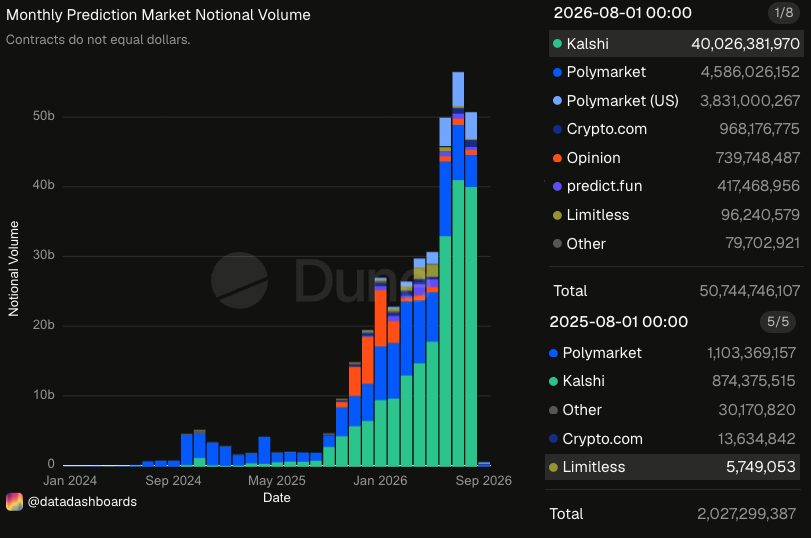
Beyond mere website visits, Kalshi’s actual trading activity has demonstrated an even more explosive trajectory. Data from a Dune Analytics prediction market dashboard reveals that Kalshi recorded approximately $40 billion in monthly notional trading volume in August 2026. This figure represents a colossal increase of roughly 4,500% from the $874 million reported just a year prior. This disparity between traffic growth and trading volume growth suggests increased user engagement, larger individual trades, or a more efficient conversion of visitors into active traders on the platform.
Kalshi’s dominance within the broader prediction market industry is equally striking. Across the entire sector, monthly notional volume surged to $50.7 billion in August 2026, up from an estimated $2 billion over the same one-year period. Kalshi alone commanded nearly 79% of this latest total, illustrating its near-monopolistic hold on a rapidly expanding market. This market leadership positions Kalshi as a bellwether for the industry’s future, making its regulatory battles particularly impactful.
A significant driver of this trading volume has been sports contracts. Barron’s reported that sports-related contracts constituted a substantial 83% of Kalshi’s total trading volume in July 2026. This concentration on sports events is a double-edged sword: while it clearly appeals to a large and engaged audience, it also places Kalshi squarely in the crosshairs of regulators concerned about the blurred lines between legitimate financial instruments and traditional sports gambling.
The Regulatory Gauntlet: Navigating a Shifting Legal Landscape
The exponential growth of Kalshi has not gone unnoticed by regulatory bodies and legal authorities, leading to a complex and high-stakes legal battle that questions the very definition and oversight of prediction markets. At the heart of the dispute lies the fundamental question of whether Kalshi’s event contracts, particularly those related to sports, fall under the purview of federal commodities regulation or state gambling laws.
What are Prediction Markets?
Prediction markets are platforms where users trade contracts based on the outcome of future events. These events can range from economic indicators and political elections to entertainment awards and, crucially, sports results. Proponents argue that these markets serve as valuable tools for aggregating information, discovering prices, and even hedging against future uncertainties, much like traditional financial derivatives. Participants buy or sell contracts that pay out if a specific event occurs, with prices fluctuating based on collective sentiment and perceived probabilities. Kalshi operates as a Designated Contract Market (DCM) regulated by the Commodity Futures Trading Commission (CFTC), the federal agency responsible for overseeing the US futures and options markets. This designation implies that Kalshi’s offerings are viewed as legitimate financial contracts, not gambling.
The Core Dispute: Federal vs. State Oversight

The regulatory contention arises from the nature of certain event contracts, especially those tied to sports outcomes. State gaming commissions and attorneys general argue that many of Kalshi’s sports-related contracts function indistinguishably from sports betting, which is typically regulated at the state level and often subject to different licensing, taxation, and consumer protection frameworks. The distinction is critical: if classified as gambling, these contracts would likely fall outside the CFTC’s sole jurisdiction and potentially be illegal in states where sports betting is not fully legalized or where Kalshi lacks appropriate state licenses. If they remain classified as legitimate derivatives, federal oversight would prevail.
The New Jersey Case: A Path to the Supreme Court
The most significant legal challenge to Kalshi’s operations has emerged from New Jersey, a state with a robust regulated sports betting market. New Jersey authorities have vigorously pursued the argument that Kalshi’s sports contracts constitute illegal gambling within their state borders. This dispute has escalated through lower courts and is now set to reach the US Supreme Court. The New Jersey Supreme Court’s decision to take up the case underscores the profound legal implications and the deep disagreement over the classification of these digital instruments. A ruling from the nation’s highest court could establish a landmark precedent, either affirming the CFTC’s jurisdiction over such contracts or empowering states to regulate them as gambling.
Michigan’s Involvement and Broader State Concerns
New Jersey is not alone in its pursuit. Authorities in Michigan have also joined the effort to block Kalshi, indicating a growing multi-state concern regarding the platform’s operations. This collective action from states highlights a broader regulatory anxiety about the rapid expansion of prediction markets and the potential for a federal-state jurisdictional conflict. States are concerned about maintaining control over their gambling markets, protecting consumers from unregulated offerings, and ensuring consistent application of tax revenues derived from legal wagering. The involvement of multiple states suggests a coordinated effort to challenge what they perceive as an overreach of federal commodities regulation into areas traditionally governed by state gambling laws.
Kalshi’s Stance and Regulatory Rationale
Kalshi, operating under its CFTC designation, firmly maintains that its markets are legitimate financial instruments designed for risk management and price discovery. Their argument centers on the idea that event contracts, even those tied to sports, are distinct from traditional gambling because they allow for hedging, provide transparent price signals, and are traded on a regulated exchange with robust market integrity rules. They contend that the CFTC, with its expertise in derivatives markets, is the appropriate authority for oversight. Kalshi’s ability to secure the CFTC designation in the first place suggests that federal regulators initially found their model compliant with existing commodities laws.
Regulators’ Concerns: Consumer Protection and Market Integrity
Conversely, state regulators and some federal officials express concerns about consumer protection, particularly regarding the potential for addiction, lack of clear disclosure for unsophisticated investors, and the blurred lines between entertainment and financial speculation. There are also apprehensions about the potential for market manipulation in thinly traded contracts and the broader societal implications of normalizing speculative trading on everyday events. The concern is that while sophisticated investors might use these for hedging, the average user might be engaging in what amounts to unregulated gambling, without the safeguards typically associated with state-licensed casinos or sportsbooks.
Global Reach Amidst Restrictions: A Complex Picture
While Kalshi’s primary growth has been concentrated in the US, the platform has also observed a notable increase in web traffic from jurisdictions where direct access and trading are explicitly prohibited under its member agreement. This situation presents a complex challenge for the company and raises questions about enforcement and user behavior.
Canada, for instance, generated approximately 450,000 visits to Kalshi’s website in July 2026, a substantial increase from roughly 50,000 visits in August 2025. Similarly, traffic from the United Kingdom surged to 296,000 visits from 31,000 over the same period. Both Canada and the UK are listed among the jurisdictions where Kalshi’s member agreement currently restricts users from directly accessing or trading on its platform.
This paradox of increasing traffic from restricted regions, even as their proportional share of Kalshi’s total traffic slightly decreased (Canada’s share slipped to 2.3% from 3.8%, and the UK’s to 1.5% from 2.4%), suggests several possibilities. Users in these regions may be employing Virtual Private Networks (VPNs) to circumvent geographical restrictions, or they might be accessing the site for information without actively trading. It also highlights the global appeal of prediction markets, irrespective of local regulatory frameworks.
Kalshi has attempted to address this international demand through strategic partnerships. In June 2026, the company announced a collaboration with Wealthsimple, a Canadian financial services company, to provide access to nearly 4,000 eligible Kalshi contracts through a separate, compliant application in Canada. This partnership represents a proactive approach to expanding internationally while adhering to local regulations, creating a model that could be replicated in other restricted jurisdictions. It acknowledges the demand while seeking to channel it through legally sanctioned pathways, differentiating between direct platform access and indirect, regulated access.
Cointelegraph reached out to Kalshi for comment regarding the traffic originating from restricted jurisdictions but had not received a response by the time of publication. This lack of comment leaves open questions about the company’s strategies for managing compliance in areas where direct access is prohibited, even as it pursues indirect partnerships.
The Broader Context of Prediction Markets: Innovation and Disruption
Kalshi’s journey is emblematic of the broader prediction market industry, which is experiencing rapid innovation and disruption. Beyond Kalshi, other platforms are also vying for market share, though Kalshi’s dominance is currently clear. The appeal of prediction markets lies in their unique blend of financial speculation, entertainment, and their potential to serve as powerful tools for collective intelligence. Academic research has often explored the accuracy of prediction markets in forecasting events, sometimes outperforming traditional polls or expert opinions.
However, this innovation comes with significant ethical and regulatory considerations. The accessibility of these platforms, coupled with the inherent allure of predicting outcomes for financial gain, raises concerns about responsible trading, the potential for addictive behavior, and the protection of vulnerable consumers. Ensuring fairness, preventing market manipulation, and maintaining transparency are paramount for the long-term viability and legitimacy of the industry. The regulatory uncertainty surrounding Kalshi underscores the challenges faced by new financial technologies that push the boundaries of existing legal definitions.
Implications and Future Outlook: A Crossroads for Kalshi and the Industry
The forthcoming US Supreme Court decision on the New Jersey dispute will be a watershed moment for Kalshi and the entire prediction market industry.
For Kalshi: A favorable ruling, upholding the CFTC’s sole jurisdiction, would significantly legitimize its business model nationwide, particularly concerning sports contracts. It would provide regulatory clarity, potentially paving the way for even further expansion and mainstream acceptance. Conversely, an unfavorable ruling, classifying its sports contracts as state-regulated gambling, could force Kalshi to drastically alter its offerings, seek state-by-state licensing, or potentially cease offering certain popular contracts in many jurisdictions. This could lead to significant operational hurdles, increased compliance costs, and a fragmentation of its market. The continued growth amidst this legal uncertainty demonstrates investor and user confidence, but the future remains contingent on this pivotal legal outcome.
For the Prediction Market Industry: The Supreme Court’s decision will set a crucial precedent for all platforms operating in this space. A clear legal framework, whether federal or state-based, is essential for the industry to mature and attract broader institutional participation. Ambiguity, on the other hand, would continue to stifle innovation, deter investment, and leave companies vulnerable to varied state-level challenges. It could force other prediction market platforms to reconsider their own offerings and regulatory strategies.
For Regulators: The case highlights the ongoing challenge for regulatory bodies to adapt existing frameworks to rapidly evolving financial technologies. Both the CFTC and state gambling boards face pressure to provide clear, consistent, and effective oversight that balances innovation with consumer protection. The outcome will influence how future financial products that straddle the lines between traditional derivatives and novel forms of speculation are classified and regulated. It may necessitate new legislation or clearer inter-agency agreements to define jurisdictional boundaries.
For Consumers: A definitive ruling will bring clarity to what constitutes a legal "event contract" versus illegal gambling, influencing how individuals can participate in these markets. It could lead to enhanced consumer protections if state gambling regulations are applied, or reaffirm the federal protections offered under CFTC oversight. The public’s access to and understanding of these complex instruments will undoubtedly be shaped by the court’s decision.
In conclusion, Kalshi stands at a critical juncture, navigating the intricate balance between explosive market growth and profound regulatory scrutiny. Its journey over the past year—marked by a phenomenal increase in traffic and trading volume—underscores the significant demand for prediction markets. However, the escalating legal battle, now reaching the highest court in the United States, casts a long shadow over its future. The resolution of this fundamental jurisdictional dispute will not only determine Kalshi’s trajectory but will also fundamentally reshape the regulatory landscape and the operational future of the entire prediction market industry for years to come.