Reynand Wu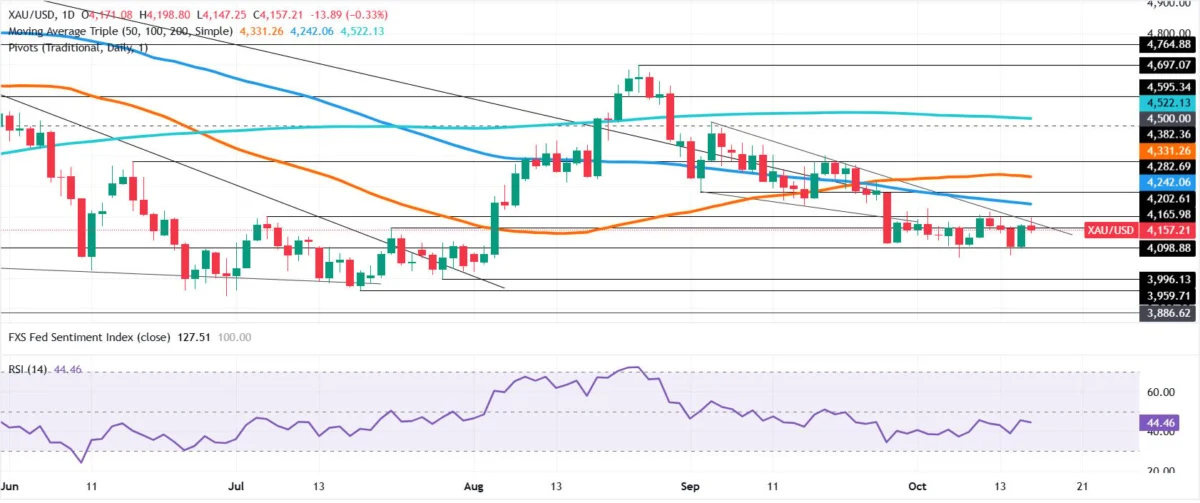
Gold (XAU/USD) experienced a retreat of approximately 0.10% on Friday, trading at $4,163 and positioning itself for a weekly loss. This downward movement in the precious metal’s value comes as market participants meticulously assess recent US inflation data, which, despite registering higher than anticipated figures, paradoxically led investors to temper their more aggressive hawkish predictions regarding the Federal Open Market Committee’s (FOMC) October meeting. The yellow metal’s struggle near the $4,160 mark is largely attributed to the sustained elevation of US Treasury yields, which continue to exert significant pressure, effectively neutralizing any potential upside from reduced immediate Federal Reserve tightening expectations.
The Intensifying Inflationary Landscape
The economic calendar this week was dominated by critical US inflation data, providing a clearer, albeit somewhat concerning, picture of price pressures across the economy. Both key indicators surpassed analyst forecasts, signaling a persistent inflationary environment. The Consumer Price Index (CPI) for September recorded a year-over-year increase of 3.7%, exceeding the consensus estimate of 3.6% and climbing from August’s 3.4% rise. This acceleration in consumer prices underscores the challenges faced by households and the Federal Reserve in achieving price stability.
Adding to the inflationary narrative, the Producer Price Index (PPI) for September delivered an even more significant surprise, crushing forecasts with a substantial year-over-year increase of 6.3%. This figure dramatically outstripped the anticipated 5.3%, indicating that inflationary pressures are not only prevalent at the consumer level but are also deeply embedded within the production pipeline, suggesting potential for further price increases down the line as producers pass on higher costs to consumers. The breadth of these increases across various sectors of the economy points to a resilient demand environment coupled with lingering supply-side constraints or elevated input costs. Such strong inflation figures typically bolster the case for gold as a traditional hedge against the erosion of purchasing power; however, the current market dynamics are proving more complex.
Federal Reserve’s Deliberate Stance Amidst Shifting Bets
The immediate aftermath of the CPI release saw a notable surge in market participants’ expectations for a Federal Reserve rate hike as early as this month. Odds for a rate increase at the October FOMC meeting briefly soared to nearly 60%, reflecting an initial knee-jerk reaction to the hotter-than-expected inflation data. However, as the trading session progressed and financial institutions digested the implications more thoroughly, a discernible shift in sentiment occurred. Most major investment banks subsequently updated their forecasts, largely expressing greater confidence in a potential rate hike occurring in December rather than October. This recalibration suggests a belief that while inflation remains a concern, the Fed might prefer to observe more data points and maintain flexibility before acting, especially given the cumulative effect of previous aggressive tightening.
Money markets, as reflected by data from Prime Terminal, now price in a mere 16% chance of a 25 basis point (bps) rate increase by the FOMC at its upcoming October meeting. In stark contrast, the probability for a similar move in December stands significantly higher at 89%. This divergence highlights the market’s current conviction that while the Fed’s tightening cycle is likely not over, there is a preference for a more measured approach, potentially avoiding back-to-back hikes immediately following recent data releases. The market’s interpretation appears to lean towards the Fed adopting a "wait and see" approach for October, reserving the option for December if inflationary pressures persist or economic growth remains robust.
Further complicating the Fed’s communication, remarks from former Fed Chair Kevin Warsh disappointed investors seeking explicit forward guidance on future interest rate policy. While Warsh acknowledged the underlying strength and resilience of the US economy, his refusal to provide specific clues on the trajectory of monetary policy left markets without the clear direction they often crave. This aligns with the broader cautious tone often adopted by central bank officials, who prefer to remain data-dependent and avoid pre-committing to future actions. The Fed’s dual mandate of maximum employment and price stability means it must carefully balance the risks of both inflation and an economic slowdown, making its policy path particularly intricate in the current environment.
The Enduring Challenge of Elevated Treasury Yields
One of the most significant headwinds for gold, despite its traditional role as an inflation hedge, has been the relentless surge in US Treasury yields. The yield on the benchmark US 10-year Treasury note continued its ascent, gaining three basis points to reach 5.106% on Friday. This upward trajectory in bond yields reflects several factors, including expectations of continued Fed tightening, the sheer volume of government bond issuance, and robust economic data that reduces the perceived need for safe-haven flows into bonds.
The inverse relationship between gold and Treasury yields is a fundamental dynamic in financial markets. Gold, being a non-yielding asset, becomes less attractive to investors when the returns offered by interest-bearing assets like government bonds rise significantly. The opportunity cost of holding gold, which provides no interest or dividends, increases substantially when investors can earn over 5% on a relatively safe 10-year Treasury bond. This dynamic explains why bullion has struggled to rally even amidst pronounced inflationary pressures. Investors, when faced with the choice, may opt for the guaranteed yield of Treasuries over the potential, but not guaranteed, capital appreciation of gold, especially if they believe the Fed will continue to combat inflation aggressively.
Intriguingly, despite this scenario of higher rates in the US, the Greenback has failed to receive a significant boost. The US Dollar Index (DXY), which measures the dollar’s performance against a basket of six major currencies, was actually down 0.10% at 101.87 on Friday. This muted reaction from the dollar, even with climbing yields, suggests that other global economic factors or perceptions of relative central bank policies are at play, preventing a stronger dollar appreciation. It could also indicate that some of the hawkish Fed expectations might already be priced into the dollar, or that other major economies are also seeing their own currencies strengthen against the dollar due to their respective economic developments.
Broader Economic Strength and Future Data Watch
Beyond inflation, other economic indicators painted a picture of a surprisingly resilient US economy. Industrial Production for September registered a robust 0.7% month-over-month increase, comfortably exceeding analysts’ estimates of 0.4% and significantly accelerating from the prior month’s modest 0.1% expansion. This strong performance in the industrial sector, encompassing manufacturing, mining, and utilities, suggests that businesses are continuing to operate at a healthy pace, driven by demand and potentially inventory rebuilding. Such positive economic data can paradoxically be a negative for gold, as it reduces the perception of economic distress that often drives safe-haven demand for the precious metal.

Looking ahead, the US economic calendar for the following week will feature several closely watched data releases that could further influence market sentiment and gold prices. Investors will be scrutinizing housing data, including housing starts and building permits, for insights into the health of the real estate sector. Initial Jobless Claims will provide an update on the labor market’s strength and any potential softening. Furthermore, Flash PMIs (Purchasing Managers’ Indexes) for both manufacturing and services will offer preliminary readings on economic activity for the current month, providing a forward-looking perspective on the pace of expansion or contraction. Each of these data points will be critical in shaping the market’s evolving expectations for Fed policy and the broader economic trajectory.
The Enduring Allure of Gold: A Historical Perspective and Current Challenges
Gold has maintained a unique and revered position throughout human history, serving not only as a symbol of wealth and status but also as a fundamental store of value and a medium of exchange. In modern financial markets, its role has evolved to encompass that of a critical safe-haven asset, particularly appealing during periods of geopolitical instability, economic uncertainty, or financial market turmoil. Its intrinsic value, independent of any specific government or issuer, makes it a preferred asset for diversification and protection against depreciating currencies. Moreover, gold is widely regarded as a natural hedge against inflation, as its value tends to appreciate when the purchasing power of fiat currencies erodes.
However, the current market environment presents a nuanced challenge to gold’s traditional inflation-hedging prowess. While inflation is undeniably elevated, the concurrent rise in real interest rates and the strong performance of alternative safe-haven assets like US Treasury bonds diminish gold’s relative attractiveness. The opportunity cost argument is particularly potent: why hold a non-yielding asset when a seemingly safe government bond offers a substantial return? This dynamic explains why gold has "failed to rally" decisively despite the hotter inflation prints.
Nevertheless, gold’s long-term appeal remains robust, underpinned by consistent demand from various sectors. Central banks globally continue to be significant purchasers, diversifying their reserves to bolster perceived economic strength and currency stability. In 2022, central banks added a staggering 1,136 tonnes of gold, valued at approximately $70 billion, to their reserves—the highest yearly purchase on record, according to the World Gold Council. Emerging economies, notably China, India, and Turkey, have been at the forefront of this trend, strategically increasing their gold holdings. This institutional demand provides a fundamental floor for gold prices, acting as a counter-force to other market pressures. Beyond central banks, demand from the jewelry sector, industrial applications, and retail investors seeking portfolio diversification also contributes to gold’s sustained market presence.
Technical Analysis: Gold’s Persistent Range-Bound Trading
From a technical perspective, Gold (XAU/USD) continues to exhibit a sideways trading pattern, firmly entrenched within the $4,100-$4,200 range. This consolidation suggests a struggle between bullish and bearish forces, with neither side able to establish a dominant trend. The price action appears to have found a temporary bottom near the lower boundary of this range, hinting at potential support.
Momentum indicators, however, offer a mixed picture. The Relative Strength Index (RSI), a popular oscillator measuring the speed and change of price movements, currently leans bearish. This indicates that recent price action has favored sellers, pushing the indicator lower. Nevertheless, a mild positive divergence has been observed. A positive divergence occurs when the price makes a lower low, but the RSI makes a higher low, suggesting that the selling momentum is weakening and could precede a potential bullish reversal. This divergence opens the door for a possible upside correction, albeit one that would need significant follow-through.
For XAU/USD to confirm a bullish reversal and break free from its current consolidation, it must first decisively clear the immediate resistance level at $4,200. A successful breach of this psychological and technical barrier would pave the way for a test of the 100-day Simple Moving Average (SMA), currently positioned at $4,242. Overcoming the 100-day SMA, a key indicator of the medium-term trend, would signal a stronger shift in momentum. Further upside targets would then include the 50-day SMA at $4,331, which represents a more immediate trend resistance, followed by the significant psychological mark of $4,500. A sustained move above these levels would indicate a more robust bullish trend.
Conversely, if XAU/USD fails to hold its current ground and continues its downward trajectory, initial support is identified at the crucial $4,100 level. A decisive break below this threshold would be a significant bearish signal, potentially accelerating declines. Such a move would bring the October 14 low of $4,073 into focus, a level that has recently provided some stability. Should selling pressure intensify further, the July 29 cycle low at $3,996 would become the next critical support. A breach of the $4,000 psychological barrier would be a substantial blow to bullish sentiment. Below this, the July 17 low at $3,959 and the yearly low at $3,941 represent the final strongholds for gold prices before potentially entering a much deeper downtrend.
Market Sentiment and Forward-Looking Projections
The current market sentiment surrounding gold is one of cautious optimism for long-term holders but short-term uncertainty. The interplay between persistent inflation, a hawkish yet data-dependent Federal Reserve, and rising Treasury yields creates a complex environment for the precious metal. While the market has largely trimmed its bets for an October Fed hike, the strong probability of a December move means that the threat of higher interest rates continues to loom, acting as an overhang for gold.
Looking forward, the trajectory of gold will heavily depend on several key factors. Firstly, the evolution of inflation: if inflation proves more stubborn than anticipated, and real interest rates remain negative or only marginally positive, gold’s appeal as an inflation hedge could strengthen. Secondly, the Federal Reserve’s policy path: any signals of an earlier-than-expected pause or pivot in tightening would likely provide significant tailwinds for gold, while a commitment to "higher for longer" could keep it suppressed. Thirdly, the health of the global economy: a significant economic slowdown or recession would typically trigger strong safe-haven flows into gold, whereas continued robust growth might favor riskier assets.
Investors will continue to monitor all incoming economic data, central bank communications, and geopolitical developments with heightened scrutiny. The current consolidation phase for gold around the $4,100-$4,200 range suggests a period of re-evaluation and accumulation or distribution before a clearer directional bias emerges. For now, gold remains in a tug-of-war, with its traditional safe-haven and inflation-hedge characteristics battling the formidable headwinds of elevated bond yields and a still-hawkish central bank narrative. The coming weeks, particularly leading up to the December FOMC meeting, will be pivotal in determining gold’s next significant move.