Reynand Wu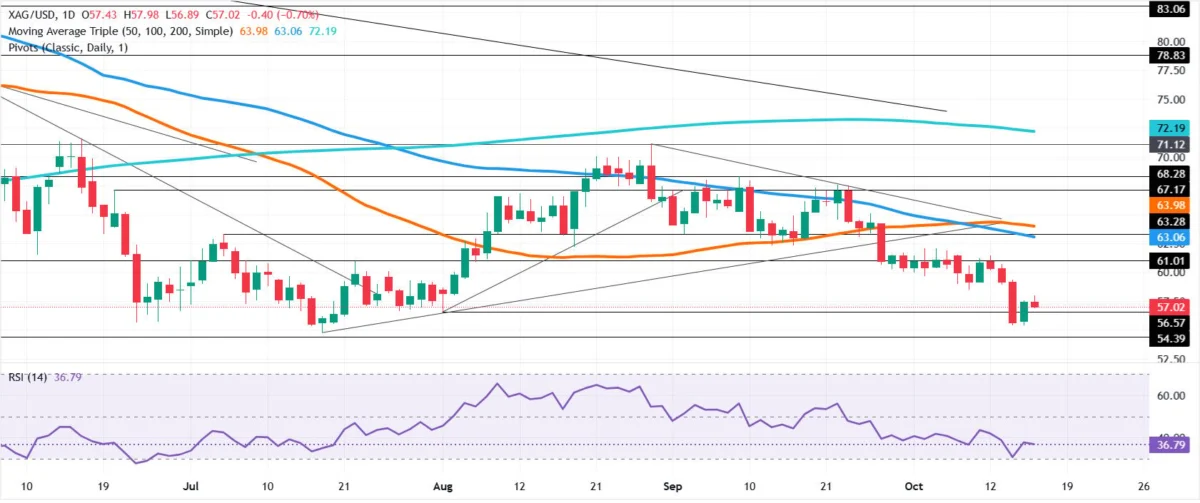
Silver (XAG/USD) price is poised to conclude the current trading week with significant losses, having breached the critical $60.00 support level, a move that has intensified a sell-off pushing the white metal towards a weekly low of $55.38. As of the latest market update, Silver is exchanging hands near $57.00, reflecting a substantial decline of 0.83% in recent trading sessions and marking a challenging period for the precious metal. This downturn has caught the attention of market participants, with analysts scrutinizing the confluence of technical breakdowns and macroeconomic headwinds contributing to Silver’s diminished valuation. The breach of a psychological and technical threshold like $60.00 often signals a shift in market sentiment, potentially paving the way for further declines unless fundamental drivers emerge to reverse the prevailing bearish trend. Investors are now closely monitoring key support levels, as the current trajectory suggests that the path of least resistance for XAG/USD remains to the downside, with broader implications for both the industrial and investment landscapes that rely on Silver.
The recent decline marks a significant retreat for Silver, which had shown signs of resilience earlier in the year. The move below $60.00 is particularly noteworthy, as this level has historically served as a strong psychological and technical barrier. Its decisive break indicates that bearish momentum has gathered significant strength, overwhelming any immediate buying interest. The weekly low of $55.38 represents the lowest point Silver has touched in several months, triggering stop-loss orders and exacerbating the downward spiral. This price action underscores a period of increased volatility and uncertainty in the commodities market, driven by a complex interplay of monetary policy expectations, global economic indicators, and shifting investor risk appetite. The rapid depreciation of Silver contrasts with its perceived role as a safe-haven asset, highlighting how broader market forces, particularly the strength of the US Dollar and rising real interest rates, can overshadow its traditional appeal during periods of economic stress.
Recent Market Dynamics and Chronology of the Decline
The current week’s performance for Silver has been characterized by a steady deterioration from early trading sessions. The initial pressure on XAG/USD began to mount as a strengthening US Dollar gained traction across major currency pairs. The Dollar Index (DXY), which measures the dollar against a basket of six major currencies, has recently surged, driven by hawkish comments from Federal Reserve officials and stronger-than-expected economic data out of the United States. This confluence of factors reinforced expectations that the Federal Reserve would maintain its restrictive monetary policy for longer than previously anticipated, pushing US Treasury yields higher. For non-yielding assets like Silver, higher yields translate into a greater opportunity cost of holding the metal, diverting investor capital towards interest-bearing instruments.
The initial breach of minor support levels around $59.00-$59.50 earlier in the week likely triggered a cascade effect, leading to increased selling pressure. As Silver approached the critical $60.00 mark, the market became highly sensitive. Once this psychological barrier was decisively broken, likely fueled by automated selling triggered by technical indicators and a lack of significant buying interest, the decline accelerated. This created a self-fulfilling prophecy, where the breach of a key level confirmed bearish sentiment for many traders, prompting further liquidation of long positions. The subsequent plunge to $55.38 before a slight recovery to current levels near $57.00 illustrates the rapid unwinding of bullish bets and the dominance of sellers in the market. The trajectory reflects a broader risk-off sentiment in some segments of the market, where investors prioritize capital preservation over speculative gains in volatile commodities.
Technical Outlook: A Deeper Dive into Price Projections
From a technical perspective, the outlook for Silver remains predominantly bearish, with several indicators confirming the downside momentum. The Relative Strength Index (RSI), a popular momentum oscillator, has been steadily extending its downward trajectory and is now nearing oversold territory. While an oversold RSI can sometimes signal an impending bounce or reversal, in a strong downtrend, it can persist for extended periods, indicating that bears are firmly in control and that selling pressure remains intense. Traders often interpret a sustained move into oversold conditions without a significant price rebound as a sign of underlying weakness rather than an immediate buying opportunity.
Further reinforcing the bearish sentiment, Silver’s price is currently trading well below its key moving averages. The 100-day Simple Moving Average (SMA) at $63.06 and the 50-day SMA at $63.98, which typically act as dynamic support levels in an uptrend, are now serving as significant resistance. The fact that the price has fallen below these averages, and particularly if a bearish crossover (where the shorter-term SMA crosses below the longer-term SMA) has occurred or is imminent, signals a strong shift in the short-to-medium term trend to the downside. The Moving Average Convergence Divergence (MACD) indicator, if showing a bearish crossover below the signal line with expanding negative histogram bars, would further confirm the prevailing negative momentum, suggesting that the selling pressure is broad and sustained.
Looking ahead, several critical support levels are in focus. If XAG/USD fails to consolidate above current levels and clears the $55.00 psychological milestone, the next significant support is the year-to-date (YTD) low of $54.77. A breach of the YTD low would represent a significant bearish signal, indicating that Silver is trading at its weakest point for the entire year and potentially opening the door to further capitulation. Beyond this, a significant historical high that has since transitioned into a support level around $54.39 will be tested. This level, once a formidable resistance, could now offer a temporary floor, but its strength is yet to be proven in the face of such strong bearish momentum. The ultimate psychological support level lies at $50.00. A decisive break below $50.00 would be a major bearish event, signaling a deeper and more entrenched bear market for Silver, potentially leading to widespread liquidation and a significant re-evaluation of its fundamental value by investors.
For a potential bullish reversal, Silver faces a series of formidable resistance levels. The immediate supply zone is the October 14 high at $59.37. Reclaiming this level would represent the first step towards nullifying the immediate bearish outlook. Once hurdled, the next major challenge is the critical $60.00 mark. A sustained move back above $60.00 is essential to restore confidence among bulls and alleviate the intense selling pressure. Further upside targets include the 100-day SMA at $63.06 and the 50-day SMA at $63.98. Surpassing these dynamic resistance levels would suggest a shift in the medium-term trend and could attract renewed buying interest. A definitive move above the 50-day SMA would open the path to challenge $65.00, a level that would indicate a more robust recovery and a potential return to previous trading ranges. However, given the current technical posture, such a bullish reversal would require a significant catalyst and sustained buying volume.
The Dual Identity of Silver: Precious Metal and Industrial Commodity
Silver’s price dynamics are uniquely influenced by its dual identity as both a precious metal and a critical industrial commodity. This dual nature means its value is subject to a broader range of economic and market forces compared to pure precious metals like gold or pure industrial metals like copper.

As a precious metal, Silver has historically been regarded as a store of value and a medium of exchange, albeit less prominently than Gold. Its status as a safe-haven asset typically leads to increased demand during periods of geopolitical instability, economic uncertainty, or high inflation, as investors seek to preserve wealth. However, during periods of aggressive monetary tightening, such as the current environment where central banks are raising interest rates to combat persistent inflation, the appeal of non-yielding assets like Silver diminishes. The opportunity cost of holding Silver increases when safer, interest-bearing assets offer attractive returns. Moreover, Silver’s inverse relationship with the US Dollar means that a strengthening dollar, often a consequence of hawkish monetary policy, makes dollar-denominated Silver more expensive for international buyers, thus dampening demand. The Gold/Silver ratio, which indicates how many ounces of Silver are needed to buy one ounce of Gold, often provides insights into their relative valuation. When Silver falls more sharply than Gold, as it may be doing in the current downturn, the ratio tends to widen, suggesting that Silver is becoming undervalued relative to Gold, potentially signaling a future buying opportunity for some contrarian investors.
Conversely, Silver is also an indispensable industrial metal, with a vast array of applications due to its exceptional electrical and thermal conductivity, reflectivity, and antibacterial properties – qualities superior to even copper and gold in many respects. Key industrial sectors driving demand include:
- Electronics: Silver is crucial in connectors, switches, circuits, and various electronic components across consumer electronics, medical devices, and automotive systems.
- Solar Energy: The rapidly expanding solar photovoltaic (PV) industry is a significant consumer of Silver. Silver paste is used in solar cells to conduct the electricity generated by sunlight. The global push for renewable energy sources positions Silver as a vital component in the green transition.
- Automotive Industry: With the surge in electric vehicles (EVs) and advanced driver-assistance systems (ADAS), Silver’s use in various electrical contacts and battery components is growing.
- Medical and Photography: Its antibacterial properties are utilized in medical instruments and water purification systems, while traditional photography still accounts for some demand.
The industrial demand for Silver makes its price highly sensitive to global economic health and manufacturing output. Strong global GDP growth, robust manufacturing Purchasing Managers’ Index (PMI) data, and healthy supply chains typically translate into higher industrial demand for Silver, supporting its price. Conversely, concerns about a global economic slowdown, recession fears, or disruptions in manufacturing activity can temper this demand, exerting downward pressure on prices. Major industrial consumers like the United States and China play a pivotal role. China, as the world’s largest industrial powerhouse, significantly influences global Silver demand; its economic performance, particularly its manufacturing sector, directly impacts Silver prices. In contrast, India’s demand for Silver is predominantly driven by jewelry and traditional investment, with cultural festivals often leading to seasonal spikes in purchases.
Analyst Perspectives and Market Sentiment
Market analysts and strategists are currently divided on Silver’s immediate future, though a consensus on the prevailing bearish sentiment for the short term is evident. Many market observers believe that the current decline is largely attributable to the relentless strength of the US Dollar and the hawkish stance adopted by the Federal Reserve and other major central banks. Analysts at leading financial institutions frequently highlight that until there is a clear pivot in monetary policy or a significant weakening of the dollar, non-yielding assets like Silver will continue to face headwinds. The expectation of ‘higher for longer’ interest rates has shifted capital away from commodities and into fixed-income assets, contributing to the selling pressure.
However, a contrasting long-term perspective exists. Despite the immediate bearish outlook, many analysts remain fundamentally bullish on Silver’s long-term prospects, primarily due to its indispensable role in the global green energy transition. They argue that the structural demand from the solar energy sector, electric vehicles, and other sustainable technologies is set to grow significantly in the coming decades. This anticipated surge in industrial demand, coupled with potential future supply constraints from mining, could lead to a substantial revaluation of Silver in the medium to long term. Some see the current price levels, particularly if the RSI continues to dip into deeply oversold territory, as a potential long-term buying opportunity for investors willing to ride out short-term volatility.
Concerns about global supply-demand balance also factor into analysts’ projections. While mining output has generally been stable, the increasing industrial demand, especially from nascent but rapidly expanding sectors, could eventually outstrip supply, pushing prices higher. Recycling rates, which contribute to overall supply, also play a role, but primary mine supply remains critical. The current market sentiment reflects a struggle between short-term macroeconomic pressures and long-term fundamental demand drivers, creating a complex environment for forecasting Silver’s trajectory.
Broader Implications and Outlook
The recent decline in Silver prices carries significant implications for various stakeholders, from individual investors to large industrial manufacturers and the broader global economy.
For investors, the fall below $60.00 necessitates a reassessment of their portfolios. Those holding Silver as a hedge against inflation or a safe-haven asset may be experiencing capital depreciation, prompting a review of risk management strategies, including the use of stop-losses or position adjustments. For long-term investors who maintain a bullish outlook on Silver’s role in the green economy, the current downturn might present an opportunity for dollar-cost averaging, acquiring more ounces at a lower price point. However, the immediate risk of further capital depreciation remains, especially if key support levels fail to hold.
For industries that heavily rely on Silver, particularly the electronics, solar, and automotive sectors, the lower prices could offer a temporary reprieve in input costs. This can enhance profitability for manufacturers and potentially reduce the overall cost of goods that incorporate Silver, such as solar panels or electronic components. However, significant price volatility can also complicate budgeting and procurement strategies, requiring careful hedging to mitigate future price fluctuations.
From an economic signaling standpoint, Silver’s performance often provides insights into broader market confidence and expectations for global economic health. While its safe-haven attributes might suggest a flight to safety during uncertainty, its strong industrial demand component means that a significant decline can also signal concerns about future industrial output and economic growth. If Silver’s fall is primarily driven by fears of a deep global recession, it could be interpreted as a bearish indicator for overall economic activity. Conversely, if the decline is mainly due to dollar strength and higher interest rates, it reflects a different set of macroeconomic dynamics.
Looking ahead, several potential catalysts could either exacerbate Silver’s decline or trigger a robust recovery. A continued hawkish stance from central banks, further strengthening of the US Dollar, or a deepening global economic slowdown could push Silver towards its $50.00 psychological support and potentially below. On the other hand, a dovish pivot by central banks, signaling an end to interest rate hikes or even future cuts, would reduce the opportunity cost of holding Silver. A significant weakening of the US Dollar, perhaps due to a shift in global capital flows or less robust US economic data, would also make Silver more attractive. Furthermore, any robust recovery in global industrial activity, particularly in China, or accelerated government initiatives supporting green energy infrastructure, could significantly bolster industrial demand for Silver, potentially igniting a strong bullish rally. Geopolitical events that trigger a strong safe-haven demand, though unpredictable, could also provide an unexpected lift to Silver prices. The confluence of these factors will ultimately determine Silver’s trajectory in the coming months, making it a critical asset to monitor for investors and industry players alike.