Clara Shinta

The intricate process of evolving Bitcoin’s core protocol is a testament to its foundational design principles, prioritizing security and decentralization above rapid change. Modifying Bitcoin’s consensus rules is far from a mere technical adjustment; it necessitates an extraordinary level of coordination across a diverse ecosystem comprising network node operators, miners, developers, and economic stakeholders. This inherent difficulty in achieving broad consensus has led to the gradual ossification of Bitcoin’s base layer, a deliberate design choice that ensures stability but also limits the introduction of new functionalities. Among the most anticipated, yet elusive, of these functionalities are covenants – programmable spending conditions that restrict how bitcoins can be spent in future transactions.
For several years, researchers have diligently explored methods to implement covenant-like behavior without requiring disruptive alterations to Bitcoin’s deeply entrenched consensus rules. A notable development in this pursuit emerged in May 2024, when Jeremy Rubin, the original architect behind the OP_CTV (CheckTemplateVerify) proposal, presented a compelling, albeit theoretically challenging, solution in his paper titled "FE’d Up Covenants." Rubin’s innovative design proposes leveraging the advanced cryptographic primitive of functional encryption (FE) to relocate the enforcement of covenant rules from Bitcoin Script – the language used for transaction conditions – into the signing key itself. This paradigm shift aims to bypass the need for a contentious soft fork by allowing Bitcoin nodes to verify transactions using existing OP_CHECKSIG operations, just as they do today.
Understanding Functional Encryption: Keys with Conditional Authority
Functional encryption represents a sophisticated generalization of traditional public-key encryption. In standard cryptographic schemes, a private key serves as the universal tool to fully decrypt a ciphertext, revealing its entire plaintext content. FE, however, operates on a more granular level. Instead of a single, all-powerful private key, a master secret is employed to generate a series of subsidiary "functional keys." Each functional key is meticulously crafted to reveal only a specific, predefined function of the plaintext, rather than the plaintext itself. For instance, if x is the encrypted secret and f is a particular function, a holder of the functional key for f can compute f(x) from the ciphertext of x, but critically, they can never reconstruct or reveal x as an unencrypted message.
In the context of Bitcoin covenants, this cryptographic elegance is applied to the signing process. While an ordinary private key possesses the unrestricted ability to sign any message, a hypothetical FE-based signing key would be intrinsically constrained. Its signing capability would be limited to a predetermined set of valid transactions that adhere to specific, encoded rules. This means the key could only produce signatures for transactions that satisfy the covenant’s conditions, effectively embedding the spending policy within the key itself. When such a signature is presented on the Bitcoin network, nodes would process it using the standard OP_CHECKSIG opcode, which merely verifies the mathematical validity of the signature against a public key. The crucial point is that this verification process remains unchanged, eliminating the need for a new opcode or any modification to Bitcoin’s consensus rules.
A Chronology of Cryptographic Advancement: The Journey of Functional Encryption
The academic journey of functional encryption began over a decade ago, marking a significant frontier in cryptographic research. The concept was first formally introduced and defined in 2011 by pioneering cryptographers Dan Boneh, Amit Sahai, and Brent Waters, laying the theoretical groundwork for this powerful primitive. Subsequent years saw rapid development, with constructions for arbitrary functions emerging by 2013. However, these early constructions, while proving the theoretical possibility, were plagued by substantial practical limitations. They exhibited computational overheads far exceeding the capabilities of contemporary computing technology, rendering them largely impractical for real-world applications. Furthermore, their security guarantees often relied on novel and largely untested building blocks, such as multilinear maps, raising concerns about their robustness.
A pivotal breakthrough occurred in 2021 when researchers successfully developed constructions for functional encryption schemes derived from "well-founded cryptographic assumptions." This represented a critical leap forward, as it anchored the security of FE in established cryptographic principles, rather than nascent and less understood mathematical constructs. This development significantly boosted the confidence in FE’s theoretical underpinnings and, in principle, opened the door to the possibility of practical implementations, even if still distant.

Within the framework of Bitcoin covenant constructions, the function f in an FE scheme is specifically designed as a signing function, with its output being a valid Bitcoin signature for a given transaction (tx). Given that a signature depends on both a private key and the transaction being signed, it naturally requires multiple inputs. Consequently, Rubin’s design necessitates the use of multi-input functional encryption. For simpler covenants, akin to OP_CTV, which might permit only a single spending transaction, two inputs suffice. However, to achieve more general and expressive covenant constructions, Rubin’s proposal envisions a function f(k, tx, program, proof), capable of accommodating additional arguments to encode complex policies.
A fundamental aspect of Rubin’s design is how f handles the private key k. Instead of directly signing with the encrypted private key k, the function derives a new key pair. This derivation occurs by "tweaking" k with a cryptographic hash of the covenant’s specific spending policy. Therefore, any signatures generated by f are valid for this tweaked public key, not for the original base public key P itself. This innovative approach allows for the creation of unique, policy-bound key pairs for each covenant, enhancing security and policy enforcement.
Architecting FE-Based Covenants: Setup and Trust Model
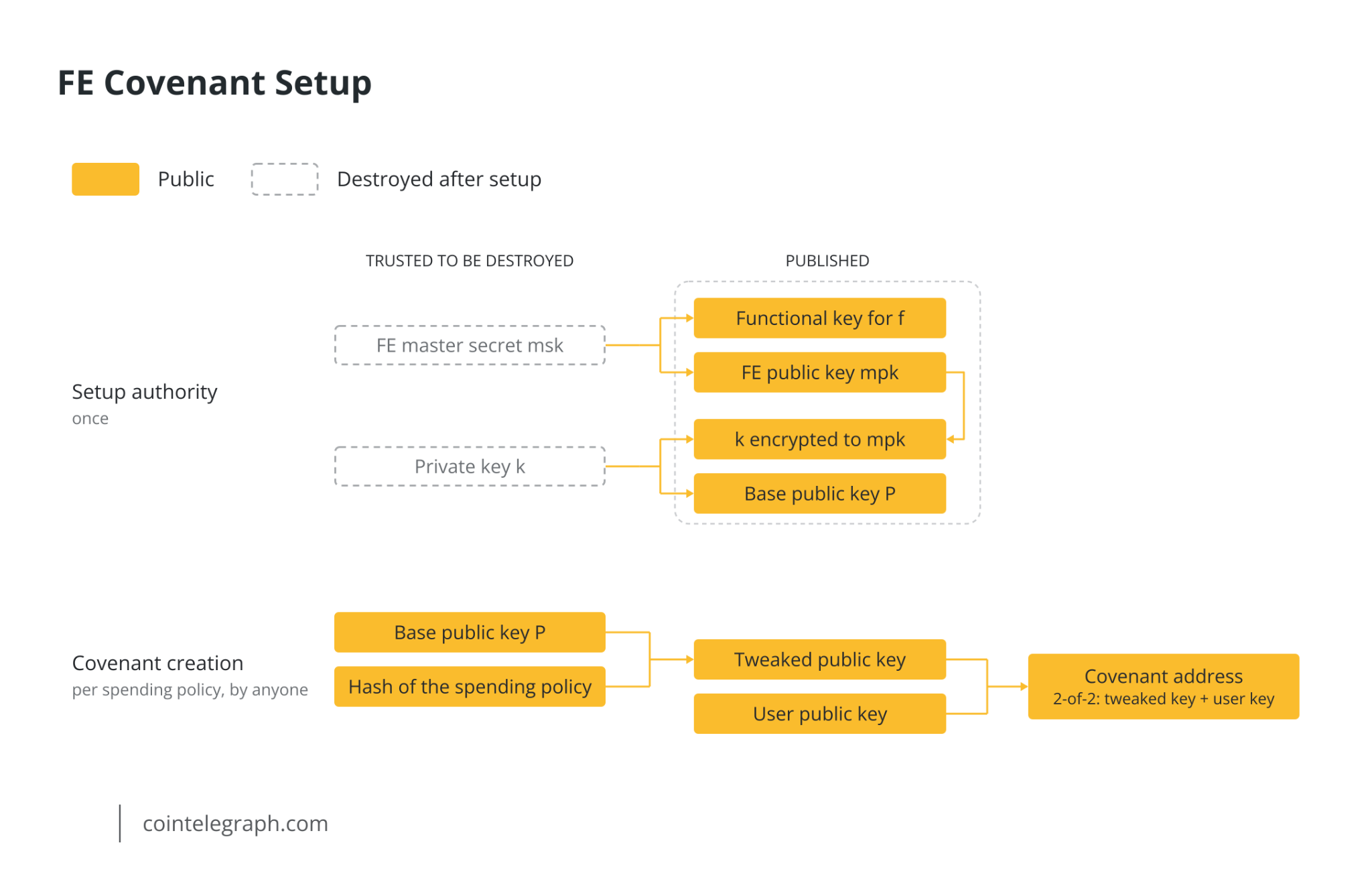
Establishing FE-based covenants from these primitives requires an initial setup phase involving a designated "setup authority." This authority plays a crucial role: it generates a standard Bitcoin key pair (comprising a private key k and its corresponding public key P), alongside an FE key pair (consisting of a master secret msk and an FE public key mpk). Following generation, the authority publishes P and mpk to the network. It then encrypts k using mpk and derives the functional key for f from msk, also making these public.
Crucially, after this setup, the setup authority must be trusted to irrevocably destroy both k and msk. This act of destruction is paramount to the security model. If k or msk were to be retained, the authority would possess the ability to generate signatures that circumvent or violate the predefined covenant rules, undermining the entire system. Once this initial, trust-intensive setup is completed, an indefinite number of new covenants can be subsequently created without further interaction with the authority.
Each new covenant is then assigned its own dedicated key pair, which is derived by tweaking the base Bitcoin key pair (k, P) with the hash of its specific spending policy. The private component of this tweaked key pair never exists in an accessible, plaintext form; it resides exclusively within the secure evaluation environment of f. Conversely, the corresponding public key can be independently derived by anyone who knows the base public key P and the hash of the desired spending policy. This capability enables the generation of covenant receiving addresses, allowing users to send funds into these programmatically controlled outputs. In practical implementations, the receiving address would typically commit to a 2-of-2 multisignature script, requiring both an FE signature and a signature from a key controlled by the user. This dual-signature requirement serves as an essential safeguard, preventing unauthorized parties from unilaterally triggering transactions permitted by the covenant.
To generate an FE signature for a transaction that complies with a covenant’s spending policy, the signer first encrypts the conforming transaction (tx) using the publicly available FE public key (mpk). This encrypted transaction, along with the encrypted base private key k and the functional key previously published by the setup authority, are then fed into the functional evaluation process of f. The function f executes its programmed logic, signing tx with the private key k (which has been tweaked by the hash of the spending policy). If a transaction attempts to deviate from the established spending policy of the address holding the funds, f would either refuse to generate a signature or, at best, produce a signature for a differently tweaked public key that does not control the funds in question, thereby preventing unauthorized spends.
The Expressive Power of Zero-Knowledge Proofs
The general version of FE-based covenants proposed by Rubin, utilizing f(k, tx, program, proof), is notably more expressive and flexible than proposals like OP_CTV. This enhanced expressiveness stems from the inclusion of a "program" that checks a specific condition on the transaction at the time of spending, complemented by a zero-knowledge proof (ZKP) demonstrating that the program accepts the transaction.
The zero-knowledge proof plays a crucial facilitating role in the implementation of the FE scheme. Without it, f would need to act as a general interpreter, capable of executing any given program directly on the transaction data. Such an f would be immensely complex, large, and computationally expensive to evaluate under functional encryption. With the ZKP, f’s task is significantly simplified: it only needs to verify a succinct proof that the transaction satisfies the program’s conditions, rather than executing the program itself. This elegant division of labor allows for the enforcement of arbitrarily complex covenants without commensurately increasing the complexity or evaluation cost of f. Furthermore, the inclusion of a zero-knowledge proof opens up possibilities for spending policies to depend on data external to the transaction itself, such as the outcomes of off-chain computations or oracle feeds, significantly broadening the scope of potential applications for Bitcoin.
The Elephant in the Room: Current Infeasibility and Cryptographic Hurdles
Despite the theoretical elegance and potential of FE-based covenants, their practical implementation currently faces formidable cryptographic and computational barriers, rendering them infeasible with today’s technology. The underlying cryptographic primitive required for multi-input FE, as introduced by Goldwasser et al. in 2014, relies heavily on what is known as indistinguishability obfuscation (iO). Indistinguishability obfuscation is a powerful, yet notoriously difficult-to-construct, cryptographic primitive. It essentially allows for a program to be "obfuscated" or scrambled in such a way that its functionality remains intact, but its internal workings and secret parameters are completely hidden. Multi-input FE and indistinguishability obfuscation are known to imply one another, meaning the complexity of building one is comparable to building the other. Even single-input FE for general circuits, if made compact, has been shown to yield obfuscation, as demonstrated by Ananth and Jain in 2015. Consequently, the cryptographic primitive necessary for Rubin’s design is at least as challenging to realize as indistinguishability obfuscation itself, a concept that remains largely at the theoretical frontier.
Empirical data starkly underscores these challenges. A seminal work by Carmer, Malozemoff, and Raykova in 2017 vividly illustrated the astronomical resource demands of even toy-scale obfuscation. They required an astounding 3.7 hours to obfuscate a mere 12-bit pseudorandom function – a tiny circuit comprising approximately 62,000 gates with a 64-bit key. To put this into perspective, this is orders of magnitude smaller and simpler than the ECDSA (Elliptic Curve Digital Signature Algorithm) signing operation, which involves 256-bit numbers and is central to Bitcoin’s security. The resulting obfuscated program occupied a staggering 120 GB of disk space, and a single evaluation of this miniature circuit consumed 67 minutes of processing time and 128 GB of RAM. The authors themselves candidly concluded that such implementations were "still far from practical."
The computational cost of such a scheme, while not borne by Bitcoin nodes directly (it would fall on whoever produces the signature), is prohibitive for any real-world application. Furthermore, existing practical FE schemes are typically confined to narrow classes of functions, such as the inner products explored by Abdalla et al. in 2015. The complex, highly specific type of ECDSA signing required for Bitcoin covenants does not fall within these currently feasible function classes. Jeremy Rubin’s paper itself acknowledges these significant drawbacks, candidly listing under-developed cryptography and the inherent setup trust assumption as key downsides. In contrast, OP_CTV-style opcodes, while requiring a base-layer change through a soft fork, offer far superior efficiency in terms of transaction bytes and verification overhead.
Broader Implications and Future Directions in Bitcoin Development
The ongoing research into FE-based covenants, despite its current impracticality, highlights a crucial tension in Bitcoin’s evolutionary path: the balance between conservative protocol stability and the desire for enhanced functionality. On one hand, the Bitcoin community’s cautious approach to consensus rule changes has cemented its status as a robust and secure monetary network. Soft forks, while difficult to deploy, represent the most direct and efficient path for introducing new features like covenants. On the other hand, the exploration of complex cryptographic primitives like functional encryption represents a "no-fork" innovation strategy, attempting to achieve similar outcomes without touching the base layer.
This research, spearheaded by figures like Jeremy Rubin, underscores the continuous quest for innovation within the constraints of Bitcoin’s design. Even if functional encryption itself remains a distant dream for practical Bitcoin applications, the theoretical advancements it drives could inform future cryptographic solutions or inspire hybrid approaches. It also illustrates the profound impact of academic cryptography on practical blockchain development, pushing the boundaries of what is considered possible.
The challenges faced by FE-based covenants have also spurred concurrent research into alternative, potentially more pragmatic, methods to achieve similar goals. For instance, Rubin himself has proposed "Un-FE’d Covenants," which aim to approximate covenant behavior by replacing the impractical FE schemes with oracle signers bonded through BitVM, a system for running complex computations off-chain and proving their validity on-chain. Similarly, [alloc]init’s "Bitcoin PIPEs" project, initially conceived as an FE design in 2024, shifted its approach by 2026 to leverage "witness encryption," another advanced cryptographic concept. These parallel efforts signify a vibrant research landscape, continually seeking to expand Bitcoin’s capabilities while respecting its fundamental architectural principles. While FE-based covenants may not be on the immediate horizon for Bitcoin, the intellectual rigor applied to their design pushes the entire field of blockchain cryptography forward, promising a future where increasingly sophisticated on-chain functionalities might one day become practical realities.