Clara Shinta

A wrapped version of Monero (XMR), known as XMR1, experienced a catastrophic price collapse of over 99% on the Hyperliquid decentralized exchange on Friday, following a massive sale of approximately $13.5 million worth of the asset by a wallet that had received tokens directly from the project’s deployer account. The dramatic downturn, which saw XMR1’s value plummet from around $500 to just $1 in approximately 30 minutes, represents a staggering 99.8% decline, according to detailed analysis provided by blockchain analytics firm Bitquery. This incident has sent shockwaves through the niche market of wrapped tokens, raising critical questions about security protocols, key management, and the inherent risks associated with such synthetic assets.
Understanding Wrapped Tokens and Monero’s Role
To fully grasp the implications of the XMR1 incident, it is essential to understand the underlying technologies and the specific context of Monero. Monero (XMR) is a privacy-focused cryptocurrency renowned for its robust anonymity features, including stealth addresses, ring signatures, and Confidential Transactions (CT). These features obscure sender, recipient, and transaction amounts, making it a preferred choice for individuals seeking financial privacy, but also, unfortunately, for illicit activities where anonymity is paramount.
Wrapped tokens, such as XMR1, serve a crucial function in the broader cryptocurrency ecosystem. They are essentially tokenized versions of other cryptocurrencies that exist on a different blockchain than their native network. For instance, wrapped Bitcoin (WBTC) allows Bitcoin to be used on the Ethereum blockchain for DeFi applications. In the case of XMR1, it was designed to represent Monero on a different chain, likely to integrate Monero’s value into a broader DeFi environment where native XMR cannot directly operate due to its distinct blockchain architecture. The process typically involves locking the native asset (XMR) with a custodian or smart contract, and then minting an equivalent amount of the wrapped token (XMR1) on the target blockchain. This mechanism allows the underlying asset’s value to be traded and utilized across disparate blockchain ecosystems. However, this convenience introduces a critical point of centralization and potential vulnerability: the custodian or the smart contract responsible for holding the native assets and issuing the wrapped tokens. The security of the wrapped token hinges entirely on the integrity and security of this bridging mechanism and the associated private keys. Wagyu is identified as the service behind XMR1, implying they were responsible for this wrapping mechanism.
The Catastrophic Plunge: A Detailed Chronology
The events unfolded rapidly on Friday, culminating in a swift and devastating loss for XMR1 holders. The initial trigger was identified when a specific wallet address received an enormous sum of 5.2 million XMR1 tokens directly from the deployer account. The deployer account is typically the entity responsible for minting and managing the initial supply of a token. The transfer of such a large quantity of tokens from this critical account immediately signaled a potential compromise or an insider action.
Following this suspicious transfer, the wallet proceeded to execute a series of large-volume sales on Hyperliquid, offloading approximately $13.5 million worth of XMR1 into the market. The sheer volume of this sell-off, occurring in a relatively short timeframe, overwhelmed the market’s liquidity, leading to an immediate and precipitous drop in price. Bitquery’s analysis pinpoints the exact timeframe of this market capitulation, noting the price collapse from approximately $500 per XMR1 token to a mere $1, marking a near-total destruction of value for anyone holding the asset at the time. This 99.8% decline within a mere half-hour window highlights the extreme volatility and illiquidity risks inherent in certain decentralized markets, especially when faced with such concentrated selling pressure. It is crucial to reiterate that this incident solely impacted XMR1, the wrapped version, and did not affect Monero’s native cryptocurrency (XMR) or its underlying blockchain. Native Monero continued to trade independently, underscoring the distinction between a project’s core asset and its synthetic representations on other chains.
Blockchain Forensics: Bitquery’s Investigation and Fund Tracing

In the wake of the incident, blockchain analytics firm Bitquery launched an immediate on-chain investigation to trace the flow of the illicitly gained funds. Their meticulous analysis provided a clear picture of how the proceeds from the XMR1 sale were laundered and moved across various blockchain networks.
According to Bitquery’s findings, the $13.5 million realized from the XMR1 sale was first converted into $13.28 million in USD Coin (USDC), a stablecoin, on the Arbitrum network. Arbitrum is a Layer 2 scaling solution for Ethereum, designed to offer faster and cheaper transactions. From Arbitrum, the funds were then swiftly moved. The analysis showed that $13.22 million of the USDC was subsequently exchanged for 7,467 Ether (ETH) using CoW Protocol, a decentralized exchange aggregator that optimizes trade execution. The final step in the laundering process involved bridging the majority of this Ether to the main Ethereum blockchain. This multi-step process, involving different blockchains and decentralized protocols, is a common tactic employed by exploiters to obscure the trail of funds and make them harder to recover. While Bitquery successfully traced the funds’ movement, the crucial question of how the deployer account’s private key was obtained or who controlled it during these transfers remains unanswered by their on-chain evidence, leaving the exact circumstances of the suspected exploit unconfirmed from a technical standpoint.
The Shadow of Prior Hacks: A Tangential Connection?
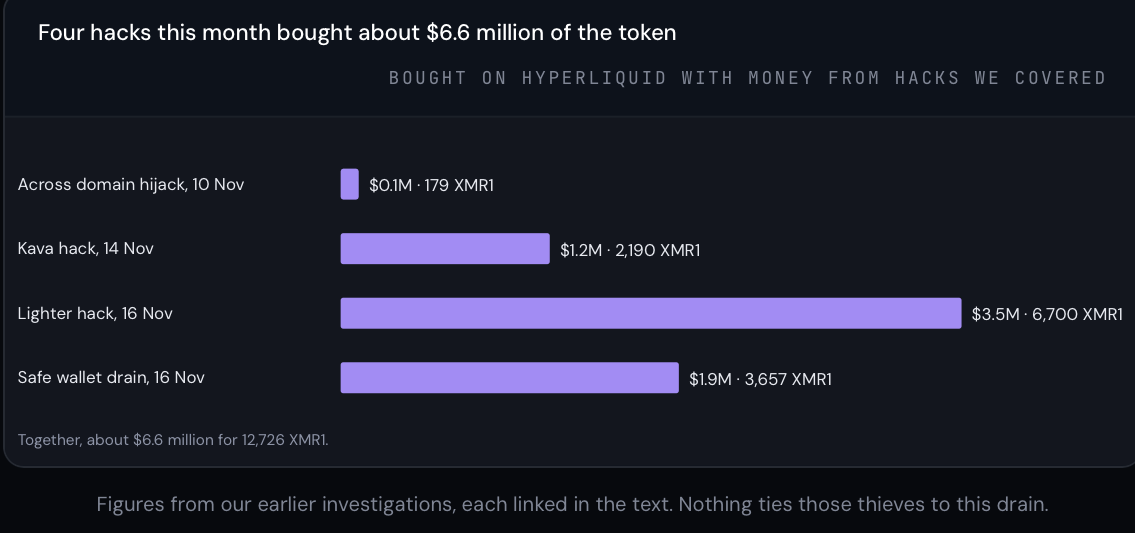
Adding another layer of complexity to the XMR1 saga, Bitquery’s investigation unearthed a potentially unsettling connection to several prior cryptocurrency hacks that occurred earlier in November. The firm discovered that proceeds totaling approximately $6.6 million from four separate exploits targeting Across Protocol, Kava, Lighter, and Safe had been funneled into XMR1 purchases.
The implication of this discovery is significant. It suggests that these earlier exploiters may have been using XMR1 as an intermediary step, potentially as a route to convert their ill-gotten gains into native Monero (XMR). Given Monero’s strong privacy features, it is a common destination for funds obtained through illicit means, as it allows perpetrators to effectively "wash" or anonymize their stolen assets, making them extremely difficult to trace further. The purchase of XMR1 would serve as a bridge, allowing funds from various Ethereum-compatible chains (where these hacks typically occur) to eventually be swapped for native Monero. However, Bitquery was careful to note a critical distinction: while funds from these earlier hacks were used to purchase XMR1, their on-chain analysis found no direct evidence linking those specific incidents to Friday’s devastating exploit of the XMR1 deployer account. This suggests two possibilities: either the Friday exploit was an entirely separate event, or if there is a connection, it was executed off-chain or through means that do not leave a traceable footprint directly linking the two sets of actors. Nevertheless, the presence of stolen funds flowing into XMR1 prior to its collapse underscores the token’s perceived utility within illicit financial circles, albeit for reasons perhaps unrelated to the final exploit.
Wagyu Operator’s Response and Allegations
In the immediate aftermath of the XMR1 collapse, "PerpetualCow," the pseudonymous operator behind Wagyu, the service responsible for XMR1, released a statement attributing the incident to an alleged breach of their hosting provider, 1984. This official response from the project operator is a critical component of understanding the perceived cause of the exploit.
PerpetualCow claimed that the breach exposed sensitive customer data and internal server files, suggesting a fundamental compromise of their operational infrastructure. More specifically, the operator stated that the critical XMR1 deployer key, which controls the minting and management of the wrapped token, had been stored on a server. Although this server was reportedly deleted, PerpetualCow alleged that the hosting provider, 1984, "retained logs and files associated with it." This claim implies a severe security lapse on the part of the hosting provider, where residual data or backups of sensitive information, even from deleted servers, could have been accessed by malicious actors. If true, this represents a significant vulnerability in the supply chain of cryptocurrency projects, where reliance on third-party infrastructure can introduce unforeseen risks.
In a move to mitigate the damage and address the affected community, PerpetualCow publicly pledged to personally reimburse affected traders for their losses. This commitment, while offering a glimmer of hope to those who lost funds, also highlights the significant financial burden now placed on the project operator. Furthermore, PerpetualCow announced plans for Wagyu to relaunch at a later date, although no specific timeline or details about how the security vulnerabilities would be addressed in the new iteration were provided. Cointelegraph reached out to PerpetualCow for additional details regarding the suspected breach and the proposed reimbursement plans but had not received a response by the time of publication, leaving many questions unanswered about the specifics of the recovery and future plans. Notably, there has been no public statement or confirmation from 1984 hosting regarding the alleged breach, leaving PerpetualCow’s claims unverified by the accused party.
Broader Implications for the Crypto Ecosystem
The XMR1 incident carries significant implications that extend far beyond the immediate financial losses suffered by its investors. It serves as a stark reminder of several systemic risks within the cryptocurrency and decentralized finance (DeFi) sectors.
Erosion of Investor Confidence: Incidents like the XMR1 collapse severely damage investor confidence, particularly in smaller, less-audited projects and wrapped assets. When a token designed to represent a secure underlying asset like Monero can be so easily exploited due to infrastructure weaknesses, it raises doubts about the reliability and trustworthiness of the entire wrapped token ecosystem. This can lead to increased skepticism and a flight of capital towards more established and rigorously audited projects.
Security of Third-Party Infrastructure: The alleged compromise of 1984 hosting underscores the critical importance of supply chain security in the crypto space. Projects often rely on third-party services for hosting, development, and other operational needs. A vulnerability in any link of this chain can be exploited, even if the project’s own smart contracts are robust. This incident will likely prompt a re-evaluation of security practices for key management, data retention policies by hosting providers, and the due diligence projects conduct on their service providers. It highlights the need for multi-factor authentication, cold storage solutions for critical keys, and stringent access controls that go beyond basic server deletion.
Inherent Risks of Wrapped Tokens: While providing interoperability, wrapped tokens introduce a layer of counterparty risk. The value of a wrapped token is only as good as the security of the underlying asset’s custodian or the bridging mechanism. If the entity holding the native assets (or the keys to mint/burn the wrapped tokens) is compromised, the wrapped token can become worthless, regardless of the security of the native asset itself. This incident serves as a cautionary tale for investors to thoroughly understand the wrapping mechanism and the associated risks before engaging with such assets.
Regulatory Scrutiny: Such high-profile exploits and fund movements, particularly those involving links to prior hacks and the use of privacy-enhancing cryptocurrencies, inevitably attract the attention of financial regulators worldwide. Governments are increasingly concerned about money laundering, illicit financing, and consumer protection in the crypto space. Incidents like XMR1’s collapse could fuel calls for stricter regulations on DeFi protocols, wrapped assets, and the reporting requirements for exchanges and service providers, potentially impacting innovation and accessibility.
Challenges for Project Recovery: Even with a pledge for reimbursement and a plan to relaunch, rebuilding trust after such a catastrophic event is an arduous task. Wagyu will face immense challenges in convincing users that their security measures have been sufficiently upgraded and that their infrastructure is truly resilient against future attacks. The lack of transparency from the hosting provider and the unconfirmed nature of the breach add to the difficulty of restoring faith in the project.
The Ongoing Cat-and-Mouse Game: The XMR1 incident, combined with the earlier hacks, illustrates the persistent cat-and-mouse game between malicious actors and blockchain security firms. Exploiters are constantly seeking new vulnerabilities, from smart contract flaws to infrastructure weaknesses, and are adept at using complex on-chain maneuvers to launder funds. This necessitates continuous vigilance, advanced analytical tools, and proactive security measures from all participants in the crypto ecosystem.
The XMR1 plunge on Hyperliquid is a multi-faceted event, encompassing a dramatic market crash, sophisticated fund tracing, allegations of a third-party security breach, and a tangential connection to prior illicit activities. It underscores the dynamic and often perilous nature of the cryptocurrency market, particularly for nascent projects and wrapped assets that rely on complex technical infrastructure. As the industry matures, incidents like this highlight the urgent need for enhanced security protocols, greater transparency, and a more robust understanding of the inherent risks by both project developers and investors alike. The full ramifications of the XMR1 exploit will likely continue to unfold as investigations progress and the broader community grapples with the lessons learned from this latest setback.