Clara Shinta
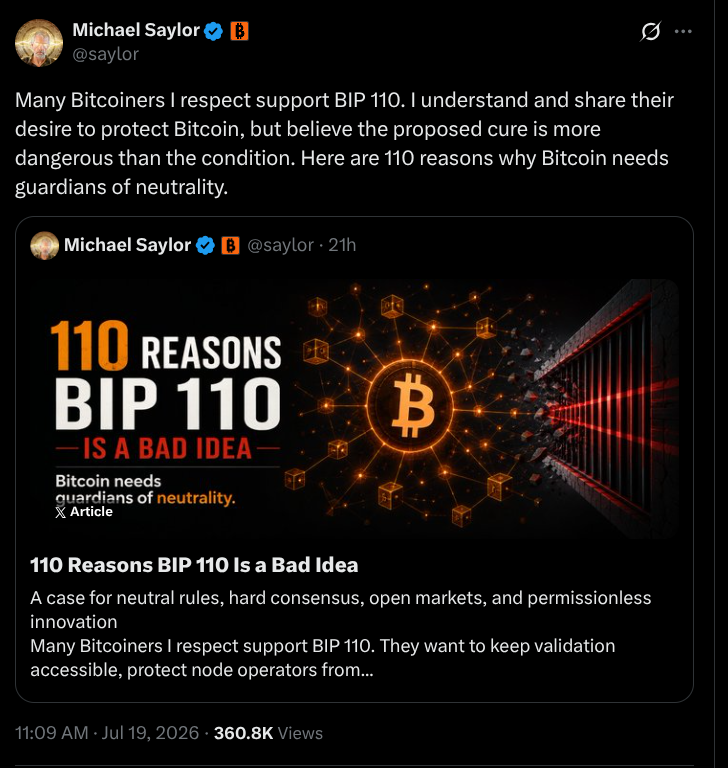
Strategy executive chairman Michael Saylor ignited a vigorous debate within the Bitcoin community on Sunday, detailing his "110 reasons" why a proposed temporary fork, Bitcoin Improvement Proposal-110 (BIP-110), designed to limit non-monetary transactions on the network, constitutes a detrimental path forward for the digital asset. His extensive critique, disseminated via social media, underscores a growing ideological chasm over Bitcoin’s foundational principles and its future trajectory, echoing past controversies that have shaped its development.
The Emergence of BIP-110 and Its Purpose
Bitcoin Improvement Proposal-110 was formally introduced in December 2025 by pseudonymous developer "Dathon Ohm," with prominent support from Ocean Protocol founder and long-time Bitcoin Core contributor Luke Dashjr. The core objective of BIP-110 is to mitigate what its proponents describe as "spam" caused by non-fungible token (NFT)-like Ordinals inscriptions and other forms of arbitrary data embedded directly onto the Bitcoin blockchain. The proposal aims to preserve Bitcoin’s primary utility as a peer-to-peer electronic cash system, asserting that the proliferation of such data detracts from its core function, potentially increasing network costs and hindering accessibility for transactional use.
The rationale behind BIP-110 stems from concerns that these "non-monetary" transactions consume valuable block space, drive up transaction fees for standard payments, and impose increased storage and processing burdens on node operators. Supporters argue that by temporarily limiting these inscriptions, Bitcoin can maintain its efficiency, affordability, and focus on sound money principles, safeguarding the network’s long-term health and decentralization. The proposal suggests a temporary, one-year limit on these types of transactions, implying that the measure is a corrective, not a permanent, redefinition of network rules.
Michael Saylor’s Comprehensive Rebuttal
In a roughly 3,700-word post published on X.com (formerly Twitter), Michael Saylor, whose company MicroStrategy controls the largest corporate treasury of Bitcoin, meticulously laid out his opposition to BIP-110. His arguments are rooted in a deep philosophical commitment to what he describes as "neutral rules, hard consensus, open markets, and permissionless innovation." Saylor’s essay, which quickly amassed 879,000 views, 692 replies, and 852 retweets by Sunday 12 p.m. ET, positions the debate as a fundamental test of Bitcoin’s core values.
Saylor acknowledged the serious concerns of BIP-110 supporters, stating, "Many Bitcoiners I respect support BIP 110. They want to keep validation accessible, protect node operators from unwanted costs and content, preserve affordable payments, and keep Bitcoin focused on sound money rather than general-purpose data storage. Those are serious concerns. I share the objectives. I disagree about the remedy." This measured tone, emphasizing respect for opposing viewpoints while vigorously critiquing the proposal itself, highlights the complexity and high stakes of the discussion. He further added, "This article critiques the proposal, not the people behind it. I assume good faith. Bitcoin is strongest when we can disagree vigorously without mistaking allies for enemies."
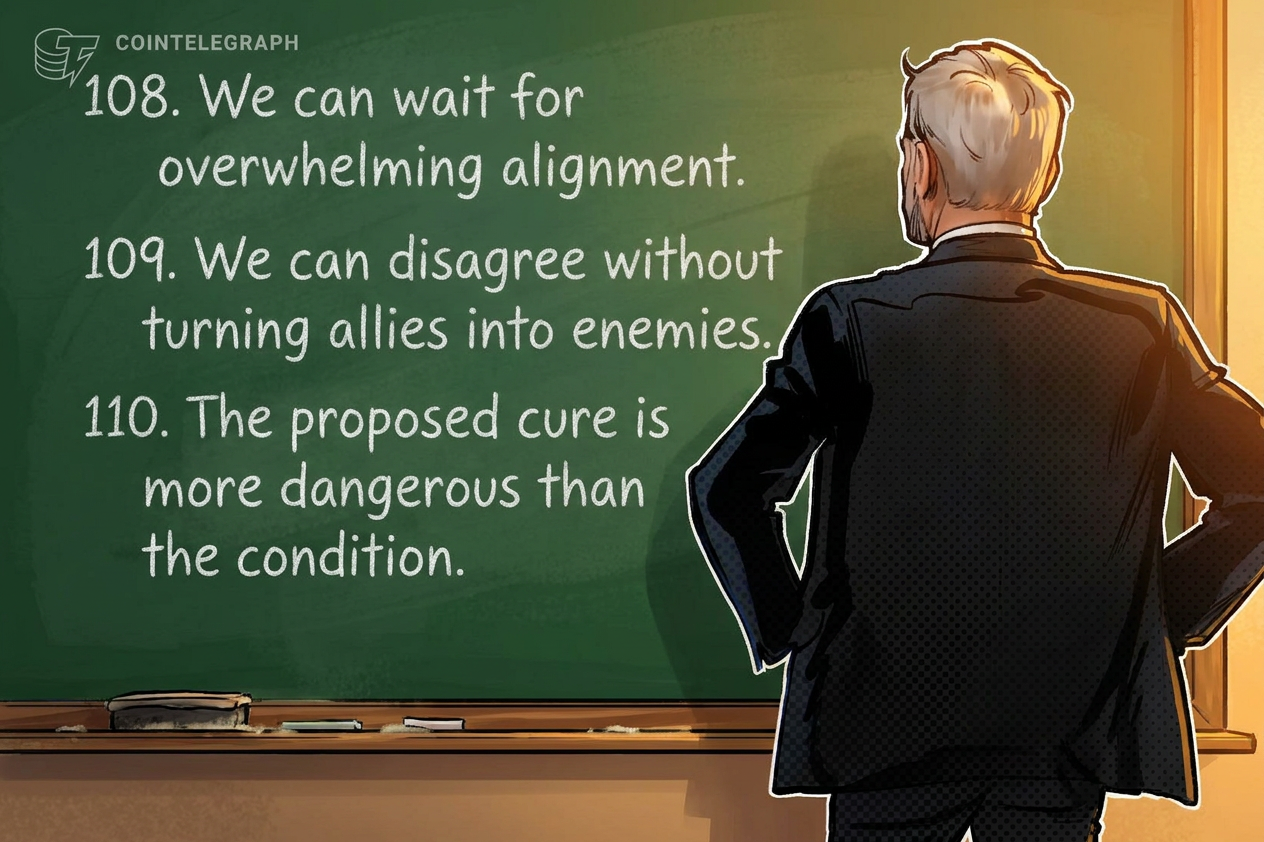
At the heart of Saylor’s "110 reasons" lies the principle of censorship resistance. He contends that any attempt to categorize and filter transactions based on their content, even if well-intentioned, sets a dangerous precedent that could erode Bitcoin’s permissionless nature. For Saylor, Bitcoin’s strength derives from its neutrality – its inability to distinguish between different types of data, treating all valid transactions equally. Introducing rules that discriminate against certain data types, he argues, could open the door to future, more expansive forms of censorship, potentially undermining the network’s fundamental value proposition as a global, uncensorable monetary system.
Furthermore, Saylor’s critique extends to the economic implications. While Ordinals activity has been cyclical, periods of high inscription volume have historically led to increased transaction fees, which directly benefit Bitcoin miners. These fees, in conjunction with block rewards, incentivize miners to secure the network, contributing to its overall robustness. Restricting non-monetary transactions could, in Saylor’s view, reduce this revenue stream, potentially impacting network security in the long run, especially as block rewards continue to halve. He posits that market forces, rather than protocol-level intervention, should dictate the optimal use of block space. If users are willing to pay higher fees for inscriptions, that demonstrates a market demand that the network, in its neutral capacity, should accommodate.
Historical Context: Echoes of the Blocksize Wars
The current dispute surrounding BIP-110 is widely considered one of the most significant protocol-level disagreements in the Bitcoin development community since the infamous "Blocksize Wars" between 2015 and 2017. That era saw intense debates among ecosystem participants regarding whether to increase Bitcoin’s block size limit to improve scalability, a conflict that ultimately led to the contentious hard fork and creation of Bitcoin Cash.
The Blocksize Wars highlighted the challenges of achieving consensus in a decentralized network and the deep ideological divisions regarding Bitcoin’s future. One faction, often referred to as "big blockers," advocated for larger blocks to accommodate more transactions and serve as a global payment network. The other, "small blockers," prioritized decentralization, resisting changes that could increase node operating costs and potentially centralize mining. The lessons learned from that period—the importance of robust debate, the risks of chain splits, and the inherent difficulty of altering fundamental protocol rules—are highly relevant to the BIP-110 discussion. Both debates touch upon core questions: What is Bitcoin’s primary purpose? How should it scale? And who decides its future? The current conflict, though focused on transaction content rather than size, similarly pits different visions for Bitcoin against each other, reigniting concerns about community fragmentation and the delicate balance of its decentralized governance model.
Key Players and Diverse Perspectives
The proposal has drawn a clear line in the sand, with prominent figures aligning on both sides. Pseudonymous developer "Dathon Ohm" introduced BIP-110, garnering the support of Luke Dashjr, a long-standing and influential Bitcoin Core developer known for his strict interpretation of Bitcoin’s original intent. Dashjr and other BIP-110 supporters have consistently argued that Ordinals-driven bloat represents a "serious threat" to the network’s health and functionality, necessitating an "imminent fix." They maintain that the proposal, structured as a temporary soft fork with a one-year limit, would not cause a permanent chain split, alleviating a major fear among opponents, and would not invalidate legitimate, fee-paying transactions in the long term. Their perspective emphasizes the technical purity and operational efficiency of the network above all else.
On the opposing side, Blockstream CEO Adam Back, another titan in the Bitcoin and cryptography world, has been an outspoken critic. Back has publicly described BIP-110 as a "quest to police other people," asserting that such interventions are incompatible with Bitcoin’s core cypherpunk ethos of permissionless, censorship-resistant money. His argument centers on the principle that Bitcoin’s decentralization should inherently mean that "you can’t impose your views on others" regarding how they utilize the blockchain’s scarce block space, as long as transactions adhere to the established consensus rules. This stance champions individual sovereignty and the network’s neutrality, seeing any content-based filtering as a slippery slope towards centralized control.
Current Status and Activation Uncertainty
Despite the fervent debate, the activation of BIP-110 remains highly uncertain. For the proposal to be adopted, a significant consensus mechanism requires 55% of Bitcoin nodes validating blocks to signal their support within a designated "period." This threshold is a deliberate design choice, ensuring that protocol changes reflect broad community agreement rather than a simple majority or the will of a vocal minority.
As of the last recorded period, period number 475, spanning blocks 955,584 to 957,599, only 1% of blocks signaled support for BIP-110. This exceedingly low signaling rate indicates that the proposal currently lacks the widespread backing necessary for activation. The disparity between the passionate advocacy for BIP-110 and its minimal signaling support suggests a substantial disconnect within the broader Bitcoin ecosystem, or perhaps a cautious wait-and-see approach from many node operators.
The timing of this intense debate is particularly noteworthy given the current state of Ordinals activity. Data from Dune Analytics shows that Ordinals inscriptions have seen a dramatic decline from their peak. Over the last month, fewer than 10,000 Ordinals have been inscribed onto the Bitcoin blockchain daily. This is a sharp contrast to the more than 400,000 daily inscriptions observed during its peak in August 2023. This downturn in activity might temporarily alleviate some of the immediate network congestion concerns that fueled the initial push for BIP-110. However, the philosophical arguments against Ordinals, and by extension the motivation for BIP-110, are not solely dependent on current network load but rather on fundamental principles of what Bitcoin should and should not be. Even with low activity, the precedent of "non-monetary" data use on the blockchain continues to be a point of contention for those who advocate for a narrower definition of Bitcoin’s purpose.
Broader Implications and The Future of Bitcoin’s Ethos
The BIP-110 debate extends beyond technical specifications; it delves into the very identity and purpose of Bitcoin. It represents a clash between two powerful visions: one that prioritizes Bitcoin as a lean, efficient, peer-to-peer cash system, potentially even a "digital gold" focused solely on monetary transactions, and another that embraces its open, permissionless nature, allowing for diverse and unforeseen applications, including data storage and digital artifacts.
The outcome of this debate, whether BIP-110 gains traction or fades, will have significant implications for Bitcoin’s future governance and the evolution of its development philosophy. If a proposal like BIP-110 were to pass, it could set a powerful precedent for future content-based filtering, potentially altering the network’s perceived neutrality and censorship resistance. Conversely, if such proposals consistently fail to achieve consensus, it reinforces the strong preference within the community for maintaining Bitcoin’s maximally permissionless and neutral characteristics, even at the cost of accommodating uses that some may deem "spam."
This ongoing discussion highlights the inherent tension in a decentralized system: how to adapt and evolve while preserving core principles. The ability of the Bitcoin network to weather such ideological storms, to allow for vigorous debate without succumbing to fragmentation, is a testament to its robust social and technical layers. As Michael Saylor eloquently stated, the strength of Bitcoin lies in its ability for allies to disagree vigorously, navigating complex challenges to forge a path forward that ideally strengthens the network for all participants. The "110 reasons" against BIP-110 serve not just as a critique of a specific proposal, but as a reaffirmation of a particular vision for Bitcoin’s enduring role in the digital economy. The path ahead will require continued dialogue, technical innovation, and the patient pursuit of consensus, ensuring Bitcoin remains true to its revolutionary promise.