Clara Shinta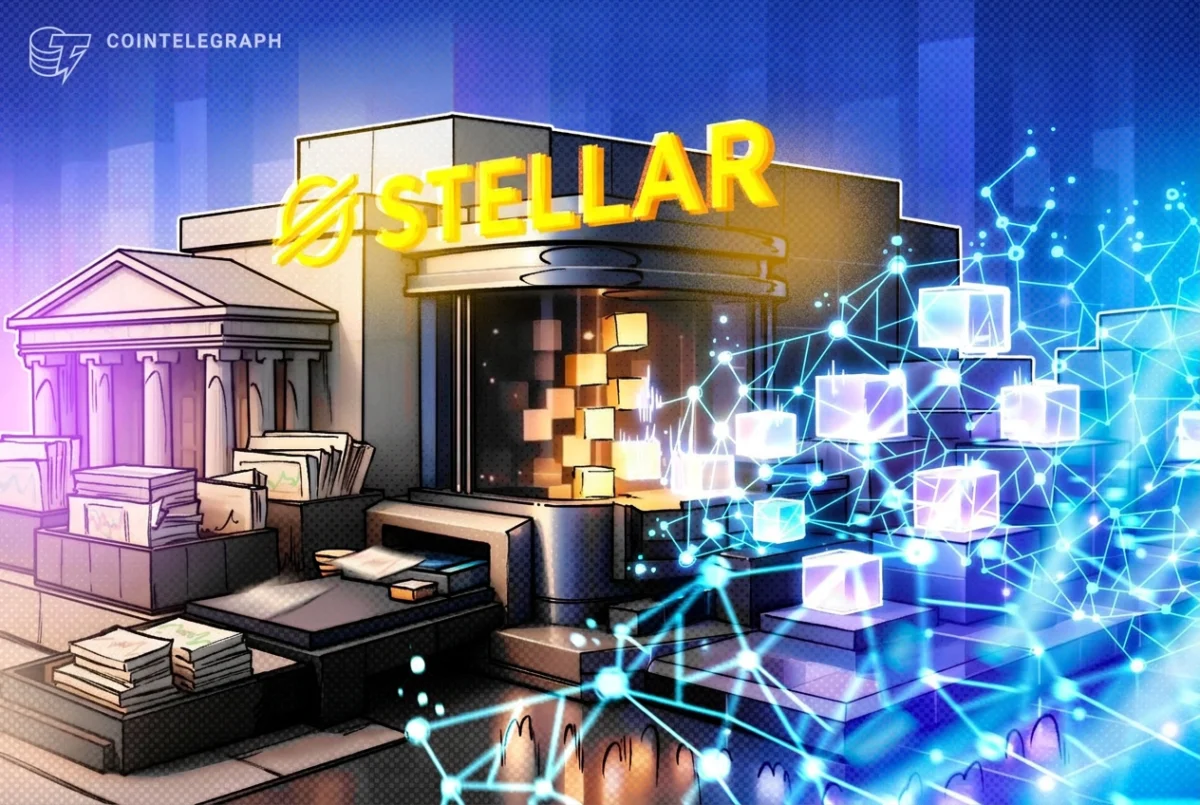
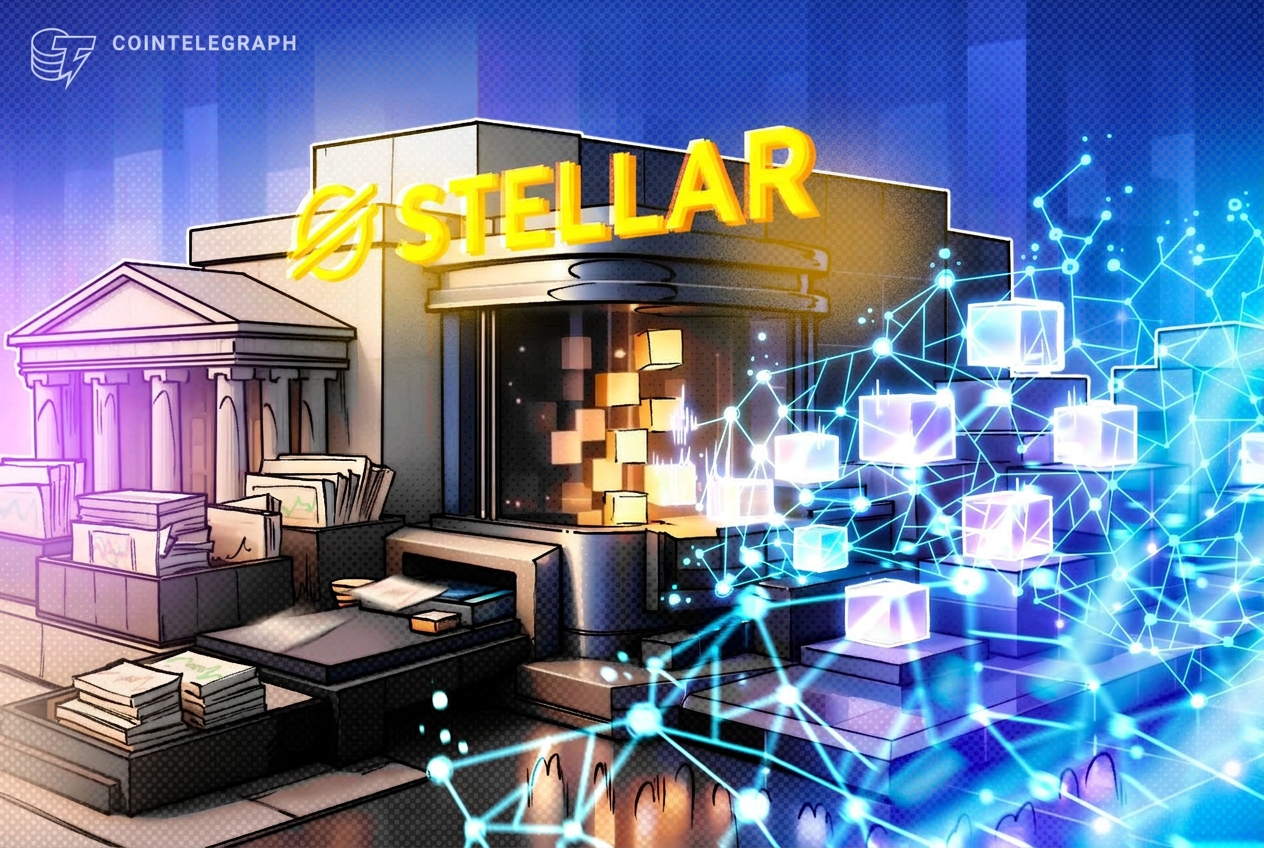
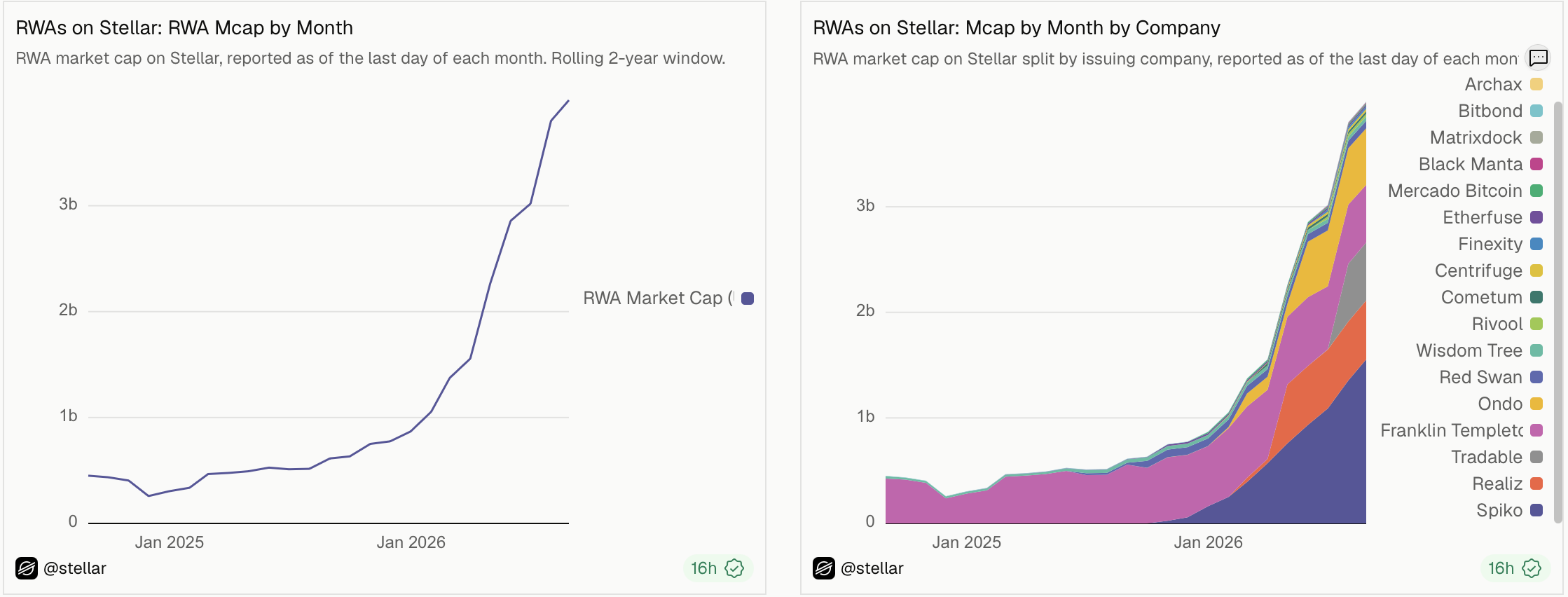
The value of tokenized real-world assets (RWAs) on the Stellar blockchain has experienced an unprecedented surge in 2026, climbing approximately 360% to nearly $4 billion. This dramatic increase marks a significant leap from $868.8 million recorded at the close of the previous year, according to data compiled on a Dune Analytics dashboard maintained by Stellar. As of August 29, 2026, the network’s RWA market capitalization stood at precisely $3.996 billion, underscoring a pivotal shift towards the on-chain representation of tangible and traditional financial instruments. This robust growth reflects a burgeoning confidence in Stellar’s infrastructure for bridging conventional finance with the burgeoning digital asset economy.
Unpacking the Growth: A $4 Billion Milestone
The near-$4 billion valuation of tokenized assets on Stellar is distributed across a diverse portfolio of asset classes. These include highly sought-after US Treasurys, various forms of private and public credit, non-US government debt, and a spectrum of other tokenized assets. The comprehensive nature of these assets highlights Stellar’s versatility and its appeal to a broad range of financial entities looking to leverage blockchain technology for enhanced liquidity, transparency, and fractionalization. The remarkable 360% growth rate within the first eight months of 2026 positions Stellar as a frontrunner in the rapidly expanding RWA tokenization landscape, demonstrating its increasing relevance to institutional players.
The tokenization of real-world assets is a transformative process that converts rights to an asset into a digital token on a blockchain. This innovation promises to unlock previously illiquid assets, streamline complex ownership structures, and reduce transaction costs. For Stellar, a network specifically designed for cross-border payments and asset issuance, its architecture provides a compelling environment for RWA tokenization. Its low transaction fees, high speed, and focus on regulatory compliance have made it an attractive platform for financial institutions seeking to explore the efficiencies of blockchain without compromising on security or oversight.
Key Drivers: Institutional Adoption and Strategic Partnerships
The meteoric rise in Stellar’s RWA market cap is not merely organic growth; it is largely propelled by a concerted push from financial institutions and specialized tokenization platforms deepening their engagement with the network. This institutional embrace signifies a maturing phase for blockchain technology, where its utility extends beyond speculative cryptocurrencies to the fundamental restructuring of asset ownership and transfer.
A significant development occurred in May 2026 when the Depository Trust & Clearing Corporation (DTCC), a cornerstone of global financial market infrastructure, announced its strategic plans to integrate its tokenization service with Stellar. This landmark collaboration is anticipated to make DTC-tokenized assets available on the Stellar network in the first half of 2027. The implications of this integration are profound, potentially enabling the tokenization of a vast array of traditional financial instruments, including US Treasurys, major index Exchange Traded Funds (ETFs), and even stocks listed in the Russell 1000. Such a move by the DTCC, which processes trillions of dollars in securities transactions daily, validates Stellar’s robust architecture and its capability to handle high-value, high-volume institutional assets. It signals a future where traditional and digital asset markets converge, offering unprecedented efficiencies and access.
Continuing this institutional momentum, July 2026 saw tokenization platform Tradable unveil ambitious plans to bring up to $1 billion in private credit assets onto the Stellar blockchain. Tradable’s integration is meticulously designed to support critical aspects of asset management, including compliance, investor onboarding, and the comprehensive lifecycle management of assets. This initiative builds upon Tradable’s existing success, having already tokenized $1.7 billion in private credit across nearly 30 positions on other platforms. The decision to leverage Stellar for an additional billion dollars in private credit underscores the network’s suitability for complex financial instruments that require sophisticated handling and robust infrastructure. Private credit, often characterized by its illiquidity and limited access, stands to gain immensely from tokenization, offering fractional ownership and broader investor participation.
Stellar has also significantly expanded its footprint in the realm of digital payments, further cementing its utility as a foundational layer for financial innovation. In June 2026, MoneyGram, a global leader in cross-border peer-to-peer payments, launched its MGUSD dollar stablecoin directly on the Stellar network. This stablecoin empowers users to hold dollar-denominated balances on-chain and seamlessly move funds through MoneyGram’s extensive global payments network. The introduction of MGUSD is a testament to Stellar’s efficiency and reliability in facilitating real-time, low-cost transfers, which is crucial for international remittances and everyday digital transactions. MGUSD contributes to the growing ecosystem of reserve-verified stablecoins issued on Stellar, which collectively amounted to approximately $438 million according to the Dune dashboard, demonstrating the network’s increasing role in providing stable, on-chain value transfer.
Market Concentration and Leading Issuers
While the overall growth is impressive, the Stellar RWA market remains concentrated among a select group of prominent issuers. This concentration is typical in nascent, high-growth sectors, as early movers and well-capitalized entities often lead the charge. As of August 27, 2026, just a few key players accounted for the lion’s share of Stellar’s RWA value:
- Spiko emerged as the dominant force, responsible for $1.55 billion of Stellar’s RWA value. Spiko’s significant contribution highlights its leadership in leveraging Stellar for tokenization solutions.
- Realiz followed with $559 million, indicating its strong presence and successful deployment of tokenized assets on the network.
- Tradable, beyond its announced $1 billion private credit initiative, already held $548 million in tokenized assets, reinforcing its pivotal role in bringing traditional financial instruments on-chain.
- Franklin Templeton, a renowned global investment management organization, contributed $546 million, underscoring the serious entry of established financial giants into the digital asset space via Stellar.
- Ondo, a decentralized finance (DeFi) protocol specializing in tokenized securities, accounted for $535 million, demonstrating the cross-pollination between traditional finance and decentralized applications on Stellar.
This issuer landscape showcases a blend of specialized tokenization platforms and legacy financial institutions, all converging on Stellar to unlock the benefits of tokenized assets. The presence of entities like Franklin Templeton is particularly noteworthy, as it signals a strategic move by mainstream asset managers to integrate blockchain technology into their core operations, potentially paving the way for wider institutional adoption.
Expanding Horizons: Non-US Government Debt and Stablecoins
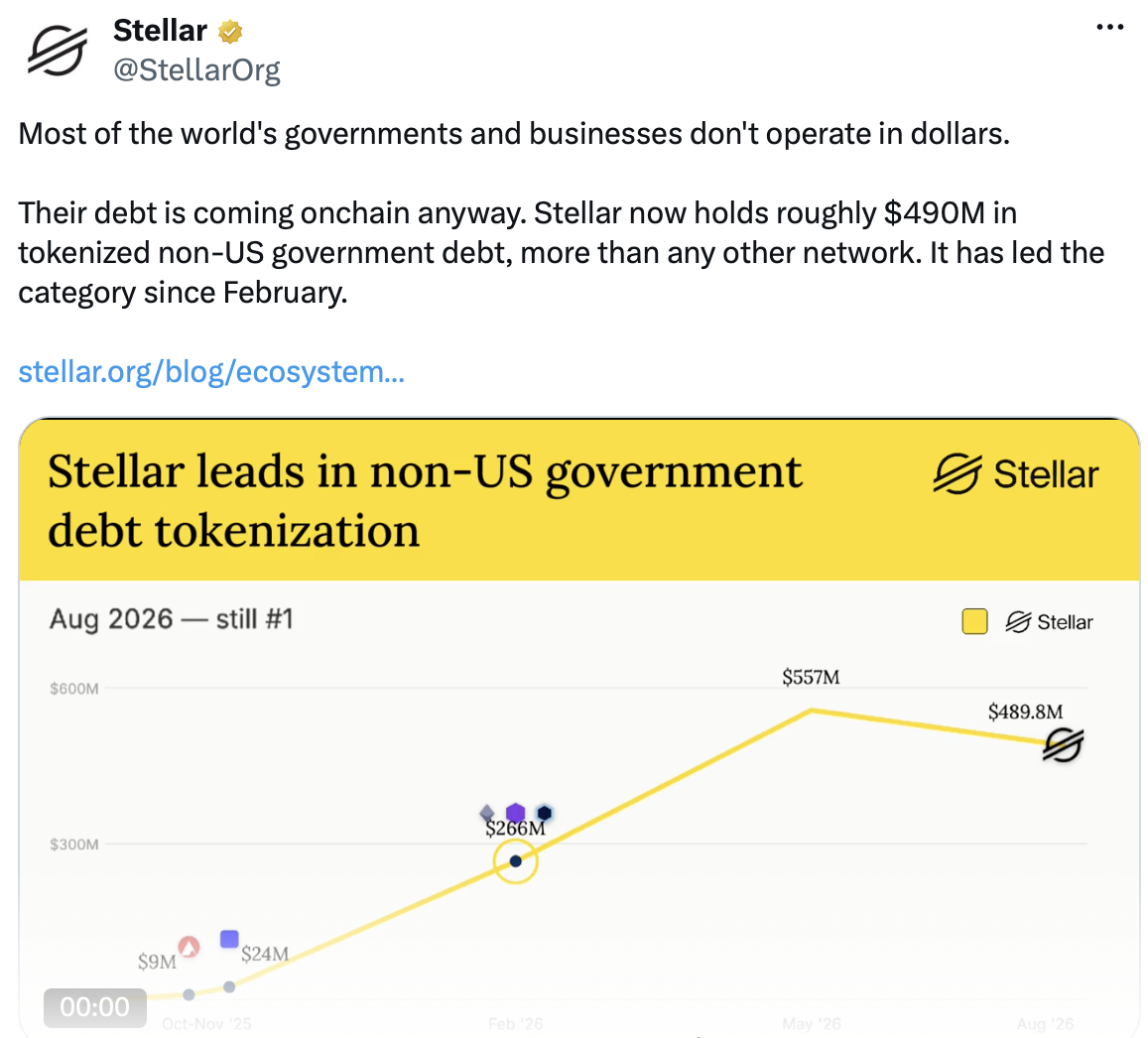
Stellar has also made significant inroads in the tokenization of non-US government debt, an asset class with immense global potential for on-chain representation. Citing data from RWA.xyz, the Stellar Development Foundation reported that the network held approximately $490 million in this asset class as of August 20, 2026. This includes notable examples such as tokenized Mexican CETES (Certificados de la Tesorería de la Federación) and Brazilian government bonds, both issued through the Etherfuse platform.
The tokenization of sovereign debt from emerging markets offers several advantages. It can broaden investor access, reduce issuance costs for governments, and enhance liquidity in secondary markets. Stellar’s robust cross-border capabilities and emphasis on regulatory adherence make it an ideal platform for these complex international financial instruments. The success in this sector demonstrates Stellar’s ability to facilitate sophisticated multi-jurisdictional financial operations, positioning it as a key player in the global expansion of digital debt markets.
Alongside RWAs, Stellar’s stablecoin ecosystem continues to grow, serving as a critical foundational layer for these tokenized assets. The aforementioned MGUSD stablecoin by MoneyGram adds to roughly $438 million in reserve-verified stablecoins already circulating on the network. These stablecoins provide the necessary on-ramp and off-ramp liquidity for investors interacting with tokenized RWAs, ensuring seamless value transfer and minimizing volatility risks inherent in other cryptocurrencies. Their transparent reserve backing and regular attestations instill confidence, crucial for institutional participation.
The XLM Conundrum: Network Utility vs. Token Price
Despite the astounding growth in its RWA market capitalization and expanding utility, Stellar’s native cryptocurrency, XLM, has experienced a challenging year. According to CoinGecko data, XLM is down approximately 11% year-to-date in 2026, trading near $0.18. This apparent disconnect between the network’s fundamental growth and its token’s market performance presents a common conundrum observed across many blockchain ecosystems.
Several factors could contribute to this divergence. Firstly, the utility derived from RWA tokenization, while significant for the network’s transaction volume and fee generation, may not directly translate into immediate speculative demand for XLM. Many RWA transactions on Stellar utilize stablecoins or other issued assets directly, minimizing the need for large-scale XLM holdings by institutional users. Secondly, broader cryptocurrency market sentiment and macroeconomic conditions often exert a more dominant influence on token prices than specific network adoption metrics, especially for established projects like Stellar. Thirdly, institutional adoption often unfolds over longer timelines, with the full economic benefits accruing gradually rather than leading to immediate price spikes. Investors might be waiting for more widespread retail and institutional access to these tokenized assets, or for further clarity on regulatory frameworks, before committing substantial capital to XLM. Finally, the supply dynamics of XLM, which has a relatively large circulating supply and a predefined emission schedule, might also play a role in moderating price movements despite increased network activity.
However, the sustained growth in RWA value and institutional partnerships lays a strong foundation for XLM’s long-term value proposition. As more assets are tokenized and more financial institutions integrate with Stellar, the demand for network resources and the underlying utility of XLM for transaction fees, account minimums, and potential governance functions could naturally increase over time.
Broader Implications and Future Outlook
Stellar’s remarkable RWA growth in 2026 carries significant implications for both the blockchain industry and traditional finance. For the blockchain sector, it demonstrates the tangible value proposition of distributed ledger technology beyond speculative digital currencies. It highlights a clear pathway for blockchain networks to become integral components of the global financial infrastructure, handling real-world assets with real economic value. Stellar’s success in attracting major players like DTCC and Franklin Templeton sets a precedent, encouraging other financial institutions to explore similar tokenization initiatives on various networks.
For traditional finance, this trend represents a pivotal step towards modernization and efficiency. Tokenization offers solutions to long-standing challenges such as illiquidity in private markets, slow settlement times, and opaque ownership structures. By leveraging Stellar, financial institutions can potentially reduce operational costs, broaden investor pools through fractionalization, and enhance the transparency and auditability of assets. The expansion into non-US government debt also signifies a move towards a more interconnected and efficient global financial system, where sovereign debt can be traded with unprecedented ease and speed across borders.
Looking ahead, the trajectory for tokenized RWAs on Stellar appears robust. The announced DTCC integration, slated for early 2027, promises to unlock an even larger volume of traditional assets. The continued innovation from platforms like Tradable and the increasing participation of asset managers like Franklin Templeton suggest a sustained institutional embrace. Challenges remain, particularly in navigating complex and evolving regulatory landscapes across different jurisdictions. However, Stellar’s proactive approach to compliance and its established track record in cross-border payments position it favorably to address these hurdles.
The journey of tokenizing real-world assets is still in its early stages, but Stellar’s performance in 2026 firmly establishes it as a critical infrastructure provider in this burgeoning field. The network’s ability to attract diverse assets, from US Treasurys to emerging market debt and private credit, alongside fostering a thriving stablecoin ecosystem, paints a picture of a blockchain actively bridging the gap between legacy finance and the digital future. While the immediate impact on XLM’s price remains a subject of market dynamics, the foundational utility being built on Stellar suggests a strong long-term outlook for the network’s role in the global financial system. The coming years are expected to witness further innovation and expansion as the promise of tokenized assets continues to materialize, with Stellar at the forefront of this transformative movement.