Clara Shinta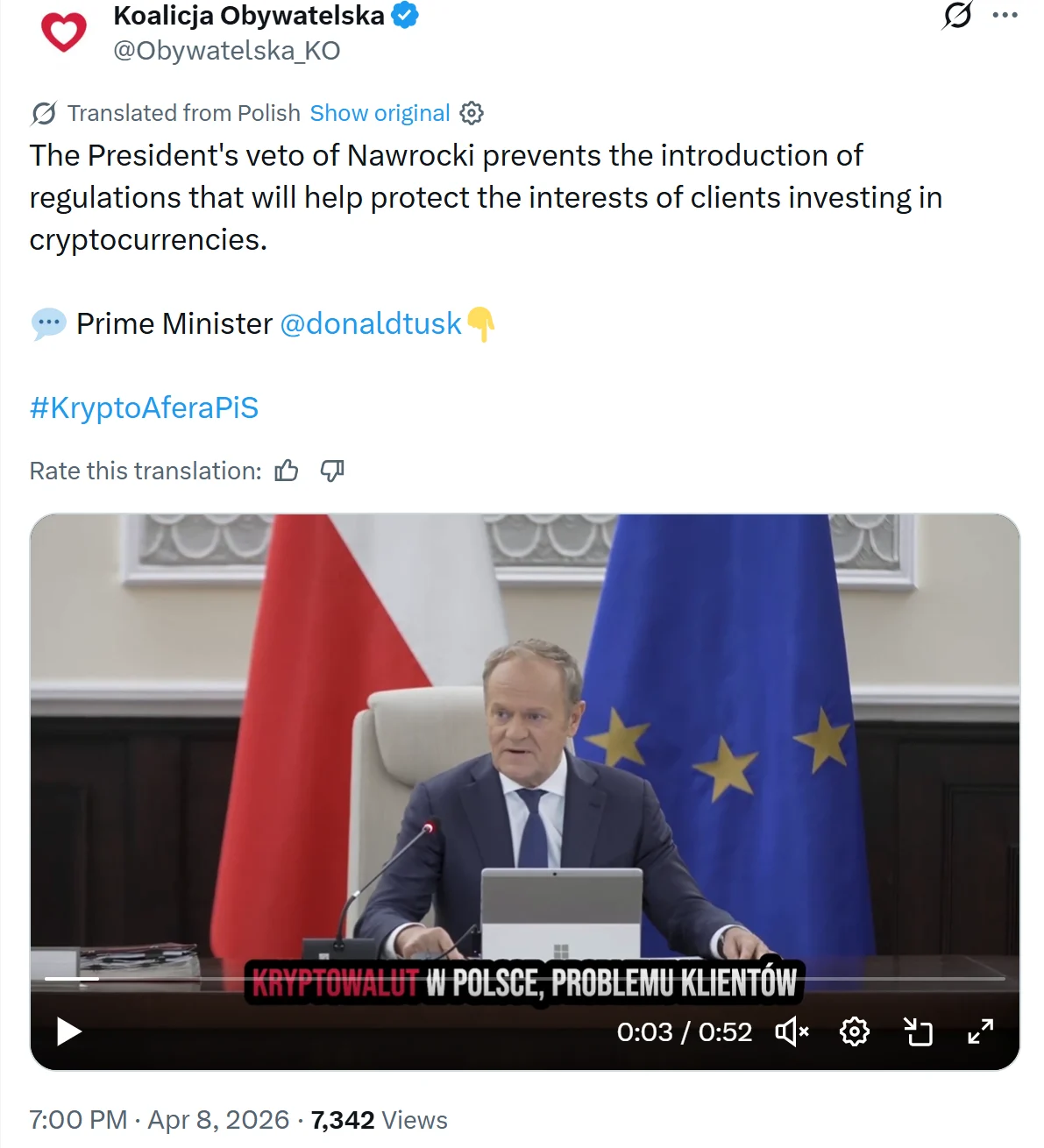
Poland’s ambitious push to integrate the European Union’s landmark Markets in Crypto-Assets Regulation (MiCA) has hit another significant roadblock, as the nation’s parliament, the Sejm, failed for a second time to override a presidential veto blocking the crucial legislation. The vote, held on Friday, underscores a deepening political chasm over the future of digital asset oversight in one of the EU’s largest economies, leaving stakeholders in a state of prolonged uncertainty.
The parliamentary session saw lawmakers fall short of the 263 votes required to overturn the veto imposed by President Karol Nawrocki. According to reports from local outlet TVP World, a total of 243 Members of Parliament (MPs) voted against upholding the veto, indicating their desire to pass the bill, while 191 MPs supported the president’s decision. This outcome mirrors a similar defeat in December, signaling a persistent deadlock between the executive and legislative branches regarding the foundational framework for cryptocurrency regulation.
MiCA’s Imperative: A Unified European Approach
At the heart of this legislative saga is the European Union’s comprehensive MiCA regulation, a pioneering framework designed to bring clarity and stability to the nascent, yet rapidly expanding, digital asset market across the bloc. Introduced in 2024, MiCA aims to standardize rules for the issuance, trading, and custody of crypto assets, providing a unified legal environment that fosters innovation while simultaneously safeguarding investors and market integrity. Its objectives include preventing market manipulation, combating financial crime, and ensuring consumer protection within the decentralized finance ecosystem.
For the EU, MiCA represents a critical step towards establishing a coherent and competitive single market for digital assets. It seeks to prevent regulatory arbitrage, where companies might choose to operate in member states with more lenient rules, thereby undermining the overall stability of the European financial system. The regulation also aims to provide legal certainty for crypto businesses, encouraging their growth and investment within the EU, rather than pushing them to jurisdictions with clearer guidelines.
Poland, a significant economic player within the EU with a population of nearly 38 million, currently stands as the sole member state yet to fully implement MiCA into its national legal framework. This unique position creates a regulatory vacuum that not only puts Polish investors at increased risk but also complicates the operations of crypto businesses seeking to comply with EU-wide standards. The delay could potentially isolate Poland’s digital asset market from the broader European ecosystem, hindering its growth and attractiveness for both domestic and international investors.
A Protracted Legislative Battle: Chronology of Vetoes
The current impasse is the culmination of a protracted legislative battle that began with the Tusk government’s initial efforts to align Poland with MiCA. The chronology of events paints a clear picture of the recurring challenges faced by the pro-regulation faction:
- Early 2024 (Approximate): The European Union’s Markets in Crypto-Assets Regulation (MiCA) officially comes into full effect, requiring all member states to transpose its provisions into national law.
- Late 2023: The Polish government, led by Prime Minister Donald Tusk, introduces a bill designed to implement MiCA’s provisions, aiming to bring Poland into compliance with the EU framework.
- December 2023: President Karol Nawrocki issues his first veto against the crypto regulation bill. The president cites concerns about excessive regulation, potential burdens on small businesses, and insufficient transparency within the proposed framework.
- Days after the first veto: Despite the presidential rejection, Polish lawmakers, demonstrating their commitment to the legislation, swiftly reintroduced a revised version of the bill. While proponents claimed it was an "improved" draft addressing some of the president’s concerns, critics argued that it remained largely unchanged from the original, leading to skepticism about its prospects.
- February 2024: President Nawrocki issues a second veto against the resubmitted bill. His resolute stance was encapsulated in his statement at the time: "I will not sign a wrong law just because it was passed again by the parliamentary majority. A wrong law that passed a hundred times still remains a wrong law." This emphasized a fundamental disagreement on the merits of the legislation, rather than merely minor technical adjustments.
- Friday’s Vote: The most recent development saw the parliament attempt to override the second presidential veto. With 243 votes against the veto and 191 in favor of upholding it, the pro-regulation faction once again failed to reach the 263-vote supermajority required for an override, prolonging the legislative deadlock.
This repeated cycle of legislative action and presidential rejection highlights a significant political division, where the prime minister’s government, advocating for rapid EU alignment and investor protection, faces staunch opposition from the presidential office, which champions a more cautious approach, prioritizing perceived business freedoms and critiquing the regulatory burden.
Presidential Concerns vs. Government Warnings
President Nawrocki’s defense of his vetoes has consistently centered on several key concerns. He has articulated worries about "excessive regulation," suggesting that the proposed framework might stifle innovation and impose undue compliance costs, particularly on smaller enterprises operating within the digital asset space. Furthermore, the president has raised questions regarding "limited transparency" within the bill’s provisions, implying that certain aspects of the regulation might not be sufficiently clear or open to public scrutiny. The potential "burden on small businesses" has been a recurring theme, reflecting a desire to protect nascent Polish crypto startups and entrepreneurs from what he perceives as overly stringent requirements that could hinder their growth or even force them out of the market. This stance aligns with a broader political philosophy that often prioritizes deregulation and a less interventionist approach to economic activity.
Conversely, government officials, led by Prime Minister Tusk and Finance Minister Andrzej Domański, have issued stark warnings about the perils of delaying regulation. Minister Domański has reportedly emphasized that the absence of clear, enforceable rules risks transforming the Polish crypto market into an "El Dorado for fraudsters." This vivid imagery underscores the government’s fear that without a robust regulatory framework, the market becomes an attractive target for illicit activities, scams, and Ponzi schemes, leaving both individual consumers and legitimate businesses vulnerable to exploitation and significant financial losses.
The government argues that regulatory clarity is not merely a bureaucratic exercise but a vital shield for investors. They point to numerous incidents globally where lax or absent regulation has led to widespread consumer harm, market instability, and a loss of public trust in the digital asset sector. By aligning with MiCA, the government believes it can establish a credible and secure environment that encourages responsible innovation while weeding out malicious actors, thereby protecting the integrity of Poland’s financial system and fostering legitimate economic growth. The argument is that the long-term benefits of a regulated market, including increased investor confidence and institutional participation, far outweigh the short-term compliance costs.
Economic and Reputational Ramifications
The prolonged legislative stalemate carries significant economic and reputational ramifications for Poland. Economically, the lack of MiCA implementation creates an uneven playing field for Polish crypto businesses compared to their counterparts in other EU member states. Companies might face difficulties accessing capital or operating across borders within the EU if they cannot demonstrate compliance with the bloc’s standard regulatory framework. This could lead to a "brain drain" or "business drain," where Polish crypto firms, seeking regulatory certainty and access to the broader European market, might opt to relocate their operations to other EU countries that have successfully integrated MiCA. This not only results in a loss of potential tax revenue and job creation for Poland but also diminishes its standing as a hub for technological innovation.
From a reputational standpoint, Poland’s non-compliance risks portraying the country as an outlier within the European Union, potentially undermining its commitment to EU integration and common market principles. International investors and financial institutions, often seeking stable and predictable regulatory environments, may view Poland with increased caution, delaying or foregoing investments in the country’s digital asset sector. This could impact foreign direct investment (FDI) and hinder Poland’s aspirations to be a leading player in the rapidly evolving global digital economy. Moreover, the "El Dorado for fraudsters" narrative, if it gains traction, could further damage Poland’s image as a safe and reliable market for digital assets.

The delay also has direct implications for consumer protection. Without MiCA’s robust provisions for transparency, disclosure, and investor safeguards, Polish citizens engaging with crypto assets are exposed to greater risks of fraud, market manipulation, and the collapse of unregulated entities. This situation contrasts sharply with the enhanced protections now afforded to consumers in other EU nations, creating a disparity that could lead to significant financial losses for Polish individuals.
The Zonda Controversy: A Tangential Dispute
Adding another layer of complexity and intrigue to the crypto regulation debate is the controversy surrounding Zonda, one of Poland’s largest cryptocurrency exchanges. Zonda has reportedly lobbied against the proposed bill, aligning itself with the concerns about excessive regulation. This lobbying effort, however, became entangled in a broader political dispute when Prime Minister Tusk publicly accused the platform of links to illicit funding.
Tusk, referencing intelligence reports, alleged connections between Zonda’s origins and Russian criminal networks. These serious accusations escalated tensions, drawing the exchange directly into the political crossfire surrounding the bill. The Prime Minister’s statements effectively weaponized the regulatory debate, suggesting that opposition to the bill might be driven by ulterior motives rather than purely economic or ideological concerns.
In response, Zonda CEO Przemysław Kral vehemently denied the accusations, taking to social media platform X to express his outrage. Kral stated that "Attempts to drag me and Zonda into the current political squabbles are as absurd as they are harmful to the Polish innovation market," further adding that he felt "compelled to take appropriate legal steps to protect my personal rights." This suggests that the CEO is considering legal action to defend his and the company’s reputation against what he views as defamatory claims.
The controversy also resurfaced an older issue concerning Zonda: access to a crypto wallet reportedly holding a significant sum of $330 million (equivalent to approximately 4,500 BTC). Last week, Kral clarified that he does not control access to this wallet, claiming it remained with former CEO Sylwester Suszek prior to his disappearance in 2022. This ongoing issue adds to the cloud of scrutiny over Zonda, further complicating its position amidst the national regulatory debate and fueling public discussion about the transparency and security of crypto platforms operating in an unregulated environment. The Zonda controversy, therefore, serves as a stark illustration of the very risks and lack of oversight that the Tusk government argues MiCA is designed to address.
The Road Ahead: Navigating the Impasse
With the latest parliamentary attempt to override the presidential veto having failed, the path forward for Poland’s crypto regulation remains unclear and fraught with political challenges. The current legislative framework dictates that without a successful override, the bill cannot proceed in its present form. This means the government must now consider alternative strategies to achieve MiCA compliance.
One potential avenue involves negotiating with the presidential office to draft a new version of the bill that addresses President Nawrocki’s specific concerns while still fulfilling the core requirements of MiCA. This would necessitate a spirit of compromise and cross-party cooperation, which has been notably absent in the current standoff. Such a revised bill would then need to pass through parliament and subsequently receive presidential assent. However, given the president’s repeated rejections and his strong stance, finding common ground may prove exceedingly difficult.
Another option for the Tusk government could be to explore whether certain aspects of MiCA can be implemented through executive orders or other governmental decrees, bypassing the legislative process for some provisions. However, the comprehensive nature of MiCA likely requires primary legislation, limiting the scope of such an approach.
The ongoing delay also raises questions about potential intervention or pressure from the European Union. While the EU typically respects the sovereignty of member states in their legislative processes, persistent non-compliance with a foundational regulation like MiCA could lead to formal proceedings, including infringement procedures, which could ultimately result in significant fines for Poland. The EU’s patience for non-compliance with its single market regulations is not infinite.
Industry and Consumer Perspectives
From the perspective of the legitimate crypto industry in Poland, the current situation is deeply frustrating. Companies that aim for long-term growth and international integration are desperate for regulatory clarity. The absence of MiCA compliance makes it challenging to attract institutional investors, secure banking partnerships, and operate with the legal certainty required for sustained business development. Many Polish crypto firms may already be looking to establish subsidiaries or relocate to other EU countries where MiCA is fully operational, seeking a more predictable and stable regulatory environment.
Consumer advocacy groups are likely to echo the government’s concerns about investor protection. They would emphasize the heightened risks faced by individual investors in an unregulated market, advocating for the swift implementation of MiCA to provide safeguards against scams, market manipulation, and opaque practices. The current environment leaves Polish consumers at a disadvantage compared to their EU counterparts, who benefit from MiCA’s protections.
Conversely, some smaller businesses and libertarian-leaning groups might support the president’s stance, arguing that heavy-handed regulation could stifle innovation and disproportionately impact startups. They might advocate for a more tailored, lighter-touch regulatory approach that is specific to the Polish market, rather than a blanket adoption of EU-wide rules. However, the overarching consensus within the global financial sector leans towards greater regulation to foster trust and stability in digital assets.
The political standoff over Poland’s crypto regulation is more than just a legislative disagreement; it is a battle for the country’s economic future within the digital sphere and its standing within the European Union. As the only EU member state yet to adopt MiCA, Poland faces increasing pressure to resolve this impasse. The coming months will reveal whether a compromise can be forged or if the nation will continue to navigate the turbulent waters of an unregulated crypto market, risking economic isolation and increased vulnerability for its citizens and businesses.