Lina Wu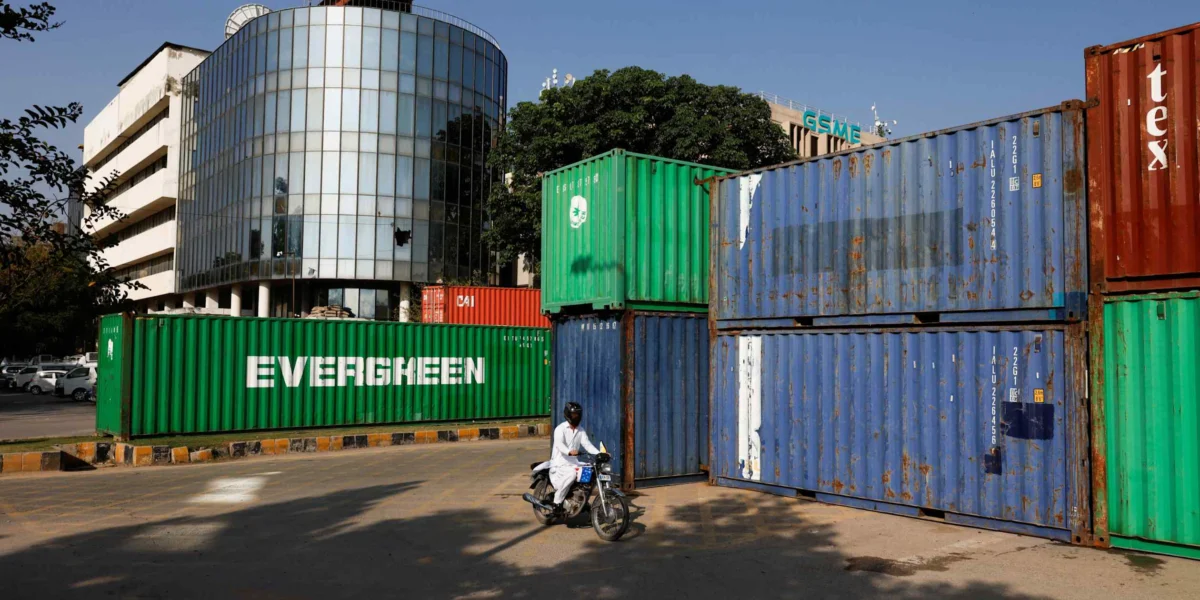
ISLAMABAD – In a dramatic escalation of political tensions, Pakistan’s federal government has deployed an imposing phalanx of over a thousand shipping containers to barricade major arteries into and out of the capital, Islamabad. This extensive logistical maneuver is a direct response to an anticipated protest march by the country’s largest opposition party, led by the incarcerated former Prime Minister Imran Khan. The move, while ostensibly aimed at preventing political disruption, is already casting a long shadow over economic activity, with significant disruptions to supply chains and severe repercussions for local businesses now a stark reality. The unprecedented scale of the deployment signals a government determined to assert control and prevent any large-scale public demonstration that could challenge its authority.
The Genesis of the Blockade: A Political Standoff
The current crisis is the culmination of a protracted and increasingly acrimonious political battle between the ruling coalition and Imran Khan’s Pakistan Tehreek-e-Insaf (PTI). Khan, a charismatic former cricket star who led Pakistan from 2018 to 2022, was ousted through a vote of no confidence and has since faced a barrage of legal challenges and allegations, culminating in his recent imprisonment. The PTI maintains that these charges are politically motivated, designed to sideline Khan and cripple his party’s ability to contest future elections. The upcoming protest march, ostensibly a show of solidarity with Khan and a demand for his release and fair elections, represents a critical juncture in this ongoing power struggle.
The decision to deploy the shipping containers was reportedly made in high-level security meetings convened by the federal government in the days leading up to the planned march. Sources within the Interior Ministry, speaking on condition of anonymity, indicated that the primary objective was to prevent any convergence of protesters in the capital, thereby averting a potential law and order situation. The sheer volume of containers – a figure exceeding 1,000 – suggests a comprehensive strategy to seal off not only the main highways but also secondary routes, aiming to create an impenetrable ring around Islamabad.
Chronology of Escalation and Response
The seeds of this confrontation were sown in the aftermath of Imran Khan’s disqualification from public office and subsequent arrest. Following his sentencing on corruption charges in early August 2026, the PTI announced a nationwide campaign of protests, vowing to challenge the government’s legitimacy. The initial demonstrations, though significant, were largely contained. However, the party’s leadership, operating from behind the scenes, began strategizing for a more impactful demonstration in the heart of the nation’s political power.
By late September 2026, intelligence reports indicated a concerted effort by the PTI to mobilize its supporters for a march on Islamabad. This intelligence, coupled with concerns about the potential for large-scale unrest, prompted the federal government to consider drastic measures. The idea of using shipping containers, a tactic previously employed in a more limited capacity during other politically sensitive periods, gained traction as a seemingly foolproof method of physical obstruction.
The procurement and deployment of the containers began in earnest during the final week of September. Logistics teams from various government departments, including the port authorities and the military, were reportedly mobilized to facilitate the operation. Over the weekend of October 1-2, 2026, a significant portion of the containers were moved into position, their massive metal forms gradually transforming the familiar cityscape of Islamabad into a fortified zone. The visual impact of these stacked containers, some reaching several stories high, has been stark and undeniable, serving as a potent symbol of the government’s resolve.
Supporting Data: The Scale of the Operation and Economic Fallout
The deployment of over 1,000 shipping containers represents a logistical undertaking of considerable magnitude. Each container, typically measuring 20 or 40 feet in length, weighs several tons. Moving and positioning such a large number requires specialized heavy machinery, meticulous planning, and a substantial workforce. The cost of such an operation, encompassing rental or purchase of containers, transportation, and labor, is estimated to be in the millions of Pakistani Rupees, a significant expenditure at a time when the nation’s economy is already under strain.
Beyond the immediate logistical costs, the economic implications are far more profound and pervasive. Islamabad, as the nation’s capital, is a crucial hub for commerce and transportation. The blockade effectively chokes off vital supply routes for goods and commodities. Trucks carrying essential items, from food and medicine to raw materials for industries, are being rerouted or, in many cases, stranded. This disruption is already leading to:
- Increased Transportation Costs: Rerouted journeys are longer and more fuel-intensive, directly impacting the cost of goods.
- Shortages and Price Hikes: Local businesses, particularly smaller retailers, are facing stock shortages, which in turn are driving up prices for consumers. Reports from markets in Islamabad and surrounding areas indicate a noticeable increase in the prices of essential commodities.
- Supply Chain Paralysis: Industries reliant on timely delivery of raw materials are experiencing production delays. This can have a cascading effect, impacting manufacturing output and potentially leading to job losses in the long run.
- Impact on Local Businesses: Small and medium-sized enterprises (SMEs) operating within the capital are particularly vulnerable. Reduced foot traffic due to the security measures and disruptions to their supply chains are leading to significant revenue losses. Many businesses have reported a drastic drop in sales over the past few days.
According to data from the Pakistan Bureau of Statistics, the transportation and logistics sector contributes significantly to the national GDP. Any prolonged disruption to this sector can have a palpable negative impact on economic growth. While precise figures for the current disruption are yet to be compiled, preliminary assessments suggest that the economic cost could run into billions of Pakistani Rupees if the blockade persists for an extended period.
Official Responses and Justifications
The federal government has defended its actions as a necessary measure to maintain law and order and protect the citizens of Islamabad. In a televised address, the Interior Minister stated, "Our primary responsibility is to ensure the safety and security of the federal capital. We have credible intelligence suggesting that the planned march could be exploited by elements seeking to sow chaos and disrupt the peace. The measures taken are proportionate and aimed at preventing any untoward incidents."
He further emphasized that the government was not seeking to suppress legitimate political expression but was acting to prevent a breakdown of order. "We respect the right to protest, but this right does not extend to endangering public safety or paralyzing the functioning of the state," he added.
The Ministry of Information has also issued statements highlighting the potential for the protest to be infiltrated by extremist elements, a claim consistently denied by the PTI. The ruling coalition has reiterated its commitment to democratic processes but has accused the PTI of resorting to disruptive tactics rather than engaging in constructive political dialogue.
Broader Impact and Implications
The deployment of shipping containers represents more than just a physical barrier; it is a potent symbol of the deepening political polarization in Pakistan. The government’s heavy-handed approach, while potentially effective in the short term in preventing a large public gathering, risks further alienating a significant portion of the population that supports Imran Khan.
The economic repercussions are equally concerning. Pakistan is already grappling with a fragile economy, high inflation, and a mounting debt crisis. The disruption to supply chains and commerce caused by the blockade exacerbates these challenges. It creates an environment of uncertainty that is detrimental to investment and economic recovery.
The international community is also observing these developments closely. Pakistan’s political stability and economic health are of significant interest to regional and global powers. The current situation raises questions about the rule of law, democratic freedoms, and the government’s capacity to manage internal dissent.
From an analytical perspective, the government’s strategy appears to be one of containment through deterrence. By making it physically impossible for a large number of protesters to reach the capital, they aim to de-escalate the situation without a direct confrontation. However, this approach carries inherent risks. If the PTI manages to mobilize significant numbers despite the blockade, or if the economic fallout becomes too severe, it could lead to a different set of challenges. The optics of a capital city sealed off by shipping containers can also be interpreted as a sign of weakness rather than strength, potentially emboldening opposition elements or creating a perception of a state under siege.
The long-term implications of this standoff are yet to unfold. The government’s current strategy may buy it time, but it does not address the underlying political grievances that fuel the PTI’s movement. The success of this maneuver will ultimately be judged not just by its ability to prevent a protest, but by its impact on Pakistan’s democratic trajectory and economic stability in the months and years to come. The stacked containers stand as a stark monument to a nation at a political crossroads, where the path forward remains uncertain and fraught with challenges.