
 Clara Shinta
A sophisticated supply chain attack targeting Ledger hardware wallets, which has already resulted in an estimated $93.4 million loss for users in Asia, appears to have expanded its reach to Europe. This development raises significant concerns about the integrity of hardware wallets and the security of digital assets globally. The initial wave of attacks predominantly affected users who acquired devices from CryptoBilis, an official Ledger reseller operating across Southeast Asia.
Emergence in Europe: A New Front in the Supply Chain Attack
The alarm was raised in Europe by X user Johannes, who shared photographic evidence of a tampered Ledger device he reportedly purchased just two weeks prior from MediaMarkt, a prominent European consumer electronics chain. The internal implant discovered in Johannes’s device bears a resemblance to earlier versions of the malicious hardware found in CryptoBilis-shipped devices in Asia, though, crucially, no funds have yet been compromised from this particular European unit. Johannes commented on the situation, speculating that "Either the device didn’t work, or they were waiting for a more widespread usage of the compromised devices."
Further analysis of the European implant was provided by Mark Karpeles, the former CEO of the defunct Mt. Gox exchange, who has been instrumental in investigating the tampered Asian Ledgers. Karpeles noted that the antenna within the European device suggests it is a "Eurasian version," implying that the perpetrators have developed region-specific variants of the implant. These distinct versions are likely designed to accommodate differing mobile frequencies utilized across various geographical regions, indicating a highly organized and adaptable attack strategy. As of the latest reports, Ledger has not officially confirmed whether the reported European device is directly linked to the ongoing Asian exploit, underscoring the complexities of tracing such elaborate cybercriminal operations.
The Asian Precedent: A Deep Dive into the CryptoBilis Compromise

The initial phase of this sophisticated attack came to light late last week, primarily affecting Ledger devices supplied by CryptoBilis. This reseller, which had recently undergone a change of ownership, was identified as the conduit for the modified devices. The modus operandi of the attackers involved physically altering the hardware wallets in a manner that seemingly allowed them to extract the users’ seed phrases. Disturbingly, these compromised devices were still capable of passing Ledger’s authenticity checks, providing a false sense of security to unsuspecting users.
In response to the escalating crisis, Ledger promptly requested CryptoBilis to halt all sales and shipments of its devices as a precautionary measure. The hardware wallet giant also issued a strong advisory to customers who had purchased devices from CryptoBilis within the preceding 90 days, recommending that they consider transferring their digital assets to a new, secure Ledger device. In its most recent public update, Ledger stated that "The volume of impacted devices is limited," attempting to assuage broader market fears while investigations continue.
CryptoBilis is officially recognized as an authorized Ledger reseller in Indonesia, Malaysia, and the Philippines. Cybersecurity firm Yfarmx provided an initial estimation of the financial impact, pegging the losses at approximately $93.4 million across 471 distinct cryptocurrency addresses. However, Ledger has not yet independently verified this specific figure, indicating that the full scope of the financial damage is still under assessment. This incident highlights a critical vulnerability in the supply chain of hardware security, where physical tampering can bypass software-based security measures, eroding user trust in even the most robust security solutions.
XRP Ledger Dodges Catastrophe: $250,000 Bounty for Critical Minting Bug
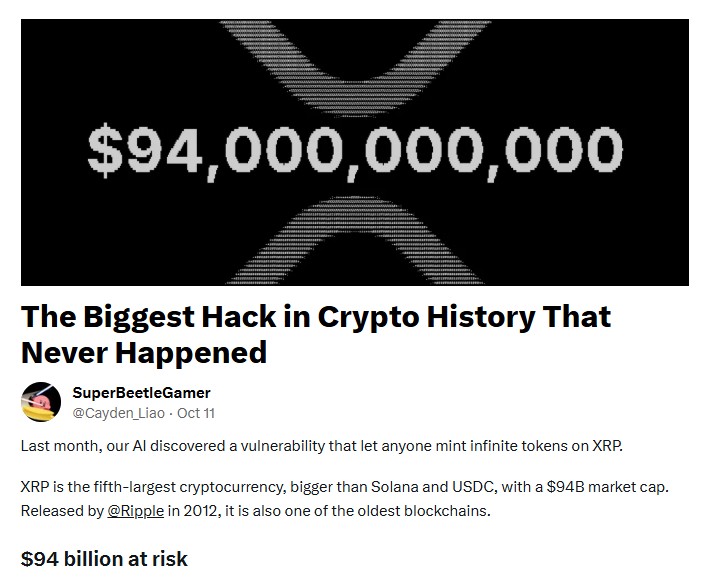
In other significant security news, the XRP Ledger (XRPL) narrowly averted a potentially catastrophic financial disaster, thanks to the diligent work of security firm Veria Labs. The firm was awarded a substantial $250,000 bug bounty for uncovering a severe overflow bug embedded within XRP’s code since 2015. This vulnerability, if exploited, could have allowed an attacker to "mint" an astronomical amount of XRP – specifically, trillions of tokens – effectively creating an infinite supply out of thin air.
Cayden Liao, co-founder of Veria Labs, elaborated on the discovery via an X post, explaining that their AI agent, tasked with auditing the rippled software that powers the XRP Ledger, initially identified two low-severity bugs. The true danger emerged when Veria Labs’ researchers realized that by chaining these seemingly minor vulnerabilities together, a much larger, critical exploit could be constructed. Liao revealed that a single malicious transaction could have generated over 18 trillion XRP, a figure 184 times greater than XRP’s entire circulating supply. He grimly noted, "This puts the full $94B at risk, more than 60 times the largest crypto hack on record." The sophisticated nature of the bug, requiring the combination of two distinct, low-severity flaws, is believed to be a key reason why it remained undetected for so long.

The good news is that the bug was reported to RippleX on September 22 and promptly patched just three days later, on September 25. Crucially, there is "no evidence" to suggest that this vulnerability was ever exploited, as confirmed by the XRPLF. This incident underscores the vital role of robust bug bounty programs and advanced security auditing tools, including AI-driven agents, in safeguarding the integrity of major blockchain networks against hidden and complex vulnerabilities.
Vitalik Buterin Backs ‘Bunker Mode’ Amid Rapid AI Math Advances
The cryptocurrency community is grappling with another potential long-term security threat, this time from the burgeoning field of artificial intelligence. Ethereum co-founder Vitalik Buterin has lent his support to researcher Justin Drake’s urgent warning that rapid advancements in AI-driven mathematics could undermine the foundational cryptography underpinning today’s blockchains, potentially even before quantum computers pose a significant threat.
Drake ignited the discussion by urging the industry to prepare for a "bunker mode" scenario. His concerns were spurred by OpenAI’s recent announcement of hundreds of novel mathematical findings, many of which had previously stumped human mathematicians. While none of these specific findings directly related to cryptography, the potential for AI agents to unearth groundbreaking insights into the mathematical structures behind elliptic curve cryptography (ECC) and lattice-based cryptography (LBC) – the bedrock of current blockchain security – has raised alarms among core Ethereum developers.
Buterin, while acknowledging the seriousness of the potential threat, adopted a more measured tone. He advised, "I don’t recommend anyone scramble to move their funds to new wallets today. But we should take the risks to cryptography from AI-accelerated math seriously." This nuanced stance reflects a growing internal debate within the crypto space. Critics have dismissed these concerns as fear-mongering, arguing that current AI capabilities are nowhere near capable of breaking sophisticated cryptographic algorithms. However, proponents of Drake’s warning point to AI’s unpredictable and rapid advancement, noting that similar skepticism preceded AI’s ability to solve hundreds of previously intractable mathematical problems in other domains. This emerging threat necessitates continued vigilance and investment in post-quantum cryptographic research to secure the future of decentralized networks.
Samsung Wallet to Integrate USDC Transfers for US Galaxy Users in October
In a significant move towards mainstream cryptocurrency adoption, Samsung has announced plans to integrate USDC transfers into its Samsung Wallet payment application. This new feature is slated for rollout in the last week of October, making it accessible to an estimated 82 million eligible US Galaxy users.
The integration will empower users to send USDC to compatible crypto wallets globally and facilitate money transfers to eligible bank accounts in over 60 countries, where recipients can receive funds in their local currency. To ensure compliance and security, users will be required to complete identity verification procedures to access this service.
The initiative is a collaborative effort, with Bastion providing the stablecoin account and payment infrastructure. Coinbase will serve as a sub-custodian through its institutional-grade Coinbase Prime Vault, ensuring secure asset management. Technical partnerships with Solana and Sui underscore the multi-chain approach to this integration, aiming for efficiency and broad accessibility. This strategic move by Samsung not only expands the utility of its digital wallet but also further legitimizes stablecoins like USDC as a viable option for international remittances and everyday transactions, potentially challenging traditional financial transfer systems.
Cuomo: Crypto’s Heavy Republican Backing Alienates Democrats
Former New York Governor Andrew Cuomo has voiced concerns that the cryptocurrency industry’s disproportionate financial backing of US Republican political campaigns has inadvertently alienated Democrats, whose support is crucial for the passage of federal crypto legislation. This political imbalance could significantly hinder the industry’s efforts to establish a clear and favorable regulatory framework in the United States.
Cuomo highlighted the current political landscape, noting that Kalshi prediction markets currently place the probability of Democrats securing control of both chambers of Congress at approximately 61%. In such a scenario, Cuomo suggested that a Democratic-controlled Congress could either seek to roll back existing crypto initiatives from regulatory bodies like the SEC and CFTC or, alternatively, work with a potential Trump administration to pass comprehensive legislation like the CLARITY Act. He stressed the fundamental need for bipartisan cooperation, stating, "You need Democrats to pass the bill. You need Republicans. You have to be more balanced."

While acknowledging the prevailing perception that Democrats are "anti-crypto," Cuomo argued that the underlying principles of cryptocurrency align well with Democratic goals and beliefs. He articulated, "It’s empowering people who otherwise wouldn’t have access to financial products, and the Democratic Party has been working to do that all its life." This perspective suggests that a more balanced political engagement strategy from the crypto industry could unlock crucial Democratic support, paving the way for more favorable and stable regulation, and aligning the industry’s innovations with broader socio-economic empowerment objectives.
Winners and Losers: Market Volatility as Week Concludes
The cryptocurrency market concluded the week with notable shifts across major assets. Bitcoin (BTC) experienced a slight downturn, dropping 2.8% to trade at $83,435. Ethereum (ETH) saw a more significant correction, falling 6.5% to $2,562, while XRP (XRP) recorded a 7% decrease, settling at $1.40. The total cryptocurrency market capitalization, according to CoinMarketCap, stood at $2.82 trillion, reflecting a week of consolidation and slight declines for top-tier assets.
Among the top 100 cryptocurrencies, several altcoins defied the broader market trend to post impressive gains. StarkNet (STRK) emerged as the top performer, surging by a remarkable 91%. This significant increase was largely attributed to the announcement that StarkNet would be evolving into a post-quantum Layer 1 blockchain, signaling its commitment to future-proofing against advanced cryptographic threats. Binance Life (币安生活) followed with a healthy 25.4% gain, and Celestia (TIA) rounded out the top three winners with a 20.8% increase.
Conversely, some altcoins experienced notable declines. Venice Token (VVV) was the week’s biggest loser among the top 100, dropping 18.5%. Sky (SKY) fell by 16.2%, and Uniswap (UNI) saw a 15.4% decrease, reflecting various project-specific developments or broader market sentiment shifts.
Prediction of the Week: Tom Lee Foresees Ethereum at $25,000 to $50,000 This Cycle

Bitmine chair Tom Lee delivered an optimistic forecast for Ethereum (ETH) during his address at Token2049 on Friday. Lee, a well-known figure for his bullish crypto predictions, projected that ETH would surpass the $5,000 mark by the end of the current year. Looking further ahead, he confidently stated that by the culmination of the current market cycle, Ethereum "could easily be 25,000 or 50,000 per token."
Lee also provided an update on Bitmine’s strategic accumulation efforts, revealing that the firm is nearing its ambitious 5% target of Ethereum’s total supply. Having already acquired approximately 6 million Ether, Bitmine only needs to purchase about 100,000 more ETH to reach this significant milestone. Lee emphasized a firm commitment to this cap: "That’s a hard cap. We’re not gonna be accumulating past 5%. We’re not gonna own more than 5% of Ethereum." This aggressive accumulation strategy by institutional players like Bitmine, coupled with a belief in Ethereum’s long-term value proposition, contributes to such high-end price predictions and signals growing institutional confidence in the asset.
Top FUD of the Week: Security Breaches and Regulatory Crackdowns
Coldcard Investigates Phishing Link on X Account
The Bitcoin-only hardware wallet provider Coldcard found itself in the spotlight for negative reasons this week as it reported an unauthorized phishing link appearing on its official X account on Sunday. This incident is particularly alarming given Coldcard’s reputation for stringent security, including the use of offline two-factor authentication. The malicious post, which has since been deleted, directed users to a fraudulent website. Coldcard quickly moved to clarify that its only official website is coldcard.com, urging users to remain vigilant. This event follows a previous security incident in July, which DefiLlama’s hack tracker estimated resulted in losses of $115 million, underscoring the persistent threat of social media-based phishing attacks even for hardware wallet companies.
THORChain Dev Accuses Tether of Temporarily Freezing USDT Vaults
In a move that stirred controversy and highlighted the centralized control of stablecoins, Chad Barraford, technical co-founder of THORChain, publicly accused stablecoin issuer Tether of temporarily blacklisting the network’s USDt (USDT) vaults without any prior explanation. In an X post on Friday, Barraford detailed that Tether had blacklisted four THORChain vault addresses, effectively freezing a combined total of approximately 1.45 million USDT belonging to the network. The situation was resolved swiftly, with Barraford reporting about two hours later that trading would resume after Tether unfroze all the affected addresses. This incident serves as a stark reminder of the inherent risks associated with centralized stablecoins, particularly their ability to unilaterally freeze assets, which poses a significant challenge for decentralized finance (DeFi) protocols reliant on these tokens.
New York Permanently Bars Celsius Founder Mashinsky in $35M Fraud Settlement
Former Celsius CEO Alex Mashinsky has faced severe repercussions for his role in the collapse of the cryptocurrency lending platform. Under a settlement reached with New York Attorney General Letitia James, Mashinsky has been permanently barred from participating in the cryptocurrency, securities, and commodities industries. The agreement includes conditional payments totaling up to $35 million. This settlement concludes a 2023 civil lawsuit that accused Mashinsky of systematically misleading hundreds of thousands of investors about the safety and stability of Celsius before its dramatic downfall in 2022. Compounding his legal woes, Mashinsky is already serving a 12-year federal prison sentence for fraud and has been separately ordered to forfeit over $48 million. This decisive action by New York authorities sends a strong message regarding accountability and consumer protection in the crypto sector.

Top Magazine Features of the Week
France is World’s Most Dangerous Place for Bitcoiners: 90 Attacks in 7 Months
A startling report revealed that French authorities recorded 90 crypto-related cases involving severe criminal activities such as kidnapping, extortion, threats, and violent theft within a mere seven-month period. This alarming statistic positions France as a disproportionately dangerous location for Bitcoin holders. The feature delves into the underlying factors contributing to this trend, exploring potential reasons why the country has become such a hotspot for crypto-related crime, ranging from specific socio-economic conditions to the perceived wealth of crypto owners.
Crypto Lending Rises Again… But Have They Solved the Risks?
After a period of significant downturns and high-profile bankruptcies, crypto lending has experienced a resurgence, with volumes reportedly rising by 55% since July. However, this feature critically examines whether the industry has adequately addressed the inherent risks that led to its previous crises. It explores new challenges, including the emerging threat of AI-assisted hacks and the persistent danger of cascading failures across interlinked protocols. The article provides insights and recommendations on how users and platforms can navigate this evolving landscape to enhance security and mitigate risks in the renewed crypto lending environment.
Capital Starting to Rotate Back to Crypto from AI: Raoul Pal
Raoul Pal, the founder of Real Vision, offered a compelling analysis suggesting a potential shift in capital flows. According to Pal, a prospective pause or slowdown in the rally of AI-related stocks could act as a catalyst, encouraging investors to rotate capital back into the cryptocurrency market. Furthermore, Pal posited that the continued advancement and integration of AI agents are likely to play a crucial role in boosting the adoption and utility of major blockchain platforms like Ethereum and Solana. This analysis highlights the dynamic interplay between different tech sectors and their influence on investment trends within the digital asset space.








