Reynand Wu
Tokyo’s determined defense of the Japanese Yen intensified on Friday, following what is widely believed to be a record-breaking, overt intervention on Thursday. While Thursday’s actions were explicit and massive, Friday’s market movements presented a more enigmatic picture, characterized by several sudden drops in the US Dollar against the Yen (USD/JPY) that lacked clear attribution. This ambiguity, however, appears to be a deliberate strategy by Japanese authorities, who received an unusual signal of support from the United States Treasury, conveyed through the Federal Reserve Bank of New York, instructing banks to prepare for potential further action. As the session drew to a close, USD/JPY was trading just under 159.00, approximately a Yen and a half lower than its opening level, underscoring the persistent pressure on the pair.
A Week of Volatility: Unpacking the Chronology of Yen Intervention
The past week has unfolded as a critical period for the Japanese Yen, marked by significant official action and market speculation. The initial catalyst for renewed Yen weakness on Thursday was a disappointing Gross Domestic Product (GDP) report from Japan, which showed an annualized growth of 1.5% against a consensus expectation of 2.1%. This data point further fueled expectations of a widening policy divergence between the Bank of Japan (BoJ) and other major central banks, particularly the U.S. Federal Reserve, pushing USD/JPY to the 163.00 handle.
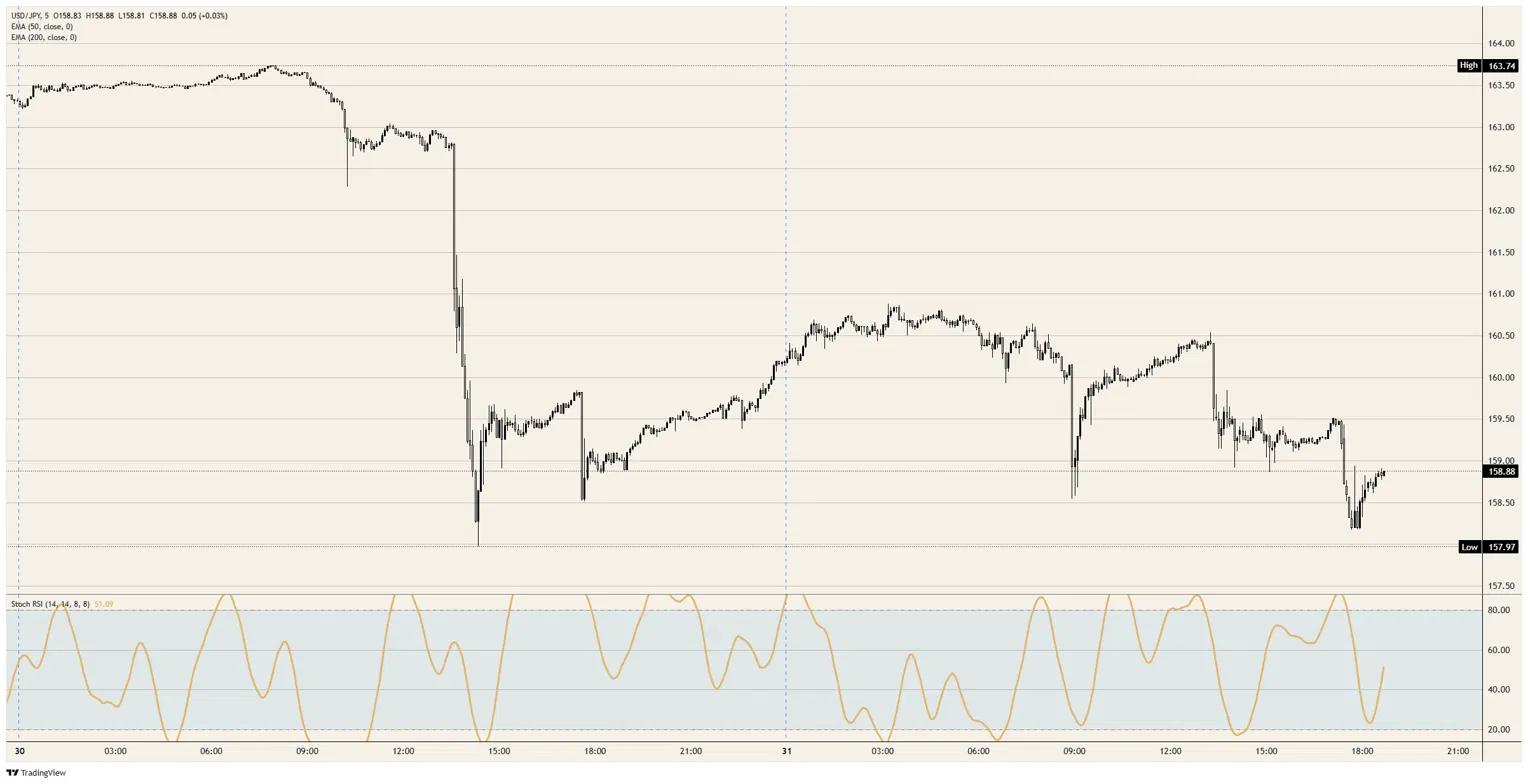
However, just an hour after the GDP release, the market witnessed an unprecedented surge of Yen buying. This rapid movement, which saw the Dollar plummet from 163.00 to just under 158.00, was almost immediately attributed to a massive, coordinated intervention by Japanese authorities. Estimates suggest this single-day operation approached an astonishing 53 billion Dollars, making it the largest in Tokyo’s history. The timing was strategic, hitting a market that had accumulated significant net short Yen positions, estimated at 11.65 billion Dollars, amplifying the impact of the intervention through short-covering.
Friday brought a different, more subtle, but equally impactful dynamic. Instead of a single, decisive move, the Dollar was sold in three distinct "lurches" throughout the trading day. The first occurred during the London morning, pushing USD/JPY down to the 158.50 area before partially rebounding. A second, more pronounced drop materialized around 13:15 GMT, coinciding with a headline indicating the US Treasury’s communication to banks regarding potential market entry. The session’s low, near 158.00, was then printed hours later in the New York afternoon. The market’s inability to definitively separate these movements between an official "operation" and mere "liquidation" highlights the calculated ambiguity employed by authorities. This strategic confusion is not a communication failure but a key component of the intervention’s efficacy, allowing Tokyo to maintain downward pressure on the Dollar with potentially less direct spending.
Adding to the complexity, the Bank of Japan, just twelve hours after Thursday’s suspected intervention, held its benchmark interest rate at 1.00% by an 8-1 vote, with one member advocating for a quarter-point increase. While maintaining its ultra-loose stance, the BoJ did issue a warning that underlying inflation could run above target, a subtle acknowledgment of the pressures driving the Yen’s depreciation.
The Scale and Strategy of Intervention: Beyond Raw Firepower
Thursday’s estimated 53 billion Dollar intervention dwarfs previous efforts and underscores the gravity of Japan’s concern over the Yen’s rapid depreciation. For context, the entire April to May intervention campaign, which spanned a month, cost approximately 74 billion Dollars. This new single-day record demonstrates a willingness to deploy significant resources to stem the tide.
However, the strategy extends beyond sheer spending power. The pattern observed, particularly on Friday, suggests a sophisticated approach designed to maximize impact while minimizing direct expenditure. By creating "deniable air pockets" – sudden market drops that cannot be definitively linked to official action – authorities compel traders to price in the possibility of intervention rather than the fact. This psychological warfare allows Tokyo to hold key levels with a fraction of the capital previously required, or even with none at all, simply by fostering market uncertainty and fear of further intervention. The market’s confusion between an "operation" and a "liquidation" is precisely the desired "product" of this strategy.
Policy Divergence: The Unyielding Force Behind Yen Weakness

At the heart of the Yen’s sustained weakness lies a profound and persistent policy divergence between the Bank of Japan and the U.S. Federal Reserve. With the BoJ maintaining its benchmark rate at 1.00% and the Federal Reserve’s effective upper bound (as per the article’s context) at 3.75%, the interest rate differential creates a powerful incentive for investors to sell Yen and buy Dollars to capitalize on higher yields. This "carry trade" mechanism generates a constant flow of Yen selling pressure, making any intervention an uphill battle against fundamental economic forces.
Beyond interest rates, several other factors contribute to the Yen’s manufacturing of "sellers." Japan, a major energy importer, faces a significantly higher import bill denominated in Dollars when the Yen depreciates, exacerbating domestic inflation and squeezing corporate profits. Global conflicts and supply chain disruptions further amplify these costs. Domestically, a government elected on platforms of increased spending may also inadvertently contribute to a perception of fiscal expansion, which can weigh on a currency’s value. These combined elements create a powerful "machine that manufactures Yen sellers faster than any operation can retire them," highlighting the challenge facing Japanese policymakers.
International Framework and the Unprecedented US Coordination
The recent interventions by Japan are not occurring in a vacuum; they are subject to international scrutiny and, notably, have involved an unusual degree of coordination with the United States. International Monetary Fund (IMF) guidelines typically treat up to three episodes of intervention within a six-month period as consistent with a free-floating exchange rate. Furthermore, three consecutive days of operations are counted as a single episode. Japanese finance ministry officials had indicated in May that two such "windows" remained before November, following the April campaign. The actions on Thursday and Friday are considered the second of these windows, and critically, they are treated as a single, combined episode under IMF rules. This means that, from Tokyo’s perspective, today’s activity is "free on the only meter Tokyo is watching," granting them strategic flexibility.
Crucially, the rate check that preceded Thursday’s move did not originate solely from the Bank of Japan. It came from the Federal Reserve Bank of New York, acting as the fiscal agent for the U.S. Treasury, not from the Federal Reserve on its own monetary policy account. Direct participation by the central bank itself would require separate authorization from the Federal Open Market Committee (FOMC), which has not been granted. This distinction is vital: the coordination running through this episode is primarily fiscal, a diplomatic signal from the U.S. Treasury acknowledging Japan’s concerns, rather than a shift in U.S. monetary policy.
The gesture, nonetheless, represents the largest American involvement in currency markets in fifteen years. U.S. Treasury Secretary Janet Yellen publicly stated on Thursday that the Yen was "badly undervalued" and that currency markets "tend to overshoot," providing significant diplomatic cover for Japan’s actions. The last direct American operation in the USD/JPY pair was in March 2011, a one billion Dollar effort split between the Exchange Stabilization Fund (ESF) and the central bank’s own portfolio, notably aimed at weakening the Yen after the Tohoku earthquake, not supporting it.
While the U.S. signal is potent, the financial contribution from the U.S. Treasury’s ESF is relatively modest compared to Japan’s firepower. The ESF’s net position at the end of 2025 was 43.6 billion Dollars, less than what Tokyo spent in a single hour on Thursday. This underscores that American money serves primarily as a "signal," a crucial diplomatic endorsement that lends legitimacy and psychological weight to Japan’s unilateral actions, rather than providing substantial financial ammunition.
Japan’s Ample Reserves and Strategic Restraint
Despite the massive sums deployed, Japan possesses formidable financial reserves, making the "ammunition" for intervention far from scarce. The country holds approximately 1.4 trillion Dollars in reserves, with a little under 1.2 trillion of that held in foreign currency assets. The previous April to May campaign, which involved about 74 billion Dollars over a month, barely dented this colossal pile.
The true constraint for Japan is not financial capacity but "permission" – both domestic and international political capital. Deploying intervention too frequently or aggressively risks accusations of currency manipulation from trading partners, particularly the United States, which values a free-floating exchange rate. The "windows" for intervention, as defined by IMF guidelines and diplomatic understanding, are therefore more critical than the sheer volume of reserves. With the Thursday/Friday actions consuming the second of Japan’s perceived three windows before November, policymakers are acutely aware that their strategic options are narrowing. This scarcity of "permission," rather than ammunition, dictates the tactical ambiguity and strategic timing of their market interventions.
Market Reaction, Technical Levels, and Upcoming Economic Barometers
The market’s immediate reaction to the interventions has been one of heightened volatility and uncertainty. Desks have struggled to differentiate between genuine market-driven liquidations and official operations, precisely the intended effect. This confusion forces traders to adopt a more cautious stance, pricing in the risk of official intervention at any given moment.
From a technical perspective, key levels are being closely watched. On the resistance side, the 50-day Exponential Moving Average (EMA), just under 161.50, capped Friday’s rebound near 161.00 and now stands as the immediate first line of defense for the Yen. Above this, 163.00 and the four-decade high short of 164.00 remain significant psychological and technical barriers. For support, the 200-day EMA near 158.00 has proven its resilience, having been tested twice: by Thursday’s flush just beneath it and by Friday’s low just above. Further below, the 155.00 area and the year’s base near 152.00 represent stronger support zones.
The immediate future of the USD/JPY pair will be heavily influenced by a series of crucial economic data releases from the United States, which will inform the trajectory of Federal Reserve policy. Monday brings the first hard read on Thursday’s intervention size when the operation clears into central bank account data. Also on Monday, the manufacturing survey at 14:00 GMT, with a consensus of 54, will provide insights into the health of the U.S. industrial sector. Wednesday will feature private payrolls data, expected at 75K, down from 98K.
However, the most significant release is scheduled for Friday, August 7, at 12:30 GMT: the Nonfarm Payrolls report. Analysts anticipate 91K new jobs against 57K prior, an unemployment rate of 4.3% from 4.2%, and average hourly earnings at 0.3% month-over-month. These figures will be critical in shaping expectations for the Federal Reserve’s next policy moves. With no FOMC meeting scheduled for August, two payroll reports will land before the September 16 meeting, where futures markets still price at least one rate increase at approximately 59%. Strong U.S. data could reinforce the Dollar’s strength, challenging Tokyo’s intervention efforts, while weaker data might provide the Yen some natural reprieve.
Official confirmation of the intervention from Japan’s finance ministry itself will not arrive until its monthly figure is released late in August. This extended period of ambiguity is, for Tokyo, strategically invaluable, allowing the market to remain on edge without explicit confirmation of every move.
Broader Implications and The Path Forward
The concerted effort by Japanese authorities, backed by an unprecedented U.S. signal, highlights the severity of concerns regarding the Yen’s depreciation. While the immediate objective is to temper volatility and prevent a runaway depreciation, the underlying structural issues – primarily the vast interest rate differential and Japan’s import-dependent economy – persist.
The market’s bias remains bearish for USD/JPY as long as the 50-day EMA caps rallies and the "unnamed bidder with an American co-signer" remains a live threat in the market. A daily close beneath 158.00 would open the path to the 155.00 area, signaling a successful, sustained push by authorities. Conversely, a daily close back above 161.50 would invalidate the current bearish call, suggesting that the market has assessed Tokyo’s remaining intervention windows and found them wanting, potentially signaling a renewed upward trajectory for USD/JPY.
Ultimately, the effectiveness and sustainability of this intervention campaign will hinge not just on Japan’s financial might, but on the delicate balance of international diplomacy, the psychological impact on market participants, and crucially, the future trajectory of monetary policy in both Tokyo and Washington. The fight to stabilize the Yen is far from over, and the coming weeks, laden with critical economic data, will be decisive in shaping its course.