Reynand Wu
The precious metal experienced a significant downturn on Friday, with gold prices tumbling nearly 1.50% to trade at $4,045 (XAU/USD). This sharp reversal comes as the US Dollar stages a notable recovery in foreign exchange markets, following intervention by Japanese authorities a day prior that had temporarily driven the Greenback to a 30-day low, according to the US Dollar Index (DXY). The confluence of a strengthening dollar, rising US Treasury yields, and hawkish commentary from Federal Reserve officials has exerted substantial downward pressure on bullion, capping a week that sees gold poised for marginal losses after failing to sustain a decisive breach of the key $4,100 milestone.
Market Reversal and Dollar Dynamics
The immediate catalyst for Friday’s gold decline appears to be the US Dollar’s rebound. On Thursday, the Japanese government and the Bank of Japan reportedly intervened in the forex markets, a move aimed at bolstering the Yen, which had been under considerable pressure. This intervention initially caused the DXY, an index tracking the dollar’s value against a basket of six major currencies, to retreat significantly. However, the effect proved temporary, and the dollar quickly began to reclaim lost ground. While the DXY was still marginally down by 0.05% at 99.91 on Friday, its recovery from deeper lows signaled renewed strength, diminishing gold’s appeal as an alternative store of value. Gold, being denominated in US dollars, typically exhibits an inverse relationship with the Greenback; a stronger dollar makes gold more expensive for holders of other currencies, thereby reducing demand.
Adding to gold’s woes, US Treasury yields have been on an upward trajectory. The yield on the benchmark US 10-year Treasury note surged by almost seven and a half basis points to 4.745%. Rising Treasury yields increase the opportunity cost of holding non-yielding assets like gold. Investors often opt for the guaranteed returns offered by government bonds when yields are attractive, diverting capital away from precious metals. This upward pressure on yields reflects ongoing market reassessment of the Federal Reserve’s future monetary policy path, particularly in its battle against persistent inflation.
Federal Reserve’s Stance and Economic Data
The broader economic narrative influencing gold’s performance this week has been dominated by signals from the Federal Reserve and key US economic indicators. On Wednesday, the Federal Open Market Committee (FOMC) concluded its latest meeting, opting to keep the federal funds rate unchanged. While this decision provided some temporary relief for markets, the underlying sentiment remains cautious, with the Fed maintaining its data-dependent approach.
However, the calm following the rate hold was disrupted by dissenting voices within the FOMC. On Friday, three prominent members who had voted for rate hikes revealed the rationale behind their more hawkish positions, injecting renewed uncertainty into market expectations. Lorie Logan, President of the Dallas Fed, articulated concerns that inflation risks are "tilting upward" and advocated for further rate increases to better balance the economic outlook. Similarly, Beth Hammack from the Cleveland Fed stressed that the current policy rate might not be "restrictive enough," citing inflation that has been "too high for too long." Adding to these sentiments, Neel Kashkari of the Minneapolis Fed expressed his preference for a 25 basis point rate hike, favoring a "gradual approach" over potentially "bolder actions" in monetary policy.
These dissents underscore the internal debate within the Fed regarding the appropriate pace and magnitude of monetary tightening. Such hawkish statements from influential policymakers tend to fuel expectations of future rate hikes, which in turn support the dollar and push Treasury yields higher, creating a challenging environment for gold.

Impact on Market Expectations and Inflation Metrics
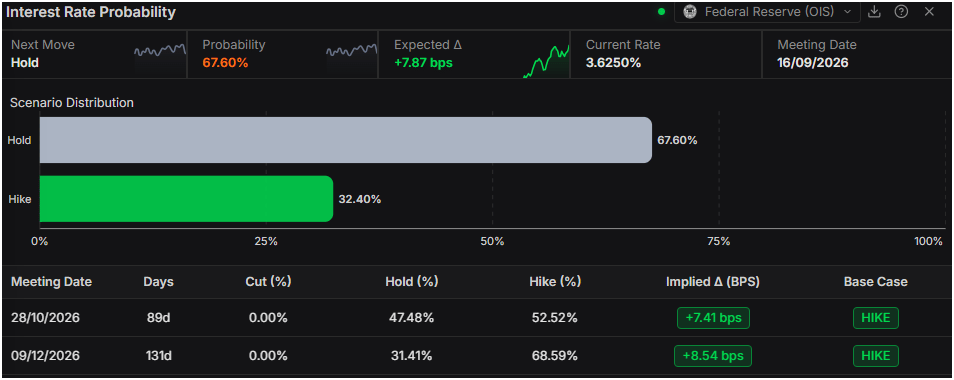
The diverging opinions within the Fed have significantly impacted money market expectations. Prior to the July meeting, the probability of a rate hike in September had been hovering near 60%. However, in the wake of the FOMC’s decision and the subsequent dissents, these hawkish bets have been trimmed considerably. As of writing, the chances of a September rate hike have fallen to 31%, with the odds for a policy hold increasing to nearly 70%, according to Prime Terminal data. This recalibration, while initially seemingly dovish, is being counterbalanced by the hawkish undertones from individual Fed members and the broader implications of inflation data.
Earlier in the week, US economic data presented a mixed picture. On Thursday, revised figures indicated that economic growth in Q2 2025 was softer than initially projected, decelerating to 1.5% quarter-over-quarter from 2.1% in Q1. This slowdown in GDP growth could be interpreted as a sign that the Fed’s past rate hikes are beginning to cool the economy, potentially reducing the need for aggressive future tightening.
However, the inflation landscape remains a primary concern for the central bank. The Fed’s preferred inflation gauge, the Core Personal Consumption Expenditures (PCE) Price Index, came in at 3.3% year-over-year. While this represented a marginal decrease from the previous month’s 3.4% and offered some "relief" to the Fed, it still remains significantly above the central bank’s long-term target of 2%. The persistence of elevated core inflation, even with slowing economic growth, presents a complex challenge for policymakers striving to achieve their dual mandate of maximum employment and price stability. The specter of "stagflation" – high inflation coupled with stagnant growth – although not fully materialized, remains a background worry that influences policy debates and market sentiment.
Consumer Confidence and Broader Economic Outlook
Amidst the complex interplay of monetary policy and inflation data, consumer sentiment offered a glimmer of optimism. The University of Michigan Consumer Sentiment Index for July showed an improvement, rising from its preliminary reading of 54.4 to a final figure of 55.2. This indicates that consumers are becoming more optimistic about the economic outlook, a trend further corroborated by Joanne Hsu, Director of the Survey of Consumers, who noted "broad-based improvements… across all groups by income, education, wealth, age, and political party."
Despite this positive sentiment, inflation expectations, a crucial metric for the Fed, remained stubbornly unchanged. Consumers anticipate inflation of 4.2% over the next year and 3.3% over the next five years. These elevated long-term inflation expectations are particularly concerning for the Fed, as they can become self-fulfilling, influencing wage demands and pricing decisions across the economy. The divergence between improving sentiment and persistent inflation expectations highlights the tightrope walk the Fed faces in managing public perception and economic realities.
Geopolitical Tensions and Commodity Markets
Beyond the immediate economic data and central bank pronouncements, geopolitical factors continue to cast a shadow over financial markets, indirectly impacting gold. The escalation of the Gulf War has been a significant driver for oil prices, with the US crude benchmark, West Texas Intermediate (WTI), trading persistently above $84.00 per barrel. Rising oil prices act as a direct headwind for bullion for several reasons. Firstly, higher energy costs can fuel broader inflationary pressures, prompting central banks to maintain or adopt more restrictive monetary policies, which, as discussed, is generally negative for gold. Secondly, while gold is often seen as an inflation hedge, its effectiveness can be diminished when the primary driver of inflation is a supply-side shock, such as rising oil prices due to geopolitical conflict, especially if coupled with a strong dollar environment.
Historically, gold has served as a safe-haven asset, attracting investors during times of geopolitical instability or economic uncertainty. However, in the current environment, the interplay of a recovering dollar, rising yields, and specific inflationary pressures stemming from energy costs appears to be overshadowing gold’s traditional safe-haven appeal, at least in the short term. The perception of the US Dollar and US Treasuries as robust safe havens, particularly when yields are attractive, can siphon demand away from gold during periods of global tension.
Gold’s Technical Outlook: A Retreat Below $4,050
From a technical perspective, gold’s price action on Friday confirms a bearish shift after two days of strong gains. The XAU/USD has retreated significantly below the $4,100 level, indicating that buyers were unable to sustain momentum above this psychological and technical barrier. The Relative Strength Index (RSI), a momentum indicator, has crossed back below the 50-level, signaling a decrease in buying interest and a shift towards bearish sentiment among traders.
Looking ahead, initial support for gold is identified at the July 24 low of $4,022. A decisive breach of this level would expose the psychologically important $4,000 mark. Should the selling pressure intensify, the next significant support lies at the June 17 daily low of $3,959. Traders will be closely watching these levels for signs of stabilization or further breakdown.
Conversely, for a bullish continuation, gold buyers need to reclaim the $4,100 level. Successful navigation above this resistance would open the path towards the July 22 daily high of $4,165. Beyond that, the 50-day Simple Moving Average (SMA) at $4,185 presents a formidable resistance zone, followed by the July 6 peak at $4,202. The ability to break above these levels would signal a potential reversal of the current bearish trend and a resurgence of buying interest. The daily chart clearly illustrates these key support and resistance levels, providing a roadmap for potential price movements in the coming trading sessions.
The Enduring Role of Gold in a Volatile Global Economy
Despite the recent downturn, gold’s fundamental role in the global financial system remains significant. Historically, gold has been revered as a store of value and a medium of exchange, and today it continues to be seen as a crucial safe-haven asset, particularly during periods of economic turbulence or geopolitical uncertainty. Its appeal also stems from its perceived ability to hedge against inflation and currency depreciation, as it is not tied to any specific government or issuer.
Central banks globally are among the largest holders of gold, consistently adding to their reserves. This strategic accumulation aims to diversify their assets, bolster the perceived strength of their national currencies, and enhance economic stability during volatile times. In 2022, central banks collectively purchased a record 1,136 tonnes of gold, valued at approximately $70 billion, marking the highest yearly purchase on record, according to the World Gold Council. Emerging economies, notably China, India, and Turkey, have been particularly active in expanding their gold reserves, signaling a broader trend towards de-dollarization and reserve diversification.
The inverse correlation between gold and the US Dollar, as well as US Treasuries, is a well-established market dynamic. When the dollar weakens, gold tends to appreciate, allowing investors and central banks to diversify their portfolios. Similarly, gold often benefits from sell-offs in riskier markets, such as equities, as investors flock to perceived safety. However, this inverse correlation is not absolute and can be influenced by other factors, including the pace of interest rate hikes, inflation expectations, and geopolitical events. The current market environment exemplifies this complexity, where a recovering dollar and rising yields, driven by the prospect of continued monetary tightening to combat persistent inflation, are collectively outweighing gold’s traditional safe-haven allure, at least for now. The ongoing interplay of these powerful forces will continue to dictate the trajectory of gold prices in the weeks and months ahead.