Reynand Wu
Gold (XAU/USD) defied conventional market wisdom on Friday, registering solid gains of more than 1.60% to trade at $3,633 at the time of writing. This robust performance comes despite a backdrop of rising US Treasury yields and a strong US Dollar, positioning the precious metal to snap a challenging two-week losing streak. The unexpected rally highlights a complex interplay of market forces, including a shift in risk sentiment and strategic profit-taking by market participants, even as the Federal Reserve’s hawkish stance continues to loom large over the broader economic landscape.
The Paradoxical Surge: Gold’s Resilience Against Headwinds
The yellow metal’s significant recovery on Friday presented a compelling paradox for market observers. Typically, a strengthening US Dollar makes gold more expensive for international buyers, reducing demand. Simultaneously, rising US Treasury yields increase the opportunity cost of holding non-yielding assets like gold, drawing capital towards fixed-income investments. Yet, gold’s ability to advance under these conditions suggests deeper undercurrents at play.
Analysts point to improved risk sentiment as a primary catalyst for Friday’s rally. This could be interpreted as a collective sigh of relief or a re-evaluation of market risks at the close of the trading week, leading investors to reallocate funds. Crucially, the move also appears to be driven by "Gold bears" booking profits. After two weeks of decline, short-position holders likely opted to close out their trades, generating buying pressure that propelled prices upward. Despite this intraday strength, price action is set to remain below this week’s high of $3,689, indicating that while a short-term rebound is underway, the broader bearish trend has not been entirely overturned.
Federal Reserve’s Unwavering Stance and Economic Resilience
The prevailing economic narrative continues to be dominated by the Federal Reserve’s persistent battle against inflation. Recent US economic data has underscored the challenge facing policymakers, with key indicators confirming that inflation remains stubbornly above the Fed’s long-term 2% target. The October Core Personal Consumption Expenditures (PCE) Price Index, the Fed’s preferred inflation gauge, exceeded 3%, a level that continues to fuel concerns about price stability.
Compounding the inflation picture, the US economy demonstrated remarkable resilience in the third quarter of 2023, with Gross Domestic Product (GDP) hitting an impressive 4.3%. This robust growth, significantly exceeding market expectations, suggests an economy operating with considerable momentum. Furthermore, a consistently solid labor market, characterized by low unemployment rates and a dip in jobless claims, signals strong underlying demand. While positive for overall economic health, this combination of strong growth and tight labor markets shows early signs that the economy could be overheating, potentially necessitating further monetary policy tightening from the Fed.
New York Fed President John Williams’ hawkish comments earlier in the week reinforced the central bank’s resolve. On Monday, Williams stated unequivocally that the Fed "still has work to do to get inflation back to its 2% target," signaling that the tightening cycle might not be over. Such rhetoric from influential Fed officials serves to anchor market expectations for future rate hikes, typically exerting downward pressure on gold prices by increasing the attractiveness of yield-bearing assets.
The Tug-of-War: Yields, Dollar, and Gold’s Appeal
In response to the strong economic data and hawkish Fed commentary, US Treasury yields have been soaring. The benchmark US 10-year T-note yield, a key barometer for global borrowing costs and a direct competitor to gold, was up nearly 6.5 basis points, reaching 4.928% on Friday. Higher yields generally increase the cost of holding non-income-generating assets like gold, making them less appealing to investors seeking returns.
Concurrently, the US Dollar Index (DXY), which measures the greenback’s value against a basket of six major currencies, also strengthened, rising by 0.22% to 104.00. A stronger dollar makes dollar-denominated assets, including gold, more expensive for holders of other currencies, which can dampen global demand. The simultaneous rise in both yields and the dollar would typically create a formidable headwind for gold, making Friday’s rally all the more noteworthy and indicative of other market factors at play.
Despite these traditional suppressants, the market’s pricing of future Fed action remains resolute. According to the CME FedWatch Tool, financial markets are currently pricing in a 99% chance that the Fed will raise interest rates by another 25 basis points at its December meeting. This near-certainty of further tightening underpins the expectation that bullion prices will likely remain contained below the $4,000 mark in the near term, as higher interest rates increase the opportunity cost of holding gold.
Global Demand and Strategic Importance of Gold

Beyond the immediate market gyrations, global demand for physical gold continues to provide a foundational support for its price. This week, key Asian hubs reported a notable uptick in demand. In India, a culturally significant market for gold, jewelry and investment buying picked up, driven by festival season demand and traditional wealth preservation motives. Similarly, strong Chinese retail purchases kept local premiums firm, reflecting robust consumer interest in the precious metal as a store of value amidst economic uncertainties.
Central banks globally also play a pivotal role in the gold market, acting as significant holders and buyers. They often diversify their reserves by accumulating gold to support their national currencies during turbulent times and to improve the perceived strength and solvency of their economies. In 2022, central banks added a staggering 1,136 tonnes of gold to their reserves, valued at approximately $70 billion – the highest yearly purchase since records began. Emerging economies, particularly China, India, and Turkey, have been at the forefront of this trend, rapidly increasing their gold holdings as part of broader de-dollarization strategies and a hedge against global financial instability. This consistent institutional demand provides a floor for gold prices, even when speculative trading might push them lower.
Navigating the Week Ahead: Key Economic Catalysts
The upcoming week’s US economic docket is packed with data releases that could significantly influence market sentiment, the dollar, yields, and, consequently, gold prices. Early in the week, investors will scrutinize the ISM Manufacturing and Services PMIs, which offer crucial insights into the health and expansion of the manufacturing and services sectors, respectively. Stronger-than-expected readings could reinforce the narrative of an overheating economy, bolstering the case for further Fed tightening.
Mid-week will feature the JOLTS (Job Openings and Labor Turnover Survey) data, providing a snapshot of labor demand, and the Challenger Job Cuts report, which tracks announced layoffs. These labor market indicators are critical for the Fed, as a tight labor market contributes to wage pressures and inflation. The week will culminate with the highly anticipated Nonfarm Payrolls (NFP) report for November on Friday. The NFP is a comprehensive gauge of US employment and wage growth, and its outcome can dramatically shift market expectations regarding the Fed’s future monetary policy path. A robust NFP report, particularly with strong wage growth, could intensify hawkish sentiment, while a weaker report might provide some relief for gold bulls hoping for a pause in rate hikes.
XAU/USD Technical Analysis: Charting the Path Forward
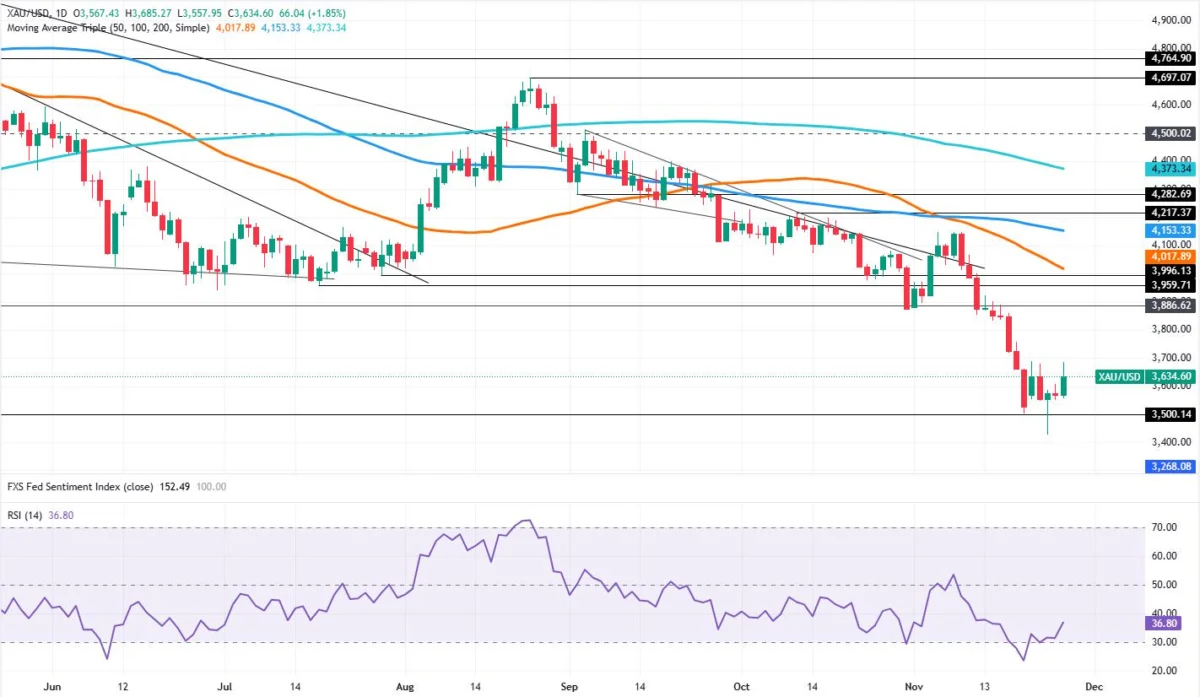
From a technical perspective, Gold’s price action continues to exhibit a pattern of lower highs and lower lows, indicating an underlying bearish bias. This pattern will remain intact unless buyers can decisively push spot prices above the October 30 swing low of $3,870, which has now transitioned into a significant resistance level.
Despite the recent rally, the Relative Strength Index (RSI), a momentum indicator, is currently aiming upwards but remains below the 50 neutral level, closer to oversold territory. This suggests that while there is some buying momentum, it is not yet strong enough to signal a definitive reversal of the broader downtrend. A sustained move above the 50-level on the RSI would be crucial for confirming stronger bullish conviction.
For XAU/USD to confirm a more significant bullish reversal, it would need to breach several key resistance levels. A sustained move above Monday’s high of $3,689 could pave the way for a test of the psychological $3,700 mark. Beyond that, the critical resistance lies at $3,870, the October 30 low. A definitive breach of this level would expose the path towards the formidable $4,000 psychological barrier, with the 50-day Simple Moving Average (SMA) at $4,017 acting as another significant technical hurdle. Overcoming these levels would signal a substantial shift in market dynamics and potentially attract more aggressive buying.
Conversely, for a bearish continuation, bullion’s first significant support level is identified at $3,500, a level that acted as a swing high on April 22, 2025 (likely a typo, possibly April 22, 2023 or a future projection) and has since become a crucial support. A break below this level could trigger further selling pressure. On further weakness, traders could target the next support level at $3,268, which corresponds to the July 30, 2025, swing low (again, likely a typo for 2023 or a future projection), before potentially challenging the key $3,000 psychological mark. The daily chart clearly illustrates these pivotal levels, offering traders a roadmap for potential price movements in the coming sessions.
The Enduring Allure of Gold: A Historical Perspective
Gold has played an unparalleled role in human history, serving as a fundamental store of value and a widely accepted medium of exchange for millennia. Its intrinsic value, scarcity, and resistance to corrosion have cemented its status as a timeless asset. In the modern financial landscape, beyond its ornamental appeal for jewelry, the precious metal is predominantly viewed as a safe-haven asset. This designation means that gold is considered a reliable investment during periods of economic turbulence, geopolitical instability, or market uncertainty, as investors flock to its perceived safety when other assets decline.
Furthermore, gold is widely regarded as a hedge against inflation and against depreciating fiat currencies. Unlike paper money, gold’s value is not reliant on any specific issuer or government, making it immune to the inflationary pressures that erode the purchasing power of conventional currencies. This characteristic becomes particularly attractive during periods of rising prices or when confidence in monetary policy wanes.
The price of gold is influenced by a complex array of factors. Geopolitical instability, such as regional conflicts or international tensions, or widespread fears of a deep recession can quickly trigger a surge in gold prices due to its safe-haven appeal. As a yield-less asset, gold tends to perform better in environments of lower interest rates, as the opportunity cost of holding it decreases. Conversely, higher costs of money, driven by rising interest rates, typically weigh down on the yellow metal. Still, the most significant determinant of gold’s price movements often revolves around the behavior of the US Dollar (USD), as gold is predominantly priced in dollars (XAU/USD). A strong Dollar tends to exert downward pressure on gold prices by making it more expensive for international buyers, whereas a weaker Dollar is likely to push gold prices higher, enhancing its affordability and appeal globally.