Reynand Wu
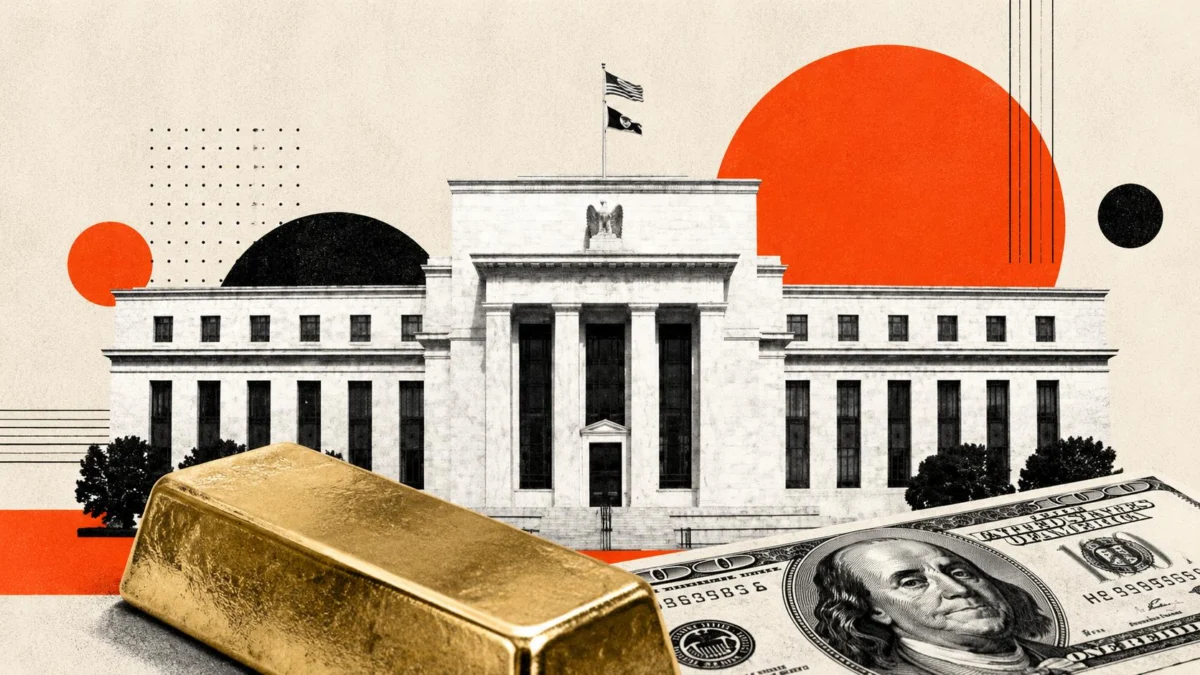
Gold (XAU/USD) is poised to conclude the trading week with a substantial loss of nearly 4.50%, despite a marginal recovery of 0.14% on Friday as the US Dollar’s advance showed signs of capping following a series of potent inflation reports from the United States. At the close of the week, XAU/USD was trading around $3,879, a critical juncture representing its lowest valuation in approximately 13 months, signaling a challenging period for the precious metal. This sharp decline underscores a significant shift in market dynamics, primarily driven by evolving expectations regarding the Federal Reserve’s monetary policy trajectory.
The Inflationary Surge: A Week of Soaring Producer and Consumer Prices
The catalyst for gold’s recent downturn can be directly attributed to a succession of US inflation data releases this week, which have collectively reinforced the market’s conviction that the Federal Reserve will likely proceed with further interest rate increases. The week began with the release of the US Consumer Price Index (CPI) on Tuesday, which indicated persistent inflationary pressures across the economy. While specific figures from the original context are missing for CPI, its impact was immediately felt, signaling that price stability remains an elusive goal for policymakers.
Mid-week, the Producer Price Index (PPI) for October further amplified these concerns. The headline PPI, which measures the average change over time in the selling prices received by domestic producers for their output, registered a significant 6.5% year-over-year (YoY) increase. Although this figure came in slightly below some of the more pessimistic forecasts, it notably surpassed September’s 6.3% print, indicating an acceleration in upstream price pressures. The primary drivers behind this acceleration were identified as higher transportation and warehousing costs, reflecting ongoing supply chain bottlenecks and elevated energy prices impacting logistics. The core PPI, which strips out volatile components like food and energy to provide a clearer picture of underlying inflation trends, remained unchanged from the previous month at 5% YoY, aligning precisely with market estimates. This consistency in core inflation, while meeting expectations, still highlights a sustained level of price growth well above the Fed’s long-term 2% target.
These inflation reports, particularly the uptick in headline PPI and the stubbornly high core PPI, provided concrete evidence that inflationary forces are not dissipating as quickly as some might have hoped. This data directly impacts the Federal Reserve’s dual mandate of achieving maximum employment and price stability, placing renewed emphasis on its commitment to controlling inflation, even if it entails more restrictive monetary policy.
Federal Reserve’s Unwavering Hawkish Resolve
The robust inflation data promptly elicited a hawkish response from several Federal Reserve officials, who reiterated their commitment to tighter monetary conditions. Their collective statements throughout the week underscored a growing consensus that current financial conditions may not yet be sufficiently restrictive to bring inflation back to target.
On Friday, Mary Daly, President of the Federal Reserve Bank of San Francisco, articulated her view that more rate hikes might be necessary as businesses continue to pass on higher costs to consumers, indicating a persistent demand-side pressure. Simultaneously, Susan Collins, President of the Federal Reserve Bank of Boston, issued a stark warning that inflation appears to be spreading more broadly across the economy, a development she believes warrants additional interest rate increases to prevent it from becoming entrenched. These sentiments were echoed by Austan Goolsbee, President of the Federal Reserve Bank of Chicago, who remarked earlier in the week that the latest inflation data suggested a worsening situation, which "would make the Fed more aggressive" in its policy actions.
These pronouncements from key FOMC (Federal Open Market Committee) members are critical for market participants. They signal an unwavering resolve within the central bank to prioritize price stability, even at the risk of potentially cooling economic growth. The consistent message across different regional Fed presidents suggests a unified front in addressing inflation, reinforcing expectations for a continued tightening cycle. This collective hawkish stance strongly suggests that the "higher for longer" narrative regarding interest rates is gaining further traction within the Fed.
Market Dynamics: Soaring Yields and a Dominant Dollar
The implications of the surging inflation reports and the Fed’s hawkish rhetoric were immediately visible in financial markets, particularly in US Treasury yields and the US Dollar’s performance. US Treasury yields continued their upward trajectory throughout the week, a clear indication that bond market participants are pricing in a higher probability of future rate hikes and anticipating a sustained period of elevated interest rates. The benchmark US 10-year Treasury yield, a crucial indicator for global borrowing costs and investment decisions, surged by almost two basis points, reaching 5.15%. This level represents a significant increase and reflects the market’s expectation of a more restrictive monetary policy environment. Higher Treasury yields make non-yielding assets like gold less attractive, as investors can earn a guaranteed return on safe government bonds.
Concurrently, the US Dollar demonstrated formidable strength. The US Dollar Index (DXY), which measures the greenback’s value against a basket of six major currencies, climbed 0.23% to 103.41. During the week, the DXY refreshed a 19-month high, reaching 103.42. A stronger dollar makes dollar-denominated commodities, including gold, more expensive for holders of other currencies, thereby dampening demand. This robust performance of the dollar is a direct consequence of the expectation of higher US interest rates, which increases the appeal of dollar-denominated assets. The DXY’s ascent to multi-month highs reflects a significant divergence in monetary policy outlooks between the Federal Reserve and other major central banks, reinforcing the dollar’s status as a dominant safe-haven currency in a volatile global economic landscape.
Market participants are now largely convinced of the Fed’s immediate course of action. According to the CME FedWatch Tool, a widely referenced barometer for future interest rate probabilities, markets are pricing in a nearly 90% chance of a 25-basis-point (bps) rate hike at the Federal Reserve’s December meeting. Furthermore, a non-negligible 10% chance of a more aggressive 50-bps increase is also being considered, underscoring the severity of current inflation concerns and the potential for the Fed to act decisively. This high probability of a rate hike directly contributes to the upward pressure on yields and the dollar, creating a challenging environment for gold.
Gold’s Diminished Luster: Opportunity Costs and Safe-Haven Appeal
Gold’s substantial weekly decline highlights its sensitivity to shifts in monetary policy expectations and the prevailing macroeconomic environment. As a non-yielding asset, gold typically thrives in periods of low interest rates, high inflation (when real yields are negative), and geopolitical uncertainty, where it serves as a traditional safe haven and a hedge against currency depreciation. However, the current scenario presents a formidable headwind for the yellow metal.
When interest rates rise, the opportunity cost of holding gold increases. Investors can earn a higher return on interest-bearing assets like government bonds or savings accounts, making gold less appealing. The concept of "real yields" – nominal bond yields minus inflation expectations – is particularly pertinent. When real yields climb, as they have been recently due to rising nominal yields and persistent, but potentially stable, inflation expectations, gold’s attractiveness diminishes. Investors are essentially being paid more to hold safe, yielding assets compared to holding a non-yielding commodity.
While gold is historically considered an inflation hedge, its effectiveness in this role is currently being challenged. In an environment where the central bank is aggressively raising rates to combat inflation, and other safe-haven assets like the US Dollar and US Treasuries are offering increasingly attractive yields, gold’s appeal as the primary inflation hedge or safe haven is diluted. The market perceives the Fed’s commitment to fighting inflation as credible, which in turn strengthens the dollar and pushes yields higher, diverting capital away from gold.
It is worth noting that central banks globally have been significant net buyers of gold in recent years, viewing it as a strategic reserve asset for diversification and to bolster confidence in their currencies. The World Gold Council reported that central banks added a record 1,136 tonnes of gold, worth approximately $70 billion, to their reserves in 2022, the highest yearly purchase since records began. Emerging economies, including China, India, and Turkey, have been particularly active in increasing their gold holdings. While these long-term strategic purchases provide a foundational demand for gold, they often operate on a different timescale and motivation than the short-term speculative and investment flows that drive daily price action based on monetary policy expectations. Consequently, while central bank buying offers underlying support, it has not been sufficient to counteract the strong bearish pressures exerted by the current hawkish Fed outlook and rising real yields.
Technical Landscape: Navigating Key Support and Resistance Levels
From a technical perspective, gold’s recent market behavior suggests further downside potential despite appearing to find some temporary footing near $3,873, slightly above the day’s low of $3,867. The overarching market structure, characterized by a series of consecutive lower highs and lower lows, indicates a persistent bearish trend that has extended significantly.
Should the current selling pressure persist, the immediate focus for traders will be a test of the year-to-date low, currently situated around $3,852. A decisive breach of this critical support level would likely trigger further downside momentum, exposing the psychologically significant $3,800 level. Beyond that, a more substantial decline could see gold targeting the $3,500 mark, which served as a significant swing high in April 2024 and could now act as a crucial support zone. The path of least resistance appears to be downwards, especially if the fundamental drivers of a strong dollar and rising yields remain intact.
Conversely, for gold to mount any meaningful recovery, it would first need to overcome immediate resistance at $3,900. A successful breach of this level could pave the way for a move towards Thursday’s high of $4,000. Subsequent resistance levels are identified at $4,100, followed by a confluence of moving averages that could present a more formidable challenge: the 50-day Simple Moving Average (SMA) at $4,154 and the 100-day SMA at $4,196. Reclaiming these moving averages would be a significant bullish signal, indicating a potential shift in market sentiment, but such a move would require a substantial change in the current macroeconomic narrative or a weakening of the US Dollar.
Looking Ahead: Critical Economic Indicators and Fed Insights
As traders and investors look to the coming week, several key economic indicators and Federal Reserve communications will be under intense scrutiny, potentially shaping gold’s immediate trajectory.
The release of the Federal Open Market Committee (FOMC) meeting minutes will be paramount. These minutes provide an in-depth account of the discussions and deliberations that took place during the latest policy meeting, offering valuable insights into the various viewpoints of FOMC members. Traders will be dissecting the language for any hints regarding the Fed’s future rate hike path, the threshold for pausing or pivoting, and their assessment of economic risks. Any subtle shifts in tone or emphasis could significantly influence market expectations for monetary policy.
Additionally, next week’s Retail Sales data will be closely watched. This report is a crucial barometer of consumer spending, which is a significant component of the US economy. Strong retail sales figures could suggest resilient consumer demand, potentially feeding into inflationary pressures and reinforcing the Fed’s hawkish stance. Conversely, weaker-than-expected sales could indicate a slowdown in economic activity, which might temper some of the more aggressive rate hike expectations.
Further speeches by Federal Reserve officials are also on the calendar. These public appearances provide opportunities for policymakers to clarify their positions, react to the latest economic data, and guide market expectations. Any deviation from the unified hawkish message observed this week could introduce volatility into the markets, impacting the dollar, Treasury yields, and consequently, gold prices.
In conclusion, gold faces a challenging outlook in the near term. The relentless march of US inflation, coupled with the Federal Reserve’s unwavering commitment to tightening monetary policy, has created an environment where the US Dollar and US Treasury yields are ascendant. This dynamic fundamentally diminishes gold’s appeal as a non-yielding asset, pushing it to multi-month lows. While technical analysis points to critical support levels, any sustained recovery would likely necessitate a significant shift in the macroeconomic landscape or a clear signal from the Fed that its tightening cycle is nearing its end. Until then, gold remains under considerable pressure.