
 Gilang Muhammad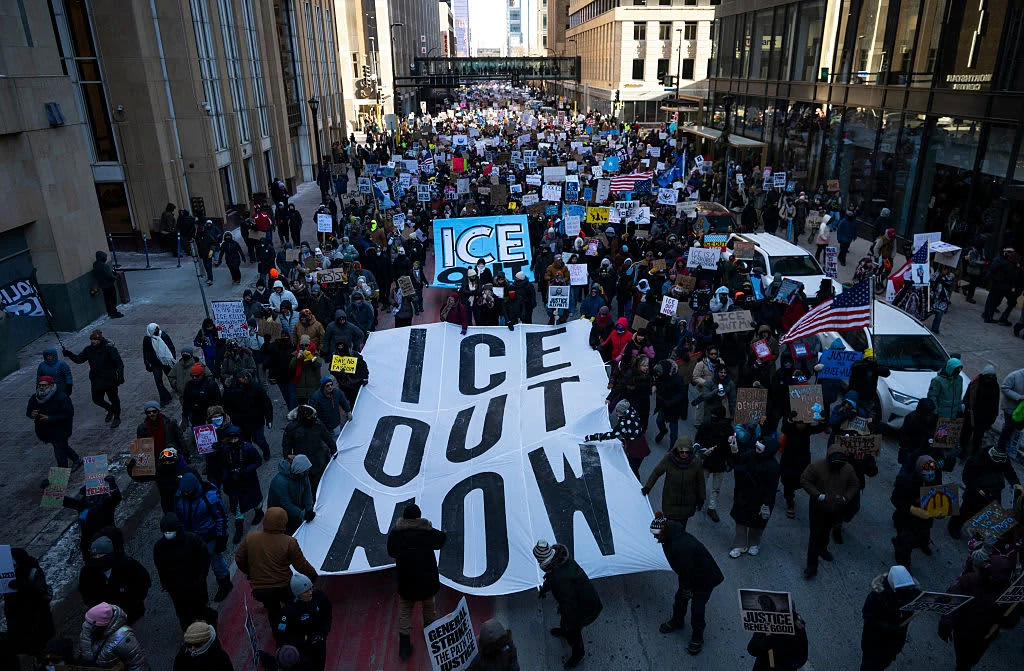
MINNEAPOLIS — Months after the official conclusion of "Operation Metro Surge," a massive federal immigration enforcement action, Minneapolis continues to grapple with profound economic and social repercussions, echoing a wider national trend of localized recessions in cities targeted by intensified deportation efforts. The immediate chill experienced by businesses and communities during the December 2025 to February 2026 operation has solidified into a protracted crisis, leaving many struggling to recover and highlighting the far-reaching economic implications of aggressive immigration policies.
Daniel Hernandez, owner of Colonial Market grocery stores, embodies the enduring struggle. His bustling Minneapolis stores, once anchors of the Hispanic business community, saw their morning lines vanish as his parking lot became an unwitting staging ground for Immigration and Customs Enforcement (ICE) officers. Despite the surge’s end, the anticipated rebound in customer traffic never materialized. "We’re barely — literally barely — surviving," Hernandez shared with CNBC during an interview amidst the vibrant Spanish-language music and dangling piñatas of one of his remaining stores. "The damage has been done." This summer, the financial strain forced Hernandez to close his Colonial Market location on Lake Street, a central artery for Minneapolis’s Hispanic businesses. The store, opened just two years prior with significant personal investment and borrowed funds, was a casualty of a 60% decline in sales across his establishments, a testament to the severe and persistent economic shockwave.
Operation Metro Surge: A Precedent-Setting Enforcement
"Operation Metro Surge," touted by the Department of Homeland Security as the largest immigration enforcement action in its history, was launched in early December 2025 and concluded in mid-February 2026. This federal initiative, a direct consequence of President Donald Trump’s second-term directive for mass deportations in major U.S. cities, aimed to significantly increase arrests and removals of undocumented immigrants. While official statements from the White House, through spokesperson Lauren Bis, linked such surges to a "surge in illegal immigration under President Biden [referring to a previous administration] that threatened the long run fiscal health of the country, contributed to record high inflation, and suppressed the wages of American workers," critics and local leaders pointed to the immediate and devastating impact on established communities and economies. A spokesperson for the Department of Homeland Security, which oversees ICE, further stated that "illegal immigration is a labor-supply shock aimed at the bottom" and could drive up rent costs, attempting to frame the enforcement as an economic necessity.
However, the reality on the ground in Minneapolis told a different story. The operation was characterized by a highly visible presence of federal agents, including National Guard troops deployed to the city, creating an atmosphere of pervasive fear and uncertainty among immigrant communities and beyond. This unprecedented scale of enforcement led to widespread protests, including a "Nationwide Shutdown" demonstration in Minneapolis on January 30, 2026, where protestors marched against ICE actions, underscoring the deep community opposition and alarm.
The Economic Chill: Quantifying the Damage
The economic fallout in Minneapolis has been stark and measurable. The Lake Street Council, a vital advocate for businesses in the heavily immigrant-populated commercial district, reported that immigrant-owned businesses cumulatively lost an estimated $46 million in December 2025 and January 2026 alone. In the months following the surge, council members undertook a strenuous door-to-door effort to assist small business owners, many of whom faced language barriers, in completing paperwork for emergency relief funds, illustrating the profound disruption and immediate need for support.
Broader city-wide data further paints a grim picture. The Minneapolis government estimated a loss of almost $700 million in economic activity between December and April, a figure Mayor Jacob Frey, a Democrat, suggested was likely conservative, acknowledging the city was left grappling with significant "tail" effects. Foot traffic data analyzed by Advan Research exclusively for CNBC revealed a persistent underperformance in bars and eateries within Lake Street ZIP codes compared to nearby neighborhoods, with the gap peaking at nearly 10 percentage points in March, a month after the surge officially ended. This indicates that consumer confidence and daily routines were profoundly disrupted and slow to recover.
The Minneapolis City Council responded by allocating approximately $7 million for local businesses and over $3 million in rental assistance. However, Mayor Frey candidly admitted that this funding would be insufficient to fully address a situation many in the community likened to a natural disaster. "Traditionally, disaster relief is not a partisan issue," Frey told CNBC, emphasizing the unusual nature of a crisis instigated by a federal government action rather than natural forces. "Traditionally, disasters are not caused by the government themselves."
National Implications and Research Findings
The economic challenges faced by Minneapolis are not isolated. A growing body of research confirms that similar monthslong economic chills followed immigration raids across the country. An analysis by University of Pennsylvania professor Zeke Hernandez (no relation to Daniel Hernandez) found that cities experiencing immigration raids in 2025 saw a nearly 3% decline in weekly foot traffic and a more than 6% drawdown in spending. Collectively, this translated to an estimated 8 billion fewer visits and billions of dollars in lost spending nationwide that year. "You are creating recession-like conditions in targeted neighborhoods," Zeke Hernandez explained, likening the phenomenon to a "localized recession."
Further supporting these findings, the Brookings Institution published a report indicating that employment dropped in U.S. cities experiencing immigration enforcement surges. Six months post-surge, the most impacted cities registered a 0.4% employment shortfall. In Minnesota specifically, the labor force participation rate fell at a faster clip than the U.S. overall in the last year, with the state’s seasonally adjusted unemployment rate in 2026 surpassing the national average for the first time in nearly two decades. Tyler Schipper, an economist at the University of St. Thomas, highlighted that "Operation Metro Surge can sometimes be perceived as only affecting undocumented workers. That wasn’t the case at all," underscoring the ripple effect on the broader labor market and local economy.
The impact also extended to housing stability. While eviction notices initially dropped year-over-year in Minneapolis in January and February, possibly cushioned by government housing funds and mutual aid programs, this respite was temporary. As these funding sources dwindled, the volume of eviction notifications spiked. Home Line, a Minnesota-based tenant advocacy group, reported that total notices in the year through August rose around 7% compared to the same period in 2025, suggesting a delayed but significant housing crisis emerging from the economic instability.
The Hispanic American Economy Under Pressure
Advocates for Hispanic Americans have voiced strong concerns that aggressive immigration crackdowns risk stifling a demographic recognized as a crucial engine for national economic growth. The Latino Donor Collaborative, a California-based organization, highlighted that if U.S.-based Latinos constituted their own country, their Gross Domestic Product (GDP) would be the world’s fourth largest, estimated at a staggering $5.1 trillion. However, data from Numerator, a market research firm, indicates that the growth rate for the average Hispanic household’s spending in the U.S. decreased by approximately 2 percentage points over the last two years. A 2025 survey by Numerator also found that Hispanic consumers were 50% more likely to identify immigration-related policy as a top issue, reflecting the direct and palpable concern within the community. "We’re being challenged right now," stated Sol Trujillo, co-founder of the Latino Donor Collaborative. "These policies can be highly disruptive to our economy."
The impact, however, was not confined to Hispanic communities. The Minneapolis-based Children’s Theatre Co., a 6-decade-old organization, was forced to cancel several shows due to venue inaccessibility caused by National Guard blockades during the surge. Upon reopening, managing director Ryan French reported that crowds were roughly half the size previously expected. This led to a loss of approximately half a million dollars in revenue, forcing the nonprofit to end its fiscal year in the red, cut three jobs, and reduce hours for other employees, illustrating the broad economic and cultural casualties of the operation.
Community Fear and the Struggle for Resilience
The psychological toll of "Operation Metro Surge" has been profound and enduring. In late September, residents in Minneapolis still referred to the operation simply as "the surge," a temporal marker dividing life into "before" and "after." The memory of Renee Good and Alex Pretti, two U.S. citizens tragically killed by federal immigration officers during the operation, is memorialized on weathered posters across the city, a stark reminder of the heightened tensions and dangers. Houses and businesses prominently display signs warning immigration officers not to enter private property, a testament to the pervasive fear and a collective effort to assert community boundaries against perceived federal overreach.
Jason Chavez, a Minneapolis City Council member representing part of Lake Street, noted that many immigrant business owners depleted their life savings to keep their stores afloat during the surge. Now, these mom-and-pop shops face precarity, vulnerable to even minor emergencies like a pipe burst or adverse weather, lacking the financial cushion they once possessed.
Despite the deep scars, signs of resilience and recovery are emerging. The Lake Street Council successfully drew large crowds for World Cup viewing events and a recent "taco tour" food crawl, offering glimmers of hope for returning customer traffic. In August, Advan Research data showed that year-over-year foot traffic growth for restaurants in Lake Street ZIP codes outperformed surrounding areas for the first time since the surge began, indicating a cautious but tangible step towards normalcy.
Yet, underlying these green shoots is a persistent apprehension that immigration enforcement could intensify once more. While ICE arrests in Minnesota have slowed compared to earlier in the year, the national number in July rose to its highest level since President Trump’s return to office, according to the Deportation Data Project. "For immigrants who are still here in Minneapolis and in the surrounding areas, that fear never left," said Miguel Hernandez, owner of Lito’s Burritos on Lake Street. "They are operating at an intense level of caution still to this day." He recounts seeing foot traffic plunge in the days following news headlines about immigration enforcement and even sold his gray Chevrolet Tahoe after children began mistaking it for an ICE vehicle and fleeing. Some of his employees, even those with work authorizations, have left the country due to fears of federal officers.
In a remarkable act of community support and self-preservation, Daniel Hernandez has transformed one of his remaining Colonial Market stores into a pop-up market on Sundays, providing a venue for immigrant entrepreneurs to sell their products. He deliberately invites Minneapolis police officers to patrol the weekly event, believing that the presence of local law enforcement equipped with body cameras will deter ICE agents, highlighting the complex and often adversarial relationship between local communities and federal immigration authorities.
However, even these innovative efforts may not be enough. Daniel Hernandez faces potential eviction later this month, having fallen behind on rent due to the crippling loss of sales during and after the surge. A GoFundMe campaign has raised over $3,000 to help keep Colonial Market’s doors open, a testament to community solidarity in the face of immense adversity. Daniel Hernandez’s poignant reflection encapsulates the broader experience: "During the storm, you can feel the winds. But once the storm is over, all that you see is destruction. That’s what happened here."
The legacy of "Operation Metro Surge" in Minneapolis serves as a powerful case study, illustrating how federal immigration policies, even after their official conclusion, can inflict deep and lasting economic wounds, erode community trust, and challenge the very fabric of urban life, with implications extending far beyond the immediate targets of enforcement. The struggle for recovery in Minneapolis is not just about rebuilding businesses, but about healing communities and confronting the complex interplay between immigration policy, local economies, and human dignity.








