Clara Shinta
Decentralized exchange Hyperliquid and memecoin launchpad Pump.fun have reportedly spearheaded an unprecedented surge in cryptocurrency token buybacks, collectively accounting for nearly 90% of the record $638 million spent by crypto projects to repurchase their own digital assets so far in 2026. This significant financial maneuver, reminiscent of traditional corporate share buybacks, signals a pivotal shift in how decentralized autonomous organizations (DAOs) and blockchain protocols are managing their treasuries and returning value to token holders. The escalating trend underscores a growing maturity within the digital asset landscape, moving beyond speculative growth towards more established financial strategies aimed at enhancing token valuations and fostering long-term investor confidence.
The Exponential Rise of Token Buybacks
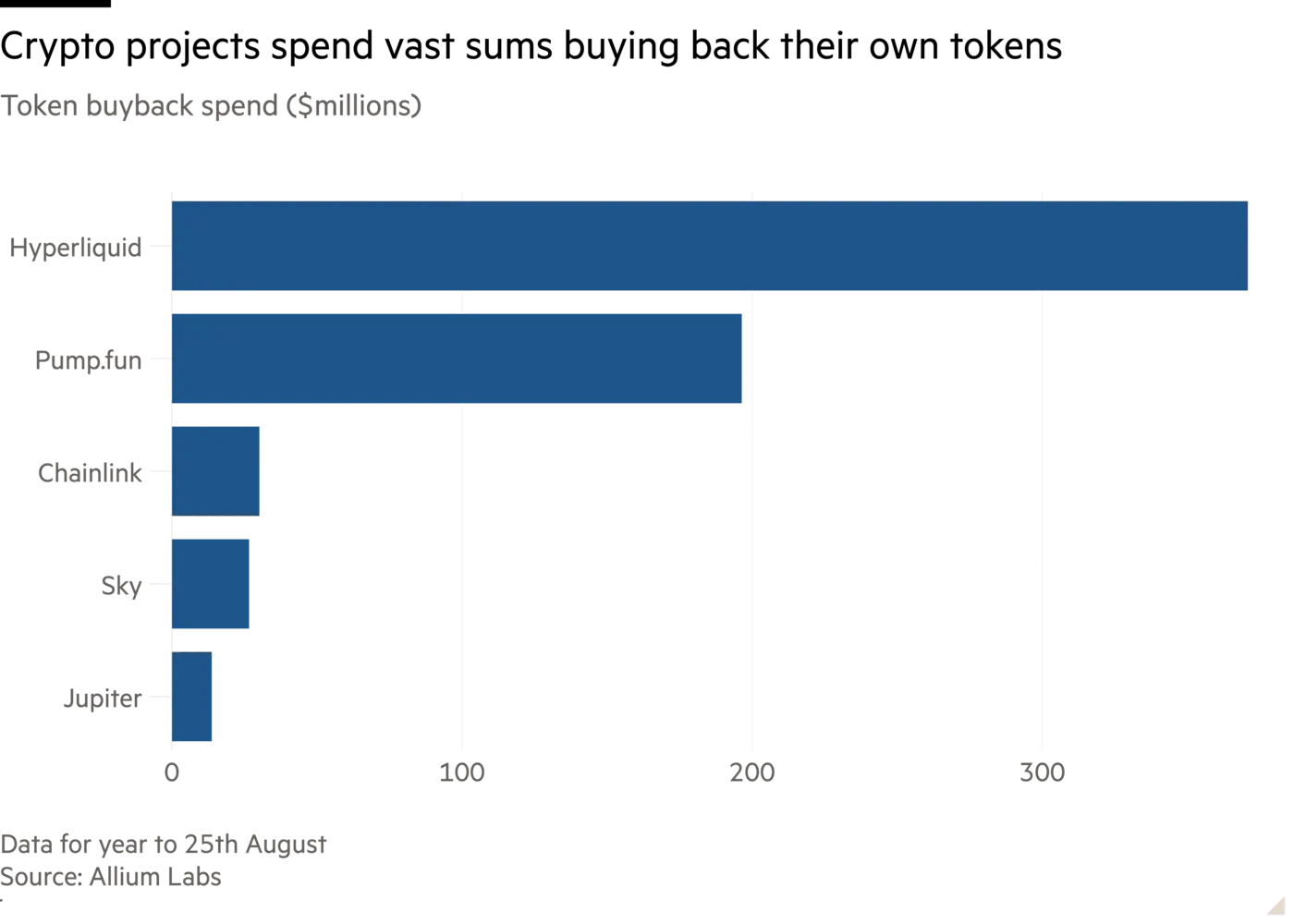
The year 2026 has witnessed an extraordinary acceleration in token buybacks, with cryptocurrency projects collectively spending a staggering $638 million to repurchase their native tokens year-to-date. This figure represents a dramatic increase from previous periods, according to data compiled by Allium Labs and cited in a recent Financial Times report. For context, the total spent on buybacks during the same period in 2025 stood at $545 million, while in 2024, the sum was a mere $366,000. The exponential growth from hundreds of thousands to hundreds of millions within two years highlights a burgeoning adoption of this financial mechanism across the crypto sector.
At the forefront of this trend are Hyperliquid and Pump.fun, whose aggressive buyback strategies have set them apart. Hyperliquid, a prominent decentralized exchange (DEX), alone accounted for approximately $370 million of the total, demonstrating its robust revenue generation and commitment to its token ecosystem. Following closely, Pump.fun, an innovative platform for launching memecoins, contributed nearly $200 million to the record sum. Their combined efforts have not only dominated the buyback landscape but have also provided a compelling case study for the effectiveness of such programs in a volatile market.
Understanding Token Buybacks: A Parallel to Traditional Finance
Token buybacks in the cryptocurrency world are conceptually similar to share buybacks executed by publicly listed companies in traditional financial markets. In conventional finance, corporations repurchase their own stock from the open market for several strategic reasons: to reduce the number of outstanding shares, thereby increasing earnings per share (EPS) and often boosting the stock price; to return capital to shareholders; or to prevent dilution from employee stock options. These actions are typically seen as a sign of financial health and a company’s belief that its stock is undervalued.
In the decentralized sphere, token buybacks serve analogous purposes but with unique blockchain-specific considerations. By reducing the circulating supply of a token, projects aim to increase its scarcity, which can lead to upward pressure on its price. This mechanism can also be used to enhance the value proposition for existing token holders, incentivize long-term investment, and strengthen the overall tokenomics of a protocol. Unlike traditional stock buybacks, which are heavily regulated and require specific corporate governance approvals, token buybacks in the crypto space can be implemented through smart contracts or DAO proposals, reflecting the decentralized nature of many projects. While transparency often exists on the blockchain, the regulatory oversight framework is still evolving, posing both opportunities and challenges.
A Nascent Trend Gaining Momentum: The Ethena Example
While still considered a relatively nascent practice within the broader crypto industry, token buybacks are rapidly gaining traction as more projects recognize their potential. The increasing adoption reflects a maturation of the sector, where protocols are moving beyond initial token distribution and pure growth phases to focus on sustainable economic models and value accrual for their communities.
A recent high-profile example illustrating this growing momentum is the Ethena Foundation. On a recent Thursday, the foundation initiated a significant vote on a fee-switch proposal. Under this proposal, a substantial 95% of the net revenue generated from Ethena’s core business lines would be specifically earmarked for the repurchase of Ethena (ENA) tokens. The market’s immediate reaction underscored the perceived positive impact of such strategies: the ENA token experienced a notable surge of 10.7% on the day the proposal was announced. This rapid price appreciation demonstrates how investor sentiment is increasingly swayed by protocols that commit to returning value through direct token repurchases, signaling financial strength and a vested interest in the token’s long-term health. The Ethena case serves as a powerful indicator that proactive value-return mechanisms are becoming a key differentiator in a competitive market.
Market Outperformance: Hyperliquid and Pump.fun Lead the Charge
The strategic implementation of token buybacks by Hyperliquid and Pump.fun has translated directly into remarkable market performance for their respective tokens, HYPE and PUMP. These tokens have substantially outperformed the broader cryptocurrency market, which has faced headwinds in 2026.
Year-to-date, the HYPE token has surged by an impressive 145%, while the PUMP token has seen a substantial increase of 109%. This stellar performance stands in stark contrast to the general market trend, where Bitcoin (BTC), the leading cryptocurrency, experienced a 10% decline in price during the same period. Similarly, the total cryptocurrency market capitalization fell by 11.9%, according to data from TradingView. The significant divergence in performance strongly suggests that consistent token buybacks act as a powerful catalyst, bolstering token valuations even amidst a bearish or stagnant market environment. Investors appear to be rewarding projects that demonstrate a clear strategy for value accrual and supply reduction.
The commitment of these platforms to their buyback programs is particularly noteworthy. Hyperliquid, for instance, dedicates an extraordinary 99% of its revenue to token buybacks. This aggressive allocation strategy was evident in its second-quarter financial report on August 6, where it announced $169 million in revenue, of which $141 million was directed towards HYPE token repurchases. This nearly complete reinvestment of revenue into its token ecosystem showcases a strong belief in its token’s future value and a direct mechanism for returning operational success to token holders.
Pump.fun also maintains a robust buyback policy, allocating approximately 50% of its net protocol revenue for token repurchases. Based on its average daily revenue over the past 90 days, the memecoin launchpad currently boasts an impressive annualized revenue of $420 million. This substantial revenue stream, coupled with a significant portion dedicated to buybacks, provides consistent upward pressure on the PUMP token. The financial health and transparent allocation strategies of these platforms underscore a growing sophistication in crypto project management, moving towards sustainable economic models.
The Economic Rationale and Broader Implications
The growing adoption of token buybacks is rooted in several key economic principles and carries significant implications for the future of the crypto market.
Firstly, scarcity and value appreciation are fundamental. By actively reducing the circulating supply of a token, projects aim to make the remaining tokens more valuable, assuming constant or increasing demand. This direct deflationary pressure provides a tangible benefit to existing token holders, contrasting with inflationary models where new tokens are continuously introduced, potentially diluting value.
Secondly, buybacks serve as a strong signal of a project’s financial health and long-term commitment to its token holders. When a protocol uses its earned revenue to repurchase its own tokens, it demonstrates a belief in its intrinsic value and a willingness to invest in its own ecosystem. This can significantly boost investor confidence, attracting more capital and fostering a loyal community. Moreover, if repurchased tokens are then locked, burned, or used for governance purposes, it can further align incentives between the protocol and its community.
The distinction between crypto token buybacks and traditional share buybacks, while conceptually similar, is also important. While both aim to return value, crypto buybacks often operate within less defined regulatory boundaries. This offers greater flexibility but also introduces potential for increased scrutiny from regulators concerned with market manipulation. However, many decentralized projects pride themselves on on-chain transparency, where buyback transactions are publicly verifiable, potentially offering a different form of accountability.
Matt Hougan, Chief Investment Officer at Bitwise, a prominent crypto asset manager, articulated a bullish outlook earlier in August, suggesting that crypto valuations could potentially double in the next two years. His reasoning centers on the increasing trend of protocols utilizing their revenue to fund token buybacks and burns, thereby returning more tangible value to investors. This perspective highlights a fundamental shift in tokenomics design, moving towards models that prioritize sustainable value accrual over purely speculative growth.
Challenges and the Evolving Regulatory Landscape
Despite the undeniable benefits, the surge in token buybacks is not without its complexities and potential challenges. One primary concern revolves around the sustainability of such programs. Crypto markets are notoriously volatile, and revenue streams for protocols can fluctuate significantly. Projects heavily reliant on buybacks must ensure their underlying business models are robust enough to generate consistent revenue, especially during market downturns, to maintain these programs without straining their treasuries.
Another area of discussion is the potential for market manipulation. Critics argue that large-scale buybacks, if not executed transparently and ethically, could be used to artificially inflate token prices, creating a false sense of demand or stability. This concern is amplified in a relatively unregulated market where insider trading and wash trading can be harder to detect and prosecute compared to traditional securities markets.
Furthermore, the evolving regulatory landscape poses a significant variable. As crypto assets gain mainstream adoption, regulators globally are increasingly scrutinizing market practices. Token buybacks, particularly those involving large sums, could attract attention from financial authorities keen on preventing market abuse or ensuring investor protection. The classification of tokens as securities in certain jurisdictions could subject these buyback programs to traditional securities laws, which could introduce new compliance burdens and restrict flexibility. Projects engaging in significant buyback activities will need to navigate this uncertain regulatory environment carefully, prioritizing transparency and adherence to emerging guidelines.
Conclusion: A Maturing Market Paradigm
The record $638 million in token buybacks year-to-date in 2026, predominantly driven by Hyperliquid and Pump.fun, marks a significant milestone in the maturation of the cryptocurrency market. This trend signifies a strategic shift from purely speculative growth to the adoption of more sophisticated, value-accrual mechanisms previously confined to traditional finance. By actively managing their token supply and committing substantial portions of their revenue to repurchases, leading crypto projects are not only boosting their token valuations but also enhancing investor confidence and establishing more sustainable economic models.
The impressive outperformance of tokens like HYPE and PUMP amidst a broader market decline serves as a compelling testament to the effectiveness of these strategies. As more protocols, like Ethena, explore and implement similar approaches, the industry is poised for a transformative period where financial discipline and direct value return become key differentiators. While challenges related to sustainability and regulation persist, the burgeoning trend of token buybacks underscores a pivotal moment for the crypto ecosystem, signaling its progression towards a more robust, financially integrated, and ultimately, a more mature global market. The coming years will likely see these practices become an increasingly integral part of how decentralized projects manage their economies and solidify their long-term appeal to a growing investor base.