
 Clara Shinta
The crypto industry’s pronounced financial backing of US Republicans has inadvertently alienated Democrats, whose bipartisan support is deemed crucial for the successful passage of comprehensive federal crypto legislation, according to former New York Governor Andrew Cuomo. Speaking at the Token2049 conference on Tuesday, Cuomo, a prominent Democratic voice, articulated a critical strategic misstep by the burgeoning digital asset sector, asserting that its concentrated investment in one political aisle undermines the very goal of regulatory clarity it seeks.
Cuomo’s remarks, made during a panel discussion that included OKX CEO Star Xu, highlighted the industry’s perceived reliance on Republican influence as a primary conduit for advancing key legislative initiatives, specifically mentioning the CLARITY Act. This strategy, he contended, risks isolating a significant portion of the legislative body whose cooperation is indispensable for any bill to navigate the complex American political landscape and ultimately become law.
The Imbalance of Political Spending
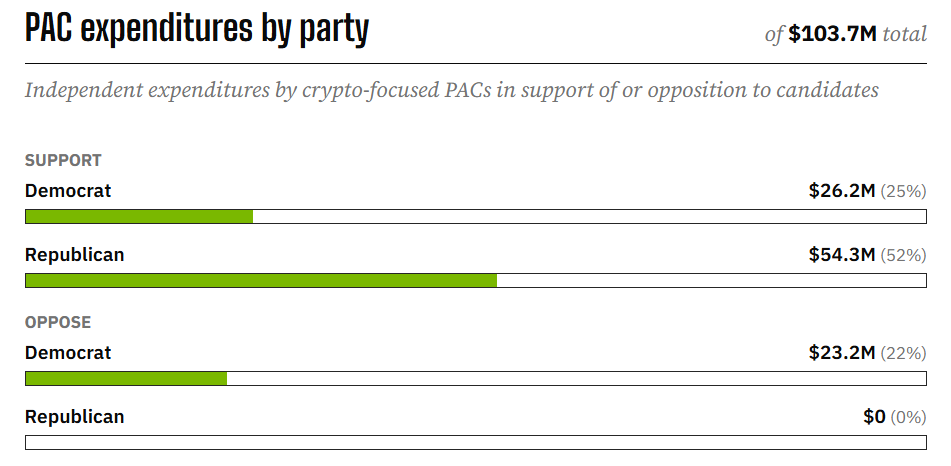
Data from Tech Influence Watch, a tracker monitoring crypto-focused political action committees (PACs), starkly illustrates the partisan tilt in campaign contributions. As of Thursday, these PACs have channeled an estimated $54.3 million towards supporting Republican candidates in the ongoing 2026 election cycle. In stark contrast, support for Democratic candidates stands at $26.2 million – less than half the amount directed to their Republican counterparts. Compounding this imbalance, an additional $23.2 million has been expended explicitly opposing Democratic candidates, further deepening the partisan divide and potentially entrenching animosity within the Democratic Party towards crypto-related initiatives.
This significant disparity in financial contributions underscores Cuomo’s central thesis: "When you invest heavily in the Republican Party, by definition, you’re going to alienate Democrats." The implication is that while the industry may believe it is investing in favorable legislative outcomes, it is simultaneously creating a formidable political barrier by alienating the very individuals whose votes are needed to translate legislative proposals into enforceable law.
The Shifting Sands of Congressional Control
The political calculus becomes even more intricate when considering the fluid nature of congressional control. A Kalshi prediction market, as of Thursday, placed the probability of Democrats securing control of both chambers of Congress at approximately 61%. This forecast introduces a critical variable into the crypto industry’s legislative strategy. Cuomo suggested that a Democratic-controlled Congress could pursue one of two paths: either seek to roll back existing agency-level crypto initiatives, potentially disrupting the nascent regulatory frameworks, or paradoxically, work with a future administration, potentially a Trump administration, to pass the full CLARITY Act. This latter scenario, however, would still necessitate a level of bipartisan cooperation that the current spending patterns seem to hinder.
The former governor emphasized the fundamental reality of American governance: "You need Democrats to pass the bill. You need Republicans. You have to be more balanced." This statement serves as a pragmatic reminder that enduring legislation in a bicameral system typically requires broad, bipartisan consensus rather than the concentrated support of a single party.

Beyond Partisan Labels: Democrats and Crypto
Cuomo also actively challenged the prevailing narrative that Democrats are inherently anti-crypto. This perception, he argued, is a significant misconception that could be detrimental to the industry’s legislative ambitions. "There’s a sense that Democrats are anti-crypto," he noted, but quickly countered this generalization with a more nuanced perspective.
He posited that the underlying ethos of crypto technology aligns remarkably well with traditional Democratic values. "As a matter of fact, I could argue that the crypto technology is exactly suited to the Democratic Party," Cuomo asserted. He elaborated by connecting crypto’s potential to empower individuals who might otherwise lack access to conventional financial products and services, a core tenet of the Democratic Party’s long-standing commitment to economic inclusion and opportunity. Decentralized finance (DeFi) and blockchain’s ability to reduce intermediaries, lower transaction costs, and provide immutable records could, in theory, resonate with progressive ideals of fairness and accessibility.
However, despite this philosophical alignment, several factors contribute to Democratic hesitancy or opposition. Concerns often revolve around consumer protection, particularly given the volatility and occasional scandals within the crypto market. Environmental impact, particularly the energy consumption associated with proof-of-work consensus mechanisms, is another significant area of apprehension for many Democrats. Furthermore, issues surrounding illicit finance, money laundering, and sanctions evasion through cryptocurrencies present substantial regulatory challenges that the party is keen to address to safeguard national security and financial integrity. These legitimate concerns, rather than an outright ideological opposition to the technology itself, often drive Democratic calls for stringent regulation and oversight.
Legislative Timeline and Bipartisan Hurdles
The journey of key crypto legislation through Congress vividly illustrates the challenges of achieving bipartisan consensus. The CLARITY Act, a landmark bill aimed at establishing a comprehensive regulatory framework for digital assets, saw significant bipartisan support in the House of Representatives. In July 2025, the bill passed the House with 78 Democrats joining 216 Republicans in favor, demonstrating a measurable appetite for clear rules within the chamber. However, 134 Democrats voted against it, highlighting the substantial internal divisions within the party on the issue.
Separately, the GENIUS Act, another piece of crypto-focused legislation, found more unified support in the Senate, passing in June 2025 with the backing of 18 Democratic senators. This suggests that certain aspects of crypto regulation can indeed garner bipartisan appeal, particularly when framed around innovation and economic competitiveness.
Despite these earlier successes, the CLARITY Act faced a critical setback in the Senate. In a procedural vote in September, all Senate Democrats, along with four Republicans, voted against advancing the bill. While many of the stated concerns at the time were linked to potential conflicts of interest involving a then-incumbent administration’s crypto businesses, the vote undeniably stalled the bill’s progress. This episode underscored the fragility of bipartisan coalitions and how external factors, even if indirectly related to the core technology, can derail legislative efforts.
Interestingly, following this setback, seven Democratic senators issued a joint statement reaffirming their commitment to passing the CLARITY Act. This move indicated that a segment of the Democratic Party remains genuinely invested in seeing robust crypto legislation enacted, suggesting that the door for bipartisan cooperation is not entirely closed, but rather requires a more carefully calibrated approach from the industry.
The Path Forward: Rebalancing Influence
The political landscape for crypto legislation remains highly dynamic and fraught with challenges. The industry’s current strategy, as highlighted by Cuomo, appears to be a double-edged sword: while it garners strong support from one side of the aisle, it risks alienating the other, thereby jeopardizing the long-term viability of any legislative efforts.
Fairshake, a prominent crypto-focused PAC, recently announced its endorsements for 32 House candidates in November’s midterm elections, demonstrating a slight shift towards a more balanced approach. The PAC declared support for 19 Republicans and 13 Democrats. While still leaning Republican, this distribution suggests an acknowledgment, perhaps nascent, of the need for broader political engagement. This move could be interpreted as a step towards mitigating the perception of partisan bias and fostering relationships across the political spectrum.
For the crypto industry to successfully achieve its goal of regulatory clarity, a fundamental recalibration of its political engagement strategy may be necessary. This would entail not just increased financial contributions to Democrats, but also a concerted effort to engage with Democratic lawmakers on their specific concerns regarding consumer protection, environmental impact, and financial stability. Developing legislative proposals that explicitly address these anxieties, rather than solely focusing on innovation and economic growth, could unlock crucial bipartisan support.
Broader Implications and the Future of US Crypto Policy
The implications of continued legislative gridlock are profound, extending beyond just the crypto industry itself. A lack of clear federal guidelines stifles innovation, drives talent and capital overseas, and leaves consumers vulnerable to unregulated practices. The current patchwork of state-level regulations and enforcement actions by federal agencies like the SEC and CFTC creates an environment of uncertainty that hinders legitimate businesses and sophisticated investors alike.
The United States, long a leader in technological innovation, risks falling behind other jurisdictions that are proactively developing comprehensive frameworks for digital assets. Countries in Europe, Asia, and the Middle East are actively competing to attract crypto businesses and talent through clearer regulatory roadmaps. Without a unified and balanced approach from Congress, the U.S. could cede its competitive edge in this rapidly evolving sector.
Cuomo’s intervention serves as a critical warning and a strategic blueprint. The path to federal crypto legislation in the U.S. is not a partisan sprint but a bipartisan marathon. Success hinges on the industry’s ability to cultivate relationships and build trust across the political divide, demonstrating a commitment to addressing the concerns of all stakeholders, not just those aligned with a particular ideology. The 2026 election cycle and subsequent legislative sessions will be crucial tests of whether the crypto industry can heed this advice and adapt its political strategy to navigate the intricate realities of American democracy.








