Clara Shinta
After a brief pause marked by Friday’s outflows, US-listed spot Bitcoin exchange-traded funds (ETFs) experienced a robust return to positive capital flows on Monday, signaling a renewed wave of investor confidence in the digital asset sector. The resurgence was overwhelmingly spearheaded by BlackRock’s dominant iShares Bitcoin Trust (IBIT), which alone accounted for a substantial majority of the day’s inflows. Concurrently, other significant digital assets, including Ether (ETH), XRP, and Solana (SOL), continued their impressive streaks of attracting capital into their respective ETF and exchange-traded product (ETP) vehicles, underscoring a broadening interest beyond the flagship cryptocurrency.
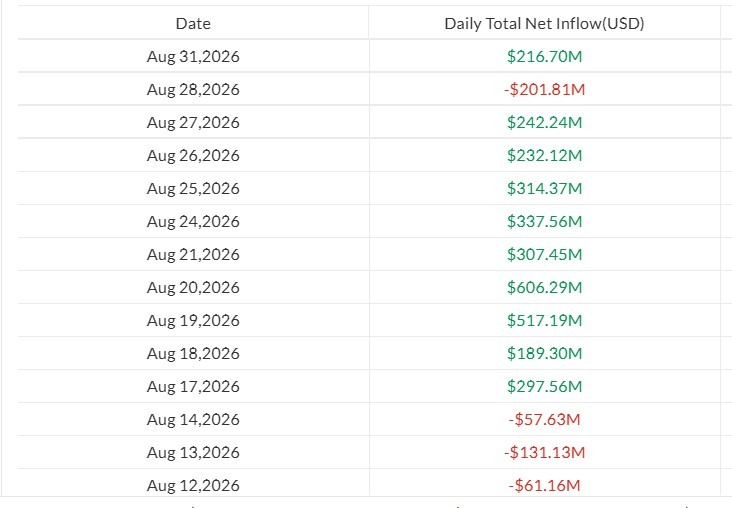
According to data compiled by SoSoValue, spot Bitcoin ETFs recorded a net inflow of $216.7 million on Monday, effectively reversing the $201.8 million in withdrawals that had been registered on the preceding Friday. This Friday outflow had notably broken a remarkable nine-session streak during which these funds had collectively attracted over $3 billion in new capital, demonstrating the strong underlying demand that has characterized the post-launch phase of these innovative investment products. At the time of reporting, Bitcoin (BTC) was trading near the $78,700 mark, reflecting an approximate 1.5% gain over the previous 24-hour period, as per CoinGecko. This price movement suggests that the renewed inflows are providing upward pressure on the asset, reinforcing market sentiment.
Beyond Bitcoin, the momentum in the digital asset market was palpable across other major cryptocurrencies. Ether ETFs extended their impressive streak of inflows to 11 consecutive trading sessions, while both XRP and Solana funds celebrated their 10th consecutive session of attracting capital. This sustained interest in altcoin-focused investment products highlights a maturing landscape where investors are increasingly looking to diversify their exposure within the cryptocurrency ecosystem, moving beyond solely Bitcoin.
A Detailed Look at Bitcoin ETF Performance and BlackRock’s Dominance
Monday’s significant rebound in Bitcoin ETF inflows was unequivocally led by BlackRock’s iShares Bitcoin Trust (IBIT). The fund registered a remarkable $205.9 million in net inflows, an astonishing figure that represented approximately 95% of the total daily capital infusion into the entire spot Bitcoin ETF category, according to analytics from Farside Investors. This commanding performance by IBIT reinforces BlackRock’s rapid ascent as a formidable player in the nascent Bitcoin ETF market, quickly accumulating a vast amount of BTC under management since its inception.
Following BlackRock’s lead, other key players also recorded positive, albeit smaller, inflows. Fidelity’s Wise Origin Bitcoin Fund (FBTC) attracted an additional $6.9 million, showcasing its continued appeal to a segment of the investor base. The Bitwise Bitcoin ETF (BITB) saw inflows of $4.3 million, further solidifying its position among the top-tier offerings. Even niche products like Morgan Stanley’s Bitcoin Trust added $3.6 million, while Grayscale’s Bitcoin Mini Trust, a more recent offering designed to compete with lower fees, attracted $9.4 million. These figures collectively illustrate a broad, albeit uneven, distribution of positive sentiment across various providers.
The only outlier among the actively trading funds was VanEck’s Bitcoin ETF (HODL), which recorded $13.4 million in net outflows. This singular withdrawal suggests that while overall market sentiment was positive, some investors engaged in rebalancing or profit-taking activities within specific funds. The remaining US spot Bitcoin ETFs reported no significant capital movements on Monday, indicating a stable holding pattern for a portion of the market. BlackRock’s outsized contribution suggests a targeted institutional allocation or a concentrated retail interest driving its performance, solidifying its role as a market leader.

The Evolution of Spot Bitcoin ETFs: A Brief Chronology
The journey of US spot Bitcoin ETFs to market approval was a protracted and often challenging one, spanning over a decade of regulatory hurdles and industry advocacy. The landscape dramatically shifted in January 2024 when the U.S. Securities and Exchange Commission (SEC) finally granted approval for several spot Bitcoin ETFs. This landmark decision followed years of rejections, primarily citing concerns over market manipulation and investor protection in the underlying spot Bitcoin market.
Upon their launch, these ETFs were met with unprecedented demand, immediately attracting billions of dollars in capital. This initial surge was partly fueled by pent-up institutional interest and the conversion of Grayscale’s Bitcoin Trust (GBTC) into an ETF, which initially saw significant outflows as investors exited a product that had previously traded at a discount. However, as the market absorbed these initial movements, the net inflows into the newly launched funds, particularly from new entrants like BlackRock and Fidelity, quickly began to dominate, leading to a sustained period of capital accumulation. The nine-session inflow streak that preceded Friday’s minor withdrawal had brought in over $3 billion, a testament to the enduring appeal and growing acceptance of Bitcoin as a legitimate asset class accessible through regulated financial instruments. The consistent performance and the rapid accumulation of Bitcoin by these funds have since established them as a critical conduit for institutional investment into the crypto market, influencing price discovery and market liquidity.
The Broadening Horizon: Ether, XRP, and Solana ETFs Extend Their Runs
The investment community’s appetite for digital assets is clearly expanding beyond just Bitcoin. Spot Ether ETFs, in particular, demonstrated remarkable strength, attracting $87.7 million on Monday. This marked their eleventh consecutive trading session of inflows, a significant milestone that underscores the increasing institutional and retail interest in Ethereum. The catalyst for this surge was the SEC’s landmark decision in May 2024 to approve spot Ether ETFs, signaling a broader regulatory comfort with major cryptocurrencies beyond Bitcoin. This approval was a pivotal moment, opening the door for similar products and legitimizing Ethereum as a mainstream investment vehicle.
BlackRock’s iShares Ethereum Trust ETF (ETHA) led the charge in the Ether category, pulling in $59.9 million, once again demonstrating the asset manager’s formidable market entry strategy. Grayscale’s Ethereum Mini Trust followed with $13.5 million, while Fidelity’s Ethereum Fund added $9.3 million, according to Farside Investors. These inflows indicate that investors are actively seeking exposure to Ethereum’s ecosystem, driven by its foundational role in decentralized finance (DeFi), NFTs, and smart contracts, positioning it as a key player in the future of Web3.
The diversification trend extends further into other altcoins, with XRP and Solana-focused investment products also showing robust demand. XRP ETFs, available in various global jurisdictions as ETPs, extended their positive run to 10 sessions, recording $5.64 million in net inflows on Monday, as reported by SoSoValue. These funds have consistently attracted capital during every US trading session since August 18. This sustained interest in XRP comes despite ongoing regulatory uncertainties surrounding the asset in the United States, particularly the prolonged legal battle between Ripple (the company behind XRP) and the SEC. The continued inflows suggest that investors are either optimistic about a favorable resolution for Ripple or are comfortable accessing XRP through regulated products in jurisdictions where clarity exists, viewing it as a distinct asset with potential for significant growth in cross-border payments.
Similarly, Solana ETFs and ETPs also posted their tenth consecutive positive session. However, the daily inflows for Solana-focused products slowed considerably on Monday, dropping to $925,010 from a more substantial $18.1 million on Friday. This figure represented the category’s weakest inflow during its current positive streak. Despite this deceleration, the overall trend remains positive, indicating a sustained, albeit sometimes fluctuating, investor interest in Solana’s high-performance blockchain ecosystem. Solana has gained significant traction for its speed, low transaction costs, and vibrant developer community, making it an attractive alternative for investors seeking exposure to next-generation blockchain technologies. The availability of Solana ETPs in European markets, for instance, provides a regulated avenue for investors to gain exposure to SOL, even as US spot ETF approvals for Solana remain a future prospect.
Broader Market Implications and Expert Commentary
The collective resurgence in inflows across Bitcoin, Ether, XRP, and Solana ETFs and ETPs carries significant implications for the broader digital asset market. Firstly, it signals a powerful reaffirmation of investor confidence in the long-term viability and growth potential of cryptocurrencies. The ability to quickly rebound from a minor outflow event demonstrates the underlying strength of demand, particularly from institutional players who often execute large-scale allocations.
Market analysts widely interpret the sustained inflows as a clear indicator of growing institutional adoption. The consistent dominance of major asset managers like BlackRock and Fidelity in attracting capital underscores that traditional finance is increasingly comfortable allocating significant resources to digital assets. This institutional endorsement lends further legitimacy to the asset class, potentially paving the way for broader integration into mainstream investment portfolios.
Furthermore, the increasing diversification into altcoin-focused investment vehicles reflects a maturation of investor strategies. While Bitcoin remains the primary gateway for many, the growing interest in Ether, XRP, and Solana suggests that investors are moving beyond a purely Bitcoin-centric view, recognizing the distinct value propositions and growth trajectories of other leading cryptocurrencies. This diversification can contribute to a more robust and resilient digital asset market, reducing its dependence on a single asset’s performance. Industry experts believe that as regulatory clarity continues to evolve globally, especially in key markets like the US, the range of accessible digital asset products will expand, offering investors even more granular exposure to various segments of the crypto economy. This trend could also spur innovation in product development, with new ETFs and ETPs tracking other promising altcoins or baskets of digital assets.
The impact on cryptocurrency prices is also noteworthy. Consistent inflows into these regulated products provide steady buying pressure, which can contribute to price appreciation for the underlying assets. While the crypto market is influenced by a multitude of factors, the structural demand created by ETF inflows is a significant bullish catalyst. This is particularly true for Bitcoin and Ether, where large, consistent institutional buying can absorb selling pressure and establish higher price floors.
Looking ahead, the successful launch and sustained growth of US spot Bitcoin and Ether ETFs are likely to accelerate discussions around similar products for other altcoins. While regulatory pathways for assets like XRP and Solana in the US remain complex and subject to ongoing legal and policy developments, the global trend towards regulated crypto investment products is undeniable. The market is keenly watching for further regulatory clarity and potential expansions of the ETF ecosystem, which could unlock even greater institutional capital and mainstream participation in the digital asset space. This ongoing evolution is set to reshape how investors interact with cryptocurrencies, embedding them more deeply within the global financial system.