Clara Shinta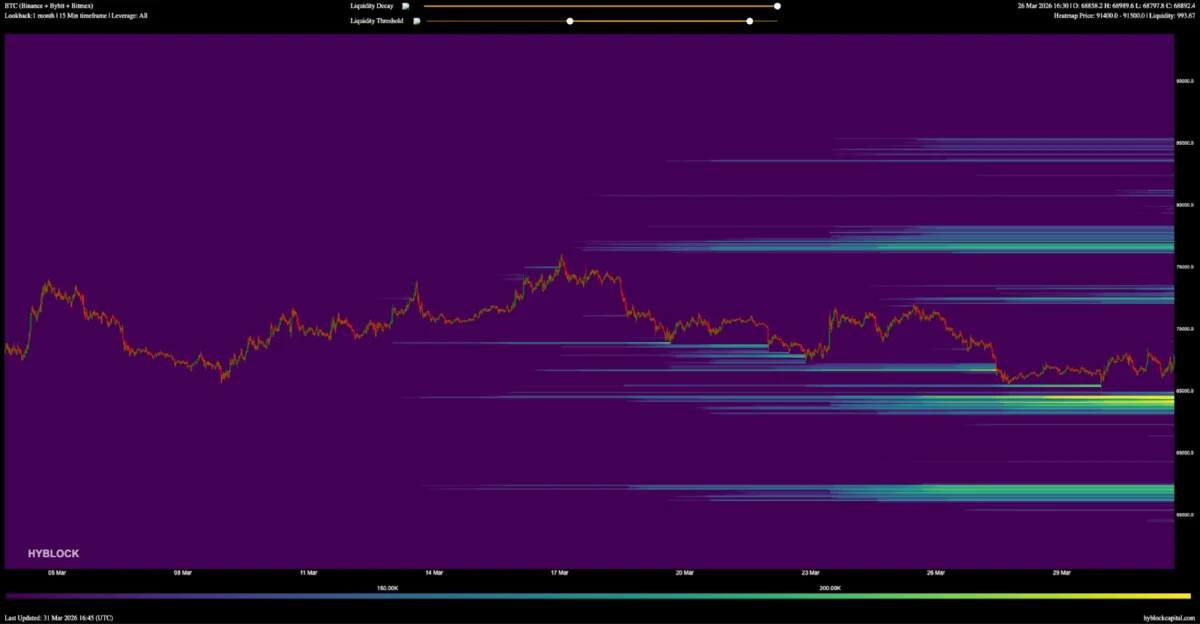
Bitcoin (BTC) has entered an extended period of price consolidation, now stretching into its fifth consecutive week since marking a significant low of $60,000 on February 6. This prolonged phase, characterized by a tightening range in its daily price swings, presents a complex picture for investors and analysts alike, with divergent forecasts emerging regarding its imminent direction. While some market observers point to technical patterns favoring a bearish tilt towards the $60,000 mark, an equally compelling technical argument suggests the potential for a powerful liquidation rally that could propel the cryptocurrency towards $82,000. The current market environment is a crucible of competing forces, balancing the gravity of macroeconomic uncertainties and geopolitical tensions against a backdrop of increasing institutional adoption and bullish technical setups.
The Extended Consolidation Phase: A Test of Market Resolve
The cryptocurrency market, particularly Bitcoin, is renowned for its volatility, yet periods of consolidation are a natural and often necessary part of its price discovery mechanism. For over a month, Bitcoin has largely traded sideways, oscillating between established daily highs and lows, a pattern that typically precedes a significant price movement in either direction. This specific consolidation began in earnest following its retreat from all-time highs earlier in the year, finding a crucial support floor around the $60,000 level. Since then, the daily chart has exhibited a classic tightening range, marked by higher lows and lower highs – a textbook formation often interpreted as a symmetrical triangle or a pennant, signaling a forthcoming breakout or breakdown.
Market participants are closely scrutinizing this narrowing band, understanding that the longer the consolidation, the more explosive the eventual move tends to be. The underlying tension stems from a tug-of-war between profit-taking from earlier rallies and sustained buying interest from new market entrants and institutional players. This extended period serves as a re-evaluation phase, allowing the market to digest recent gains, re-calibrate sentiment, and build energy for the next directional thrust. Historically, Bitcoin has undergone several such consolidation phases, each eventually resolving with a significant price swing that either confirmed a bullish trend continuation or signaled a deeper correction. The current phase is particularly critical as it follows a monumental rally fueled by the approval of spot Bitcoin Exchange-Traded Funds (ETFs) in the United States, suggesting that the market is attempting to establish a new, higher equilibrium.
Bearish Perspectives: Scrutinizing the Market’s Underlying Structure
Despite the potential for a bullish breakout inherent in tightening ranges, a segment of analysts maintains a cautious, if not outright bearish, short-term outlook. Their apprehension is rooted in specific technical indicators and a reading of the overall market structure, which they perceive as still favoring a downward trajectory.
Independent market analyst filbfilb articulated this sentiment in a recent Telegram post, describing the broader market outlook as "still bearish overall." He emphasized the significance of key technical levels, specifically the 50-day moving average (DMA) and a diagonal resistance trendline. According to filbfilb, these levels are "nicely placed to prove that wrong should it be the case," implying that while his primary outlook leans bearish, a decisive breach of these resistance points could invalidate his thesis. He noted, "BTC currently making a reversal back to previous support, the 50 DMA as suspected. The 50-DMA currently sits at $68.8K give or take and is critical to watch IMO."
The 50-DMA is a widely followed technical indicator that represents the average closing price of Bitcoin over the past 50 trading days. It acts as a dynamic support or resistance level, and a break below it is often interpreted as a bearish signal, suggesting a shift in momentum. For filbfilb and others, Bitcoin’s current struggle around this moving average, coupled with its interaction with a descending diagonal resistance, reinforces the view that sellers maintain control. Should Bitcoin fail to reclaim and hold above the 50-DMA, a further retest of lower support levels, potentially towards $60,000, becomes increasingly probable.

Echoing this cautious sentiment, Michael van de Poppe, founder of MN Fund, also forecasted a resumption of the bearish trend in the short term. In a post on X (formerly Twitter), van de Poppe remarked, "It’s probably better to ask ‘when’ instead of ‘if’ we’re going to see the price of Bitcoin fall. It looks quite clear that every bound upwards is slammed back down." This observation highlights the persistent selling pressure that has capped Bitcoin’s upward movements during its consolidation. Each attempt to rally has been met with significant resistance, pushing the price back down and reinforcing the idea that overhead supply is abundant. This pattern of rejection at higher price points suggests a lack of conviction among buyers at these levels and a willingness among sellers to offload their holdings. For these analysts, the market structure, characterized by these repeated rejections, indicates that the path of least resistance in the immediate future remains downwards, potentially leading to a retest of the critical $60,000 support level, or even lower, before any sustained recovery can materialize.
The Counter-Narrative: Bullish Technicals and the Prospect of a Liquidation Rally
Contrasting sharply with the bearish outlook, a robust counter-narrative has emerged, grounded in Bitcoin’s recent resilience and specific technical indicators that point towards a significant upside potential, particularly a "liquidation rally." This perspective argues that the very forces that appear to suppress Bitcoin’s price are, in fact, creating the conditions for a sharp upward movement.
Remarkably, Bitcoin’s price action since the beginning of the week has shown a defiance of conventional wisdom. Despite significant macroeconomic headwinds, including a rally in oil prices above $105 per barrel on Monday and escalating military tensions in Iran casting a shadow of geopolitical uncertainty, Bitcoin has demonstrated unexpected strength. It has largely held firm within the $67,000 to $68,000 range, a behavior that contradicts its typical sensitivity to global risk-off events. This resilience suggests an underlying demand or a shift in investor perception, where Bitcoin might increasingly be viewed as a store of value or a hedge against traditional market instability, rather than purely a high-beta risk asset.
From a technical standpoint, the potential for a substantial rally hinges on Bitcoin’s ability to decisively flip the $68,879 level. This specific price point aligns with the 38.2% Fibonacci retracement level, a crucial technical benchmark derived from the Fibonacci sequence that helps identify potential support and resistance levels. A successful break and sustained hold above this Fibonacci level would signal a significant shift in market momentum, indicating that Bitcoin has overcome a key resistance hurdle and is poised for further gains.
The most compelling argument for an imminent upside move, however, comes from the concept of a "liquidation rally." This phenomenon occurs when a cryptocurrency’s price rises sharply, forcing short sellers (investors betting on a price decline) to close their positions. To close a short position, traders must buy back the asset, creating additional buying pressure that further fuels the price increase, leading to a cascade of liquidations and an accelerated upward movement.
Evidence supporting this potential rally is visible in the volume profile visible range (VPVR) gap on the daily chart and the BTC/USDT liquidation heatmap data. The VPVR is a charting tool that displays trading activity over a specified price range and period. A "gap" in the VPVR signifies areas where there was relatively low trading volume, implying that price could move quickly through these zones once momentum builds. Above current levels, such gaps suggest less resistance for an upward move.
Furthermore, the liquidation heatmap, a tool that visualizes concentrations of leveraged short positions, paints a clear picture. Data from Hyblock indicates significant clusters of short liquidity positioned between $68,500 and $70,000, and even more substantially between $72,000 and $74,000. Should Bitcoin’s price breach the initial resistance, it would trigger a wave of liquidations for short positions in the $68,500-$70,000 range. This forced buying would then likely provide the momentum needed to push the price higher, activating the next cluster of liquidations in the $72,000-$74,000 zone. This domino effect could rapidly propel Bitcoin towards the $82,000 mark, transforming current resistance into a powerful catalyst for a sustained upward trend. This scenario underscores the highly leveraged nature of the cryptocurrency market and how technical setups, combined with concentrated short interest, can lead to dramatic price swings.

Underlying Market Dynamics: Institutional Inflows and Macro Factors
Beyond the immediate technical skirmishes, the broader market dynamics and the evolving landscape of institutional adoption play a pivotal role in shaping Bitcoin’s trajectory. The recent consolidation occurs against a backdrop of significant positive developments that could provide fundamental support for a bullish breakout.
A key factor is the observable resumption of buying activity from institutional investors. Following the initial excitement and subsequent moderation in inflows after the launch of spot Bitcoin ETFs in the U.S., these sophisticated players appear to be re-engaging with the asset. This renewed institutional interest is critical, as it signifies growing confidence in Bitcoin as a legitimate asset class and provides substantial capital inflows that can absorb selling pressure and drive price appreciation. Institutions often have longer investment horizons and greater capital reserves, making their participation a stabilizing and bullish force for the market.
Further cementing institutional conviction, Morgan Stanley, one of the world’s leading financial services firms, has reportedly announced its plans to launch its own spot Bitcoin ETF soon. This development is monumental. Morgan Stanley’s entry into the spot Bitcoin ETF space would not only legitimize Bitcoin further within traditional finance but also open up a vast new channel for capital allocation from its extensive client base, including high-net-worth individuals and institutional clients who previously had limited direct exposure options. Such a move from a financial giant signals a clear institutional acceptance of Bitcoin and could trigger a new wave of demand.
Adding to this bullish sentiment are the hefty purchases by companies like Strategy (formerly MicroStrategy). Strategy has been a pioneering corporate adopter of Bitcoin, consistently adding substantial amounts of BTC to its balance sheet. Their ongoing accumulation, often involving multi-billion-dollar plans to fund Bitcoin buys, serves as a powerful vote of confidence in Bitcoin’s long-term value proposition and acts as a significant demand driver in the market. These strategic corporate acquisitions remove a considerable amount of Bitcoin from circulating supply, contributing to scarcity and potentially upward price pressure.
Moreover, the context of geopolitical events cannot be overlooked. Traditionally, periods of global instability, such as the oil rally above $105 and military escalations, tend to drive investors towards traditional safe-haven assets like gold or the U.S. dollar. However, Bitcoin’s recent resilience in the face of these specific tensions suggests a potential shift in its role. While not yet universally recognized as a safe haven, its ability to hold ground amidst such turmoil indicates a growing perception of its uncorrelated nature or its utility as an alternative asset during times of economic uncertainty. This evolving narrative could attract a new class of investors seeking refuge from conventional market volatility, further diversifying Bitcoin’s investor base. The combined effect of these institutional endorsements and Bitcoin’s surprising resilience against external shocks creates a compelling argument for a fundamentally strong market, even amidst short-term technical challenges.
Broader Implications and Investor Sentiment
The resolution of Bitcoin’s current consolidation phase carries significant implications not just for the cryptocurrency itself, but for the entire digital asset ecosystem and global financial markets. A decisive breakout or breakdown will invariably influence investor sentiment, market stability, and the trajectory of broader crypto adoption.
Should Bitcoin achieve a sustained rally towards $82,000, fueled by a liquidation cascade, it would send a powerful message of renewed bullish momentum. This would likely invigorate retail investor confidence, potentially attracting fresh capital from those who have been waiting on the sidelines. For institutional investors, a move to new highs would validate their strategic allocations and potentially accelerate further institutional inflows, as firms seek to capture upside potential and maintain competitive positioning. A strong Bitcoin performance often acts as a leading indicator for the broader altcoin market, suggesting that such a rally could usher in a new wave of enthusiasm across the entire crypto space, including decentralized finance (DeFi) and non-fungible tokens (NFTs).

Conversely, a tilt towards the $60,000 level or below would likely trigger a wave of caution and potentially a period of fear. While a retest of $60,000 might be seen as a healthy correction by some, a break below this critical support could signal a deeper bearish trend. This scenario could lead to increased profit-taking, reduced trading activity, and a temporary dampening of investor enthusiasm. For institutional players, a significant downturn might lead to a re-evaluation of their crypto strategies, although long-term investors often view such pullbacks as accumulation opportunities. The volatility inherent in such moves underscores the importance of risk management for all participants, from individual traders to large-scale investment funds.
The current juncture highlights Bitcoin’s dual identity as both a speculative asset driven by technicals and sentiment, and an increasingly institutionalized asset influenced by macroeconomics and traditional finance flows. The outcome of this consolidation will be closely watched as a bellwether for the crypto market’s health and its ongoing journey towards mainstream integration. The interplay between technical indicators, fundamental developments like ETF approvals, and geopolitical events underscores the complexity of forecasting Bitcoin’s price. What is clear is that Bitcoin stands at a critical inflection point, and its next major move will undoubtedly shape narratives and investment strategies for the foreseeable future.
Concluding Outlook: Awaiting the Decisive Move
As Bitcoin navigates this pivotal five-week consolidation, the market remains on edge, awaiting a decisive directional move. The conflicting signals from prominent analysts and the technical charts underscore the inherent uncertainty and the high stakes involved. On one hand, the cautious and bearish perspectives, championed by analysts like filbfilb and Michael van de Poppe, highlight the persistent selling pressure and the critical resistance levels, particularly the 50-day moving average at approximately $68.8K, which must be overcome to invalidate a short-term bearish bias. Their assessment of the current market structure suggests that downward pressure continues to weigh on upward movements, leading to a potential retest of the $60,000 support.
On the other hand, a compelling technical argument, bolstered by Bitcoin’s recent resilience against adverse macroeconomic and geopolitical events, points towards a strong potential for a liquidation rally. The confluence of the 38.2% Fibonacci retracement level at $68,879, a visible range volume profile gap, and significant clusters of short liquidations positioned between $68,500-$70,000 and $72,000-$74,000, creates a highly charged environment for an upward breakout. Should Bitcoin successfully flip the $68,879 level, these technical factors suggest a rapid ascent towards $82,000, driven by forced short covering.
The underlying market dynamics further complicate this outlook. The re-engagement of institutional investors, the impending launch of a spot Bitcoin ETF by Morgan Stanley, and the sustained accumulation by entities like Strategy provide a robust fundamental demand base that could ultimately overpower short-term bearish technicals. Bitcoin’s unexpected strength amidst global tensions also hints at an evolving perception of its role in a diversified portfolio.
Ultimately, Bitcoin stands at a critical juncture where both significant upside and downside movements appear plausible. The coming days and weeks will be crucial as market participants keenly observe which technical levels yield and which hold firm. The resolution of this extended consolidation will not only dictate Bitcoin’s immediate price action but also set the tone for the broader cryptocurrency market, influencing investor sentiment and strategic positioning well into the future.