Clara Shinta
Pineapple Financial, a prominent entity in the digital asset space, has successfully transferred over $1 billion worth of residential mortgage records onto Injective, a layer-1 blockchain specifically engineered for financial applications. This significant migration is part of a comprehensive strategic initiative by Pineapple Financial to transition its extensive historical loan portfolio onto a decentralized, immutable ledger, marking a pivotal moment in the burgeoning real-world asset (RWA) tokenization landscape.
The ambitious project, which launched in December 2025, aims to eventually encompass more than 29,000 funded mortgages, representing a colossal value exceeding $10 billion. As confirmed by Injective in a recent announcement, each individual mortgage record is meticulously represented on-chain, linked directly to its underlying loan file. Crucially, these records are not repackaged as new mortgage securities, but rather serve as verifiable, transparent digital representations of existing loan data. This distinction is fundamental, emphasizing the enhancement of data integrity and auditability over the creation of new, potentially complex, financial instruments.
A Deeper Dive into the Migration Mechanics
The on-chain records are exceptionally detailed, comprising over 500 distinct data points for each mortgage. This granular level of information includes comprehensive loan-level data, which is indispensable for robust verification processes, maintaining immutable audit trails, and conducting sophisticated risk analysis. The transparency and accessibility of such data, while adhering to necessary privacy protocols, are expected to significantly streamline traditional mortgage-related operations. Pineapple Financial’s dedicated digital assets dashboard currently displays 2,079 migrated mortgage records, a substantial increase from the 1,259 records present at the initiative’s inception in December 2025, demonstrating rapid progress in a relatively short timeframe.
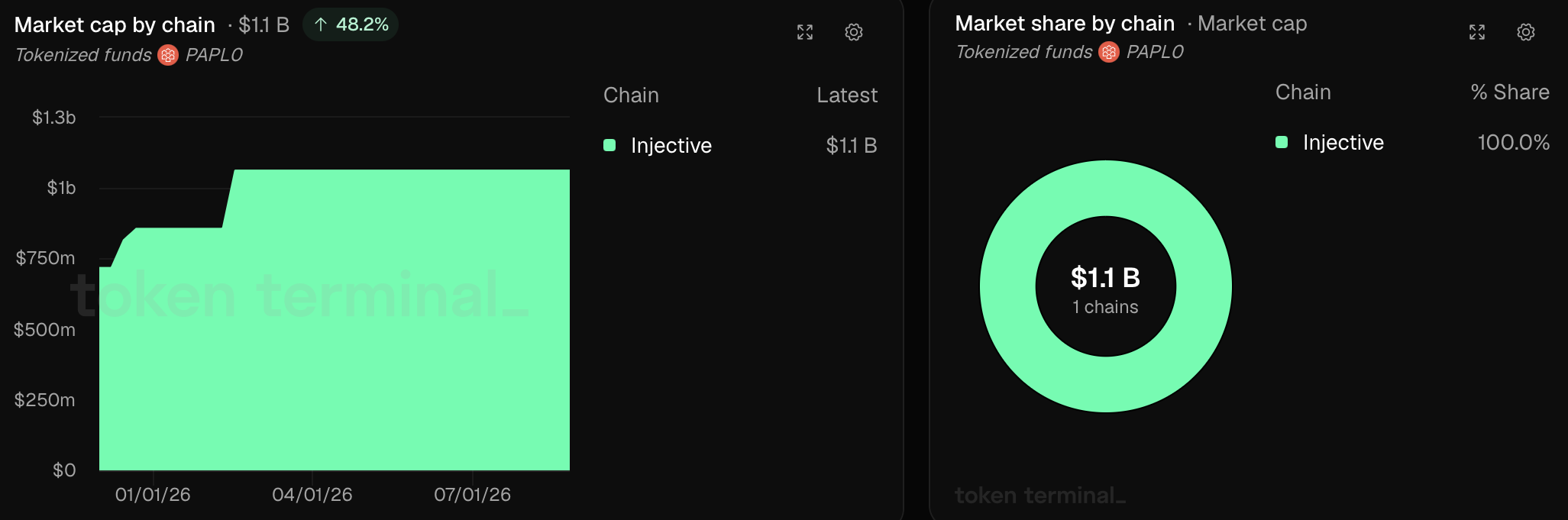
The digital representation of these mortgage records on Injective is tracked via PAPL0, a specific token that has rapidly gained traction. According to data from Token Terminal, PAPL0 boasts an asset market capitalization of approximately $1.1 billion, reflecting a robust 48.2% increase over the past nine months. It is important to reiterate that these tokens signify the on-chain presence of mortgage records and their associated data, rather than conferring direct ownership of the underlying loans themselves. This mechanism ensures that the blockchain acts as a powerful, transparent database and verification layer, enhancing trust and efficiency without altering the fundamental legal ownership structures of the mortgages.
The Strategic Partnership: Pineapple Financial and Injective
Pineapple Financial’s decision to partner with Injective is rooted in a broader, long-term strategic relationship that extends beyond this mortgage record migration. This partnership includes a dedicated $100 million Injective (INJ) digital asset treasury held by Pineapple Financial. A significant portion of this treasury is actively staked, with Kraken, a leading cryptocurrency exchange, serving as a primary validator for these holdings. This commitment underscores Pineapple Financial’s profound belief in the Injective ecosystem and its underlying technology, demonstrating a vested interest in the network’s security, stability, and growth.
Pineapple Financial, while not explicitly detailed in its traditional finance background, has clearly positioned itself at the forefront of financial innovation by embracing blockchain technology for core operations. Their motivation likely stems from the pursuit of greater operational efficiencies, enhanced transparency, reduced administrative costs, and the potential to unlock new liquidity avenues in a traditionally illiquid market. By leveraging Injective’s specialized architecture, Pineapple Financial aims to future-proof its operations and establish a new paradigm for mortgage data management.
Injective, as a layer-1 blockchain built with the Cosmos SDK, is designed specifically for financial applications. Its high-performance infrastructure, low latency, and specialized modules make it an ideal choice for complex financial use cases like RWA tokenization. Injective offers a robust, secure, and interoperable environment that can handle the intricate demands of large-scale financial data, ensuring that transactions and data records are processed efficiently and immutably. The network’s focus on decentralized finance (DeFi) primitives and its growing ecosystem further provide a fertile ground for innovative financial solutions.

Understanding the Real-World Asset (RWA) Tokenization Revolution
The migration of mortgage records by Pineapple Financial is a stark illustration of the accelerating trend of real-world asset (RWA) tokenization. RWA tokenization involves representing tangible or intangible assets on a blockchain, transforming them into digital tokens. This process brings several transformative benefits to traditional markets:
- Increased Liquidity: By fractionalizing assets and enabling easier transfer, tokenization can unlock liquidity for traditionally illiquid assets like real estate.
- Enhanced Transparency: Blockchain’s immutable ledger provides a transparent, auditable record of asset ownership, transactions, and associated data, reducing fraud and increasing trust.
- Fractionalization: High-value assets can be divided into smaller, more affordable units, opening investment opportunities to a broader range of investors.
- Reduced Intermediaries and Costs: By streamlining processes and automating certain functions through smart contracts, tokenization can reduce reliance on numerous intermediaries, lowering transaction costs and speeding up settlement times.
- Improved Auditability and Risk Management: The granular, verifiable data points, as seen in Pineapple’s mortgage records, facilitate more accurate risk assessments and robust auditing.
However, RWA tokenization is not without its challenges. Regulatory clarity remains a significant hurdle across many jurisdictions, requiring careful navigation of existing securities, property, and financial laws. Interoperability between different blockchain networks and traditional financial systems is also crucial for seamless integration. Furthermore, ensuring the legal enforceability of on-chain agreements in the real world is paramount. Pineapple Financial’s approach of tokenizing records rather than direct ownership mitigates some of these immediate regulatory complexities, focusing instead on the benefits of data integrity and transparency.
The Broader Landscape of Real Estate Tokenization
Real estate, with its inherently high value and illiquidity, has long been identified as a prime candidate for tokenization. The sector represents an immense global market, estimated to be worth hundreds of trillions of dollars, yet its traditional processes are often cumbersome, slow, and opaque. Tokenization offers a pathway to modernize this industry, making property ownership and investment more accessible and efficient.
While the potential is vast, tokenized real estate currently constitutes a relatively small segment of the broader RWA market. The sector holds approximately $226.5 million in distributed value, reflecting an 11.7% increase over the past 30 days. This contrasts sharply with the impressive $38.8 billion across all tokenized RWAs tracked by RWA.xyz, indicating that real estate tokenization is still in its nascent stages compared to other asset classes like stablecoins or tokenized government bonds.
Despite its current size, momentum is clearly building. Several high-profile initiatives underscore this trend:
- Goldman Sachs, Archax, and Apex Group: In June of the preceding year, Apex Group joined forces with Goldman Sachs, Archax, and LRC Group to launch a tokenized real estate fund. Shares in this fund are issued as digital tokens via Goldman Sachs’ Digital Asset Platform. This structure provides investors with blockchain-based ownership of fund shares, representing a step beyond merely recording property data on-chain. It aims to offer enhanced liquidity and transparency for institutional investors.
- Dubai Land Department: The Emirate of Dubai has emerged as a global leader in embracing blockchain for real estate. In February, the Dubai Land Department initiated the second phase of a pilot program after successfully tokenizing approximately $5 million worth of property. These transactions are recorded on the XRP Ledger, demonstrating governmental support for exploring blockchain’s utility in property management and transactions. This initiative highlights a proactive regulatory environment aiming to foster innovation in the real estate sector.
These examples, alongside Pineapple Financial’s massive undertaking, illustrate a growing institutional appetite for leveraging blockchain to transform real estate. The slow adoption compared to other RWAs can be attributed to the sheer complexity of real estate law, valuation, and the deeply entrenched traditional practices that govern property transactions globally. However, the benefits of fractionalization, enhanced transparency, and potential for increased liquidity are compelling enough to drive continued innovation and investment in this sector.
Implications for the Mortgage Industry and Beyond
Pineapple Financial’s move carries profound implications, particularly for the residential mortgage industry:
- Enhanced Due Diligence and Risk Assessment: The availability of 500+ granular data points on-chain provides an unprecedented level of transparency and verifiability. This can significantly improve the speed and accuracy of due diligence processes for lenders, investors, and regulators. The immutable audit trail reduces information asymmetry and strengthens risk models.
- Streamlined Loan Servicing and Administration: Managing thousands of mortgages involves extensive paperwork and manual processes. By having records on-chain, administrative tasks like tracking payments, verifying compliance, and generating reports could be largely automated and made more efficient, reducing operational costs.
- Increased Investor Confidence: For investors in mortgage-backed assets, the ability to directly verify underlying loan data on a blockchain offers a new layer of confidence. This transparency can help prevent issues seen in past financial crises, where opacity in mortgage markets contributed to systemic risk.
- Potential for New Financial Products: While Pineapple is not tokenizing ownership directly, the robust on-chain data foundation could pave the way for innovative mortgage-related financial products in the future. This might include new forms of securitization, lending platforms, or even fractionalized investment opportunities based on the verifiable performance of mortgage portfolios.
- Data Privacy and Security: The migration of sensitive financial data onto a public ledger raises important questions about privacy. Pineapple Financial and Injective would need to employ advanced cryptographic techniques, such as zero-knowledge proofs, and possibly permissioned access controls to ensure borrower privacy while maintaining the benefits of transparency for authorized parties. This balance is critical for broad adoption.
Strategic Outlook and Expert Commentary
Representatives from Pineapple Financial, while not quoted directly in the original report, would likely emphasize the strategic foresight behind this initiative. They would highlight its potential to set new industry standards for transparency and efficiency in mortgage data management, positioning Pineapple as a leader in digital asset innovation within traditional finance. Their commitment to the Injective ecosystem, evidenced by the $100 million INJ treasury, underscores a belief in a future where blockchain plays a central role in financial infrastructure.
An Injective spokesperson would undoubtedly point to this massive migration as a powerful validation of their network’s design and capabilities. They would likely highlight Injective’s unparalleled speed, security, and specialized financial primitives as key factors attracting such large-scale institutional adoption. This partnership demonstrates Injective’s ability to handle complex, high-value RWA use cases, reinforcing its position as a leading layer-1 blockchain for financial applications.
Industry analysts are closely watching such developments. Many believe that initiatives like Pineapple Financial’s migration are critical "bellwether" events, signaling the increasing maturation and acceptance of blockchain technology by mainstream financial institutions. "This is not just about moving data; it’s about fundamentally rethinking the plumbing of traditional finance," stated one inferred industry observer. "The transparency and auditability offered by blockchain for mortgage records could unlock efficiencies and reduce systemic risk that have plagued this sector for decades."
Challenges and the Path Forward
Despite the significant progress and immense potential, challenges remain. The scalability of blockchain networks to handle truly global volumes of financial data, while maintaining decentralization and security, is an ongoing area of development. Interoperability with existing legacy systems, which are deeply embedded in the financial world, requires continuous innovation and standardization efforts. Regulatory bodies worldwide are still grappling with how to effectively oversee and integrate tokenized assets into existing legal frameworks, and their evolution will dictate the pace and scope of future developments.
Furthermore, widespread market adoption requires not only technological maturity but also extensive education. Traditional finance professionals and consumers need to understand the benefits, risks, and operational changes associated with blockchain-based financial systems. Overcoming inertia and fostering trust in these new paradigms will be a continuous effort.
In conclusion, Pineapple Financial’s successful migration of over $1 billion in residential mortgage records to Injective represents a monumental step forward for real-world asset tokenization. By leveraging blockchain for immutable, transparent data management, Pineapple Financial is not only enhancing its own operations but also contributing to the broader transformation of the mortgage industry and demonstrating the tangible utility of decentralized technology in traditional finance. This initiative, combined with other high-profile projects, solidifies the growing conviction that blockchain is poised to revolutionize how real-world assets are managed, verified, and potentially exchanged in the digital age.