Clara Shinta
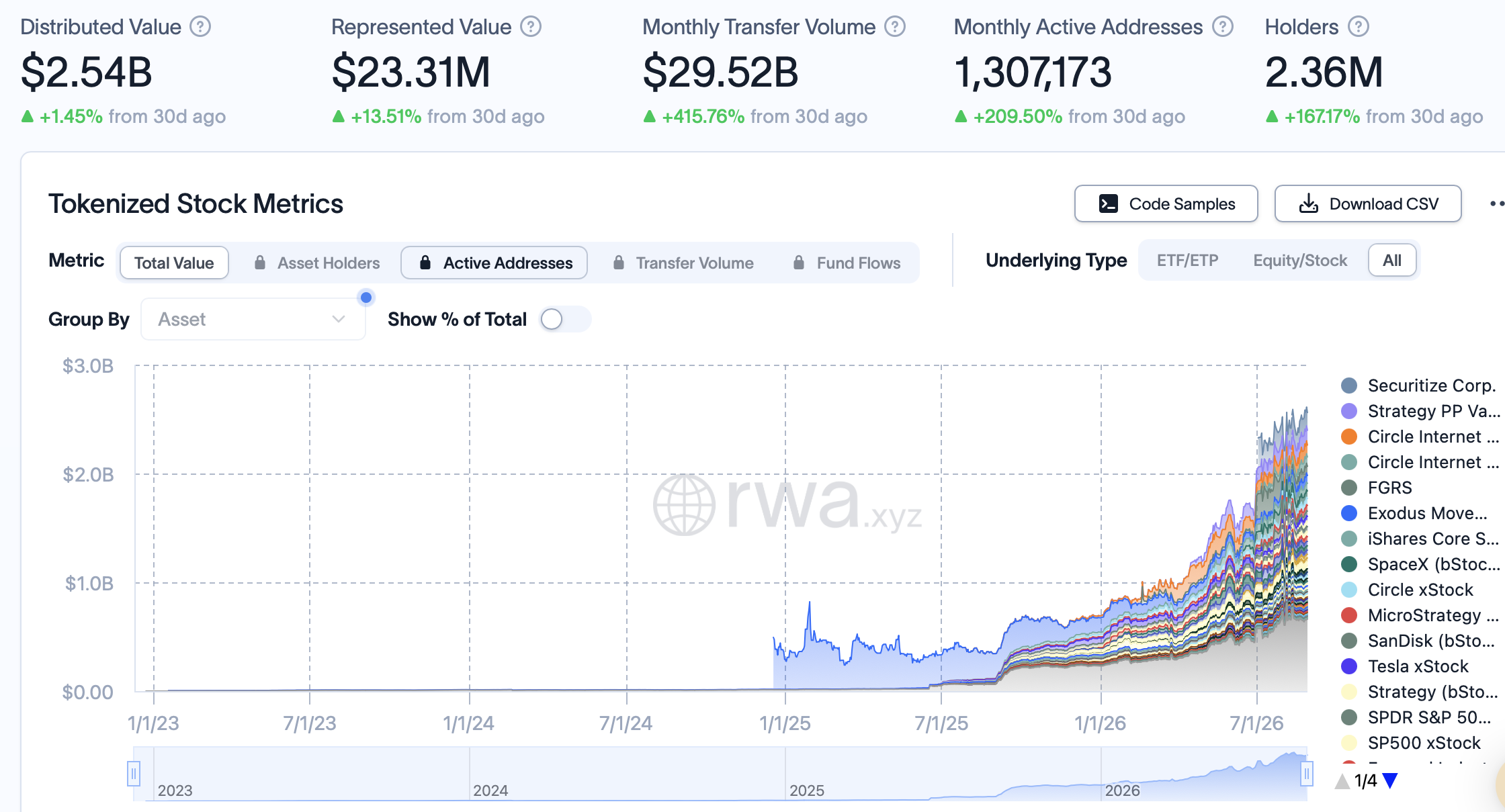
The nascent market for tokenized stocks has experienced an extraordinary period of growth over the past 30 days, with monthly transfer volume skyrocketing by more than 415% to reach an impressive $29.5 billion. This remarkable surge, detailed in recent data compiled by RWA.xyz, underscores a rapidly accelerating integration of traditional financial assets with blockchain technology, signaling a pivotal shift in how investors access and interact with global equities. The dramatic increase in activity is not isolated to trading volume alone; it reflects a broader expansion of the ecosystem, encompassing a significant rise in active participants and the total value of assets distributed on-chain.
The comprehensive data from RWA.xyz paints a vivid picture of this burgeoning sector’s momentum. Beyond the headline-grabbing transfer volume, the number of monthly active addresses engaging with tokenized stocks soared by over 209%, climbing to approximately 1.3 million unique participants. Concurrently, the total count of tokenized stock holders expanded by 167% within the same 30-day window, reaching an estimated 2.36 million individuals and entities. These figures indicate not just heightened trading intensity but also a substantial widening of the investor base, suggesting growing mainstream acceptance and interest in this innovative financial instrument. Furthermore, the total value of tokenized stocks distributed on-chain saw a modest but steady increase of 1.45% over the past month, settling at $2.54 billion. This current valuation represents a staggering 637% increase from the $344 million recorded just one year ago, highlighting the exponential growth trajectory of tokenized equities over a longer timeframe.
Understanding the Phenomenon of Tokenized Stocks
To fully appreciate the significance of this surge, it is crucial to understand what tokenized stocks are and why they are gaining traction. Tokenized stocks are digital representations of traditional shares issued on a blockchain. Each token typically represents ownership of a fractional share in a company, backed by actual equity held by a regulated custodian. This innovative approach offers several compelling advantages over conventional stock ownership. Firstly, it democratizes access to global equity markets, allowing investors from regions with restricted access to participate. Secondly, it enables fractional ownership, meaning investors can buy a small portion of an expensive stock like Nvidia or Apple, lowering the barrier to entry for many. Thirdly, tokenized stocks often facilitate 24/7 trading, unlike traditional exchanges that operate within specific business hours. This continuous liquidity can be particularly appealing to a global investor base. Finally, by leveraging blockchain technology, tokenized stocks introduce enhanced transparency, immutability of records, and the potential for seamless integration with decentralized finance (DeFi) applications, opening up new avenues for utility such as collateral for loans or participation in yield-generating protocols.
The concept of tokenizing real-world assets (RWAs) has been a significant narrative in the blockchain space, aiming to bridge the gap between traditional finance and the decentralized ecosystem. Tokenized stocks are a prime example of this RWA trend, bringing tangible, regulated financial instruments into the crypto domain. The recent explosion in activity indicates that this bridge is not merely conceptual but is being actively built and utilized by a growing number of participants.
Leading Instruments and Platforms Driving Growth
The market for tokenized stocks, while still evolving, is already seeing distinct leaders emerge among individual instruments and platforms. According to RWA.xyz data, Securitize Corp. stands out as the largest individual tokenized stock tracked, boasting approximately $163 million in distributed value. Following closely are Strategy PP Variable xStock at $136 million and an Ondo-tokenized version of Circle Internet Group, valued at $109 million. These top individual tokens reflect investor confidence and demand for specific, often institutional-grade, offerings within the tokenized landscape.
When examining the platforms facilitating this activity, a clear hierarchy also becomes apparent. Ondo has taken a commanding lead, responsible for $842.8 million in distributed value. Kraken’s xStocks follow with a substantial $609.3 million, and Binance’s bStocks round out the top three with $599.9 million. Collectively, these three platforms account for roughly 81% of the entire tokenized stock market by distributed value. This high concentration suggests that early movers and platforms with robust infrastructure, strong liquidity, and broad user bases are currently dominating the space. Their ability to attract significant capital and users highlights the importance of regulatory compliance, user experience, and a diverse range of offerings in capturing market share in this rapidly expanding sector. The competition among these platforms is likely to intensify as the market matures, potentially leading to further innovation and improved services for investors.
A Timeline of Recent Catalysts and Strategic Expansions
The remarkable surge in tokenized stock activity is not an isolated event but rather the culmination of strategic initiatives and new product launches by key players in the crypto and fintech space. These developments have progressively introduced new avenues for investors to trade, hold, and leverage tokenized equities on-chain, acting as significant catalysts for the recent growth.
One of the most impactful recent events occurred on August 24, when Coinbase, a leading cryptocurrency exchange, launched its tokenized US stocks on Base, its Ethereum Layer 2 blockchain. This move was particularly significant as it enabled eligible non-US users to trade these assets around the clock, bypassing traditional market hours. The B20 tokens, representing shares in tech giants such as Nvidia, Apple, Meta, and Alphabet, can also be held in self-custody wallets, offering investors greater control over their assets. This initiative by Coinbase, a major regulated entity, signals a strong endorsement of tokenized equities and their potential to revolutionize global access to financial markets. The integration with Base further enhances the utility of these tokens by making them compatible with the growing ecosystem of decentralized finance (DeFi) applications, allowing for possibilities like collateralized lending or liquidity provision.
Building on Coinbase’s momentum, just a day later, Bitwise, a prominent crypto asset manager, unveiled automated portfolios constructed from Coinbase’s tokenized stocks. These portfolios are designed for eligible non-US investors, allowing them to follow preset investment strategies while maintaining self-custody of the underlying assets. The initial offerings targeted high-demand sectors, including the "Magnificent Seven" (a group of influential tech stocks), robotics, and artificial intelligence. This launch by Bitwise addresses a crucial need for structured investment products in the tokenized stock space, catering to investors who seek diversified exposure without active management. It combines the benefits of tokenization with traditional portfolio management principles, making tokenized investing more accessible and appealing to a broader range of investors, including those new to blockchain-based assets.
Beyond these significant launches, other platforms have also expanded the utility and accessibility of tokenized stocks. In July, Bybit, another major cryptocurrency exchange, integrated tokenized shares of Nvidia, Apple, Tesla, and other US companies as collateral for margin loans. This development enhances the liquidity and flexibility of tokenized holdings, allowing investors to leverage their digital stock positions to obtain capital without selling the underlying assets. Such features blur the lines between traditional equity and crypto markets, creating a more integrated financial ecosystem. Earlier, Robinhood-backed decentralized exchange (DEX) Arcus also made headlines by launching over 95 stock tokens and perpetual markets on Robinhood Chain. This initiative further diversifies the offerings in the tokenized stock market, providing users with more sophisticated trading instruments and greater choice. These collective efforts from major players demonstrate a concerted push to embed tokenized equities deeper into the fabric of crypto platforms and their associated DeFi ecosystems.
The Broader Real-World Asset (RWA) Narrative
The explosive growth in tokenized stocks is a powerful testament to the burgeoning Real-World Asset (RWA) tokenization movement. RWAs refer to any tangible or intangible asset outside the crypto native ecosystem that is represented on a blockchain. This includes everything from real estate and commodities to private credit and, crucially, traditional equities. The RWA narrative gained significant traction as the crypto industry matured, recognizing the immense potential in leveraging blockchain’s efficiencies for assets that traditionally reside in siloed, often opaque, and illiquid markets.
Tokenized stocks fit perfectly within this narrative, offering a clear and tangible use case for blockchain technology beyond speculative cryptocurrencies. By bringing stocks on-chain, the RWA movement aims to unlock liquidity, enhance transparency, reduce settlement times, and lower transaction costs—benefits that are highly appealing to both retail and institutional investors. The success of tokenized stocks suggests a growing confidence in the legal and technological frameworks supporting these digital representations of traditional assets. Industry observers often point to the RWA trend as a key driver for the next phase of blockchain adoption, potentially attracting trillions of dollars from traditional finance into the decentralized ecosystem. The significant increase in tokenized stock activity serves as a strong indicator that this transition is not just theoretical but is actively unfolding, with equities leading the charge.
Implications for Investors and Traditional Finance
The rapid expansion of the tokenized stock market carries profound implications for various stakeholders, from individual investors to the broader traditional financial landscape. For investors, the benefits are multifaceted. Increased accessibility is paramount, as tokenization removes many geographical and operational barriers that have historically limited participation in global equity markets. Fractional ownership democratizes access to high-value stocks, enabling smaller investors to build diversified portfolios. The 24/7 trading capability means investors are no longer constrained by conventional market hours, allowing for greater flexibility and responsiveness to global events. Furthermore, the ability to hold assets in self-custody wallets offers a level of control and security often unavailable in traditional brokerage accounts. The integration with DeFi platforms also opens up novel opportunities, allowing tokenized stock holders to use their assets as collateral for loans, earn yield, or participate in other decentralized financial services, thereby enhancing capital efficiency.
For traditional finance, the rise of tokenized stocks presents both a challenge and an opportunity. It challenges existing intermediaries and market structures by offering a more efficient, transparent, and globally accessible alternative. Legacy institutions may face pressure to innovate and adapt their services to compete with blockchain-native solutions. However, it also presents a significant opportunity for collaboration and innovation. Traditional financial institutions can leverage blockchain technology to streamline their back-office operations, reduce settlement times, and offer new products to their clients. Many are already exploring or actively participating in the RWA tokenization space, recognizing its potential to modernize infrastructure and expand their reach. The increasing volume and participation in tokenized stocks could eventually lead to a more integrated global financial system, where traditional and decentralized finance coexist and interact seamlessly.
Regulatory Horizons and Future Prospects
Despite the undeniable momentum, the long-term success and widespread adoption of tokenized stocks will heavily depend on the evolution of the regulatory landscape. Regulators globally are grappling with how to classify and oversee these novel financial instruments, which blend characteristics of both traditional securities and digital assets. Clarity on issues such as security registration, investor protection, market manipulation, and cross-border transactions is crucial for fostering institutional confidence and ensuring sustainable growth. Different jurisdictions are taking varying approaches, leading to a fragmented regulatory environment that can pose challenges for global platforms. However, the increasing activity itself may spur regulators to develop more comprehensive and harmonized frameworks, potentially leading to greater legal certainty and a more robust market.
Looking ahead, the prospects for tokenized stocks appear bright, provided regulatory clarity emerges. Industry experts and platforms involved in the space generally express optimism, viewing the recent surge as validation of their efforts to bridge traditional and crypto finance. They anticipate continued innovation in product offerings, including more sophisticated investment strategies, broader asset coverage, and enhanced DeFi integrations. The potential for institutional adoption remains a significant growth driver, as large financial entities seek more efficient ways to manage and transfer assets. Challenges such as liquidity fragmentation across different platforms and the need for ongoing investor education will need to be addressed. Nevertheless, the recent data from RWA.xyz strongly indicates that tokenized stocks are moving beyond a niche concept to become a significant and increasingly integral part of the global financial landscape, poised for further expansion and transformation.