Reynand Wu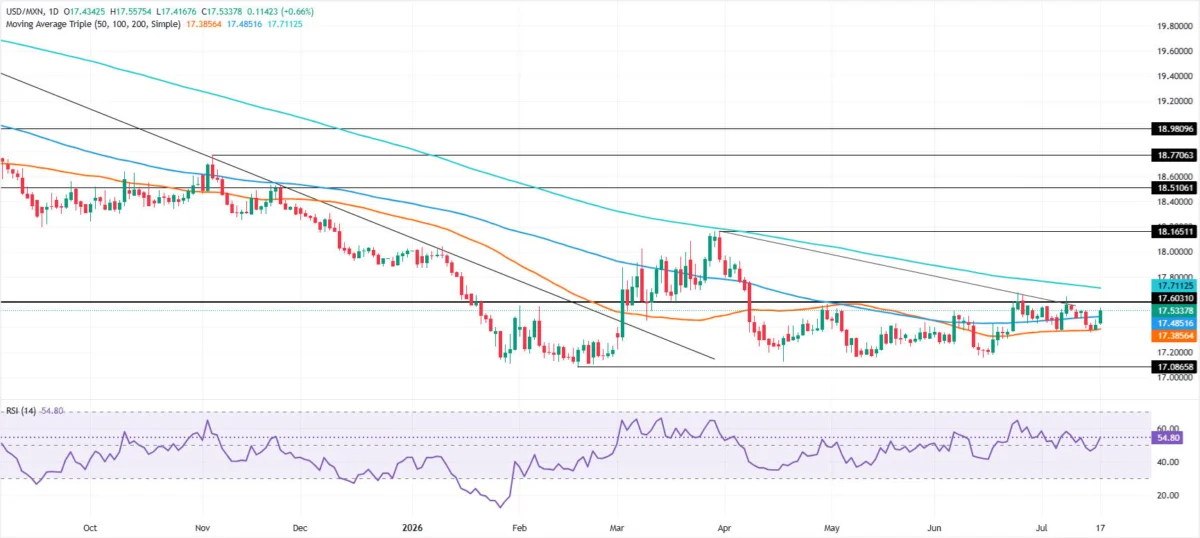
The Mexican Peso experienced a notable loss of traction against the US Dollar during Friday’s North American trading session, depreciating by over 0.65% as the American currency reasserted its safe-haven appeal amidst persistent geopolitical uncertainties stemming from the US-Iran conflict. The USD/MXN pair concluded the week trading at 17.53, having bounced from an earlier daily low of 17.41, signaling a shift in market sentiment that favored the greenback. This movement underscores the intricate interplay of global politics, central bank policies, and commodity markets in shaping currency valuations, particularly for emerging market currencies like the Peso.
Geopolitical Undercurrents: The Enduring US-Iran Standoff
The primary catalyst for the US Dollar’s resurgence as a safe-haven asset was the ongoing and seemingly intractable conflict between the United States and Iran. Despite initial reports of diplomatic talks aimed at de-escalation, the underlying tensions remain palpable, casting a long shadow over global energy markets. The Strait of Hormuz, a critical maritime choke point through which a significant portion of the world’s oil supply transits, lies at the heart of this geopolitical friction. Any perceived threat to shipping or stability in this region invariably triggers anxieties about potential disruptions to oil supplies, leading to upward pressure on crude prices.
The recent escalation, which has seen increased naval activity and exchanges of rhetoric, revives memories of past crises that sent oil prices soaring and injected volatility into financial markets. For investors, the US Dollar, backed by the perceived stability of the US economy and its deep, liquid financial markets, becomes the preferred refuge during such periods of heightened risk. The notion that the conflict is "far from ending" suggests that this safe-haven demand for the Dollar could persist, providing a structural tailwind for the USD against riskier assets.
Economic Crosscurrents: Fed Policy, Oil, and Shifting Market Sentiment
Beyond the geopolitical sphere, a confluence of economic factors contributed to the Peso’s retreat and the Dollar’s advance. Market sentiment broadly deteriorated on Friday, evidenced by a significant sell-off in chip stocks, which often serve as a bellwether for global growth expectations and technological innovation. This sector-specific downturn reflected broader concerns about potential economic slowdowns or supply chain disruptions.
Simultaneously, the renewed ascent in global oil prices, directly linked to the US-Iran tensions, fueled speculation that the US Federal Reserve might be compelled to adopt a more hawkish stance. Higher energy costs are a significant inflationary pressure point, and a sustained rise could complicate the Fed’s efforts to bring inflation back to its 2% target. Such a scenario could lead the Fed to hike interest rates further, or at least maintain them at elevated levels for longer than previously anticipated. This potential shift in monetary policy has crucial implications for the interest rate differential between the US and Mexico.
For much of the preceding period, the substantial interest rate differential, with Mexico’s central bank (Banxico) having initiated its appreciation cycle earlier and maintaining higher benchmark rates than the Fed, had been a significant factor favoring the Mexican Peso. This differential made Peso-denominated assets more attractive to carry traders, driving capital inflows and bolstering the currency’s value, contributing to what analysts often termed the "super peso" phenomenon. However, if the Fed were to continue hiking or delay cuts while Banxico signals a pause or even considers future cuts, this differential could narrow, eroding one of the key pillars of the Peso’s strength.
Mixed Signals from US Economic Data and Fed Commentary
The economic landscape in the US presented a mixed picture, further complicating the outlook for monetary policy. Earlier in the week, benign US inflation data had been met with enthusiasm by investors, who interpreted it as reducing the odds of a Fed rate hike at the upcoming September meeting. This data suggested that disinflationary trends might be taking hold, potentially allowing the Fed to adopt a more accommodative stance sooner.
However, Friday brought new data from the University of Michigan (UoM), revealing a slight improvement in consumer optimism. The Consumer Sentiment Index for July increased to 54 from 50.7, indicating that American consumers were feeling marginally better about current economic conditions and the future outlook. Crucially, both short- and medium-term inflation expectations eased, which could be seen as a positive sign for the Fed’s inflation fight. While improved sentiment is generally positive, the underlying hawkish tilt from some Fed officials continued to resonate.
Cleveland Fed President Beth Hammack, crossing the wires on Friday, delivered a distinctly hawkish message. She expressed deep concern about persistent high inflation, placing it "at the top of her list" of worries, unequivocally stating, "Inflation is too high." Hammack’s comments also highlighted the resilience of the US economy, noting that the labor market remains "solid," "growth numbers are good," and "consumer spending is stable." Such remarks from a prominent Fed official underscore the central bank’s vigilance and its data-dependent approach, suggesting that despite some positive inflation prints, the battle against price pressures is far from over. These statements, juxtaposed with rising oil prices, reinforced the narrative that the Fed might indeed need to keep its options open for further tightening.
The US Dollar Index (DXY) and Broader Strength
The US Dollar Index (DXY), a measure of the American currency’s performance against a basket of six major peers (Euro, Japanese Yen, British Pound, Canadian Dollar, Swedish Krona, and Swiss Franc), registered a modest rise of 0.05% to 100.76. This upward movement, while seemingly small, acted as a significant tailwind for the USD/MXN exotic pair. The DXY’s strength is indicative of broader demand for the Dollar, driven by a combination of safe-haven flows due to global uncertainties, and expectations surrounding the Federal Reserve’s monetary policy path relative to other major central banks. A stronger DXY typically implies that the Dollar is gaining ground across the board, making it more expensive for countries to import US goods and services, and impacting commodity prices often denominated in USD.

A Quiet Day in Mexico, but Key Data Looms
In Mexico, the economic docket remained absent of significant data releases on Friday, allowing global macro developments to largely dictate the Peso’s trajectory. However, the coming week promises to be more eventful for the Mexican economy, with several crucial data points scheduled for release. These include Retail Sales, which will offer insights into consumer spending and overall economic activity; employment data, providing a snapshot of the labor market’s health; and inflation figures for the first fifteen days of July, which will be closely scrutinized by Banxico and market participants alike. These indicators will be vital in shaping expectations for Banxico’s future monetary policy decisions.
Meanwhile, in the US, the upcoming week’s schedule will feature critical jobs data, including the highly anticipated non-farm payrolls report, alongside S&P Global Flash PMIs, offering early indications of manufacturing and services sector performance. Federal Reserve officials have now entered their traditional blackout period ahead of the July 29 policy meeting, meaning no further public comments from policymakers will be forthcoming until after the decision. This period of silence often amplifies market speculation and sensitivity to incoming economic data.
Expert Analysis and Market Outlook
Market strategists are closely monitoring the evolving dynamics. Many analysts infer that the renewed geopolitical risks, particularly concerning the Strait of Hormuz, introduce an unpredictable element that could quickly shift market sentiment. "The US-Iran situation acts as a significant risk premium for oil, which in turn fuels inflation concerns and strengthens the Dollar’s safe-haven appeal," commented one senior currency strategist at a major investment bank, speaking on background due to company policy. "This creates a challenging environment for emerging market currencies, even those like the Peso that have shown resilience."
Economists are also weighing the implications of the mixed US data. While easing inflation expectations from consumers are positive, the hawkish tone from Fed officials like Hammack suggests that the central bank remains focused on its dual mandate and may not be swayed by a single data point. The consensus appears to be that the Fed will remain data-dependent, with the upcoming jobs report and PMIs playing a crucial role in shaping the market’s perception of the July 29 meeting outcome.
For Mexico, the "super peso" narrative, while not entirely dismissed, faces headwinds. "The narrowing interest rate differential, coupled with external shocks like geopolitical conflicts, makes the Peso more vulnerable," noted another market observer. "While Mexico’s fundamentals, including nearshoring benefits and robust remittances, remain strong, global risk aversion can easily overshadow domestic positives in the short term." The impending Mexican economic data will provide a clearer picture of the domestic economy’s resilience in the face of these external pressures.
Technical Outlook: Navigating Key Levels for USD/MXN
From a technical perspective, the USD/MXN pair, trading at 17.5333, currently holds above a clustered support zone formed by its 50, 100, and 200-day simple moving averages (SMAs) around 17.3856. This positioning generally suggests a constructive near-term bias, indicating that the pair remains supported by its broader trend floor. The price is currently testing a significant downward-sloping resistance trend line, originating from the 18.1651 high, with this barrier located near 17.5456. The Relative Strength Index (RSI) over a 14-period window is registering at approximately 54.8, which hints at mildly positive momentum without yet reaching overbought territory, suggesting there might be room for further upside if bullish pressures intensify.
Looking at potential resistance levels, the immediate hurdle is the aforementioned near-term descending trend line at 17.5456. A decisive break above this level could open the path toward a higher structural cap, represented by a longer-term downward resistance line drawn from the 21.0808 high, currently converging near 18.1200. This longer-term resistance would represent a more significant challenge for the bulls.
On the downside, initial support is robustly provided by the triple SMA cluster at 17.3856. A sustained daily close above this crucial moving-average base would be interpreted as a confirmation of the bullish bias, maintaining the upward pressure on the pair. Conversely, a daily close back below this triple SMA support would signal fading upside momentum and could expose the USD/MXN to a deeper corrective phase, potentially targeting lower support levels not immediately visible on the current chart but implied by previous price action. Technical analysts will be closely watching these key levels for directional cues in the coming sessions.
Looking Ahead: Key Events and Potential Catalysts
The immediate future for the USD/MXN pair will be shaped by a series of critical events. Geopolitical developments in the Middle East, particularly concerning the US-Iran conflict and its impact on oil markets, will remain a paramount concern. Any further escalation or de-escalation could trigger rapid shifts in safe-haven demand and inflationary expectations.
On the economic front, the upcoming week’s data releases will be crucial. In the US, the jobs report and Flash PMIs will provide essential inputs for the Federal Reserve’s July 29 meeting. Given the Fed’s blackout period, these data points will carry amplified weight in shaping market expectations for monetary policy. In Mexico, Retail Sales, employment data, and the mid-July inflation report will offer insights into the domestic economy’s health and provide critical guidance for Banxico’s future policy decisions. The divergence or convergence of monetary policies between the Federal Reserve and Banxico, influenced by these data, will be a dominant theme.
Ultimately, the Mexican Peso’s performance against the US Dollar will continue to be a finely balanced act between domestic economic resilience, the attractiveness of its interest rate differential, and the pervasive influence of global risk sentiment and US monetary policy. The recent retreat serves as a reminder of the Peso’s vulnerability to external shocks, even as its underlying fundamentals suggest a capacity for recovery.