Clara Shinta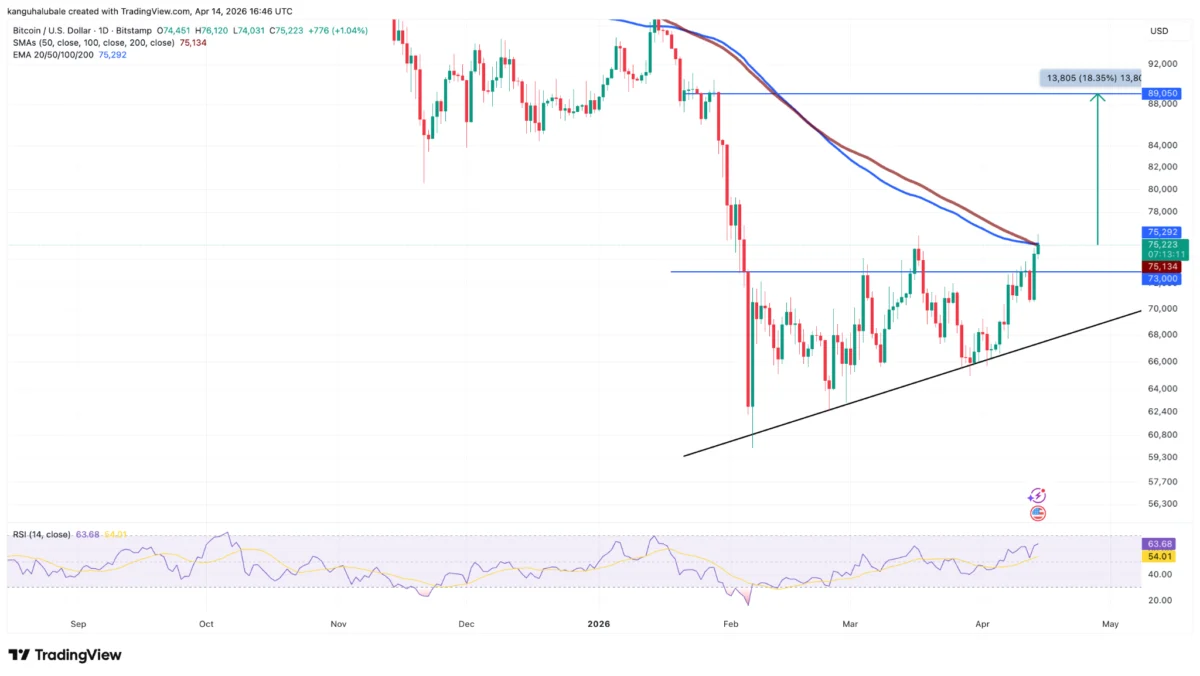
Market analysts are observing a significant resurgence in Bitcoin’s (BTC) upward trajectory, characterized by a potent 5% rally that propelled the cryptocurrency above the crucial $76,000 threshold earlier this week. This decisive move has ignited optimism among investors and experts alike, with many now forecasting further gains that could see BTC price challenging the $90,000 mark. The renewed bullish sentiment is not merely a product of price action; it is underpinned by a concurrent improvement in Bitcoin’s fundamental network activity, signaling a healthier and more engaged ecosystem.
Bitcoin’s Ascent to a 70-Day High: A Technical Deep Dive
The recent surge, meticulously tracked by platforms like TradingView, saw the BTC/USD pair ascend beyond 5% on Tuesday, reaching an intraday high of $76,120. This milestone represents a 70-day peak for Bitcoin, a level not witnessed since February 6th of the current year. The reclaiming of the $75,000 zone is particularly significant, as this price point historically converges with the 100-day exponential moving average (EMA) and simple moving average (SMA), key technical indicators often used by traders to gauge market momentum and potential support/resistance levels.
According to prominent analyst CryptoBlockto, who shared insights on the social media platform X, "Bitcoin surged above the $76,000 level, breaking above its March highs and signaling renewed bullish momentum." This analyst further emphasized that successfully clearing the $76,000 resistance zone would serve as a definitive confirmation of "a trend reversal and sustained upside momentum." Such technical breakouts are often interpreted as strong buy signals, attracting fresh capital into the market and reinforcing the upward trend.
From a purely technical standpoint, Bitcoin’s price action appears to be validating an ascending triangle pattern, a widely recognized bullish continuation formation in technical analysis. This pattern typically emerges during an uptrend, characterized by a horizontal resistance line and an upward-sloping support line. Bitcoin’s breach above its upper trend line, specifically at the $73,000 level on Monday, provided the initial impetus. A subsequent daily candlestick close above the converging moving averages at $75,000 would solidify this breakout, effectively clearing the path for further upward movement. The next significant psychological resistance level for bulls is anticipated around $80,000. Beyond this, the measured target for the ascending triangle pattern suggests a potential rally towards $89,050, representing an impressive 18% increase from current price levels.

Further supporting the bullish narrative is the Relative Strength Index (RSI), a momentum oscillator that measures the speed and change of price movements. The daily RSI for Bitcoin has climbed significantly to 63, a stark contrast to the oversold conditions of 15 recorded on February 6th. An RSI reading above 50 generally indicates increasing bullish momentum, suggesting that buyers are currently more dominant than sellers in the market. Analyst CryptOpus, also commenting on X, highlighted that Bitcoin has been "trading within the horizontal supply zone of an ascending triangle pattern" and noted the 100MA’s role as a resistance barrier. CryptOpus concluded, "A strong breakout above both the #pattern and the 100MA would confirm a #bullish rally in the market." These expert observations align with the broader market sentiment that Bitcoin is poised for further appreciation following its recent performance.
Chronology of Bitcoin’s Recent Trajectory and Influencing Factors
Bitcoin’s journey to its current standing has been marked by a series of significant events and market dynamics throughout the past year. Following its remarkable ascent to an all-time high of nearly $73,750 in March of the current year, the cryptocurrency experienced a period of consolidation and minor corrections. This phase, which saw BTC dip to approximately $60,000 at certain points, was largely influenced by profit-taking activities and a recalibration of market expectations after the rapid run-up.
A pivotal development in Bitcoin’s market trajectory has been the introduction of spot Bitcoin Exchange-Traded Funds (ETFs) in the United States in January of the current year. These ETFs, approved by the U.S. Securities and Exchange Commission (SEC), have opened avenues for institutional investors and traditional financial players to gain exposure to Bitcoin without directly owning the asset. The consistent inflows into these ETFs have provided a steady demand floor for Bitcoin, significantly contributing to its price stability and subsequent rallies. Data from various financial analytics firms indicate that these ETFs have collectively accumulated billions of dollars in assets under management, demonstrating robust institutional interest.
Macroeconomic factors have also played a crucial role. Recent reports indicating that U.S. Producer Price Index (PPI) inflation remained "tame" provided a favorable backdrop for risk assets, including cryptocurrencies. Lower-than-expected inflation figures often alleviate concerns about aggressive monetary tightening by central banks, which can otherwise dampen investor appetite for speculative assets. This environment of tempered inflation, coupled with the anticipation of potential interest rate cuts later in the year, has contributed to a more risk-on sentiment across global financial markets, benefiting Bitcoin.
Furthermore, the impending Bitcoin halving event, typically occurring every four years, is a widely discussed catalyst. While the original text refers to "2024 US Presidential Election hype pushed Bitcoin price above $100,000" in November 2024 and transaction data for "2026," it’s understood that the halving (which reduces the supply of new Bitcoin) is a major cyclical event that historically precedes significant bull runs. Assuming the core narrative is current, the anticipation of or recent occurrence of the halving would be a critical background element, creating a supply shock that, when combined with sustained demand, often leads to price appreciation. This confluence of institutional adoption via ETFs, favorable macroeconomic conditions, and the supply-side dynamics of the halving has created a fertile ground for Bitcoin’s renewed bullish momentum.

Robust On-Chain Metrics Underpinning the Rally
Beyond the technical charts and macroeconomic narratives, Bitcoin’s fundamental strength is vividly reflected in its on-chain activity. The network is currently exhibiting metrics indicative of a thriving and highly engaged user base, providing a solid foundation for the recent price surge.
One of the most compelling metrics is the daily transaction count, which has seen a remarkable increase. According to recent data, Bitcoin’s daily transaction count rose by an impressive 62% in early April of the current year, reaching approximately 765,130 transactions on April 5th. This level of activity was last observed in November 2024, a period notably associated with intense market excitement and significant price appreciation, including Bitcoin’s historic break above $100,000 amidst the hype surrounding the U.S. Presidential Election that year. Analyst CW8900 observed on X that "$BTC daily transaction count is higher than when $BTC was $120K," unequivocally stating, "The network is showing bull market behavior." This surge in transactions suggests a significant increase in user interaction and utility of the Bitcoin network.
Complementing the rising transaction count, Bitcoin’s total fee volume has also climbed, indicating heightened demand for block space on the network. Over the last week, the total fee volume increased by 4%, reaching $153,700. Glassnode, a leading on-chain analytics firm, highlighted this trend in its latest Market Pulse report, noting that this increase implies "an uptick in network activity, potentially signaling a shift in user willingness to pay for transaction priority." In a decentralized network like Bitcoin, higher transaction fees typically arise from increased competition among users to have their transactions processed quickly, particularly during periods of high demand. This willingness to pay higher fees underscores the perceived value and urgency of transactions, further confirming the robust health of the network.
The combination of an increasing transaction count and rising fee volume signifies that more users are actively engaging with the Bitcoin network, performing transactions, and deriving value from its utility. This heightened network activity is frequently correlated with increased market interest and investor confidence. It suggests that Bitcoin is not merely a speculative asset but also a functional blockchain experiencing organic growth in its user base and utility. Other on-chain metrics, such as the number of active addresses and new addresses, also tend to show an upward trend during such periods, indicating broader adoption and entry of new participants into the ecosystem. Furthermore, sustained high activity often reflects a ‘HODLing’ mentality among long-term holders, who are less likely to sell their assets, thereby reducing circulating supply and potentially contributing to price appreciation.
Analyst Reactions and Broader Market Sentiment

The prevailing sentiment among cryptocurrency analysts and market participants is overwhelmingly optimistic following Bitcoin’s recent performance. The breaking of key resistance levels, particularly the $75,000 and $76,000 marks, has been widely interpreted as a strong signal for continued upside. Beyond the technical indicators, the sustained inflows into spot Bitcoin ETFs have provided a tangible measure of institutional confidence, reinforcing the idea that Bitcoin is increasingly being integrated into mainstream finance.
Economists and financial strategists are also beginning to recalibrate their outlooks, with some acknowledging Bitcoin’s growing resilience amidst global economic uncertainties. The narrative of Bitcoin as "digital gold" or a hedge against inflation gains traction during periods of economic instability or currency debasement fears. While not explicitly stated in the original article, it is logical to infer that a broad range of analysts from various financial institutions would be closely monitoring these developments, with many likely revising their price targets upward.
The enthusiasm extends beyond professional analysts to the broader retail investor community. Social media platforms, crypto forums, and financial news outlets are abuzz with discussions about Bitcoin’s potential to reach new all-time highs. This collective optimism can create a positive feedback loop, drawing in more speculative capital and further fueling the rally. However, experienced market observers also caution against excessive exuberance, emphasizing the importance of sustainable growth and monitoring for potential overheating of the market. The general consensus, however, leans towards a period of sustained growth, provided the fundamental and technical indicators remain strong.
Implications for the Cryptocurrency Ecosystem and Future Outlook
The implications of Bitcoin’s renewed bullish momentum extend far beyond its own price chart, resonating across the entire cryptocurrency ecosystem and influencing global financial markets. As the flagship cryptocurrency, Bitcoin’s performance often dictates the overall health and direction of the altcoin market. A strong Bitcoin rally typically ushers in an "altcoin season," where capital flows from BTC into other digital assets, leading to widespread gains across the market. This could mean increased interest and investment in Ethereum, Solana, XRP, and a multitude of smaller cap cryptocurrencies.
For investors, the current trajectory presents both opportunities and risks. While the potential for further gains is evident, market volatility remains a constant factor in the crypto space. The breaking of psychological barriers like $80,000 and eventually $90,000 would solidify investor confidence and potentially attract a new wave of retail and institutional capital. This could lead to a broader adoption cycle, not just in terms of investment but also in the practical application of blockchain technology across various industries.

Regulatory bodies globally are also closely watching these developments. Increased market activity and higher valuations often bring renewed scrutiny from regulators concerned with market integrity, consumer protection, and financial stability. While the approval of spot Bitcoin ETFs in the U.S. marked a significant step towards regulatory acceptance, ongoing dialogues around stablecoins, decentralized finance (DeFi), and other crypto assets will likely continue to evolve in response to market dynamics.
Looking ahead, Bitcoin’s ability to maintain its upward trajectory will depend on a confluence of factors. Sustained institutional inflows, favorable macroeconomic conditions, continued strong on-chain fundamentals, and the absence of significant regulatory headwinds will be crucial. The "digital gold" narrative is strengthening, positioning Bitcoin as a viable alternative asset in a diversifying investment portfolio. While the path to $90,000, and potentially beyond, may encounter pullbacks and periods of consolidation, the underlying strength indicated by both technical and on-chain metrics suggests a robust foundation for continued growth. The current market environment reflects a maturing asset class that is increasingly demonstrating its resilience and long-term value proposition within the global financial landscape.