Clara Shinta

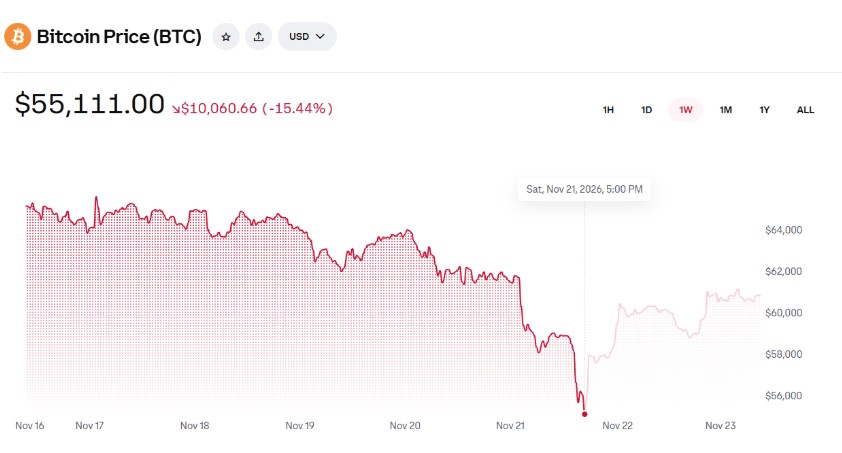
Bitcoin witnessed a notable recovery over the past weekend, surging to $61,034, marking an 11% rebound from its recent cycle low of approximately $55,110 recorded on Coinbase. This upward movement, however, is set against a backdrop of significant turbulence across global financial markets, raising questions about the sustainability of this crypto upturn amidst broader economic anxieties. The cryptocurrency’s price held steady around $60,750 at the time of reporting, but market analysts remain divided on its immediate trajectory, with many anticipating further downward pressure.
Broader Market Instability and Bitcoin’s Resilience
The recent market downturn was not confined to the cryptocurrency sector. Concerns are increasingly mounting over the long-term sustainability of the debt-financed artificial intelligence (AI) build-out, which has contributed to a broader tech sector pullback. The tech-heavy Nasdaq Composite index experienced a sharp decline, falling an additional 5.3% on Friday, pushing it to the brink of a bear market, having already dropped nearly 20% from its October peak. Similarly, the S&P 500 index saw an 8.6% weekly decline, marking its twelfth worst week since 1952. Even traditionally safe-haven assets were not immune, with gold losing another 4.3% within a 24-hour period, accumulating a 21.6% loss since September, and currently on track for its worst three-month performance since June 2013.
This widespread market instability has placed Bitcoin’s recent recovery under intense scrutiny. While the 11% rebound offers a glimmer of hope to investors, many seasoned analysts point to historical parallels within Bitcoin’s four-year halving cycles. These cycles have historically shown tendencies for market bottoms to occur after the US mid-term elections, suggesting that the current market could still be in a consolidation or downtrend phase. Veteran trader Peter Brandt recently articulated this sentiment, noting, “Every bull market phase in BTC’s history has ended with at least a 75% correction of the previous parabolic bull trend. Could this be what’s happening in Bitcoin?” This observation implies a potential for significantly lower prices if historical patterns hold true.
Further analytical frameworks contribute to the debate. Crypto influencer "Cryptobull" offered a counter-perspective, highlighting Bitcoin’s MVRV (Market Value to Realized Value) peak this cycle, which reached only 2.29 times above its cost basis. Extrapolating this to a cycle low, he suggested it would hover around 1.03 times the cost basis of $53,700, aligning closely with Bitcoin’s recent low of $55,130. This analysis implies that the recent bottom might already be in, or very near. However, cycle theorist Benjamin Cowen presented a more cautious outlook, positing that in bear markets, Bitcoin typically falls significantly below its realized price, often reaching the balanced price, which Coinglass currently places at a substantially lower $38,700. These contrasting viewpoints underscore the prevailing uncertainty and the complex interplay of technical indicators, historical precedents, and broader economic factors influencing Bitcoin’s price discovery.
Kraken’s CAD Market Sees Brief Bitcoin Plunge to $17,000
In an isolated but alarming incident, Bitcoin’s price briefly plummeted to approximately US$17,000 on Kraken’s Canadian dollar (CAD) markets. This flash crash, representing a staggering 71% drop compared to its USD market price, sparked immediate concern among traders and observers. However, the cryptocurrency exchange Kraken quickly moved to reassure its user base, stating unequivocally that "everything was fine," that "every order was processed correctly," and that its security teams found no evidence of a breach or compromised accounts. The exchange emphasized that "executed trades stand," confirming the finality of transactions that occurred during the brief anomaly.

Flash crashes are typically characterized by a rapid, deep, and short-lived price decline followed by a swift recovery. They can be triggered by a confluence of factors, including thin order books, particularly on less liquid trading pairs like BTC/CAD, or large market sell orders that overwhelm available buy orders. Algorithmic trading strategies can also exacerbate such events, creating a cascading effect. Kraken’s swift communication and insistence on the integrity of its systems were crucial in mitigating wider panic. However, the incident highlights the inherent volatility and potential for extreme price dislocations, especially on specific exchange pairs, underscoring the importance of liquidity and robust market mechanisms to prevent such occurrences from having broader systemic impacts. For traders, such events serve as a stark reminder of the risks associated with market orders and the need for stop-loss strategies, particularly in illiquid markets.
Ledger Hardware Wallets: A Rising Tide of Tampering Incidents
The security of digital assets was thrust into the spotlight this week with Ledger, a leading hardware wallet manufacturer, issuing a critical warning to customers. The company has advised individuals who purchased hardware wallets in Berlin since January 2026 to contact its support team, as it investigates multiple reports of tampered devices in Germany and the United Arab Emirates. This latest wave of incidents is linked to a sophisticated distribution-channel tampering campaign that Ledger first began investigating in Southeast Asia in October.
The reports detail concerning losses, including two customers in Dubai who collectively lost $604,000 in cryptocurrency after acquiring what appeared to be compromised devices. These incidents underscore a growing and alarming trend of supply chain attacks targeting hardware wallets. Such attacks typically involve malicious actors intercepting devices during transit or at retail points, implanting them with hidden malware or modifying their internal components to compromise the user’s private keys or seed phrase during setup. When a user initializes a tampered device, their funds can be siphoned off by the attackers.
Ledger has reiterated its commitment to user security by offering physical inspections, including advanced X-ray analysis, at its factory in Vierzon, France, for concerned customers. This proactive measure aims to detect any internal modifications that might not be visible externally. The company’s ongoing investigation into a campaign spanning multiple regions, from Southeast Asia to Europe and the Middle East, suggests a well-organized and persistent threat. These events serve as a stark reminder of the paramount importance of purchasing hardware wallets directly from the manufacturer or highly reputable, authorized resellers to minimize the risk of supply chain interception. For cryptocurrency users, the adage "not your keys, not your crypto" extends to ensuring the integrity of the hardware used to secure those keys.
Ethereum’s "Glamsterdam" Upgrade Faces Potential Delays
Ethereum’s ambitious development roadmap is encountering potential roadblocks, with discussions during the latest All Core Devs Call suggesting that the proposed "Glamsterdam" upgrade might be pushed back to May 2027. This potential delay from an earlier target of mid-January 2027 stems primarily from compatibility concerns related to modifications of Ethereum Improvement Proposals (EIPs), particularly those affecting gas pricing.
The "Glamsterdam" upgrade is anticipated to introduce significant enhancements to the Ethereum network, potentially including further scalability improvements, efficiency optimizations, and foundational work for future advancements. However, the integration of new EIPs, especially those altering fundamental economic parameters like gas fees, requires rigorous testing to ensure they do not inadvertently break existing smart contracts or introduce unforeseen vulnerabilities. Such extensive testing phases are crucial for maintaining the network’s stability and security, but inherently consume considerable time.
During the core developer discussions, the possibility of modifying EIPs within the "Hegota" fork to prioritize post-quantum features was also raised. The drive to make Ethereum "post-quantum and AI proof" by 2027 reflects a forward-looking approach to secure the blockchain against the theoretical threats posed by future quantum computers, which could potentially break current cryptographic algorithms. However, several developers argued that simply reducing the scope of an upgrade to include post-quantum features would offer little practical benefit unless it also resulted in a tangible shortening of the overall rollout timeline. This highlights the delicate balance developers must strike between implementing cutting-edge security features, ensuring backward compatibility, and adhering to development schedules. No definitive decision regarding the timeline or scope modifications has been reached, leaving the exact path forward for Ethereum’s next major upgrade somewhat uncertain.
Binance Hacker Moves $600 Million in Ether Through Cross-Chain Protocols
In a significant development concerning past illicit activities, wallets linked to a major Binance-related exploit moved nearly $600 million in Ether (ETH) over a two-day period. Blockchain analysts have meticulously tracked these movements, revealing that a substantial portion of the stolen funds was routed through sophisticated cross-chain swap protocols such as THORChain and Chainflip.
The movements began with approximately $248 million ETH transferred to new wallets on Thursday, followed by another $346 million ETH on Friday. These transactions underscore the persistent challenge of tracking and recovering stolen digital assets, as hackers increasingly leverage decentralized tools designed for asset interoperability and obfuscation. Cross-chain protocols allow users to swap cryptocurrencies across different blockchain networks without relying on a centralized intermediary, often providing a layer of anonymity that makes tracing funds more complex for law enforcement and blockchain analytics firms.
The routing of funds through THORChain notably impacted the protocol’s activity, with its 24-hour swap volume soaring to $239 million on Friday. This surge in volume, while potentially boosting the protocol’s earnings to $243,000, also brought increased scrutiny. The incident highlights the dual nature of decentralized finance (DeFi) tools: while they offer innovative solutions for liquidity and interoperability, they can also be exploited by malicious actors seeking to launder illicit funds. This ongoing cat-and-mouse game between hackers and blockchain intelligence outfits emphasizes the need for continuous advancements in tracing technologies and increased collaboration between protocols and regulatory bodies to combat financial crime in the digital asset space.
Anthropic’s Nasdaq Debut: Retail Investor Enthusiasm Tempered by Net Purchases

The initial public offering (IPO) of Anthropic, a prominent artificial intelligence company, on Nasdaq generated significant retail investor interest, with shares trading $772 million on its debut Thursday. This trading volume actually surpassed that of SpaceX’s first day of trading in June, which saw $669 million. However, a deeper look at the metrics reveals a more nuanced picture of investor sentiment. While gross trading volume was high, Anthropic’s net purchases by retail investors totaled just $60 million, roughly half of the $118 million invested in SpaceX on its debut.
The distinction between trading volume and net purchases is crucial. Trading volume represents the total value of shares bought and sold, while net buying measures the extent to which purchases exceeded sales, indicating genuine new capital inflow. The lower net purchase figure for Anthropic suggests that while retail investors were highly active in trading the stock, there was also a significant amount of selling activity, potentially from early investors or those looking to take quick profits. This dynamic could reflect a more cautious approach by retail investors, possibly influenced by the broader market sell-off and growing concerns about the valuation and sustainability of the AI sector, as highlighted by the earlier discussion of debt-financed AI build-outs.
Anthropic’s stock, trading under the ticker ANT, closed its first day up 17% from its IPO price, indicating a positive initial reception. However, this gain was partially eroded on the second day of trading, with the stock falling to just 7% above its IPO price amidst a broader market decline. This performance trajectory underscores the current volatility in the tech and AI sectors, where even high-profile debuts can be quickly impacted by overarching market sentiment and investor risk aversion. The comparison with SpaceX also offers insights into how different types of innovative companies are perceived by the retail investment community.
Weekly Market Performance: Winners and Losers
The past week concluded with a generally negative trend across major cryptocurrencies, reflecting the broader market instability. Bitcoin (BTC) saw a 6.5% decrease, trading at approximately $60,815. Ethereum (ETH) followed suit, down 5.9% to $1,713, while XRP experienced a 4.3% drop, settling at $0.02. These declines contributed to a reduction in the total cryptocurrency market capitalization, which stood at $2.08 trillion, according to CoinMarketCap.
Despite the overall bearish sentiment, a few altcoins managed to defy the trend. Among the top 100 cryptocurrencies, Pieverse (PIEVERSE) emerged as the top gainer with an impressive 91.2% increase. Venice Token (VVV) secured the second spot with a 28.74% gain, and Falcon Finance (FF) rounded out the top three winners with a 4.1% rise. These individual gains often reflect project-specific news, community developments, or unique market dynamics that can temporarily decouple them from broader market movements.
Conversely, several altcoins faced significant headwinds. Sky (SKY) was the week’s biggest loser, plummeting by 22.6%. Artificial Superintelligence Alliance (FET), likely impacted by the wider AI sector concerns, fell by 18.4%. Aptos (APT) also experienced a substantial decline, dropping by 16.8%. These losses highlight the amplified volatility often seen in smaller-cap cryptocurrencies during periods of market uncertainty, where liquidity can dry up quickly and investor confidence can wane rapidly.

Top Prediction of the Week: Bitcoin Carry Trades to Outperform Treasury Bills by 2027
Amidst the current market volatility, digital asset bank Sygnum has offered a forward-looking prediction that could excite institutional investors: Bitcoin carry trades are expected to regain their competitive edge over US Treasury bills by 2027. In its comprehensive 2027 outlook, Sygnum forecasts that the annualized premium on three-month Bitcoin futures at the Chicago Mercantile Exchange (CME) will average more than 2% above the yields of three-month US Treasury bills next year.
This prediction hinges on several factors, as articulated by Fabian Dori, chief investment officer at Sygnum. Dori suggests that returns could recover as investor risk appetite gradually improves, leading to increased demand for leverage in the crypto markets. Furthermore, he anticipates a reduction in the number of hedge funds competing for the same profits, which could create more favorable conditions for those engaged in carry trades. Bitcoin carry trades typically involve exploiting the difference between the spot price of Bitcoin and its futures price, often involving borrowing at a lower rate to buy spot Bitcoin and simultaneously selling futures at a higher price, thus locking in a profit. When the futures premium is higher than the borrowing cost and the yield on traditional risk-free assets like Treasury bills, these trades become highly attractive.
The implication of Sygnum’s forecast is significant for institutional adoption and portfolio diversification. If Bitcoin carry trades consistently offer superior risk-adjusted returns compared to traditional fixed-income instruments, it could attract a fresh wave of institutional capital seeking yield in the digital asset space. This would not only enhance Bitcoin’s credibility as a legitimate financial asset but also further integrate it into mainstream investment strategies, potentially influencing market dynamics and liquidity in the coming years.
Top FUD of the Week: Security, Regulation, and Illicit Funds
The week also brought several significant sources of fear, uncertainty, and doubt (FUD) that underscore ongoing challenges in the cryptocurrency and blockchain ecosystems.
IOSCO Warns of Quantum Upgrade Challenges for Blockchains:
The International Organization of Securities Commissions (IOSCO) issued a stark warning regarding the future of blockchain technology, particularly concerning the necessary upgrades to withstand quantum attacks. In a report released Thursday, IOSCO cautioned that implementing quantum-resistant digital signatures could significantly slow down blockchain transaction speeds and increase associated fees. The core issue lies in the fact that some quantum-resistant signatures are considerably larger than the cryptographic signatures currently used to authorize transactions. Larger signatures mean fewer transactions can be packed into each block on a blockchain, leading to increased network congestion, higher transaction costs, and greater data storage requirements. To illustrate the potential impact, IOSCO cited an experiment where a test version of the Solana blockchain operated approximately 90% slower when incorporating quantum-resistant signatures. This warning highlights a critical long-term challenge for blockchain developers: balancing the imperative of future-proofing against quantum threats with the practical needs for scalability, efficiency, and cost-effectiveness. The implications extend to all blockchain networks, necessitating careful research and development into optimized quantum-resistant cryptographic solutions that do not cripple network performance.

US Senate Advances "DEATH BETS Act" to Restrict Prediction Markets:
In a move that signals increased regulatory scrutiny on decentralized applications, the US Senate passed legislation on Thursday that would prohibit federally regulated prediction markets from offering contracts tied to specific, ethically contentious events. The "DEATH BETS Act," introduced by Democratic Senator Adam Schiff in March, specifically targets contracts related to war, terrorism, assassination, and events primarily determined by a person’s death. The bill passed by voice vote after an amendment was adopted by unanimous consent, and it now moves to the House of Representatives for further consideration. Prediction markets, which allow users to bet on the outcome of future events, have been praised by some as tools for aggregating information and providing valuable insights. However, they have also faced ethical and moral objections, particularly when dealing with sensitive or potentially harmful subject matter. The passage of this act in the Senate reflects a growing legislative effort to define the boundaries of what is permissible within decentralized finance and to prevent markets from incentivizing or profiting from human tragedy. Its potential enactment could set a precedent for further regulation of prediction markets and other novel decentralized applications.
Sky Protocol Faces $2 Billion Stablecoin Withdrawals Amidst Illicit Fund Claims:
Sky Protocol, a stablecoin-focused platform, experienced a massive outflow of funds on Thursday, processing more than $2 billion in stablecoin redemptions. This significant withdrawal activity occurred on the same day that a CoinDesk investigation linked $518 million in transactions through the protocol to illicit activities. The investigation raised concerns that Circle, the issuer of the USDC stablecoin, might freeze USDC held by Sky Protocol accounts if illicit connections were definitively proven. The ability of centralized stablecoin issuers like Circle to freeze funds has long been a point of debate in the crypto community, highlighting the tension between censorship resistance and regulatory compliance. In response to the allegations and subsequent withdrawals, Sky Protocol issued a statement on Friday, vehemently disputing the illicit fund claims. The protocol cited a review by Block Analitica, which it presented as challenging CoinDesk’s report, and affirmed that its native stablecoin, USDS, maintained its $1 peg throughout the record-breaking redemption period. This incident underscores the ongoing battle against money laundering in the crypto space, the power of blockchain analytics in identifying suspicious flows, and the critical importance of transparent and verifiable audit trails for decentralized protocols to maintain user trust and regulatory standing.
Top Magazine Features of the Week:
Beyond the daily news cycle, several in-depth analyses provided critical insights into broader industry trends and challenges. Dragonfly’s Haseeb Qureshi, in a feature titled “Bitcoin to $1M by 2030? ‘Almost certainly not,’ says Dragonfly’s Qureshi,” offered a more grounded perspective on Bitcoin’s long-term price potential. While acknowledging that Bitcoin could reach $400,000 by 2030, Qureshi expressed skepticism about a return to $100,000 by year-end, citing the prevailing rout in AI stocks as a significant headwind for the broader crypto market.
Another feature, “Ethereum’s new DeFi security tool raises questions over censorship,” delved into the implications of Phylax’s system. This new tool allows decentralized protocols to block potentially harmful transactions, aiming to enhance security within the DeFi ecosystem. However, the article explored the critical questions this raises regarding potential censorship and the growing concentration of builder market power within Ethereum, prompting debate about the balance between security and decentralization principles.
Finally, “How to preserve wealth and access funds during a national emergency” offered practical guidance in an increasingly uncertain world. With geopolitical and technological threats multiplying, the piece explored strategies for individuals to safeguard their wealth and ensure access to funds even if traditional financial systems face disruptions or failures, highlighting the role of self-custody and decentralized solutions in emergency preparedness.