Gilang Muhammad
European Central Bank President Christine Lagarde will conclude her tenure on February 7, 2027, an announcement made on Thursday that immediately ignites a high-stakes succession race. This pivotal transition, occurring nine months ahead of her originally scheduled departure in October 2027, is set against a backdrop of complex political bargaining within the European Union and the deepening fiscal crisis engulfing France. Her early exit marks the end of a transformative period for the ECB, which she has steered through unprecedented global upheavals, and opens a new chapter for the institution as it grapples with persistent inflation, economic fragility, and the delicate balance of political independence.
Lagarde’s Landmark Tenure: Navigating a Decade of Crises
Since assuming the presidency in July 2019, Christine Lagarde has presided over one of the most tumultuous periods in the Eurozone’s history. Her leadership was immediately tested by the onset of the COVID-19 pandemic in early 2020, which plunged the global economy into its deepest recession in decades. Under her guidance, the ECB launched an aggressive suite of monetary policy measures, including the Pandemic Emergency Purchase Programme (PEPP) totaling €1.85 trillion, to stabilize financial markets and support economic activity. This was swiftly followed by targeted longer-term refinancing operations (TLTROs), providing crucial liquidity to banks and businesses. These interventions were instrumental in preventing a more severe economic collapse and maintaining the integrity of the single currency area.
No sooner had the pandemic’s immediate economic shock begun to recede than the Eurozone was confronted with the geopolitical ramifications of Russia’s full-scale invasion of Ukraine in February 2022. This conflict triggered a cascading series of energy price shocks, exacerbating pre-existing supply chain disruptions and sending inflation soaring across the European Union. Headline inflation in the Eurozone, which had been subdued for years, peaked at an alarming 10.6% in October 2022, a level unseen since the inception of the euro. This forced the ECB to pivot sharply from its long-standing accommodative stance, initiating a historic cycle of interest rate hikes that brought an end to the post-Financial Crisis era of negative rates. Between July 2022 and September 2023, the ECB raised its key interest rates by a cumulative 450 basis points, bringing the main refinancing operations rate to 4.50% and the deposit facility rate to 4.00%. These decisive actions aimed to curb persistent price pressures and re-anchor inflation expectations, though they also introduced new challenges for economic growth and financial stability, particularly in highly indebted member states.
Beyond these immediate crises, Lagarde also oversaw the introduction of new policy tools, such as the Transmission Protection Instrument (TPI) in July 2022, designed to counter unwarranted, disorderly market dynamics that could pose a serious threat to the transmission of monetary policy across the euro area. Her tenure has been characterized by a pragmatic approach, often balancing the divergent views of the Governing Council’s hawkish and dovish members, and consistently emphasizing the ECB’s commitment to its primary mandate of price stability while acknowledging broader economic and social considerations.
The Quest for ‘Freedom of Expression’: Lagarde’s Rationale for an Early Departure
Lagarde’s decision to depart nearly a year ahead of schedule has drawn considerable attention, particularly given her stated reasons. During a press conference following the ECB’s October interest rate decision, she confirmed earlier media reports, articulating a desire for greater "freedom of speech" and "freedom of expression" on matters beyond the strict confines of monetary policy. "The reason I’m anticipating the end of my term by leaving in February 2027 instead of October is… because I want to have the freedom of speech, the freedom of expression and the freedom to engage on matters that are not monetary policy matters," she explained.
As ECB president, Lagarde highlighted the "constraint" of an "obligation of neutrality," a fundamental principle safeguarding the central bank’s independence. She emphasized, "We don’t get out of that mandate, because that’s the price we pay for being independent." However, she conveyed a profound personal conviction that, at this juncture, her voice and actions could be impactful in addressing principles she holds dear, particularly regarding the erosion of truth and the proliferation of misinformation. "One of those principles… I don’t think that I can remain neutral; I don’t think that I can be comfortable in that neutrality, at the present time. I’m interested in the truth, and I see the truth being very often damaged, contradicted by misrepresentation, and from the position that I have had for the last 20-plus years of my life… there are things that I can say."
Market watchers and political commentators have swiftly linked the timing of her departure to the upcoming French presidential election, slated for spring 2027. While Lagarde has repeatedly downplayed any intention to run for political office herself, her early exit ensures that the process to appoint her successor will commence and potentially conclude before the French electorate casts its votes. This timing is particularly significant given the current political landscape in France, where polling suggests far-right candidate Marine Le Pen is a frontrunner. Felix Feather, an economist at Aberdeen Investments, observed that an early exit means the new French president "will have no role in choosing the next ECB president – particularly significant given the political and fiscal uncertainty surrounding France." This effectively insulates the ECB’s leadership transition from potential political interference or influence from a new French administration, especially one that might pursue policies challenging traditional European integration or fiscal discipline.
The Succession Race: Political Bargaining and Economic Expertise

The process to appoint a new ECB president is a complex interplay of institutional independence, political negotiation, and national representation. While the ECB’s Governing Council, comprising the six-member Executive Board and the governors of the 21 euro area national central banks, operates independently in monetary policy decisions, appointments to its top jobs are ultimately made by the European Council. This involves consultations with the European Parliament and euro area member states, with negotiations often reflecting broader political bargaining over national influence, regional balance, and ideological leanings.
The current vacuum extends beyond the presidency. The ECB faces a broader leadership transition with chief economist Philip Lane and influential executive board member Isabel Schnabel, responsible for market operations, also due to step down next year. These concurrent departures underscore the critical need for a smooth and well-considered succession plan that maintains stability and policy continuity.
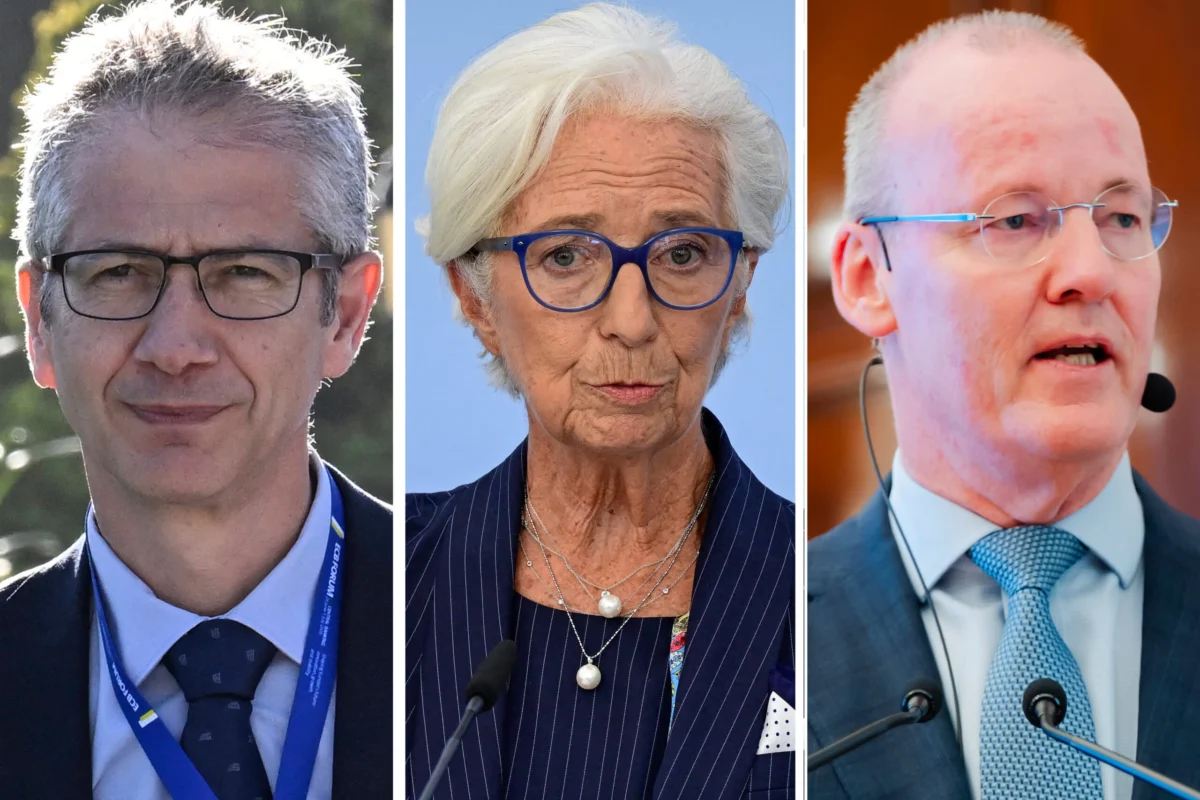
Two names have quickly emerged as frontrunners for the presidency: Pablo Hernández de Cos of Spain and Klaas Knot of the Netherlands. Both have extensive experience leading their respective national central banks and are highly regarded within international financial circles.
Pablo Hernández de Cos, who served as Governor of the Bank of Spain from 2018 to 2024, is currently the General Manager of the Bank for International Settlements (BIS). His tenure at the Bank of Spain was marked by a focus on financial stability and a balanced approach to monetary policy, often aligning with the more centrist members of the ECB Governing Council. He is perceived as a candidate who would likely signal continuity with the current ECB approach, prioritizing financial stability alongside price stability. Given Spain’s position within the Eurozone, his appointment could also help maintain a geographical balance in top EU roles.
Klaas Knot, who led De Nederlandsche Bank (the Dutch central bank) from 2011 until 2025, is now a distinguished visiting fellow at the Peterson Institute for International Economics. Knot is widely known for his hawkish stance on monetary policy, often advocating for stronger and earlier action to combat inflation. During the recent inflation surge, he publicly warned that the ECB risked doing too little and suggested the possibility of larger rate increases than initially pursued. His background, including a former chairmanship of the G20’s Financial Stability Board (FSB), positions him as a strong candidate with a deep understanding of financial turbulence. Berenberg Chief Economist Holger Schmieding noted that Knot’s FSB experience "may have an edge" in dealing with potential financial instability.
Hawkish vs. Continuity: Implications for Monetary Policy and Markets
The choice between de Cos and Knot carries significant implications for the future direction of ECB monetary policy and market sentiment. Pierre Roke, global capital markets associate at Validus Risk Management, highlighted these distinctions:
A Knot appointment "would likely be read as hawkish and could support the euro, though a tougher stance could also add pressure to French and peripheral bond spreads." His known preference for decisive action against inflation suggests a potential for quicker or larger rate hikes if inflationary pressures were to re-emerge, or a more cautious approach to rate cuts. This could be reassuring to Northern European economies traditionally more sensitive to inflation but might create headwinds for heavily indebted Southern European states.
Conversely, a de Cos appointment "would signal more continuity, with a stronger focus on financial stability." In an environment where French debt is under pressure and inflation, though receding, remains above target, rate markets might take more comfort in a de Cos appointment, signaling a measured and potentially less volatile policy trajectory. His emphasis on financial stability could be particularly crucial if France’s fiscal woes escalate and threaten wider Eurozone contagion.
Nationality will undoubtedly play a significant role in the political horse-trading. ING’s global head of macro, Carsten Brzeski, pointed out, "While Knot might find more support among Northern European governments, the question is whether De Cos will be supported by the current Spanish government." The political alignment and support from national capitals are often as crucial as a candidate’s economic credentials. Both candidates, however, would bring a high level of monetary policy expertise, a quality Lagarde herself had to cultivate rapidly upon taking office given her legal and political background.
France’s Fiscal Crisis: A Shadow Over the Succession

The backdrop of France’s escalating fiscal crisis adds a layer of urgency and complexity to the succession process. France, the Eurozone’s second-largest economy, has seen its public debt-to-GDP ratio soar, exacerbated by extensive spending during the pandemic and subsequent energy crisis. Concerns have mounted over the sustainability of its public finances, particularly as the European Commission prepares to reinstate stricter fiscal rules. The potential for a far-right government under Marine Le Pen, whose past platforms have included proposals for increased spending and challenging EU fiscal frameworks, further amplifies these anxieties.
Economists like Holger Schmieding of Berenberg emphasize that while the EU is attempting to "guard itself at least somewhat against the risk that right-wing Marine Le Pen may win the French presidential election," the ECB’s mandate is clear. "However, the ECB has no mandate and no appetite to fund French fiscal follies. In our view, the ECB would only support France if Paris returns to more sustainable policies," Schmieding asserted. This highlights the delicate position the next ECB president will inherit, potentially having to navigate a major member state’s fiscal challenges without compromising the central bank’s independence or its commitment to price stability. The TPI could become a critical tool in such a scenario, but its activation is conditional on member states adhering to EU fiscal rules and sound macroeconomic policies.
Lagarde’s Legacy and Future Prospects
Christine Lagarde’s departure will leave a significant void at the helm of the ECB. Her tenure, though challenging, has been marked by a strong sense of duty and a consistent focus on navigating crises with innovative policy responses. She received a standing ovation from the Governing Council of the central bank on Thursday, with European Council President Antonio Costa commending her "steady and determined stewardship, helping to safeguard stability and the resilience of the euro area."
Born in Paris in 1956, Lagarde’s career has been one of pioneering achievements. She began as a high-ranking lawyer, eventually becoming the first female Finance Minister of a G7 country in 2007. In 2011, she broke another barrier as the first woman to be appointed managing director of the International Monetary Fund (IMF), a role she held for eight years before joining the ECB. Her transition from a legal and political background to central banking required a steep learning curve, but she quickly established herself as a formidable leader on the global financial stage.
However, her leadership was not without its critics. A staff survey in 2024 revealed a "heavily critical verdict on her tenure," with many employees feeling she spent too much time discussing topics unrelated to monetary policy. This criticism, perhaps ironically, aligns with her stated desire for "freedom of expression" outside the strictures of her central banking role.
Looking ahead, Lagarde is widely viewed as a top candidate to become the next chair of the World Economic Forum, according to Financial Times reporting. Such a role would provide a global platform for her to engage on the broader political and societal issues she feels compelled to address, free from the institutional constraints of a central bank presidency. Her extensive experience in international finance, diplomacy, and crisis management positions her well for continued influence on the global stage.
Timeline of Key Events:
- 1956: Born in Paris, France.
- 2007: Becomes the first female Finance Minister of a G7 country (France).
- 2011: Appointed Managing Director of the International Monetary Fund (IMF), becoming the first woman to hold the post.
- July 2019: Assumes presidency of the European Central Bank.
- March 2020: ECB launches Pandemic Emergency Purchase Programme (PEPP) in response to COVID-19.
- February 2022: Russia’s invasion of Ukraine triggers energy crisis and inflation surge in the Eurozone.
- July 2022: ECB begins historic cycle of interest rate hikes, ending the era of negative rates.
- October 2022: Eurozone inflation peaks at 10.6%.
- September 2023: ECB concludes its rate hiking cycle, bringing deposit rate to 4.00%.
- January 2024: ECB staff survey reveals critical assessment of Lagarde’s leadership.
- October 2026: Christine Lagarde announces her early departure from the ECB.
- February 7, 2027: Christine Lagarde officially steps down as ECB President.
- Spring 2027: French presidential election anticipated.
- October 2027: Original scheduled end of Lagarde’s term.
The departure of Christine Lagarde marks a significant inflection point for the European Central Bank. The institution stands at a critical juncture, tasked with safeguarding price stability, maintaining financial resilience, and navigating complex geopolitical and fiscal challenges. The choice of her successor will not only shape the future of Eurozone monetary policy but also send a powerful signal about the region’s commitment to economic stability and its response to an increasingly uncertain global landscape.