Putri Inara
The rapid ascension of pickleball from a niche backyard activity to the fastest-growing sport in the United States has caught the attention of sociologists, urban planners, and, increasingly, digital strategy experts. As of 2024, the Association of Pickleball Professionals (APP) reports that more than 36.5 million Americans have played the sport at least once in the past year. This exponential growth, characterized by its low barrier to entry and high community engagement, offers a precise metaphorical framework for the modern digital content creator. By analyzing the mechanics of the game—specifically its emphasis on strategic positioning, controlled pacing, and community-driven expansion—bloggers can extract actionable methodologies to navigate the saturated attention economy of the 2020s.
The Genesis and Evolution of a Phenomenon
To understand the strategic parallels between pickleball and blogging, one must examine the historical trajectory of both mediums. Pickleball was conceptualized in 1965 on Bainbridge Island, Washington, by Joel Pritchard, Bill Bell, and Barney McCallum. Faced with a lack of proper equipment for a standard badminton game, the trio improvised using a perforated plastic ball and handmade plywood paddles. This "start with what you have" ethos mirrors the early days of the blogosphere in the late 1990s, where pioneers utilized basic HTML and platforms like Open Diary to share information before the advent of sophisticated Content Management Systems (CMS) like WordPress.
The timeline of pickleball’s expansion provides a blueprint for sustainable growth. While it remained a localized activity for decades, the sport hit a critical inflection point between 2020 and 2023. According to the Sports & Fitness Industry Association (SFIA), participation increased by 158.6% over three years. Similarly, the blogging industry has transitioned from personal journaling to a foundational component of a $600 billion creator economy. In both instances, the transition from "hobby" to "industry" was fueled by accessibility and the inherent shareability of the experience.
Strategic Pacing: The Power of the Dink
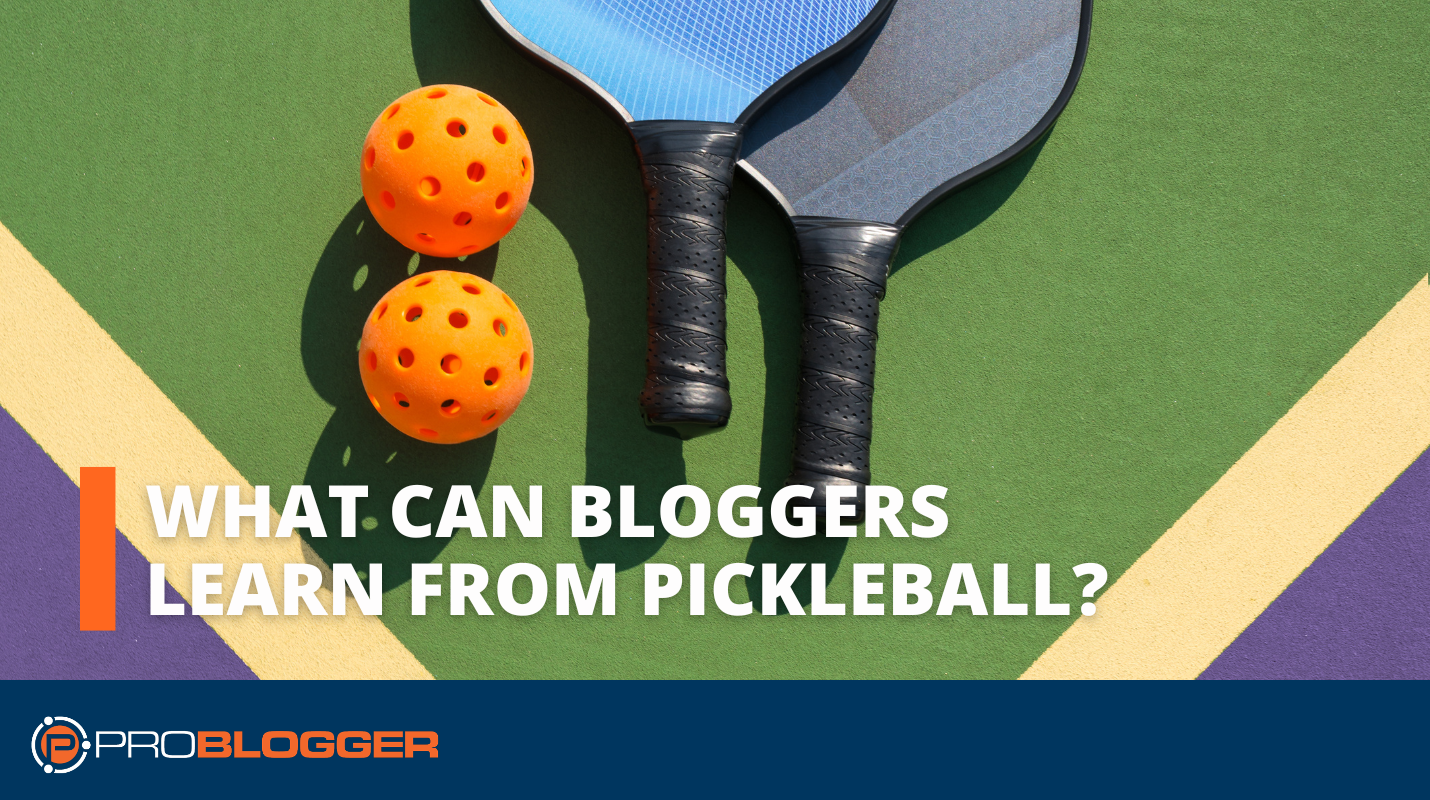
In professional pickleball, the "dink"—a soft, tactical shot placed into the opponent’s non-volley zone, known as the "kitchen"—is often more effective than a high-powered drive. The objective of the dink is to neutralize the opponent’s aggression and wait for a high-percentage opportunity to score.
For the digital publisher, "dinking" represents the art of content simplification and strategic consistency. In an era of information overload, technical jargon and overly complex narratives often act as barriers to entry. Data from HubSpot indicates that 73% of internet users admit to skimming blog posts, while only 27% read them thoroughly. By adopting a "dink" strategy—producing clear, digestible, and highly focused content—bloggers can control the pace of the reader’s journey. This approach prioritizes long-term engagement over short-term "viral" spikes, allowing the creator to build a foundation of trust through clarity and precision.
The Architecture of the Kitchen: Boundaries and Balance
The "non-volley zone" or "kitchen" is a seven-foot area on both sides of the net where players are prohibited from volleying the ball unless it has first bounced. This rule prevents players from dominating the game through brute force at the net, forcing a reliance on skill and patience.
In the context of blogging, the "kitchen" serves as a metaphor for the boundaries of a content niche. Professional bloggers often struggle with "scope creep," where the desire to capture a larger audience leads to a dilution of the core brand. Strategic positioning requires staying within the "zone" of one’s expertise. Market analysis from the Content Marketing Institute suggests that blogs with a clearly defined niche and specific audience personas see a 40% higher conversion rate than those that attempt to cover broad, unrelated topics. Success in both pickleball and blogging is dictated by the ability to operate effectively within these constraints, ensuring that every "shot" (or post) is intentional and serves a broader tactical goal.

Analyzing the Whiff: Failure as a Data Point
In pickleball parlance, a "whiff" occurs when a player swings and misses the ball entirely. While often a source of brief embarrassment, the whiff provides immediate feedback on positioning, timing, and eye-ball coordination.
The digital equivalent of a whiff is the underperforming post—the article that fails to generate traffic or social shares despite significant effort. Journalistic analysis of digital trends suggests that even high-authority domains experience a failure rate of approximately 20-30% on new content initiatives. The lesson from the pickleball court is one of resilience and analytical adjustment. Rather than abandoning a strategy after a single miss, successful creators treat the "whiff" as a data point. By utilizing tools such as Google Analytics or A/B testing, bloggers can identify whether the failure was due to a poor "serve" (headline), bad "positioning" (SEO), or a lack of "reach" (distribution).
The Community Rally: Engagement as a Growth Engine
One of the primary drivers of pickleball’s popularity is its social nature. Matches are often played in doubles format, requiring constant communication and synchronization. This "rally" is the heartbeat of the sport.
For bloggers, the rally represents the feedback loop between the creator and the audience. In the current Web 3.0 landscape, content is no longer a one-way broadcast; it is a conversation. Statistics from OptinMonster reveal that blogs with active comment sections and high social media engagement see a 60% increase in returning visitor rates. Engaging with the community—responding to queries, acknowledging feedback, and facilitating discussions—turns a static webpage into a dynamic hub. This communal engagement acts as a force multiplier, where the audience becomes part of the content’s distribution network, much like a spectators’ cheers can energize players in a high-stakes match.

Chronology of Innovation: Parallels in Development
The developmental milestones of both pickleball and blogging highlight a shared path toward institutionalization and professionalization:
- 1965 / 1994: Invention of Pickleball / Launch of "Links.net" (the first blog).
- 1972 / 1999: Formation of the first pickleball corporation / Launch of Blogger and LiveJournal.
- 1984 / 2003: Publication of the first official pickleball rulebook / Launch of WordPress.
- 2010s: Pickleball enters retirement communities and schools / Blogging becomes a primary tool for Search Engine Optimization (SEO).
- 2020-2024: Professional leagues (MLP, PPA) gain major sponsorships / The "Creator Economy" reaches a valuation of over $250 billion.
This timeline demonstrates that both fields have moved from experimental phases into structured, highly competitive environments where strategy outweighs luck.
Broader Impact and Industry Implications
The convergence of recreational trends and professional digital strategies suggests a shift in how modern professionals approach skill acquisition. The "gamification" of business strategy—using the rules of a sport like pickleball to inform content creation—reflects a broader trend toward cross-disciplinary learning.
Industry analysts suggest that the "pickleball model" of blogging—accessible, community-focused, and strategically paced—is the most viable path forward in an AI-driven world. As Artificial Intelligence begins to saturate the web with automated content, the human elements of "fun," "personality," and "community" become the primary differentiators. Just as a machine can be programmed to hit a ball but cannot replicate the social camaraderie of a local court, AI can generate text but cannot replicate the authentic voice of a passionate blogger.

Conclusion: Serving for Success
The transition from a casual hit on the court to a high-level strategic game requires a shift in mindset. For bloggers, the lessons of pickleball emphasize that longevity is the result of smart "serves," disciplined "dinking," and an unwavering focus on the "sweet spot" of the audience’s needs.
The data is clear: the most successful digital platforms are those that prioritize accessibility without sacrificing depth. By embracing the "fun" of the process while adhering to the "strategy" of the game, content creators can ensure their blog remains a vibrant, competitive, and relevant entity in an ever-changing digital marketplace. As the sport of pickleball continues its global expansion, its core tenets—start small, think big, and keep the rally going—will remain essential pillars for anyone looking to master the art of the digital serve.