Reynand Wu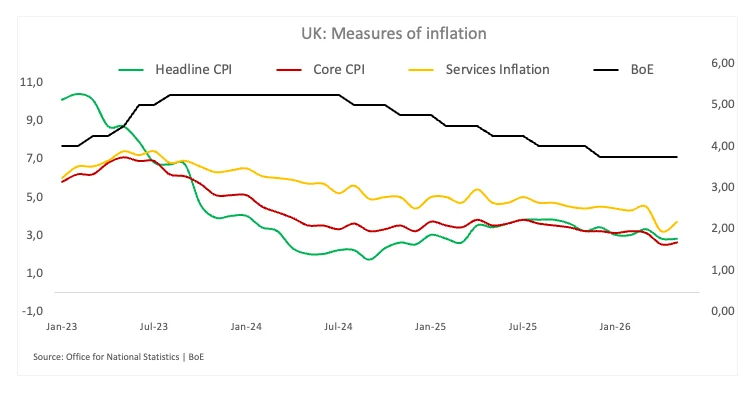
The United Kingdom’s Consumer Price Index (CPI) recorded a year-over-year increase of 2.6% in June, marking a slight deceleration from the 2.8% rise observed in May, according to data released by the Office for National Statistics (ONS) on Wednesday. This headline figure came in marginally below market expectations, which had broadly predicted a 2.7% growth for the reported period. Despite this modest moderation, the inflation rate remains firmly above the Bank of England’s (BoE) long-standing 2% target, underscoring persistent price pressures within the economy. Of particular note, the core CPI, which meticulously strips out the more volatile components of food and energy prices to provide a clearer view of underlying demand-driven inflation, held steady at 2.6% year-over-year in June, identical to May’s reading. This core inflation print surprisingly surpassed analysts’ forecasts of 2.5%, indicating a stubbornness in underlying inflationary forces that continues to challenge policymakers. On a monthly basis, the UK CPI rose by a modest 0.1% in June, a slower pace compared to the 0.2% increase reported in May, aligning precisely with the market consensus for the period. The immediate reaction in currency markets saw the British Pound (GBP) edge slightly lower against the US Dollar (USD) following the report’s release, though it later recovered to trade marginally higher, reflecting a nuanced and somewhat mixed market interpretation of the latest economic data.
Understanding the Nuances of UK Inflationary Dynamics
Inflation, fundamentally defined as the rate at which the general level of prices for goods and services is rising, thereby eroding the purchasing power of currency, is a critical barometer of economic health. For the UK, the ONS’s monthly CPI report serves as the primary and most closely watched gauge of consumer price inflation, tracking changes in the cost of a representative basket of goods and services typically purchased by households. This basket is regularly updated to reflect evolving consumer spending patterns, ensuring the index remains relevant. The distinction between headline and core inflation is paramount for central banks like the Bank of England. Headline CPI offers a comprehensive snapshot of overall price movements but can be significantly swayed by transient and often unpredictable shifts in global commodity markets, such as fluctuations in oil and gas prices, or seasonal variations and geopolitical impacts on agricultural produce. Core CPI, by deliberately excluding these highly volatile elements, aims to offer a more stable and accurate measure of underlying, persistent price pressures within the domestic economy, making it a crucial metric for informing monetary policy decisions.
The latest figures for June present a complex and somewhat contradictory narrative for the UK economy. While the headline rate’s modest dip from 2.8% in May to 2.6% in June might initially suggest a gradual easing of broader inflationary pressures, the unexpected stickiness and persistence of core inflation at 2.6% signals that more deeply embedded domestic factors continue to exert significant upward pressure on prices. These underlying factors can include robust wage growth, sustained consumer demand, or persistent supply chain bottlenecks that are not directly related to global energy or food prices. For the Bank of England, this duality creates a significant policy dilemma: how to effectively navigate between its primary objective of curbing inflation to meet its 2% target and its secondary aim of supporting broader economic growth without triggering a severe downturn. The continued elevation of both headline and core inflation above the target underscores the ongoing challenge faced by UK policymakers in restoring price stability.
The Bank of England’s Stance and Recent Monetary Policy Trajectory
The Bank of England operates with a clear mandate to maintain price stability, specifically targeting a 2% inflation rate, while also supporting the government’s economic policies, including objectives for sustainable growth and high employment. Over the past year, in response to unprecedented inflation rates that soared to multi-decade highs, the BoE has been actively engaged in an aggressive monetary policy tightening cycle. This has involved a series of consecutive interest rate hikes, culminating in the current bank rate of 3.75%. These hikes were designed to cool an overheating economy, dampen consumer demand, and bring inflation back towards its mandated target.
A pivotal moment in this ongoing policy trajectory was the BoE’s Monetary Policy Committee (MPC) meeting on June 18. Despite the prevailing inflationary environment, which saw headline CPI still significantly above target, the MPC opted to keep the bank rate unchanged at 3.75%. This decision, while largely anticipated by financial markets, was not unanimous, revealing a notable 7-2 vote split among committee members. Two members, Megan Greene and Huw Pill, dissented from the majority, actively advocating for a further 25-basis-point increase. This hawkish dissent underscored the ongoing internal debate within the committee regarding the appropriate pace and extent of monetary tightening necessary to effectively tame inflation without inadvertently triggering a deeper economic recession.
Governor Andrew Bailey, in his recent public pronouncements, has consistently emphasized the necessity for patience and a cautious "wait-and-see" approach, acknowledging the multifaceted global challenges impacting the UK economy. He specifically highlighted renewed hostilities in the Gulf region as a significant source of global instability, capable of disrupting supply chains and influencing international commodity prices, which inevitably feed into domestic inflation. Domestically, Bailey reiterated his confidence that the UK’s economy is underpinned by a robust fiscal framework and adequately supported by existing monetary policy measures. However, he also stressed that the central and most pressing challenge remains fostering sustainable economic growth amidst these formidable global headwinds. Furthermore, Bailey offered assurances regarding the resilience of the UK’s core banking system and affirmed that national debt levels, while significant, are not currently overstretched. Nevertheless, he issued a crucial warning, stating unequivocally that sustainable economic expansion would not be possible without maintaining steadfast financial stability. This nuanced messaging from the BoE reflects a delicate balancing act, carefully assessing incoming economic data while attempting to manage market expectations and guide the economy through a period of heightened uncertainty. The persistent core inflation figures from June will undoubtedly add further complexity to the MPC’s deliberations, potentially intensifying the debate between those advocating for continued tightening and those prioritizing economic stability.
Market Expectations and the Forward Outlook for Monetary Policy
The June CPI data carries substantial weight for market participants, playing a crucial role in shaping their expectations for the Bank of England’s upcoming Monetary Policy Committee meeting, which is currently scheduled for July 30. Prior to the release of the latest inflation figures, the prevailing consensus among investors largely leaned towards the BoE maintaining a steady hand, predicting that the committee would opt to keep the policy rate unchanged. This sentiment was primarily reinforced by the BoE’s cautious "hold" decision in June and its explicit articulation of a "wait-and-see" stance.
However, the latest inflation figures introduce a significant layer of complexity and potential ambiguity into this outlook. While the slight easing in the headline CPI might offer some relief, hinting at a potential peak in broader price pressures, the unexpected stickiness of core CPI, remaining above forecast and at the same elevated level as May, presents a distinct hawkish challenge. This resilience in underlying inflation suggests that domestic price pressures might be more entrenched and persistent than previously assumed by some, potentially increasing the pressure on the MPC to reconsider its position and contemplate further tightening measures. Currently, implied rates derived from financial markets suggest nearly 43 basis points of further monetary tightening by year-end. This indicates that while a rate hike at the immediate July meeting might not be universally seen as a certainty, the market clearly anticipates additional rate increases before the year concludes, reflecting a belief that the BoE will ultimately need to do more to bring inflation under control. This divergence between the consensus for the immediate July meeting and the longer-term market pricing highlights the inherent uncertainty surrounding the Bank of England’s future policy path.
Should the BoE decide to implement another rate hike, it would be a clear and direct response to persistent concerns about entrenched inflation and a strong reaffirmation of its unwavering commitment to achieving its 2% target, even if such a move carries the risk of dampening economic growth. Conversely, a decision to maintain rates could be interpreted as the MPC’s belief that the current policy stance is sufficiently restrictive, and that existing inflationary pressures will naturally abate over time as the lagged effects of previous rate hikes fully filter through the economy. The committee’s ultimate decision on July 30 will undoubtedly hinge on a comprehensive and thorough assessment of a wide array of incoming economic indicators, including detailed employment data, trends in wage growth, and broader business sentiment, all meticulously weighed against the prevailing inflation trajectory and global economic conditions. The mixed signals from the June CPI report underscore the delicate and challenging balancing act facing the Bank of England.
Broader Economic Implications and the Consumer Impact
Persistent inflation, especially when it remains significantly above the central bank’s target, has profound and far-reaching implications for the UK economy and its citizens. For consumers, the ongoing elevated price levels directly translate into a continued and palpable erosion of purchasing power, thereby exacerbating the already severe cost-of-living crisis. Households across the country face relentlessly higher costs for essential goods and services, including but not limited to food staples, domestic energy, and transportation. This sustained pressure on household budgets inevitably leads to reduced discretionary spending, as consumers prioritize necessities, which in turn can significantly dampen overall economic activity and consumption-led growth.

Businesses across all sectors are also grappling with the multifaceted effects of inflation. Rising input costs for raw materials, surging energy prices, and increasing labor expenses (driven by demands for higher wages to offset inflation) can severely squeeze profit margins. To maintain profitability, many businesses are compelled to pass these increased costs onto consumers in the form of higher prices, inadvertently fueling a self-reinforcing inflationary cycle. Small and medium-sized enterprises (SMEs) are often particularly vulnerable to these inflationary pressures due to their more limited capacity to absorb increased costs compared to larger corporations. This can lead to reduced investment, job cuts, or even business closures, further impacting economic stability.
From a governmental perspective, high inflation introduces considerable complexities into fiscal policy management. It can significantly increase the cost of government borrowing, making it more expensive to finance public debt and new spending initiatives. Furthermore, inflation can erode the real value of public services if funding allocations do not keep pace with rising costs. The government’s flexibility to stimulate economic growth through targeted spending or tax cuts can be severely constrained by the overarching need to support the Bank of England’s efforts to bring inflation under control, often necessitating austerity measures or prioritizing fiscal discipline over expansionary policies.
Therefore, the June CPI data is far more than a mere statistical release; it is a critical and deeply influential input into the ongoing national economic discourse. Its implications ripple through every facet of society, influencing everything from individual household budgeting decisions and corporate investment strategies to government policy priorities and the broader sentiment of international investors towards the UK as an economic destination. The challenge for policymakers remains immense: to engineer a path back to price stability without triggering a deep and prolonged recession.
The Pound Sterling’s Performance and Technical Outlook
In the immediate aftermath of the June CPI report’s release, the British Pound (GBP) experienced an initial, albeit slight, dip against the US Dollar (USD). This knee-jerk reaction likely stemmed from the headline CPI figure coming in softer than anticipated, which some market participants might have initially interpreted as reducing the immediate likelihood of a Bank of England rate hike. However, the GBP/USD pair quickly reversed course, recovering to trade marginally higher, suggesting that the stickier-than-expected core CPI, combined with the overall elevated inflation environment, provided some underlying support for the Pound. The GBP/USD pair was last observed trading around 1.3380, indicating a relatively stable but cautiously optimistic sentiment for the currency given the mixed signals from the inflation data.
Analyzing the broader performance of Pound Sterling this week against other major currencies, as indicated by various market metrics, reveals a nuanced picture. While the Pound showed relative strength against certain counterparts, notably the Canadian Dollar, it experienced relative weakness against others, such as the Australian Dollar and Japanese Yen. This mixed performance underscores the fact that while domestic inflation data is undeniably a significant driver, global macroeconomic factors, prevailing risk sentiment, and the relative monetary policy outlooks of other major central banks also play crucial and interconnected roles in determining currency valuations on the international stage.
From a technical analysis perspective, insights from Pablo Piovano, Senior Analyst at FXStreet, offer valuable guidance into the GBP/USD pair’s potential trajectory. Piovano notes that the recent multi-week recovery in GBP/USD appears to have encountered significant resistance in the 1.3550-1.3560 band, which aligns closely with recent July tops. Should the bullish momentum resume and buyers manage to decisively break above this key resistance zone, the next significant technical barrier for the pair would emerge at the May top of 1.3653 (recorded on May 11), followed by the year-to-date ceiling at 1.3868 (from January 27). These levels represent important psychological and technical hurdles that would need to be convincingly overcome for a sustained upward trend to materialize.
Conversely, on the downside, Piovano identifies initial contention and support at the current yearly lows, situated near 1.3140 (observed on June 24). A decisive break below this critical level could signal further bearish weakness, potentially exposing a move towards the November 2025 base at 1.3010 (from November 5). This suggests that while the Pound has shown some recent resilience, significant downside risks remain if economic data deteriorates more broadly or if the Bank of England’s policy stance is perceived by markets as less hawkish than currently anticipated.
Furthermore, momentum indicators provide additional layers of insight. Piovano points out that the Relative Strength Index (RSI) is currently hovering just below 54, which generally indicates a somewhat bullish sentiment, but importantly, not an excessively overbought condition. The Average Directional Index (ADX) near 18, however, suggests that the current trend, whether upward or downward, lacks strong conviction or significant "muscle." This implies that while there might be a prevailing directional bias, its intensity is moderate, and price movements could be prone to periods of volatility or consolidation within established trading ranges. Traders will be meticulously observing these technical levels and indicators in conjunction with fundamental economic releases to accurately gauge the future direction of the GBP/USD pair and the broader market sentiment towards the British Pound.
Global Context of Persistent Inflationary Pressures
The United Kingdom’s ongoing struggle with elevated inflation is by no means an isolated phenomenon; it is rather a significant component of a broader, global trend that has characterized the post-pandemic economic landscape. Many major economies across the world, including the United States, the Eurozone, and Canada, have experienced stubbornly high inflation rates in recent years. This global inflationary surge has been driven by a complex confluence of factors: robust consumer demand, often bolstered by substantial fiscal stimulus measures; widespread supply chain disruptions that were initially triggered by the pandemic and subsequently exacerbated by geopolitical events, most notably the conflict in Ukraine; and persistently tight labor markets contributing to significant wage pressures. In response, central banks worldwide have embarked on aggressive monetary policy tightening cycles, raising interest rates to levels not seen in decades, in a concerted effort to restore price stability.
However, the specific pace and severity of inflation, as well as the perceived effectiveness of monetary policy responses, have varied significantly across different regions. The UK, in particular, has confronted a unique set of challenges. These include the lingering effects of Brexit on trade relationships and labor markets, which some economists argue have contributed to persistent supply-side constraints and upward price pressures within the British economy. Comparing the UK’s 2.6% CPI to, for instance, the Eurozone’s recent inflation figures, or the US CPI, provides crucial context for understanding the relative position and the distinct challenges faced by the Bank of England. While global inflation appears to be gradually cooling in certain areas, the persistent nature of core inflation in economies like the UK suggests that the path back to target inflation will likely be protracted, gradual, and fraught with potential policy dilemmas, demanding continued vigilance and adaptive strategies from central bankers.
Conclusion
The June UK CPI data presents a mixed and complex picture for policymakers, financial markets, and the broader public. The slight easing in headline inflation offers a glimmer of hope that the peak