Ena Muazin
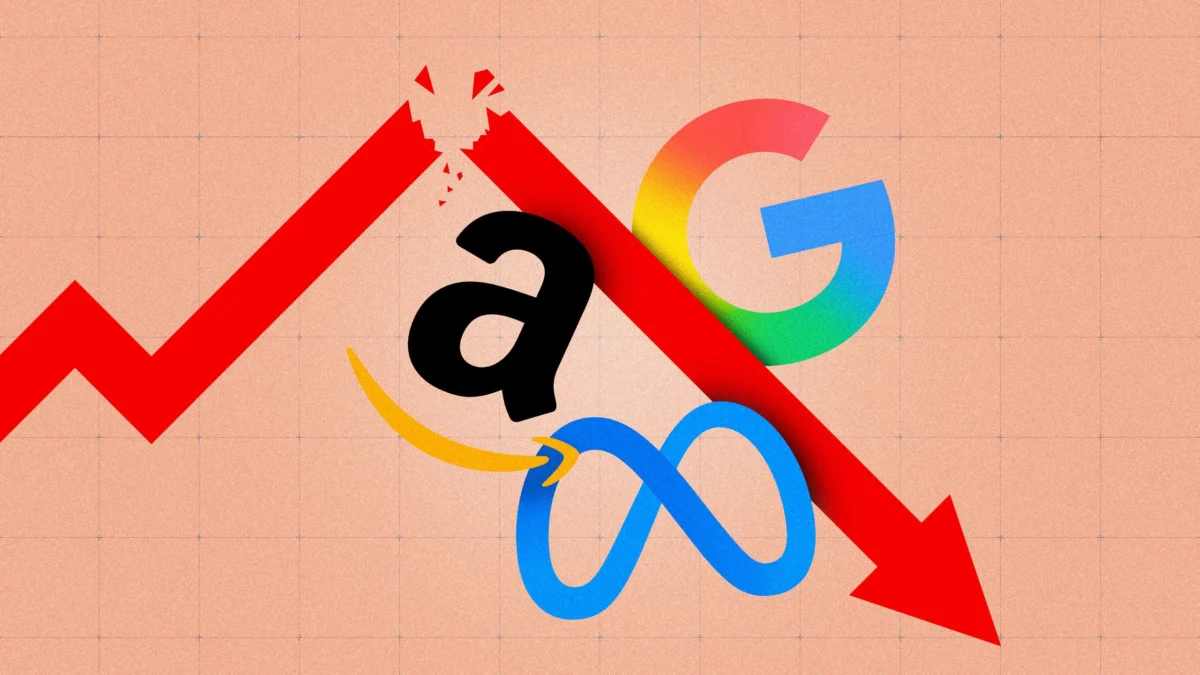
The landscape of the stock market, long dominated by the stellar performance of a select group of technology giants, is undergoing a significant recalibration. Recent quarterly reports from these colossal tech corporations have evidently failed to meet investor expectations, signaling a potential shift in market dynamics. Experts are now speaking of a new era on the stock exchange, one where the unified ascent of these tech titans may be a relic of the past.
Collectively, these three major tech behemoths have seen their market capitalization plummet by approximately $700 billion. This staggering figure is roughly equivalent to the combined market value of the three largest German companies listed on the DAX index. This substantial erosion of value underscores a growing investor caution and a more discerning approach to evaluating the future prospects of these previously untouchable entities.
For years, the group encompassing Alphabet (Google), Amazon, Apple, Microsoft, Nvidia, and Tesla – often referred to as the "Magnificent Seven" or "Mag7" – has served as the primary engine driving the U.S. stock market. Their relentless growth propelled major indices to record highs, almost single-handedly. However, the recent performance trends indicate a divergence, with their stock price trajectories becoming increasingly uncoupled.
Decoupling Performance: The End of a Unified Rally

The aptness of the "Magnificent Seven" moniker is increasingly being questioned by market analysts. Sören Hettler, an analyst at DZ Bank, observes, "The era of the ‘Magnificent Seven’ as a cohesive group of stock market outperformers appears to be over." This sentiment is corroborated by calculations from Handelsblatt, which reveal a significant divergence in the performance of these tech stocks over recent weeks – a level of disparity not witnessed in at least a decade.
This observation is based on the analysis of rolling 60-day correlations. The 60-day correlation measures the statistical relationship between the price movements of stocks over a given period. In this analysis, all 21 possible pairs among the seven stocks were formed, and their price developments were compared. A correlation value of +1 would indicate that all seven stocks moved identically, while a value of -1 would signify that all seven moved in completely opposite directions.
Historically, the "Magnificent Seven" often moved in lockstep, largely due to their perceived market dominance and consistent upward trajectory. In 2023, for instance, these seven companies were responsible for an astonishing 70% of the year’s gains in the broad-based U.S. stock market index, the S&P 500. This collective strength created an illusion of a unified force, where the success of one often mirrored the success of others.
However, the current market environment presents a starkly different picture. Ulrich Stephan, an investment strategist at Deutsche Bank, attributes this shift primarily to the market’s increasing differentiation between companies, particularly in their artificial intelligence (AI) strategies. "From my perspective, this is primarily due to the market differentiating more strongly between companies four years after the release of ChatGPT and evaluating their respective AI strategies more closely," Stephan explains. ChatGPT, the groundbreaking chatbot that ignited the artificial intelligence boom on the stock market, has indeed become a pivotal point of reference for evaluating AI-driven growth.
The rolling 60-day correlation metric illustrates this changing landscape. At its peak, the correlation among the "Magnificent Seven" approached +0.8. By mid-October of the current year, this value had plummeted to a mere +0.12. While there has been a slight recovery to +0.2 recently, this figure remains significantly below the historical average of 0.49. This substantial decline in correlation signifies that the stocks are no longer moving in near-unison.

A Divided Market: Only Four Tech Giants Outperform
The current market narrative is further characterized by a significant dispersion in performance among the tech giants. According to Hettler’s observations, "In the current year, only two members of the ‘Magnificent Seven’ have managed to outperform the performance of the U.S. benchmark index S&P 500. Furthermore, three representatives show a clear negative performance compared to the beginning of the year." This indicates that the days of a blanket positive performance across the board for this group are definitively over.
The prior period of high correlation was fueled by the perception of these companies as near-monopolists in their respective domains. This perception fostered a belief that their growth was almost guaranteed, leading investors to treat them as a cohesive investment block.
The Shifting Sands of Business Models and Competition
However, the underlying business models of several of these tech powerhouses are evolving, with a pronounced shift towards artificial intelligence. This evolution is transforming them from perceived monopolists into direct competitors, both in the operation of data centers and in the development and deployment of AI models.

Peter Reichel, chief investment strategist at asset manager Oddo BHF, posits, "The time when they were largely traded as a homogeneous block by the market is likely over." This sentiment is echoed by the market’s reaction to recent quarterly earnings.
Alphabet’s latest earnings report, for instance, revealed disappointment in its advertising revenue from internet search. This decline is attributed to increasing competition from AI-powered alternatives. Simultaneously, Meta recently unveiled its latest language model, Muse, signaling its own aggressive push into the AI space.
This increasing overlap in business focus is particularly evident in the cloud computing sector, where Alphabet, Amazon, Microsoft, and Meta are locked in intense competition. These companies operate vast data centers, renting out computing power, storage, and software solutions over the internet. The burgeoning AI boom has transformed this sector into a significant growth area. However, the expansion and maintenance of these data centers are extraordinarily expensive, making the business increasingly capital-intensive.
Skyrocketing Investment: The High Cost of the AI Race
The financial implications of this AI race are substantial. Investment expenditures (CapEx) for Alphabet, Amazon, Microsoft, and Meta are projected to collectively reach an astounding $754 billion in the current fiscal year, according to data compiled by Bloomberg. This represents a dramatic surge from $409 billion a year ago and a mere $157 billion three years prior.

This escalating investment has had a tangible impact on the companies’ financial health. For Alphabet, Amazon, and Meta, free cash flow turned negative in the most recent quarter. Free cash flow, which represents the available liquid funds after deducting all operational expenses and investments, indicates that these companies are currently spending more than they are earning.
This financial strain has not gone unnoticed by investors. Reichel observes, "Investors are increasingly asking not just who is investing the most in artificial intelligence, but who can actually translate these investments into growth, free cash flow, and attractive returns on capital." This sentiment underscores a fundamental shift in investor priorities, moving beyond mere investment figures to a focus on tangible financial outcomes.
The market’s response to the latest quarterly results reflects this new scrutiny. Alphabet, Amazon, and Meta have all faced stock price penalties following their earnings announcements. In contrast, Microsoft’s stock has remained relatively stable, suggesting a perceived resilience in its business model or a more favorable outlook on its AI strategy. Apple, despite facing criticism in recent years for its more measured approach to AI investments, has seen its stock price surge by nearly 30% since the beginning of the year, indicating that the market may be re-evaluating its long-term strategy.
The Rise of a "Selection Market" in Tech
The divergent reactions to the latest quarterly earnings reports highlight a growing trend: investors are becoming more selective. "The differing reactions to the current quarterly figures underscore that investors are differentiating more strongly between companies," states Hettler of DZ Bank. The key determinant for investor confidence now appears to be the perceived sustainability of earnings and whether future projected profits can justify the considerable investments being made, particularly in the artificial intelligence sector.

Reichel of Oddo BHF characterizes the current market environment as a "selection market." Stephan of Deutsche Bank elaborates, "Companies with high investments and declining, sometimes negative, cash flow are less in demand than companies with stronger balance sheet figures." This signifies a preference for companies that can demonstrate not only innovation but also financial prudence and a clear path to profitability.
Implications for Investors and the Future of Tech
This evolving market dynamic presents both challenges and opportunities for investors. The era of blindly following the "Magnificent Seven" as a unified investment strategy may be drawing to a close. Instead, a more nuanced approach, characterized by careful selection and a thorough understanding of individual company strategies and financial health, is likely to be more rewarding.
Stephan suggests that this shift does not necessarily signal a negative outlook for all tech investments. "Interesting investment opportunities are available across the entire value chain," he notes. The critical factor for investors will be to align their choices with their individual risk profiles.
The long-term success of AI investments is likely to benefit from broad diversification. However, those who continue to place their sole faith in the "Magnificent Seven" as a monolithic investment vehicle may find themselves disappointed. The market is demanding more than just grand pronouncements of AI prowess; it seeks demonstrable growth, robust cash flow, and sustainable returns. The "new era" on the stock exchange will likely reward companies that can effectively navigate the complexities of the AI landscape and translate ambitious investments into tangible financial success. The era of uncritical adoration for a select group of tech giants is over, replaced by a more discerning and data-driven approach to investment.