Clara Shinta
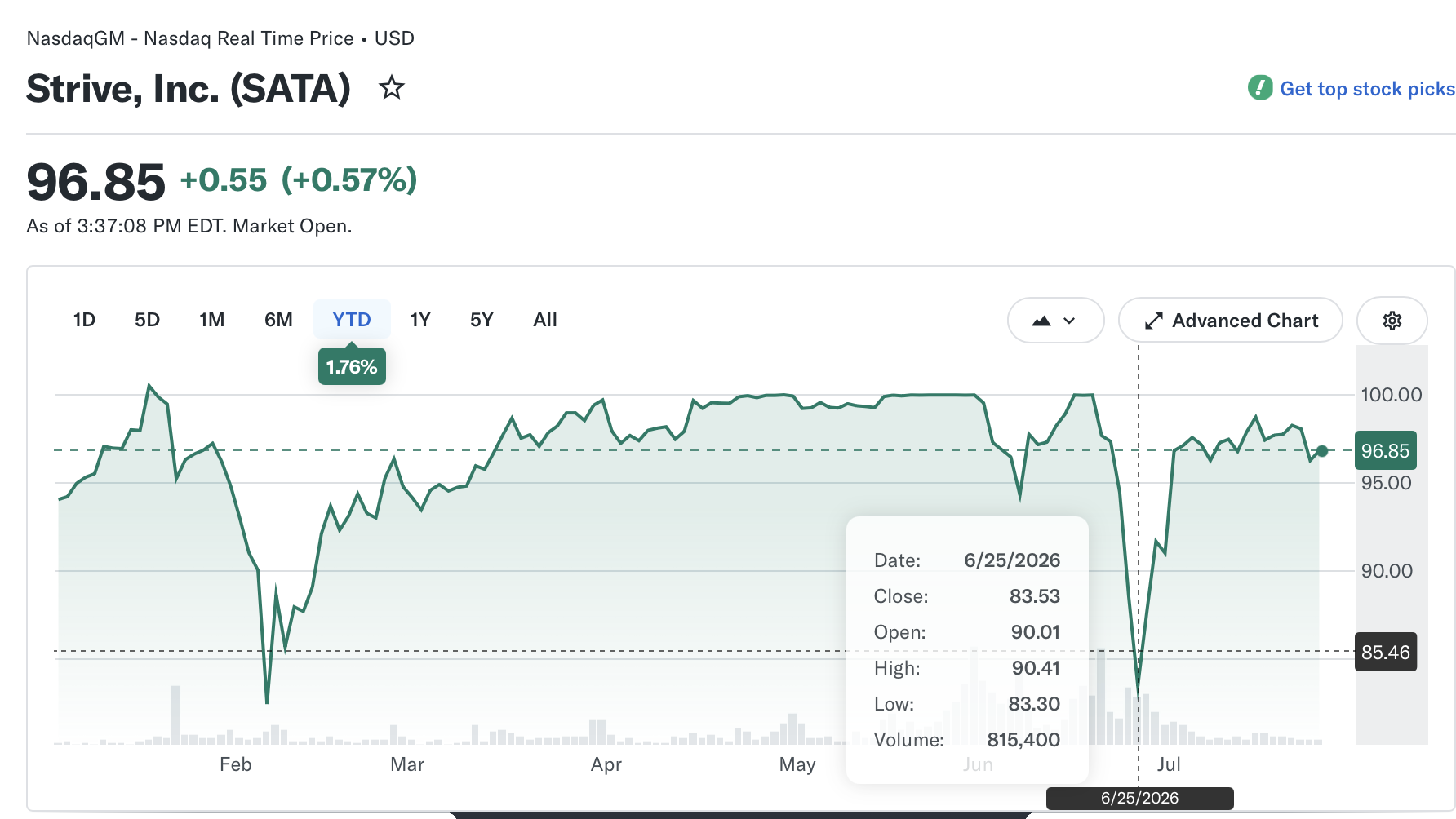
Strive’s SATA preferred shares have staged a robust recovery, rebounding significantly from a June low of $83.30 to trade at approximately $97, according to recent data from Yahoo Finance. This impressive resurgence marks a near-complete recouping of the earlier selloff, positioning the shares within roughly 3% of their crucial $100 par value. The performance offers a strong signal of renewed investor confidence in the innovative financial instruments designed to fuel corporate Bitcoin treasuries, even as the broader cryptocurrency market navigates periods of volatility.
The Genesis of Bitcoin Treasury Preferred Shares: Strive’s SATA
Strive introduced SATA in November 2025 as a cornerstone of its ambitious strategy to finance the expansion of its Bitcoin (BTC) treasury. The financial instrument, formally classified as variable-rate perpetual preferred stock, was meticulously designed with a clear objective: to trade consistently near its $100 par value. This stability is engineered through a mechanism that dynamically adjusts its dividend rate, making the shares attractive to investors seeking a blend of income and capital preservation. Crucially, this approach allows Strive to raise substantial capital for its Bitcoin holdings without resorting to the issuance of additional common shares, thereby preventing dilution of existing equity holders.
The strategic rationale behind SATA’s introduction was multifaceted. First, it offered an alternative capital-raising mechanism for companies keen on accumulating Bitcoin as a treasury asset. Traditional debt markets can be less flexible or more costly for firms whose primary treasury asset is a volatile cryptocurrency. Second, preferred shares, by their very nature, offer a fixed income stream (or in this case, a variable one designed for stability) that can appeal to a different segment of investors than common stock. For Strive, this meant tapping into capital that might otherwise be hesitant to directly invest in a company whose balance sheet is heavily weighted towards a digital asset. The perpetual nature of the shares also provides long-term, non-maturing capital, offering greater financial flexibility.
The Emerging "Digital Credit" Paradigm
SATA is not an isolated phenomenon but rather a prominent example of a growing number of preferred-share products intrinsically tied to Bitcoin treasury strategies. This burgeoning segment is increasingly being characterized by industry pioneers, such as Strategy, as "digital credit." This term encapsulates a new frontier in corporate finance, where companies leverage their Bitcoin holdings, or their intent to accumulate Bitcoin, as collateral or underlying value for innovative financial instruments.
The concept of "digital credit" signifies a strategic evolution. It moves beyond simply holding Bitcoin on a balance sheet to actively using it as a foundational asset for capital formation. This paradigm shift offers several advantages. It allows companies to access capital markets specifically for Bitcoin acquisition, often at terms that might be more favorable or structured than traditional equity or debt offerings. It also provides investors with exposure to Bitcoin’s potential upside through a more conventional and potentially less volatile financial product, often with dividend income. This structured approach aims to mitigate some of the direct price volatility associated with holding Bitcoin outright, at least from the perspective of the preferred share investor seeking stable income and capital preservation near par. The market’s reception to such instruments, particularly their ability to recover from market downturns, is crucial for the continued growth and acceptance of this innovative financial category.

Comparative Performance: Strive vs. Strategy Amidst Market Volatility
The performance of Strive’s SATA preferred shares gains further context when compared to similar offerings in the market. Strategy, a pioneer in the corporate Bitcoin treasury space and the world’s largest public corporate Bitcoin holder, launched its own preferred share product, STRC, in 2025. STRC shared a similar objective with SATA: to maintain a $100 share price through a variable dividend mechanism, thereby enabling Strategy to expand its formidable Bitcoin holdings without diluting common shareholders.
During the late-June market selloff that impacted cryptocurrency and related assets, STRC also experienced a sharp decline. While it has since recovered, its trajectory has been less pronounced than SATA’s. As of recent data, STRC continues to trade below its par value, hovering around $87. This disparity in recovery rates between SATA and STRC prompts analysis. Several factors could contribute to this difference, including market perception of each company’s balance sheet strength, the specific mechanics of their dividend adjustments, the size of their respective Bitcoin treasuries, or broader investor sentiment towards each entity. For instance, Strategy’s immense Bitcoin holdings, while a strength, might also expose it to greater perceived volatility risk in the eyes of some preferred share investors during extreme market downturns, even if its overall financial position remains robust. Strive’s more agile recovery, therefore, suggests a strong market belief in its specific financial structuring and operational resilience.
The Mid-2026 Market Downturn: A Crucible Moment
The late-June selloff, which significantly impacted both SATA and STRC, served as a critical test for these innovative digital credit instruments. This period was characterized by a confluence of factors that triggered a broader downturn across cryptocurrency markets. Global macroeconomic concerns, including persistent inflation fears and anticipated interest rate hikes by central banks, contributed to a risk-off sentiment among investors. Additionally, regulatory uncertainties in various jurisdictions and specific market events within the crypto ecosystem, such as liquidations or high-profile insolvencies, further exacerbated downward pressure on Bitcoin prices.
During this tumultuous period, Bitcoin experienced a notable price correction, falling from a high of around $70,000 earlier in the year to lows nearing $55,000. This sharp decline naturally cast a shadow over companies whose balance sheets were heavily invested in BTC. The preferred shares, designed to be stable near par, were not immune to this widespread market panic. Investors, fearing further depreciation in the underlying asset and potential stress on the issuing companies’ ability to maintain dividends, sold off these shares, pushing their prices significantly below their $100 par target. The subsequent recovery of SATA, in particular, demonstrates the inherent resilience of its structure and the renewed confidence of investors once the immediate panic subsided and the underlying market fundamentals began to stabilize. This event underscored the importance of robust financial engineering and clear communication from issuers during periods of extreme market stress.
Expert Commentary: Samson Mow’s Perspective on Resilience
Samson Mow, the founder and CEO of Jan3, a prominent figure in the Bitcoin ecosystem, provided insightful commentary on the recent market dynamics. Speaking to Cointelegraph, Mow articulated his belief that the recent adjustments undertaken by Bitcoin treasury companies are instrumental in restoring confidence in preferred-share products. He views this as a reinforcing signal for his conviction that Bitcoin has already found its bottom following the late-June correction.
Mow elaborated on his perspective, stating, "I think every action that Strategy has undertaken to strengthen their balance sheet and encourage STRC to go back to par is also working." He emphasized the interconnectedness of these market movements: "But everything sort of works in tandem. I think as SATA returns to par, you’re going to see STRC return to par too, because people say, ‘OK, this model’s not broken.’ Everyone is capitalized for three or more years of dividend payments… there was no reason to panic all along."
Mow’s analysis highlights several key points. Firstly, it underscores the importance of proactive financial management by companies holding significant Bitcoin treasuries. Adjustments could include optimizing cash flow, securing additional financing, or strategically managing their BTC holdings to weather market downturns. Secondly, his confidence in the "model" not being broken is crucial. It suggests that the fundamental design of these preferred shares – their variable dividend mechanism and their role in non-dilutive capital raising – remains sound. Lastly, the assurance that companies are capitalized for extended dividend payments addresses a primary concern for preferred shareholders, who prioritize consistent income. This perspective suggests that the market’s initial panic during the selloff was an overreaction, and as fundamental strengths are re-evaluated, these instruments will gravitate back towards their intended par value.
Mechanism of Stability: Variable Dividends and Par Value
The core innovation behind Strive’s SATA and Strategy’s STRC preferred shares lies in their variable dividend rate, explicitly designed to maintain the share price near its $100 par value. Understanding this mechanism is vital to appreciating the resilience of these instruments. Unlike common stock, which fluctuates based on market sentiment and company performance, preferred shares typically offer a fixed dividend. However, in the context of Bitcoin treasury strategies, a fixed dividend might not adequately insulate the share price from the volatility of the underlying asset or broader market sentiment.
By implementing a variable dividend, the issuing company can adjust the payout to make the shares more or less attractive to investors, thereby influencing their market price. If the shares begin to trade significantly below par (e.g., $83.30 as seen with SATA), the company can increase the dividend rate. A higher yield makes the shares more appealing, attracting buyers and theoretically pushing the price back towards $100. Conversely, if the shares trade above par, the dividend rate could potentially be lowered to reduce demand and bring the price down. This active management of the dividend yield serves as a dynamic lever to stabilize the share price, offering investors a more predictable return profile compared to direct Bitcoin exposure, while still providing a pathway for companies to raise capital for their Bitcoin ambitions. The effectiveness of this mechanism, as demonstrated by SATA’s rapid recovery, is a testament to its design and the market’s eventual trust in its functionality.
Corporate Bitcoin Holdings Landscape: A Shifting Power Dynamic
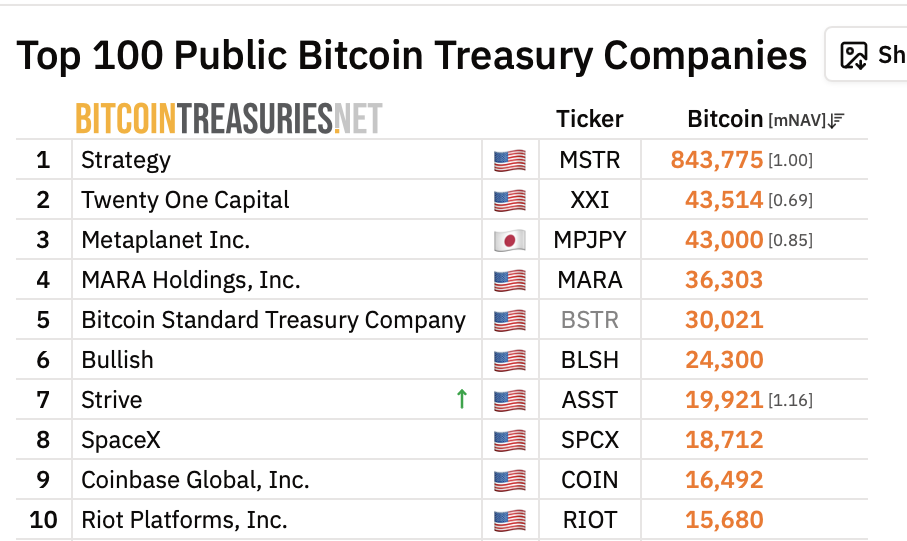
The broader context of corporate Bitcoin holdings further illustrates the significance of these financial instruments. While Strategy remains the undisputed leader in this space, holding an astounding 843,775 BTC, other companies are rapidly expanding their treasuries. Strive, with its current holdings of 19,921 BTC, has climbed to an impressive seventh position among public corporate Bitcoin holders, according to BitcoinTreasuries.NET. This ascent underscores the success of its capital-raising strategies, including the issuance of SATA preferred shares.
The landscape of corporate Bitcoin treasuries is dynamic and indicative of a maturing institutional embrace of digital assets. Companies are increasingly viewing Bitcoin not merely as a speculative asset but as a strategic reserve, a hedge against inflation, and a decentralized alternative to traditional treasury assets. The growth in the number of companies accumulating Bitcoin, alongside the innovative financial products they employ to do so, points to a long-term trend. The rankings reflect not just the volume of Bitcoin held but also the conviction of corporate boards in Bitcoin’s future value proposition. As more companies enter this arena, the demand for sophisticated, non-dilutive financing mechanisms like preferred shares is likely to intensify, further solidifying the "digital credit" segment.
Evolution of Bitcoin Treasury Strategies: New Entrants and Innovation
The improving performance of preferred-share products, as noted by Samson Mow, is part of a broader, ongoing refinement within the Bitcoin treasury sector. Companies are continuously evolving their capital-raising strategies, seeking more efficient and resilient ways to build and manage their Bitcoin holdings. This evolution is evident in the emergence of new players and diverse approaches.
Mow pointed to Lyn Alden’s Orange Juice treasury company, which launched on July 15, as another compelling example of this trend. Orange Juice’s entry into the market signals a new wave of firms exploring Bitcoin treasury operations, often with different operational models and a concerted focus on achieving a lower Bitcoin cost basis. A lower cost basis provides a greater buffer against market downturns and enhances profitability potential. This pursuit of efficiency and optimization in capital allocation, coupled with innovative financing structures, suggests a maturing ecosystem where sophisticated financial engineering meets the unique demands of digital asset treasuries. The lessons learned from the performance of instruments like SATA and STRC during market stress are invaluable for these new entrants, informing their strategies and reinforcing the need for robust financial frameworks.
Broader Market Implications and Future Outlook
The robust recovery of Strive’s SATA preferred shares carries significant broader market implications. Firstly, it serves as a powerful validation of the underlying financial model for digital credit instruments tied to Bitcoin treasuries. The ability of these shares to not only withstand a significant market downturn but also to rebound strongly instills greater confidence among institutional investors and corporate finance professionals. This validation could pave the way for more companies to explore similar non-dilutive capital-raising methods for their own Bitcoin acquisition strategies.
Secondly, this renewed confidence could contribute to a more stable and predictable environment for Bitcoin itself. If more corporations are able to build and maintain their Bitcoin treasuries through stable financing vehicles, it could reduce the overall market’s sensitivity to short-term price fluctuations, as corporate buyers become a more consistent source of demand.
The concept of "digital credit" is still in its nascent stages, but the successful navigation of market volatility by instruments like SATA suggests a promising future. As the regulatory landscape for digital assets becomes clearer, and as financial innovation continues, these preferred share models could become a standard feature in corporate finance, blurring the lines between traditional securities and the burgeoning world of digital assets. The long-term vision is one where Bitcoin, as a treasury asset, supports a sophisticated ecosystem of financing tools that allow companies to optimize their balance sheets and participate in the digital economy without undue risk or dilution. This evolution is critical for Bitcoin’s journey towards mainstream institutional adoption, moving beyond mere speculation to become a fundamental building block of corporate financial strategy.
In conclusion, Strive’s SATA preferred shares have not merely recovered; they have demonstrated the resilience and fundamental soundness of an innovative financial product. Their bounce back to near par value, coupled with expert analysis from figures like Samson Mow, suggests that the "digital credit" model for financing Bitcoin treasuries is proving its worth. This development is a crucial milestone for the broader Bitcoin treasury sector, promising to foster greater institutional confidence and paving the way for further innovation in how companies leverage digital assets for strategic growth. The market is learning, adapting, and ultimately, maturing, as it embraces the complexities and opportunities presented by Bitcoin as a corporate treasury asset.