Clara Shinta
Strategy, the enterprise renowned for holding the largest corporate Bitcoin treasury, has once again engaged in strategic capital management, selling a portion of its Bitcoin holdings for the second consecutive week to facilitate the repurchase of its STRC preferred stock. This move, detailed in a recent regulatory filing, underscores the company’s evolving approach to leveraging its digital asset reserves as an integral component of its financial engineering.
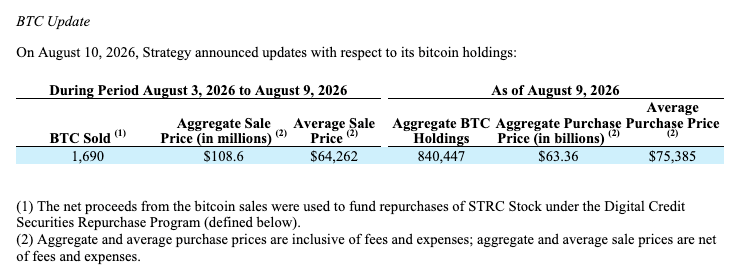
Between August 3 and August 9, Strategy divested 1,690 Bitcoin for a total of $108.6 million. The transaction was formally disclosed in an 8-K filing with the U.S. Securities and Exchange Commission (SEC) on Monday, August 10, 2026. This divestment served a singular purpose: to fund the repurchase of 1.15 million shares of its STRC preferred stock, also for $108.6 million, effectively utilizing the proceeds to optimize its capital structure.
A Deeper Look at the Latest Transaction
The average net price achieved in the latest Bitcoin sale was approximately $64,262 per Bitcoin. This figure stands in contrast to the company’s aggregate average purchase price for its entire Bitcoin treasury, which is reported at $75,385 per BTC, inclusive of all associated fees and expenses. This differential highlights Strategy’s pragmatic approach to capital management, even if it entails realizing a loss on specific tranches of Bitcoin sold, prioritizing immediate financial objectives over holding every coin for a higher price.
This marks the fourth disclosed Bitcoin sale by Strategy in 2026, bringing the cumulative total of Bitcoin sold this year to 6,948 BTC. Despite these sales, Strategy’s formidable Bitcoin treasury remains largely intact, with the company still holding an impressive 840,447 BTC, acquired for an aggregate sum of $63.36 billion. These figures solidify Strategy’s position as a dominant institutional holder of the cryptocurrency, showcasing a strategy that balances aggressive accumulation with judicious financial maneuvering.
Chronology of 2026 Bitcoin Sales and Repurchases
The recent sale follows a similar transaction executed just prior, between July 27 and August 2. During that period, Strategy sold 1,638 BTC, generating $104.73 million, which was also directed towards funding STRC preferred stock repurchases. These consecutive sales establish a clear pattern of utilizing Bitcoin as a liquid asset for specific corporate finance initiatives rather than solely as a long-term, static store of value.
The STRC preferred stock, a key instrument in Strategy’s financing toolkit, is designed as a variable-rate preferred stock that pays monthly dividends. The company’s decision to repurchase these shares is a strategic move aimed at reducing its ongoing dividend obligations and potentially improving its overall cost of capital. By retiring these dividend-paying shares, Strategy can streamline its financial commitments, potentially benefiting common shareholders by reducing the drag of preferred dividends on earnings.
Bitcoin’s Evolving Role: From Treasury Asset to Funding Engine

Strategy’s innovative use of Bitcoin has transitioned the digital asset from merely a corporate treasury holding to an active component of its financial "funding engine." When Strategy, under the visionary leadership of its CEO, Michael Saylor, embarked on its ambitious Bitcoin acquisition strategy in August 2020, the primary goal was to adopt Bitcoin as its primary treasury reserve asset. This pivot was driven by concerns over inflation, the erosion of fiat currency purchasing power, and the long-term potential of Bitcoin as a superior store of value.
Initially, Strategy primarily funded its Bitcoin purchases through a combination of convertible debt offerings and sales of its Class A common stock (MSTR). These financing mechanisms allowed the company to amass its vast Bitcoin holdings without significantly depleting its operational cash reserves. However, the recent series of Bitcoin sales signifies a new phase in this strategy, where the accumulated Bitcoin itself becomes a dynamic tool for capital management. This approach allows Strategy to optimize its balance sheet, manage its debt, and service its equity obligations using its primary treasury asset.
This evolution is not without its complexities. Selling Bitcoin at an average price lower than the aggregate purchase price for its overall holdings indicates a calculated decision. Financial analysts suggest that such moves are often driven by liquidity needs, a desire to reduce higher-cost capital (like preferred stock dividends), or a re-evaluation of the optimal capital structure. It underscores the company’s commitment to active portfolio management, where even a conviction-driven asset like Bitcoin can be leveraged for strategic financial maneuvers.
Broader Capital Management Initiatives and USD Reserve Growth
Beyond the Bitcoin sales, Strategy is actively managing its capital structure through several other programs. The company currently has $785.2 million remaining under its digital credit securities repurchase program, which encompasses its preferred stock. Additionally, a separate program for its Class A common stock repurchase retains $1 billion in available funds. These programs provide Strategy with substantial flexibility to return value to shareholders and further optimize its equity structure.
Parallel to its stock repurchase efforts, Strategy has also been diligently building its U.S. dollar reserve. The latest update reveals a robust balance of $4.65 billion as of Sunday, marking a significant increase from approximately $4 billion reported in the previous weekly update. This substantial reserve provides the company with a significant financial cushion, enhancing its liquidity and mitigating potential risks.
The growth in the USD reserve is largely attributable to recent fundraising activities. Strategy reported that $650 million of the $653.1 million in net proceeds from recent MSTR common stock sales went directly towards bolstering this reserve. Furthermore, the latest reserve figure includes expected proceeds from "at-the-market" (ATM) sales that had not yet settled, indicating continuous efforts to fortify its financial position through various capital-raising avenues. The strategic accumulation of a large USD reserve suggests a prudent approach to financial stability, particularly as the company navigates its Bitcoin-centric strategy. This reserve serves to cushion preferred dividends, manage operational expenses, and provide a buffer against market volatility.
Market Response and Share Performance
The financial markets have responded positively to Strategy’s recent capital management initiatives. The STRC preferred shares have demonstrated a notable rally during the period of recent buybacks, retaking the $90 mark on August 3 after rebounding a significant 24% from their June lows. This recovery suggests investor confidence in the company’s ability to manage its preferred stock obligations and optimize its financial health.
In premarket trading on Monday, STRC shares continued their upward trajectory, gaining 0.46% to reach $95.45, building on their Friday closing price of $95. Concurrently, Strategy’s Class A common stock (MSTR) also saw a positive movement, gaining 0.25% to trade at $100.26, according to data from Yahoo Finance. The performance of both preferred and common stock indicates that the market is largely interpreting Strategy’s multifaceted capital strategy as a positive development, recognizing the financial discipline behind these moves.
Background Context: Strategy’s Journey to Bitcoin King
Strategy’s journey to becoming the "Bitcoin King" is a compelling narrative that began in August 2020. Before this pivot, the company was primarily known as a business intelligence software firm, and perhaps infamously, for its significant stock market correction during the dot-com bust of the early 2000s. Under Michael Saylor’s leadership, Strategy made a bold and unprecedented decision for a publicly traded company: to adopt Bitcoin as its primary treasury reserve asset.
Saylor articulated a vision where Bitcoin, with its decentralized nature, finite supply, and resistance to inflation, represented a superior form of money and a long-term hedge against macroeconomic uncertainties. This decision was met with a mix of excitement and skepticism, but Strategy systematically executed its accumulation strategy, often raising capital through debt and equity offerings specifically to buy Bitcoin. This aggressive accumulation transformed Strategy’s identity, making it a proxy for Bitcoin exposure for traditional investors and a bellwether for institutional adoption.
The company’s financing strategies have evolved over time, from initial direct purchases to issuing convertible notes and selling common stock, all geared towards increasing its Bitcoin holdings. The current phase, involving the direct sale of Bitcoin to manage its capital structure, represents a maturation of this strategy, demonstrating that Bitcoin is not just an asset to be held, but a dynamic tool within a sophisticated corporate finance framework. This strategic flexibility, however, also introduces new considerations, such as managing the tax implications of Bitcoin sales and navigating market volatility.
Implications and Future Outlook
The implications of Strategy’s repeated Bitcoin sales for capital management are multifaceted. For the company, it demonstrates a commitment to disciplined financial engineering, aiming to reduce debt, optimize its cost of capital, and potentially enhance shareholder value through stock repurchases. The use of Bitcoin as a liquid asset for these purposes sets a precedent for other corporations that might consider integrating cryptocurrencies into their treasury management.
From a broader market perspective, Strategy’s actions provide insights into the evolving perception and utility of Bitcoin. While some maximalists might view any sale of Bitcoin as contrary to a long-term holding strategy, Strategy’s approach showcases Bitcoin’s potential as a highly liquid, globally accessible asset that can be mobilized for corporate objectives. It suggests that Bitcoin’s role in the corporate world might expand beyond just a reserve asset to include a dynamic tool for liquidity and capital structure management.
However, selling Bitcoin at a price below its aggregate average purchase cost also highlights the inherent volatility of the asset and the risks associated with holding large quantities. This move underscores that even for a company as committed to Bitcoin as Strategy, pragmatic financial decisions, including realizing losses on specific asset tranches, are sometimes necessary to achieve broader strategic goals.
Looking ahead, market observers will keenly watch Strategy’s continued balancing act. The company’s remaining repurchase programs for both preferred and common stock, coupled with its growing USD reserve, indicate a comprehensive and ongoing effort to optimize its financial position. The question remains how Strategy will continue to leverage its massive Bitcoin treasury in future capital allocation decisions, and whether these sales will become a more frequent tool in its financial management arsenal. The ongoing narrative of Strategy will likely continue to shape discussions around corporate treasury management in the age of digital assets.
This article is produced in accordance with Cointelegraph’s Editorial Policy and is intended for informational purposes only. It does not constitute investment advice or recommendations. All investments and trades carry risk; readers are encouraged to conduct independent research.