Reynand Wu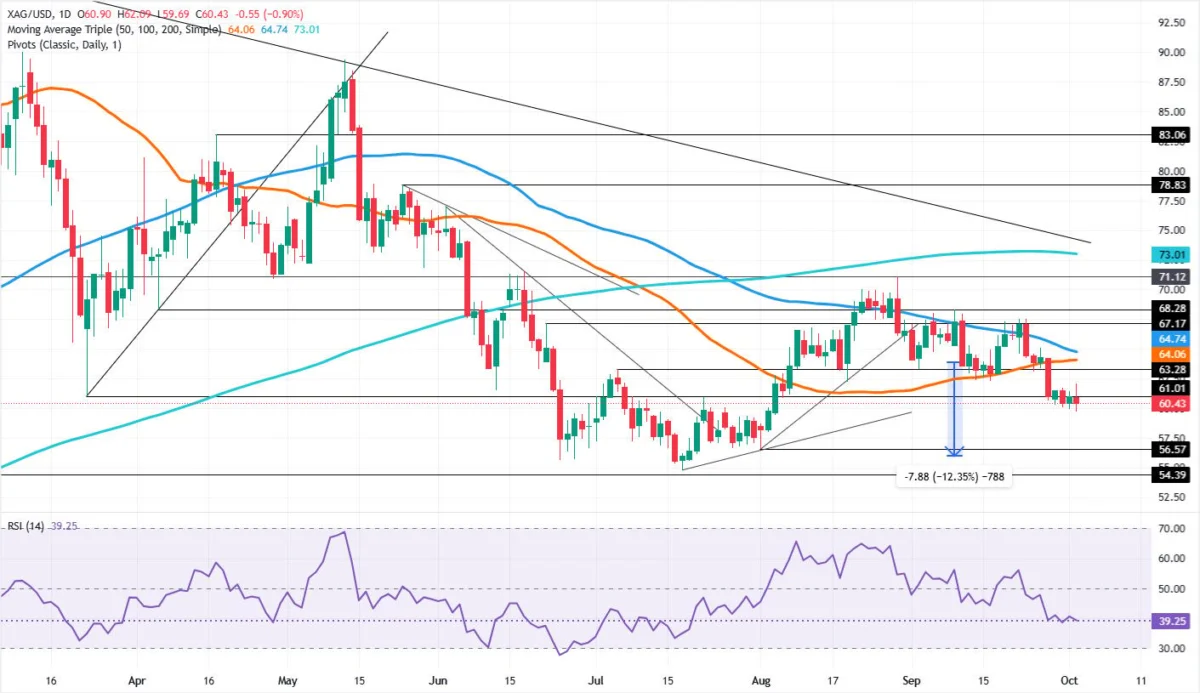
The precious metal silver experienced a notable retreat on Friday, shedding approximately 0.76% of its value to trade around $60.50 per ounce, as an uptick in US Treasury yields partially curbed the US Dollar’s depreciation, which itself had been pressured earlier by a softer-than-expected US jobs report. This daily decline contributed to a significant weekly loss for the white metal, exceeding 6%, pushing its price below crucial technical support levels and intensifying bearish sentiment among investors. The confluence of macroeconomic indicators—namely employment figures, bond yields, and currency fluctuations—created a volatile environment, underscoring silver’s sensitivity to shifts in global economic outlook and monetary policy expectations.
The Week in Review: A Chronology of Market Influences
The week began with tentative gains for precious metals, including silver, as market participants anticipated key economic data releases that could offer insights into the health of the US economy and the Federal Reserve’s future monetary policy trajectory. Early-week trading saw silver attempt to consolidate above the $64 mark, buoyed by general optimism that a slowing economy might prompt a less aggressive stance from central banks. However, this optimism was fragile, quickly giving way to apprehension as the week progressed.
The pivotal moment arrived with the release of the latest US jobs report on Friday morning. Initial reactions saw the US Dollar weaken against a basket of major currencies, a typical response to data suggesting a cooling labor market, which could signal reduced inflationary pressures and potentially lead to a pause or even a pivot in the Fed’s rate hike cycle. This initial dollar depreciation briefly offered some support to dollar-denominated commodities like silver, making them more attractive to international buyers. However, this relief was short-lived.
Despite the softer jobs figures, US Treasury yields, particularly on benchmark instruments like the 10-year note, began to edge higher. This unexpected upward movement in yields, possibly driven by a reassessment of long-term inflation expectations, concerns about government bond supply, or perhaps a more nuanced interpretation of the jobs data that still pointed to underlying economic resilience, proved to be a significant headwind for silver. Higher yields increase the opportunity cost of holding non-yielding assets such as precious metals, drawing capital away. The rising yields in turn provided a floor for the US Dollar, preventing a deeper depreciation and thus removing one of silver’s potential catalysts for a rebound. By the end of the trading day, silver had succumbed to these pressures, marking a decisive downward close and confirming its worst weekly performance in recent memory.
US Jobs Report and Its Ripple Effects
Unpacking the Data
The "soft" US jobs report was a critical factor in Friday’s market movements. While specific figures can vary, such a description typically implies that key metrics like Non-Farm Payrolls (NFP) came in below consensus estimates, or that the unemployment rate saw an unexpected increase, or that average hourly earnings growth decelerated more than anticipated. For instance, if NFP additions were significantly lower than the projected 180,000-200,000 new jobs, or if the unemployment rate ticked up from a previous low of, say, 3.5% to 3.8%, it would signal a cooling labor market. A slowdown in wage growth, perhaps from 0.4% month-over-month to 0.2%, would further reinforce the narrative of easing inflationary pressures. These indicators collectively suggest that the Federal Reserve’s aggressive monetary tightening over the past year and a half might finally be translating into a moderation of economic activity.
Monetary Policy Implications
A consistently weakening labor market typically prompts central bankers to reconsider the pace and extent of future interest rate hikes. A softer jobs report can be interpreted by the market as reducing the likelihood of further rate increases, and potentially even bringing forward the timeline for rate cuts if economic contraction becomes a significant concern. This expectation of a less hawkish Federal Reserve generally tends to weigh on the US Dollar, as the currency’s appeal diminishes when interest rate differentials narrow or reverse. Conversely, it often provides a supportive environment for precious metals, as lower interest rates decrease the carrying cost of holding non-yielding assets, making them relatively more attractive compared to interest-bearing alternatives like bonds. However, Friday’s market action demonstrated that the relationship is complex, with other factors like real yields and overall risk sentiment also playing crucial roles.
Treasury Yields and the Dollar: A Complex Interplay
The Yield Surge
Despite the narrative of a cooling labor market, US Treasury yields exhibited a perplexing upward trend on Friday. For example, the yield on the benchmark 10-year Treasury note might have climbed by several basis points, moving from, say, 4.10% to 4.25%. Similarly, the more policy-sensitive 2-year Treasury yield could have seen a similar increase. This rise in yields, even in the face of a "soft" jobs report, can be attributed to several factors. Some market participants might have interpreted the jobs data as merely a temporary blip rather than a definitive shift towards recession, maintaining long-term inflation expectations. Others might have focused on the sheer volume of new Treasury issuance required to fund government spending, leading to supply concerns that push yields higher. Moreover, a robust economy, even with some signs of cooling, can still justify higher rates if inflation remains sticky. This dynamic created a challenging environment for silver, as higher real yields—the nominal yield adjusted for inflation—tend to reduce the appeal of assets that offer no yield.
Dollar Dynamics
The US Dollar’s trajectory on Friday was equally complex. Immediately following the jobs report, the Dollar Index (DXY), which measures the greenback against a basket of six major currencies, initially dipped, perhaps from 104.00 to 103.50. This initial depreciation was a direct consequence of the market pricing in a potentially less aggressive Fed. However, as Treasury yields began to climb, the Dollar found renewed support. The higher yields made dollar-denominated assets more attractive relative to those in other currencies, helping to stem the greenback’s decline and even prompting a modest recovery. For silver, priced in US Dollars, a stronger or even stable dollar makes the commodity more expensive for holders of other currencies, thereby dampening demand. The inability of the dollar to sustain its post-jobs-report weakness removed a key tailwind for silver, contributing significantly to its Friday decline.
Silver’s Dual Nature: Industrial and Safe-Haven Demand
Silver’s unique position as both a precious metal and a critical industrial commodity means its price dynamics are influenced by a diverse set of factors. This duality often leads to more volatile price swings compared to its sister metal, gold.
Industrial Backbone
Approximately half of the global silver demand comes from industrial applications. Its unparalleled electrical and thermal conductivity makes it indispensable in a wide array of high-tech sectors. It is a vital component in electronics, from smartphones and laptops to advanced circuit boards. The rapidly expanding solar energy sector is a major consumer, with silver paste being crucial for photovoltaic cells. Medical devices, water purification systems, and automotive components also rely heavily on silver’s unique properties. Consequently, the health of the global manufacturing sector, reflected in Purchasing Managers’ Index (PMI) data and industrial production figures from major economies like the US, China, and Germany, plays a significant role in determining industrial demand for silver. A slowdown in global growth or a recessionary outlook can significantly dampen industrial demand, putting downward pressure on prices. China, as the world’s largest industrial consumer and producer of electronics, exerts substantial influence on this aspect of silver’s market. Similarly, robust consumer demand for jewelry and silverware in countries like India also contributes to price swings, though to a lesser extent than industrial usage.
Safe-Haven Allure

Like gold, silver also serves as a safe-haven asset, albeit typically considered a "poor man’s gold" due to its lower price point and higher volatility. During periods of geopolitical instability, economic uncertainty, or heightened inflation concerns, investors often flock to precious metals as a store of value. However, silver’s safe-haven appeal can be somewhat overshadowed by its industrial demand. In a severe economic downturn, industrial demand can plummet, potentially offsetting any gains from safe-haven buying. This contrasts with gold, which has fewer industrial applications and thus tends to react more purely to safe-haven flows and monetary policy expectations. The Gold/Silver ratio, which measures how many ounces of silver it takes to buy one ounce of gold, is a key indicator often watched by investors to gauge the relative valuation and sentiment between the two metals. A high ratio often suggests silver is undervalued relative to gold, while a low ratio might suggest the opposite.
Technical Outlook: A Battle for Key Levels
The technical landscape for XAG/USD appears increasingly challenging following Friday’s sell-off and the substantial weekly loss.
Weekly Performance and Key SMAs
Silver concluded the week with a significant loss exceeding 6%, a strong indication of bearish dominance. Crucially, the price breached and closed below the confluence of the 50-day and 100-day Simple Moving Averages (SMAs), located in the range of $64.06-$64.74. These moving averages are widely followed by traders as dynamic support and resistance levels. A decisive break below them is a strong bearish signal, suggesting that the short-to-medium term trend has shifted downward. The failure to hold above these SMAs indicates a loss of buying momentum and increased selling pressure, positioning the white metal to potentially test the psychologically significant $60.00 milestone in the very near term.
Momentum Indicators
Further reinforcing the bearish outlook are momentum indicators. The Relative Strength Index (RSI), a popular oscillator that measures the speed and change of price movements, remains firmly below its 50-neutral level. This indicates that sellers currently have the upper hand. Moreover, the RSI is trending closer to the oversold territory, suggesting that while the downtrend is strong, a temporary bounce or consolidation might occur if it enters deeply oversold conditions, although this would not necessarily negate the overall bearish structure. The price action itself is respecting a clear pattern of "lower highs and lower lows," a classic technical formation that confirms a sustained downtrend and indicates that sellers are consistently pushing prices lower after each attempt at a rebound.
Critical Support Levels
The immediate and most critical support level for XAG/USD is the $60.00 psychological barrier. This level holds significance not just as a round number but often as an area where previous buying interest or profit-taking might emerge. A decisive breach of $60.00 would open the door for a potential move towards the August 3 low of the day (LOD) at $56.57. This level would represent a significant retracement and could test the resolve of remaining bulls. Should this support also fail, the next crucial target for sellers would be the year-to-date (YTD) low of $54.77. A break below the YTD low would be a severe bearish development, potentially signaling a much deeper capitulation and a re-evaluation of silver’s long-term prospects.
Path to Recovery: Bullish Reversal Points
For a bullish reversal to materialize and gain traction, silver buyers face a formidable task. First, they must successfully push the price back above the recently breached 50-day and 100-day SMAs, effectively reclaiming the $64.00-$64.74 zone. This would signify a re-establishment of short-to-medium term bullish sentiment. Following this, the price would need to convincingly break above the $65.00 level. Even if these hurdles are cleared, the overarching bearish structure would still largely remain intact. To truly invalidate the current downtrend and signal a significant shift towards a sustained bullish phase, buyers would need to clear the August 28 swing high of $71.12, which represents the latest cycle high. Only a move above this level would negate the series of lower highs and lower lows, indicating that buyers have regained control of the market.
Broader Market Implications and Forward Outlook
The recent price action in silver highlights its vulnerability to the broader macroeconomic environment. The interplay between inflation expectations, interest rate trajectories, and currency valuations will continue to be dominant drivers. While a softer jobs report initially suggests a less hawkish Federal Reserve, the persistent rise in Treasury yields complicates this narrative, implying that market participants are still grappling with the full implications of economic data.
Inflationary Pressures and Interest Rate Trajectories
The battle against inflation remains central to central bank policies worldwide. If inflation proves to be more persistent than anticipated, or if economic resilience allows central banks to maintain higher interest rates for longer, precious metals like silver will likely continue to face headwinds. Conversely, a definitive pivot by central banks towards rate cuts, triggered by a more severe economic slowdown, could provide a strong tailwind for silver by reducing the opportunity cost of holding non-yielding assets.
Geopolitical Landscape
Beyond economic data, geopolitical tensions and global uncertainties always play a role in precious metals markets. Escalations in international conflicts, trade disputes, or other global crises can quickly trigger safe-haven demand, potentially providing a floor for silver prices. However, as demonstrated recently, strong counter-forces from yields and the dollar can sometimes outweigh these factors.
Analyst Consensus
Many market analysts currently suggest that silver remains in a consolidation phase with a bearish bias, at least until clear signals emerge regarding the Fed’s next moves or a significant shift in industrial demand. The immediate focus will be on whether the $60.00 support level holds and how the market reacts to upcoming inflation data and central bank commentary. Investors will also closely monitor the Gold/Silver ratio for clues on relative valuation and potential arbitrage opportunities.
In conclusion, silver’s recent retreat underscores the complex interplay of macroeconomic forces. While a soft jobs report initially hinted at potential dollar weakness and support for precious metals, the subsequent rise in US Treasury yields provided a strong counter-narrative, ultimately leading to significant weekly losses for silver. The technical outlook remains challenging, with key support levels under pressure. The path forward for silver will largely depend on the evolving narrative surrounding global economic health, central bank policies, and the delicate balance between its industrial and safe-haven demand characteristics.