Lina Wu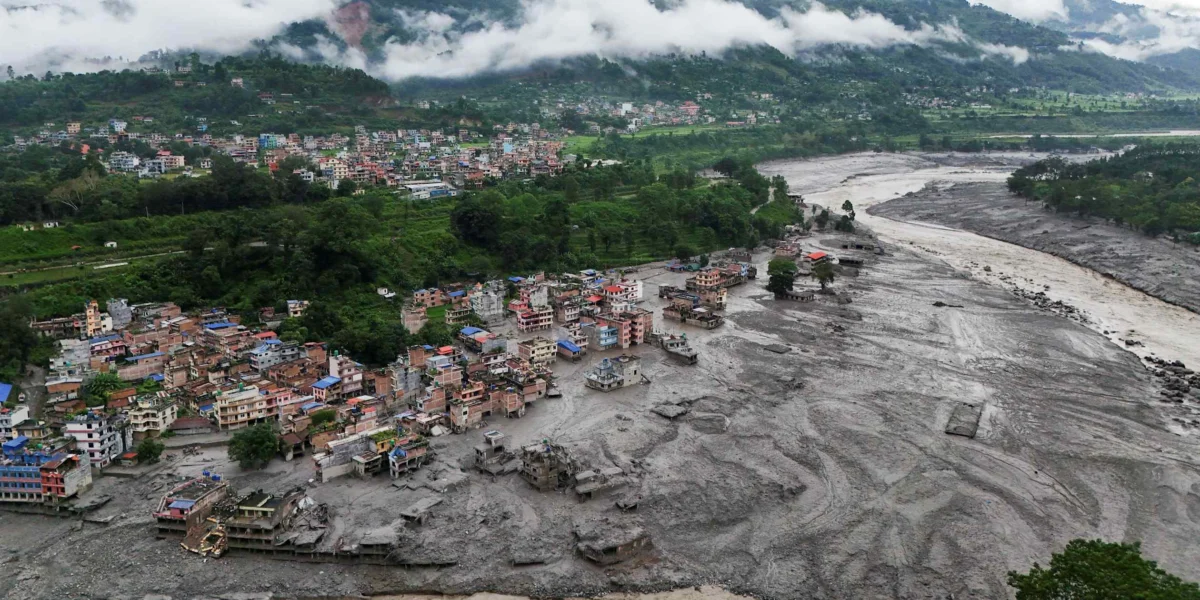
TOKYO — As glaciers retreat and freeze-thaw cycles shift in the Himalayas, increasing mountain instability, scientists say disasters like the avalanche that struck a valley at the Nepal-China border may become more likely. That, in turn, is making improved warning systems vital, particularly in a region scientists say is experiencing much faster warming than the global average.
The recent glacial lake outburst flood (GLOF) in the Trishuli river valley of Nepal’s Nuwakot district, occurring on August 27, 2026, has underscored a growing and urgent concern among glaciologists and disaster management experts: the amplified threat posed by climate change in the Hindu Kush Himalayan (HKH) region. While specific casualty and damage figures are still being consolidated by Nepalese authorities, initial reports and aerial imagery depict widespread destruction, with mud and debris inundating properties and infrastructure along the riverbanks. The event, which sent a torrent of water and glacial ice downstream, has triggered evacuations and emergency response efforts in affected communities.
The Trishuli Valley Disaster: A Developing Situation
The disaster in the Trishuli valley, a crucial waterway flowing through central Nepal, began to unfold in the early hours of August 27. Eyewitness accounts, gathered from villagers who managed to flee the immediate impact zone, describe a thunderous roar preceding the inundation. The exact source of the GLOF is believed to be a glacial lake located at a higher altitude within the surrounding mountains. While the specific lake has not yet been definitively identified, researchers are working to pinpoint its origin.
The sudden release of vast quantities of water and ice from the glacial lake unleashed a destructive force that carved a path of devastation. Properties, agricultural land, and critical infrastructure, including bridges and roads, have reportedly sustained significant damage. The immediate priority for Nepalese authorities has been search and rescue operations, as well as providing aid to displaced residents. The National Disaster Risk Reduction and Management Authority (NDRRMA) has mobilized teams, and international aid agencies are reportedly on standby to offer support.
The Science Behind the Growing Threat: Accelerated Warming in the Himalayas
The scientific consensus is clear: the Himalayas are warming at a rate significantly higher than the global average. Data from various research institutions, including the International Centre for Integrated Mountain Development (ICIMOD), consistently show that temperatures in the HKH region are rising approximately 0.7 to 1 degree Celsius per decade, nearly twice the global average. This accelerated warming has profound implications for the region’s vast glacial systems.
Key Scientific Findings:
- Glacial Retreat: The Himalayan glaciers, often referred to as the "Third Pole" due to their immense ice reserves, are retreating at an alarming pace. Studies estimate that the region has already lost between 15 and 20 percent of its ice volume over the past few decades. This process is not uniform; some glaciers are melting much faster than others.
- Formation of Glacial Lakes: As glaciers melt, depressions in the landscape can fill with meltwater, forming glacial lakes. These lakes can grow in size and volume over time.
- Increased Instability: The freeze-thaw cycles, which are becoming more erratic due to warming temperatures, contribute to the instability of glacial moraines (rock debris that dam glacial lakes). This instability increases the risk of moraine dam failure, leading to GLOFs.
- Permafrost Thaw: Rising temperatures also affect permafrost, the layer of soil that remains frozen throughout the year. Thawing permafrost can destabilize mountain slopes, increasing the likelihood of landslides and rock avalanches, which can, in turn, trigger GLOFs by impacting glacial lakes.
A 2021 study published in Nature Climate Change projected that up to two-thirds of Himalayan glaciers could disappear by the end of the century if global greenhouse gas emissions continue on their current trajectory. This stark projection highlights the long-term implications of inaction on climate change for this critical region.
A Chronology of Concern: Previous GLOF Events in the Himalayas
The Trishuli valley disaster is not an isolated incident. The Himalayas have a history of devastating GLOFs, and recent decades have seen an increase in their frequency and intensity, correlating with the observed warming trends.
- 1977, Pagri, Tibet: One of the earliest documented major GLOFs in the region, which caused significant damage downstream in Bhutan.
- 1981, Langtang Valley, Nepal: A catastrophic GLOF that claimed at least 20 lives and destroyed a village and a small hydroelectric power station.
- 2013, Uttarakhand, India: While primarily known for the Kedarnath flood, which was a complex event involving cloudbursts and landslides, glacial melt and GLOF dynamics were identified as contributing factors in some of the upstream events.
- 2014, Tsho Rolpa Glacier Lake, Nepal: Although no major outburst occurred, concerns about the stability of this large glacial lake led to significant monitoring and early warning system development.
- 2020, Upper Dig Tsho, Bhutan: A GLOF event that caused damage to infrastructure and raised further alarms about the region’s vulnerability.
- February 2021, Chamoli, Uttarakhand, India: A devastating event where a portion of a hanging glacier broke off, triggering a massive flood and debris flow down the Dhauliganga river valley. This event, which killed over 200 people, was widely attributed to glacial melt and associated instability.
The recurring nature of these events underscores a pattern that scientists have been warning about for years. The increasing frequency and magnitude of GLOFs are a direct consequence of the accelerating impact of climate change on the fragile mountain ecosystem.
Broader Implications for the Region and Beyond
The implications of escalating GLOF risks in the Himalayas extend far beyond the immediate affected communities. The region is a vital source of freshwater for billions of people downstream, sustaining major river systems like the Indus, Ganges, and Brahmaputra.
- Water Security: The long-term stability of these river systems is directly linked to the health of the Himalayan glaciers. Accelerated melting initially increases water flow, but as glaciers shrink significantly, downstream regions face severe water scarcity. GLOFs, while immediate disasters, are also symptomatic of this larger, slow-moving crisis of glacial loss.
- Infrastructure and Livelihoods: The destruction of bridges, roads, and power infrastructure disrupts essential services and economic activity. Agriculture, a cornerstone of many Himalayan economies, is particularly vulnerable to inundation and soil erosion caused by GLOFs.
- Displacement and Migration: Repeated GLOF events can lead to the permanent displacement of communities, forcing migration and creating new humanitarian challenges.
- Regional Cooperation: Addressing the GLOF threat necessitates enhanced regional cooperation on early warning systems, disaster preparedness, and climate change mitigation strategies. Countries sharing these mountain ranges must work collaboratively.
The Imperative for Enhanced Warning Systems
In light of the escalating risks, the development and implementation of robust early warning systems are paramount. Scientists and disaster management agencies are working to leverage technological advancements to monitor glacial lakes and anticipate potential outbursts.
- Remote Sensing and Satellite Monitoring: Advanced satellite imagery and remote sensing technologies allow for the continuous monitoring of glacial lakes, tracking changes in their size, volume, and the stability of their moraine dams.
- Ground-Based Monitoring: Sensor networks installed around vulnerable glacial lakes can provide real-time data on water levels, temperature, and seismic activity, offering crucial early indicators of impending danger.
- Predictive Modeling: Sophisticated hydrological and glaciological models are being developed to simulate the potential impact of glacial lake outbursts, helping authorities to better prepare evacuation plans and allocate resources.
- Community-Based Early Warning Systems: Empowering local communities with knowledge and simple warning mechanisms, such as sirens and communication networks, is vital for ensuring timely evacuations.
The recent disaster in the Trishuli valley serves as a stark reminder that the consequences of climate change are not a distant threat but a present reality for vulnerable populations in the Himalayas. As the region continues to warm at an unprecedented rate, the international community and national governments must intensify their efforts to mitigate climate change and bolster resilience against the growing threat of glacial disasters. The future of water security for a significant portion of Asia, and the safety of millions, hinges on proactive and decisive action.