Clara Shinta
The digital asset landscape was rocked this week by a significant security incident on the Liquid Network, a Blockstream-operated Bitcoin sidechain. A staggering 4,000 Bitcoin, valued at approximately $319 million, was reportedly extracted from the network. The perpetrators, in an unverified OP_RETURN message embedded within a transaction, claimed to be "white hats" and invited contact "on chain," suggesting a potential security audit or exploit demonstration rather than outright theft. This event immediately triggered a halt in operations, with Blockstream pausing bridge nodes and advising exchanges to suspend Liquid Bitcoin (LBTC) deposits and withdrawals, while the team scrambles to understand the breach and engage with the purported white hats.
The Liquid Network Breach: A Deep Dive into a Sidechain Security Scare
The incident, which saw the Liquid explorer reveal a drastic drop in its federation wallet balance from 4,200 BTC to just 207.275 BTC, represents one of the most substantial security challenges faced by a Bitcoin sidechain. The Liquid Network is designed to facilitate faster, more confidential Bitcoin transactions and enable the issuance of tokenized assets by "pegging in" Bitcoin from the main blockchain. Its security model relies on a federated multisig setup, where transactions typically require authorization from 11 out of 15 "functionaries" (federation members) and funds are sent to an approved whitelist of addresses.
Liquid Network’s official statement indicated that "the funds were withdrawn via the SideSwap PAK (Peg-out Authorization Key), but that key was not compromised, nor were any others." This detail, while intended to reassure, raised immediate questions within the crypto community about the exact nature of the exploit. If no keys were compromised, how could such a large sum be moved? The statement further confirmed, "Bridge nodes have been temporarily disabled, so no new transactions can be submitted to the network. Effectively, the Liquid sidechain is paused until this issue is resolved."
The "white hat" claim adds a layer of complexity. Typically, white hat hackers identify vulnerabilities and responsibly disclose them to project teams, often for a bug bounty, rather than executing a large-scale withdrawal of funds. The method of communication, an OP_RETURN message, is a standard way to embed small amounts of data into Bitcoin transactions, but it lacks the directness of a traditional vulnerability report.
Crypto analyst DBCrypto weighed in on the situation, noting that "the coins aren’t running and they’re just sitting on Bitcoin and haven’t been mixed. That’s more consistent with a whitehat extraction than a theft." However, he also underscored the profound security implications: "Either 11 of 15 functionaries signed this off, or the whitelist built to prevent exactly this didn’t hold. Neither answer makes Liquid look good." Both scenarios point to a fundamental flaw in the network’s security architecture or operational procedures.

At the time of reporting, neither Blockstream, the primary developer behind Liquid, nor its CEO Adam Back had publicly commented on the incident on X (formerly Twitter). However, Samson Mow, CEO of Jan3 and a prominent figure in the Bitcoin ecosystem, provided an update, stating, "Everyone is actively working to resolve this…These are difficult times but we’ll pull through." The silence from key Blockstream figures, contrasted with Mow’s brief reassurance, highlighted the gravity and ongoing nature of the crisis. The full implications for Liquid Network’s future, and indeed for the broader trust in Bitcoin sidechains, remain to be seen as investigations continue.
Bitcoin ETFs Surge: $3.8 Billion Inflows Signal Renewed Bullish Momentum
Amidst the turbulence in the sidechain sector, the broader Bitcoin market showed robust signs of a potential bull run, with US spot Bitcoin Exchange-Traded Funds (ETFs) recording their strongest three-week inflow stretch of 2026. These funds attracted a remarkable $3.8 billion in net inflows over the period, pushing Bitcoin’s price comfortably above the $80,000 mark.
The week ending Friday alone saw nearly $1 billion ($986.9 million) pour into these investment vehicles, according to data from SoSoValue. This impressive performance builds on a trend of increasing institutional interest and investor confidence in Bitcoin as a legitimate asset class. The ETFs, which launched in early 2024 after years of regulatory hurdles, have provided a regulated and accessible gateway for traditional investors to gain exposure to Bitcoin without directly holding the cryptocurrency.
On Thursday, the Bitcoin ETFs witnessed an extraordinary single-day inflow of $730.9 million, marking the strongest daily showing since January 14. This surge in capital injection is a critical indicator for market analysts, often seen as a precursor to sustained price appreciation. While Bitcoin is yet to firmly hold above its 50-week moving average – a key technical indicator that would definitively confirm a bull market to some observers – the consistent and substantial ETF inflows suggest that underlying market demand is rapidly strengthening.
Total net assets across all US spot Bitcoin ETFs reached $101.3 billion by Friday, with cumulative net inflows since their inception swelling to $55.6 billion. These figures underscore the monumental impact these products have had on the cryptocurrency market, drawing in capital that might otherwise have remained on the sidelines. The sustained interest from institutional and retail investors alike, channeled through these regulated financial products, paints a bullish picture for Bitcoin’s trajectory through 2026 and beyond, hinting at broader mainstream adoption and integration into traditional financial portfolios.
AMC CEO Adam Aron Clashes with Robinhood Over Tokenized Stocks

The burgeoning world of tokenized assets sparked a heated public dispute this week, as AMC Entertainment CEO Adam Aron threatened legal action against Robinhood’s new Ethereum Layer 2 (L2) platform for offering tokenized AMC stock without his company’s consent. Robinhood’s L2 has been a runaway success, quickly becoming a leading chain for daily fees and even surpassing Solana’s 24-hour DEX volume. Its token launchpad, PONS, also entered the Top 100 cryptocurrencies this week with an impressive 140% gain, partly fueled by the platform’s innovative pairing of meme coins with tokenized versions of popular stocks like AMC.
However, this innovation was met with fierce opposition from Aron, a figure well-known for his engagement with AMC’s retail shareholder base, often dubbed "apes." Taking to X, Aron expressed his outrage in no uncertain terms: "I find this practice to be contemptible, outrageous, disgusting, detestable, inexcusable, vile. How can it possibly be legal? We have no connection to this at all, and do not condone it in any way." His strong language reflects a deep concern over the unauthorized use of his company’s brand and stock, especially given AMC’s history as a "meme stock" heavily influenced by retail trading sentiment.
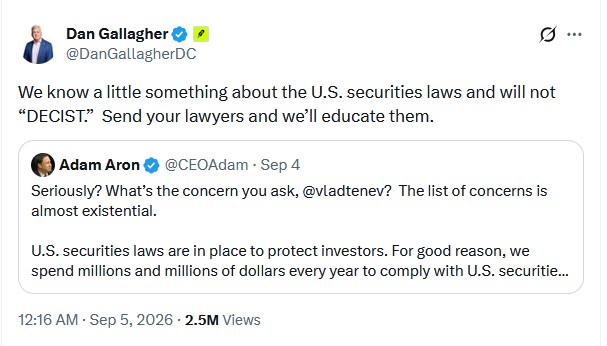
The situation escalated when Robinhood co-founder Vlad Tenev responded with a seemingly nonchalant query: "What’s the concern?" This ignited a further tirade from Aron, who labeled Robinhood’s conduct "shocking and shameful" and demanded they "CEASE AND DECIST (sic)." He also vowed to involve the U.S. Securities and Exchange Commission (SEC), stating, "You can be sure we will be asking them."
The exchange culminated in a sharp retort from Dan Gallagher, Robinhood’s chief legal officer and a former SEC commissioner. Gallagher, leveraging his deep understanding of securities law, defiantly wrote back: "We know a little something about the U.S. securities laws and will not ‘DECIST.’ Send your lawyers and we’ll educate them." This aggressive stance from Robinhood highlights the legal complexities and jurisdictional ambiguities surrounding tokenized securities, particularly when they represent real-world assets without explicit corporate approval. The confrontation sets the stage for a potential legal battle that could have far-reaching implications for the future of tokenized assets and the intersection of traditional finance with decentralized blockchain platforms.
Global Financial Titans Embrace Stablecoins, G20 Backs Digital Asset Innovation
A monumental shift in the mainstream financial world’s approach to digital assets was announced this week, with a consortium of 21 major financial institutions revealing plans to establish a new company dedicated to developing and issuing stablecoins. This formidable group includes some of the biggest names in banking and investment, such as Bank of America, Goldman Sachs, Citi, Deutsche Bank, UBS, Santander, MUFG, and Fidelity Investments.
The consortium aims to launch its first US dollar-denominated stablecoin in the first half of 2027, contingent upon the successful formation of the company and other regulatory conditions. This initiative marks a significant acceleration in the integration of blockchain technology into traditional finance, driven by the recognized potential of stablecoins for more efficient, secure, and cost-effective transactions across various financial markets. The group’s long-term vision extends beyond the US dollar, with plans to expand into stablecoins denominated in other G7 currencies, identifying a euro-backed offering as its next priority. This strategic move signals a concerted effort by financial giants to lead, rather than simply react to, the evolving digital asset landscape.
Further bolstering the legitimacy of digital assets on a global scale, the G20 member nations issued a joint statement unequivocally supporting crypto as a transformative force for "broad-based economic growth." The statement committed member nations to "advancing responsible and effective regulatory and supervisory frameworks that preserve financial stability, support economic growth, and establish clear pathways for sound digital financial and digital assets innovation." This endorsement from the world’s leading economies represents a crucial turning point, moving away from past skepticism towards a more constructive and collaborative approach to integrating digital assets into the global financial system. The combined weight of institutional stablecoin development and G20 regulatory support indicates a future where digital assets are not just tolerated, but actively leveraged for economic progress and financial innovation.
Kalshi Bans George Santos for Life, Prediction Markets Face Regulatory Showdown
The contentious realm of prediction markets saw both a high-profile ban and a significant legal challenge this week. Kalshi, a regulated event contract trading platform, issued a lifetime ban to ousted Republican lawmaker George Santos for allegedly engaging in insider trading. This unprecedented move, one of the first lifetime bans imposed by Kalshi since its 2021 launch, stemmed from Santos’s reported bets on markets related to his own actions, specifically his attendance at the State of the Union address in February 2026. Kalshi’s decision underscores the platform’s commitment to market integrity and preventing manipulation, even from public figures.
In response to the ban, Santos, known for his controversial tenure in Congress, dismissed Kalshi as an "unserious company," maintaining his characteristic defiance. However, the incident highlighted the ethical dilemmas and regulatory ambiguities that frequently surround prediction markets, which allow users to bet on the outcome of future events.
Meanwhile, the broader legal status of prediction markets intensified as New Jersey’s Attorney General officially petitioned the U.S. Supreme Court to weigh in on a critical jurisdictional dispute. The case seeks to resolve whether state authorities or federal agencies, specifically the Commodity Futures Trading Commission (CFTC), hold precedence over the regulation of prediction market companies. Officials cited civil cases brought by gaming authorities in "at least 20 states," all requiring a definitive ruling on whether state gambling laws or CFTC rules should apply.
The New Jersey Attorney General argued vehemently, stating, "These companies have no right to offer their sports bets without following state law, which is why dozens of States across the ideological spectrum have opposed them […] We’re calling on the Supreme Court to resolve this issue and recognize that Congress did not silently make the sports-betting industry immune from state law." This legal challenge has significant implications for the future of prediction markets across the United States. A Supreme Court decision could either consolidate federal oversight, potentially streamlining regulations, or empower individual states to enforce their own gambling laws, creating a fragmented and complex regulatory landscape for these innovative, yet often controversial, platforms.
Market Snapshot: Winners, Losers, and Key Predictions
As the week concluded, the cryptocurrency market displayed overall positive momentum despite isolated incidents. Bitcoin (BTC) saw a 2.6% gain, trading at $80,234, while Ethereum (ETH) increased by 2.3% to $2,513. XRP (XRP) also climbed 3% to $1.42. The total cryptocurrency market capitalization stood robustly at $2.72 trillion, according to CoinMarketCap data.
Among the top 100 cryptocurrencies, the week’s standout performers were Pons (PONS), which surged an impressive 140%, likely buoyed by the attention surrounding Robinhood’s L2 platform. Arbitrum (ARB), an Ethereum scaling solution, followed with a significant 116% gain, reflecting continued interest in Layer 2 solutions. Dash (DASH) also performed strongly, up 66%. On the other side of the spectrum, the top three altcoin losers were Pump.fun (PUMP), down 13.2%; Canton (CC), which dropped 6.9%; and Official Trump (TRUMP), declining by 4.1%.
Top Prediction of the Week: Arthur Hayes on Bitcoin’s Million-Dollar Horizon and Ethereum’s Immediate Potential
In a bold forecast this week, BitMEX founder Arthur Hayes articulated a compelling case for Bitcoin reaching $1 million by 2030. Speaking to Cointelegraph, Hayes cited several macroeconomic factors as catalysts, including the potential collapse of the artificial intelligence (AI) bubble, "massive" global money printing, and the looming prospect of US yield curve control. These conditions, he argued, create a fertile environment for Bitcoin’s ascent. "We have the ingredients. The time is now. So I think the $58,000 was probably the bottom in Bitcoin, and now it’s going to grind higher in this hate f*ck rally," the billionaire investor remarked, encapsulating his conviction in Bitcoin’s long-term trajectory.
Despite his bullish outlook on Bitcoin, Hayes revealed a strategic investment preference for Ethereum (ETH) in the short to medium term. He described ETH as offering the "best risk-reward adjusted bet in crypto right now," and confirmed he has been "amassing a sizeable position." Hayes explained his rationale: "That doesn’t necessarily mean that Hyperliquid won’t rise in price. I just don’t think it’s poised for a 5x, and like where I think Ethereum could do, you know, 3x to 5x pretty quickly." His comments highlight a nuanced investment strategy that differentiates between long-term macro-driven appreciation for Bitcoin and nearer-term, potentially higher-multiplier gains in the rapidly evolving Ethereum ecosystem.
Top FUD of the Week: El Salvador’s Bitcoin Transparency, AI Malware Threats, and Miner Exodus
The week also brought its share of "Fear, Uncertainty, and Doubt" (FUD) across various sectors of the crypto world.

El Salvador’s Bitcoin Accumulation Under Scrutiny:
El Salvador’s pioneering adoption of Bitcoin as legal tender continued to draw international attention, particularly from the International Monetary Fund (IMF). Reports emerged this week suggesting that El Salvador utilized no public funds for its Bitcoin accumulation after the first review of its IMF financing program in June 2025. Documents provided by Salvadoran authorities reportedly indicated that subsequent Bitcoin purchases were financed through private donations, not government resources. The IMF also noted that majority ownership and operational control of the Chivo wallet, a key component of El Salvador’s Bitcoin strategy, had been transferred to a private operator, with the government retaining a minority stake and custodial responsibilities.
However, President Nayib Bukele swiftly dismissed these reports as "fake news," specifically refuting the claim that El Salvador had transferred its Bitcoin returns to a private party. Bukele clarified, pointing to an IMF link, that "Read it. It clearly says the opposite: that the only thing that was transferred were Chivo shares, something that was offered a year and a half ago, and NOT the Bitcoin Strategic Reserve." This ongoing back-and-forth underscores the challenges of transparency and international scrutiny faced by nations integrating volatile assets like Bitcoin into their national treasuries and financial systems.
Fake Claude App Spreads Crypto-Stealing Malware:
A stark warning emerged from cybersecurity firm Morphisec this week regarding a malicious fake Claude desktop application. This imposter app is reportedly being used to distribute RevStealer, a potent Windows malware designed to pilfer cryptocurrency, passwords, and browser data. Previously disseminated through platforms like GitHub repositories and game-cheat-themed sites, the most recent vector is a deceptive "Claude Opus 5 Free Desktop" project that impersonates AI developer Anthropic, luring users with promises of free access to the advanced AI.
Morphisec researchers highlighted that RevStealer is engineered to leave minimal traces, systematically searching browser databases, cookies, password-manager records, VPN and remote-access settings, messaging data, screenshots, and selected documents. Crucially, the malware specifically targets over 50 different cryptocurrency wallets, posing a significant threat to digital asset holders. This incident serves as a critical reminder of the persistent and evolving nature of cyber threats in the crypto space, emphasizing the need for extreme caution when downloading software, especially from unofficial sources.
Hyperscale Data Pivots from Bitcoin Mining to AI Data Centers:
In a significant strategic shift, Hyperscale Data announced the cessation of all Bitcoin mining operations at its Michigan facility, signaling a pivot towards the burgeoning artificial intelligence (AI) data center market. The company confirmed on Wednesday that all Bitcoin miners at the site had been switched off, with plans to sell the associated mining equipment. This decision reflects a broader trend among some infrastructure providers to capitalize on the soaring demand for AI computing power.
Hyperscale revealed that an AI customer has contracted for 20 megawatts (MW) of computing capacity under a 10-year master services agreement, with two optional five-year extensions. This agreement is projected to generate over $1.2 billion in revenue over its maximum 20-year term. An additional 32 MW option could further elevate potential revenue beyond $3 billion, with the site ultimately expected to support 340 MW. To fund this transition and AI buildout, Hyperscale has sharply reduced its Bitcoin holdings, which plummeted from 1006 BTC at the end of July to approximately 215 BTC today. This move underscores the economic pressures and strategic reevaluations occurring within the data center industry, as the profitability of Bitcoin mining increasingly competes with the lucrative opportunities presented by the AI boom.
Top Magazine Stories of the Week

The Cointelegraph Magazine section offered compelling long-form reads this week, delving into some of the most intriguing and thought-provoking topics in crypto:
- Mystery surrounds why an OG burned $1M in Bitcoin: This feature explored the perplexing decision of a Bitcoin early adopter to deliberately destroy 20 BTC, valued at $1 million, after a seemingly routine custodian transaction. The article delved into potential motivations and the broader implications of such an irreversible act in the crypto world.
- Does the Bitcoin rally mean we haven’t wasted our lives in crypto? This piece reflected on a decade of building and innovation in the crypto space, examining whether the recent Bitcoin rally finally validates the efforts of early believers, while also acknowledging how the industry’s biggest wins have diverged from initial utopian visions.
- Token buybacks are booming. But are they good for crypto projects? Investigating the increasing trend of crypto projects spending hundreds of millions to repurchase their own tokens, this article analyzed whether these buybacks genuinely create lasting value for projects or merely serve to artificially inflate token prices, raising questions about market manipulation and sustainable growth.
- Recovery specialists crack $1B crypto wallet… but find just $10: A fascinating exposé into the world of crypto recovery, this story detailed how specialists employ various techniques to retrieve lost funds from forgotten wallets and seed phrases. However, it also highlighted the bittersweet reality that sometimes, despite successfully cracking a seemingly valuable wallet, the actual funds might never have been there in the first place, emphasizing the complexities and pitfalls of digital asset storage.
Cointelegraph publishes long-form journalism, analysis and narrative reporting produced by Cointelegraph’s in-house editorial team with subject-matter expertise. All articles are edited and reviewed by Cointelegraph editors in line with our editorial standards. Some articles contain affiliate links, from which Cointelegraph may earn a commission. These relationships do not influence which products we review or our editorial conclusions. Content published in here does not constitute financial, legal or investment advice. Readers should conduct their own research and consult qualified professionals where appropriate. Cointelegraph maintains full editorial independence.