Lina Wu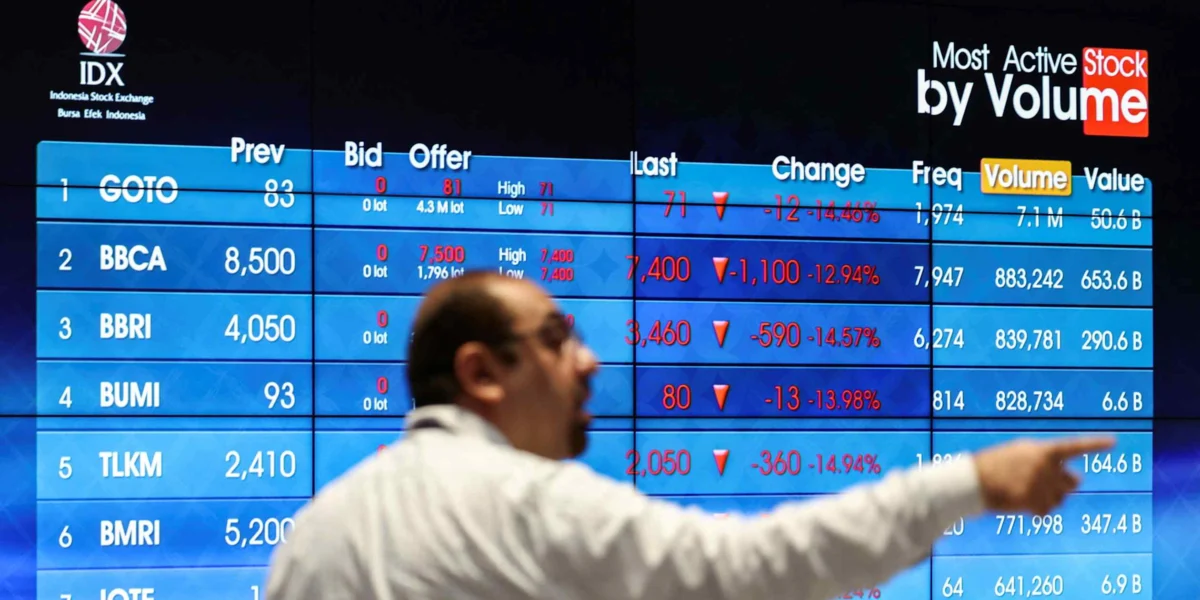
JAKARTA – The Indonesia Stock Exchange’s (IDX) composite index registered a notable decline of 94.03 points, or 1.51%, on Monday, marking its first trading session since the elimination of the 50 rupiah (approximately 0.3 US cents) minimum share price. This policy shift triggered a sharp downturn for a significant number of listed companies, including prominent technology firm GoTo Gojek Tokopedia, as investors reassessed valuations in the newly unfettered market. The benchmark index closed at 6,142.87, reflecting a broader sentiment of caution and repricing across various sectors.
The implications of this policy change, enacted by the IDX to foster market liquidity and encourage investment in smaller capitalization companies, are already becoming apparent. Historically, the 50 rupiah floor served as a psychological and practical barrier, effectively preventing shares from trading at extremely low nominal values. Its removal has opened the floodgates for price discovery based purely on market sentiment and underlying company fundamentals, leading to a more volatile trading environment for many.
Background and Rationale Behind the Policy Shift
The decision to abolish the 50 rupiah minimum share price was not an abrupt one. It emerged from extensive discussions and analysis by the IDX and the Indonesian Financial Services Authority (OJK) over several years. The primary objective was to address a growing concern within the Indonesian capital market: the increasing number of "penny stocks" or "zombie stocks" that traded at extremely low valuations, often below the cost of a single stamp. These stocks, while technically listed, contributed little to market turnover and often served as speculative vehicles rather than genuine investment opportunities.
Proponents of the policy change argued that the minimum price acted as an artificial cap, hindering the natural price discovery process and making it difficult for investors to acquire shares in companies that might have genuine long-term potential but were previously unable to break through the psychological barrier. The removal was intended to:
- Enhance Market Liquidity: By allowing prices to fall to their natural levels, it was hoped that more trading activity would be generated, particularly for smaller companies that had been languishing at the 50 rupiah mark.
- Promote Fairer Valuations: The policy aimed to ensure that stock prices reflected the true market perception of a company’s worth, rather than being artificially propped up by the minimum price regulation.
- Attract New Investors: A more dynamic and liquid market, with a wider range of entry points, was expected to appeal to both domestic and international investors.
- Streamline Market Operations: The existence of numerous stocks trading at the absolute minimum price created administrative complexities and distorted market indices.
The IDX had previously implemented measures to address the issue of low-priced stocks, including the introduction of a "two-tier" pricing system in 2017, where stocks priced below 200 rupiah were subjected to stricter trading rules. However, these measures proved insufficient to fundamentally alter the landscape of low-valuation stocks. The complete removal of the 50 rupiah floor was seen as a more decisive step.
The Day of Reckoning: Monday’s Trading Activity
Monday’s trading session provided the first real-time data on the impact of the policy change. The composite index’s decline was a broad-based phenomenon, but its severity was amplified by the performance of individual stocks that had been trading at or near the previous 50 rupiah floor. More than 40 companies listed on the IDX, out of approximately 900 constituents of the composite index, were observed to be trading at or below this nominal threshold prior to the policy’s implementation.
GoTo Gojek Tokopedia (GOTO), a prominent technology company that has been a significant component of the IDX composite index, experienced a notable price adjustment. While specific figures for GOTO’s intraday performance on Monday were not detailed in the initial report, its inclusion as an example of a company affected suggests a downward price movement. GOTO, like many other technology firms globally, has faced increased scrutiny regarding its profitability and growth trajectory, making its stock price particularly sensitive to market sentiment and valuation recalibrations. Its performance on Monday would have been closely watched as an indicator of how larger, more established technology players would fare in this new pricing environment.
Beyond GOTO, numerous smaller and mid-cap companies, many of which operate in sectors such as manufacturing, consumer goods, and various services, saw their share prices tumble. The immediate aftermath of the policy change led to a wave of selling pressure as investors who had been holding these stocks at the 50 rupiah mark sought to exit or re-evaluate their positions. This dynamic created a cascading effect, dragging down the broader market sentiment.
Supporting Data and Market Trends
While the immediate focus was on the price drops, understanding the broader context requires looking at historical data and market composition. Prior to Monday, a substantial portion of listed companies traded at very low nominal values. This skewed the perception of market depth and made certain indices appear higher than they would have if all stocks traded at more substantial price points.
Pre-Policy Scenario:
- Number of Stocks Below 50 Rupiah: Reports indicated that over 40 companies were trading at or below 50 rupiah.
- Average Price of Low-Cap Stocks: Many of these companies had their stock prices anchored at 50 rupiah due to the minimum price rule.
- Market Representation: These low-priced stocks, while numerous, often had very low market capitalizations, meaning their direct impact on the composite index’s movement was limited, but their sheer volume at the floor price represented a segment of the market that was no longer artificially constrained.
Post-Policy Scenario (Immediate Impact):
- Price Discovery: The removal of the floor allowed these stocks to trade at prices reflecting market demand and supply, leading to sharp declines for many as liquidity dried up or speculative interest waned.
- Increased Volatility: The market experienced heightened volatility as investors adjusted to the new pricing reality.
- Index Adjustment: The decline in the composite index was a direct consequence of the broad-based selling pressure, particularly from stocks that were previously held back by the minimum price.
Long-Term Implications (Projected):
- Potential for Growth: Companies with strong fundamentals and genuine growth prospects, even if previously undervalued due to the 50 rupiah floor, might see their share prices appreciate over time as market forces take over.
- Consolidation and Delisting: It is possible that some companies with weak financial health and no clear path to recovery might face delisting if their share prices fall too low and they fail to meet listing requirements.
- Attraction of Institutional Investors: If the market becomes more liquid and prices are perceived as more reflective of value, it could attract more substantial institutional investment, both domestic and foreign.
Official Responses and Expert Opinions
While formal statements directly addressing Monday’s market performance were limited in the immediate aftermath, the IDX and OJK have consistently articulated their long-term vision for a more robust and transparent capital market. Their rationale for removing the minimum share price has been well-documented.
Indonesia Stock Exchange (IDX): The IDX has emphasized its commitment to market modernization and investor protection. The removal of the 50 rupiah floor is viewed as a necessary step towards achieving these goals. Officials have likely expressed optimism that the initial volatility will subside as the market adjusts, leading to a more efficient allocation of capital. The exchange’s communication strategy would typically involve highlighting the long-term benefits of such reforms, such as improved liquidity and fairer valuations, while acknowledging the short-term adjustment period.
Indonesian Financial Services Authority (OJK): The OJK, as the primary financial regulator, has a vested interest in the stability and integrity of the capital markets. The OJK’s approval and support for the IDX’s policy changes underscore a shared commitment to developing a mature financial ecosystem. Their focus would be on ensuring that the transition is managed smoothly and that investor interests are safeguarded throughout the process.
Market Analysts and Economists: Financial analysts and economists have offered a range of perspectives. Some have lauded the move as a necessary "spring cleaning" for the Indonesian stock market, arguing that it will eventually lead to a more efficient and attractive investment environment. They point to the experiences of other developed markets where such minimum price floors are uncommon.
Conversely, some analysts have expressed concerns about the immediate impact on retail investors who may have held these low-priced stocks with the expectation of a price recovery. They highlight the potential for significant capital losses for these investors in the short to medium term. The consensus among many experts is that while the long-term outlook is positive, the transition period requires careful monitoring and potentially supportive measures to mitigate undue hardship for certain market participants.
Broader Impact and Implications for the Indonesian Economy
The implications of this policy shift extend beyond the daily fluctuations of the stock market. A more efficient and liquid capital market is a cornerstone of economic development. By allowing for better price discovery and potentially attracting more investment, the IDX reforms could:
- Facilitate Capital Raising: Companies will find it easier to raise capital through equity offerings if their valuations are more transparent and their stocks are actively traded. This can fuel expansion and innovation.
- Boost Economic Growth: Increased investment in productive assets can lead to job creation, technological advancement, and overall economic expansion.
- Enhance Market Sophistication: The shift towards a market driven by fundamentals rather than artificial price barriers will foster a more sophisticated investment culture.
- Improve Global Competitiveness: A well-functioning and liquid stock market makes Indonesia a more attractive destination for foreign direct investment, enhancing its global economic standing.
However, the transition also presents challenges. The initial period of price adjustment could lead to a decline in investor confidence if not managed carefully. The IDX and OJK will need to maintain clear communication, provide educational resources for investors, and potentially implement safeguards to prevent excessive market manipulation.
The removal of the 50 rupiah minimum share price is a bold step in the evolution of the Indonesian capital market. While Monday’s trading session underscored the immediate impact of this significant policy change, the long-term success will depend on the market’s ability to adapt, the sustained commitment of regulators, and the resilience of companies to demonstrate their intrinsic value in a truly free-pricing environment. The IDX has embarked on a path toward greater efficiency and transparency, with the expectation that this will ultimately benefit investors and contribute to the broader economic prosperity of Indonesia. The coming weeks and months will be crucial in observing how the market settles and whether the intended benefits of this reform materialize.