Reynand Wu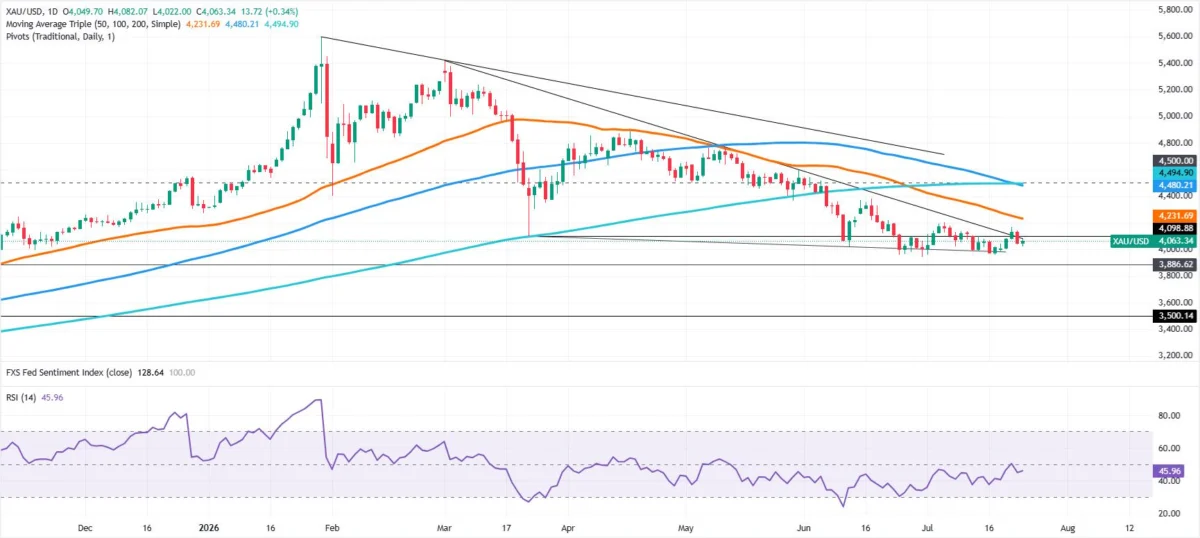
The price of Gold (XAU/USD) recorded a modest ascent on Friday, trading at $4,065, an increase of 0.38%, even as the US Dollar maintained a firm stance. This upward movement in the precious metal reflects a complex interplay of market forces, primarily driven by escalating speculation that the conflict between the United States and Iran could persist longer than anticipated, thereby bolstering gold’s traditional role as a safe-haven asset. Simultaneously, a notable decline in US Treasury yields has provided additional support for the yellow metal, effectively countering the upward pressure from a strengthening Greenback and growing market expectations for a Federal Reserve interest rate hike.
Geopolitical Undercurrents and the Enduring Demand for Safe Havens
The current geopolitical landscape, particularly the simmering tensions between the United States and Iran, continues to be a significant catalyst for gold’s appeal. For centuries, gold has served as a reliable store of value during periods of global instability, and the latest developments in the Gulf region underscore this enduring characteristic. Reports indicating a protracted conflict between the two nations have amplified risk aversion among investors, leading them to seek refuge in assets perceived as secure and less susceptible to the volatility of equity markets or the fluctuating value of fiat currencies.
The historical backdrop of US-Iran relations is marked by cycles of confrontation and uneasy detente, largely centered on Iran’s nuclear program, its regional influence through proxy groups, and control over vital global shipping lanes like the Strait of Hormuz. Recent escalations, which often include increased rhetoric, naval maneuvers, alleged attacks on shipping, or cyber warfare, invariably heighten uncertainty in global markets. Such events create a fertile ground for gold’s appreciation as investors seek to protect capital from potential economic fallout or broader geopolitical contagion.
Diplomatic efforts to de-escalate the situation appear to be making limited headway, suggesting that a quick resolution is unlikely. Sources indicate that Pakistan is attempting to mediate talks between Washington and Tehran, reportedly at the behest of China. Beijing’s involvement highlights its growing geopolitical influence and its strategic interest in maintaining regional stability, particularly given its substantial reliance on Middle Eastern oil imports. However, statements attributed to former President Trump, indicating a loss of patience with Iran, alongside his confirmation that China and Russia are not supplying weapons to the Islamic Republic, paint a picture of continued diplomatic deadlock and underlying frustration. Such pronouncements, even from a former head of state, carry significant weight in international discourse and can signal potential shifts in policy or heightened resolve, further contributing to market unease and the flight to safety.

The intertwining of geopolitical risk with global energy markets is also crucial. While West Texas Intermediate (WTI) crude oil prices eased on Friday, dropping 3.83% to $88.79, they are still poised to conclude the week with substantial gains exceeding 8.50%. Geopolitical flare-ups in the Middle East frequently lead to spikes in oil prices due to fears of supply disruptions from a region critical to global energy supply. Historically, higher oil prices can contribute to inflationary pressures and economic uncertainty, which, in turn, often enhances gold’s attractiveness as a hedge against inflation. Therefore, the volatility in oil markets, even with a day’s decline, reinforces the underlying tension that supports gold’s safe-haven premium.
Monetary Policy Crossroads: The Federal Reserve’s Stance
The prevailing narrative in financial markets remains heavily influenced by the Federal Reserve’s monetary policy trajectory. Despite the safe-haven demand for gold, the prospect of rising interest rates typically presents a formidable headwind for the non-yielding precious metal. Higher interest rates increase the opportunity cost of holding gold, as investors can earn better returns from interest-bearing assets like government bonds or savings accounts, thereby making gold relatively less attractive.
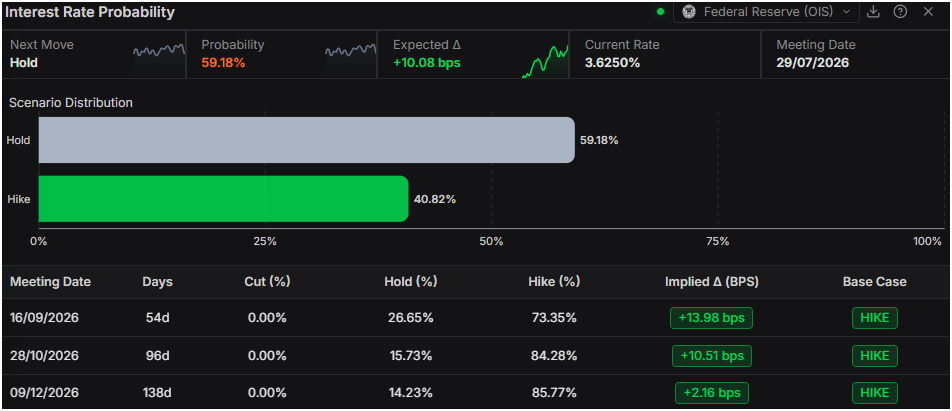
Currently, money markets are signaling increased probabilities for a rate hike by the Fed at its upcoming meeting. While the consensus on July 29 projects a 59% chance of the US central bank maintaining current rates, a significant 41% likelihood of a 25-basis-point (bps) rate hike underscores the prevailing hawkish sentiment. Looking further ahead to the September meeting, the odds of a rate increase escalate dramatically to 84%, according to Prime Terminal data. This strong expectation for continued tightening monetary policy suggests that persistent inflation concerns or robust economic indicators are compelling the Fed towards further action, despite recent progress in bringing inflation down from multi-decade highs.
The Federal Reserve operates under a dual mandate: to foster maximum employment and price stability. In recent months, persistent inflation above its 2% target has been a primary driver of its aggressive rate-hiking cycle, which began in early 2022. Should inflation prove more entrenched than anticipated, or if labor market data continues to show resilience (potentially leading to wage-price spirals), the Fed may feel compelled to continue its tightening path. Conversely, any signs of significant economic slowdown, such as a sharp rise in unemployment or a contraction in GDP, could prompt a pause or even a reversal in policy, which would generally be bullish for gold as real interest rates decline.
Traders and analysts are keenly awaiting a series of critical US economic data releases in the coming weeks that will undoubtedly inform the Fed’s decisions. These include figures on US Retail Sales, which provide insights into consumer spending health; Durable Goods Orders, indicative of business investment and manufacturing activity; comprehensive jobs data, offering a snapshot of the labor market’s robustness, including non-farm payrolls and unemployment rates; the Gross Domestic Product (GDP) figures for Q2, which will measure overall economic growth; and the Personal Consumption Expenditures (PCE) report, the Fed’s preferred inflation gauge. Each of these reports holds the potential to significantly shift market expectations regarding future rate adjustments and, consequently, gold’s valuation. Stronger-than-expected data could reinforce hike bets, while weaker data might temper them.
Economic Landscape: Mixed Signals from US Business Activity
The latest economic data from the United States presents a nuanced picture of business activity, reflecting both resilience and areas of moderation. S&P Global’s Purchasing Managers’ Index (PMI) data for Friday revealed a slight dip in the Manufacturing PMI, moving from 53.9 to 53.8. This figure, which measures the health of the manufacturing sector, fell short of economists’ expectations of 54.5, suggesting a modest deceleration in factory output and new orders. This could be attributed to various factors, including persistent supply chain constraints, moderating global demand for goods following the post-pandemic surge, or the lagged impact of higher interest rates on industrial investment and consumer spending on durable goods. A reading above 50 still indicates expansion, but the decline suggests a loss of momentum.
In contrast, the Services PMI showed robust expansion, rising from 51.2 to 53.6, comfortably surpassing forecasts of 51. The services sector, which constitutes a larger portion of the US economy (approximately two-thirds of GDP), appears to be enjoying sustained momentum. This surge in services activity was reportedly "helped by the World Cup held in the country," as per the original reporting. While the 2022 FIFA World Cup was hosted in Qatar, and no major international World Cup event has been held in the US in the immediate reporting period, this statement likely refers to a broader trend of robust consumer spending on leisure, hospitality, and entertainment, or the economic activity generated by major sporting events (domestic or international viewership) which can indeed provide a considerable boost to the services sector. This reflects strong underlying demand and business confidence in this segment. The robust performance in services could contribute to persistent inflationary pressures, particularly in labor-intensive service industries, further influencing the Federal Reserve’s policy considerations. The divergence between a slightly cooling manufacturing sector and a flourishing services sector highlights an uneven economic recovery, complicating the Fed’s task of achieving both price stability and maximum employment without triggering a recession.
The Dollar’s Enduring Strength and Yield Dynamics
The US Dollar Index (DXY), a measure of the dollar’s strength against a basket of six major currencies, closed slightly higher at 101.46 on Friday, positioning it for weekly gains exceeding 0.60%. A stronger dollar typically exerts downward pressure on gold prices because gold is denominated in dollars. When the dollar appreciates, it makes gold more expensive for holders of other currencies, thereby reducing demand. This inverse correlation is a fundamental aspect of gold market dynamics.
However, the current scenario presents a subtle paradox where gold is rising despite a firm dollar. This can be largely attributed to the countervailing force of declining US Treasury yields. The benchmark 10-year Treasury note yield dropped three basis points to 4.667% on Friday. Lower Treasury yields reduce the attractiveness of holding government bonds, which are considered safe-haven assets but offer a yield. In such an environment, gold, a non-yielding asset, becomes relatively more appealing as a safe haven, particularly when geopolitical risks are elevated. Investors may be prioritizing the perceived safety and inflation-hedging properties of gold over the modest, albeit declining, yield offered by bonds, especially if they anticipate a potential future economic slowdown or further geopolitical instability. This dynamic suggests that while the dollar’s strength is a