Reynand Wu
Gold experienced a significant decline, shedding over 1.5% during Wednesday’s North American trading session, as market participants increasingly solidified their conviction that the Federal Reserve (Fed) is poised to implement another interest rate hike at its upcoming October meeting. This heightened confidence was primarily driven by a series of assertive, or "hawkish," statements emanating from various Fed officials, coupled with stronger-than-expected economic indicators. The XAU/USD pair, a benchmark for gold’s value against the U.S. Dollar, was trading at $4,285 after having earlier touched a high of $4,369, reflecting the sudden and sharp reversal in sentiment. Concurrently, the oil market witnessed its own dramatic swings, with West Texas Intermediate (WTI) crude rallying more than 1.5% to $91.42 per barrel, following reports of a potential U.S. diesel export ban, a move that could significantly reshape global energy flows.
Fed’s Stance Hardens: Inflation Concerns Drive Rate Hike Bets
The narrative dominating financial markets revolves around the Federal Reserve’s unwavering commitment to combating persistent inflation. The immediate catalyst for gold’s decline was the collective hawkish posture adopted by a majority of Fed officials. This follows last Wednesday’s decision by the Federal Open Market Committee (FOMC) to raise the benchmark interest rate by 25 basis points, a move characterized by Fed Chair Warsh as reducing a "doze of accommodation." Crucially, the updated "dot plot," a graphical representation of individual FOMC members’ projections for future interest rates, revealed that a significant majority of officials anticipate at least one more rate increase before the year concludes.
Post-meeting commentary from several key Fed figures reinforced this hawkish outlook. Minneapolis Fed President Neel Kashkari articulated a pervasive concern, stating that inflation remains "too high in all aspects" of the U.S. economy, underscoring the broad-based nature of price pressures. St. Louis Fed President Alberto Musalem echoed this sentiment, suggesting that "more rate hikes are likely needed to tame inflation." Chicago Fed President Austan Goolsbee further contributed to the discussion, attributing inflationary pressures, in part, to "strong demand."
The chorus of hawkish voices continued into the current week. On Tuesday, Boston Fed President Susan Collins warned of "elevated inflation risks" and firmly supported the recent rate increase. Richmond Fed President Thomas Barkin acknowledged that "inflationary shocks could take some time" to fully dissipate, indicating a long-term commitment to price stability. Federal Reserve Governor Michael Barr further solidified the collective stance, asserting that "further rate hikes will likely be needed." This uniform response from a diverse group of Fed policymakers left little doubt in the market regarding the central bank’s direction.
Economic Resilience Fuels Tightening Bets
The Fed’s increasingly aggressive rhetoric was bolstered by robust economic data, particularly the latest Purchasing Managers’ Index (PMI) figures. S&P Global’s release of the September U.S. Flash Manufacturing PMI registered an impressive 57.0, significantly surpassing economists’ expectations of 53.5 and rising from the previous month’s 53.9. This strong performance in the manufacturing sector indicates sustained economic activity and potentially growing demand.
Even more striking was the Services PMI, which climbed from 56.5 to 58.7, comfortably beating forecasts and highlighting the resilience of the dominant services sector in the U.S. economy. Consequently, the Composite PMI, which combines both manufacturing and services, also saw a notable increase from 56.0 to 58.4. These figures collectively paint a picture of an economy that remains robust, capable of absorbing higher interest rates, and potentially still generating inflationary pressures. Strong PMIs are often seen as leading indicators of economic health, and their upward trajectory diminishes the likelihood of a near-term recession, thereby providing the Fed with ample justification to continue its tightening cycle without immediate concern for stifling growth too severely.
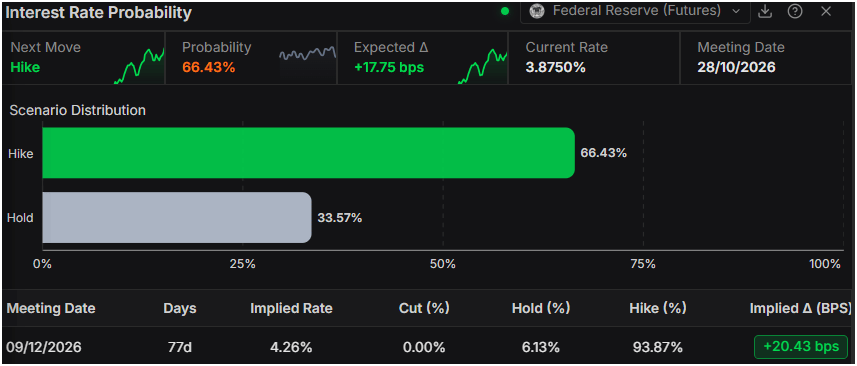
The market’s reaction to this combination of hawkish statements and strong economic data was swift and decisive. Money markets, which price in the probability of future interest rate changes, dramatically adjusted their expectations. The odds of a Fed rate hike at the October meeting surged to 66%, a substantial increase from 52% just a day prior, according to data from Prime Terminal. This significant shift underscores the market’s conviction that another rate hike is not just possible, but highly probable.
Treasury Yields Soar, U.S. Dollar Strengthens
A direct consequence of escalating rate hike expectations was a sharp rise in U.S. Treasury yields. The yield on the benchmark 10-year Treasury note soared by 15 basis points, reaching 5.12%. Rising Treasury yields increase the opportunity cost of holding non-yielding assets like gold, making the precious metal less attractive to investors. When investors can earn higher returns on relatively safe government bonds, the appeal of gold, which does not pay interest or dividends, diminishes considerably.
Simultaneously, the U.S. Dollar Index (DXY), which measures the dollar’s strength against a basket of six major currencies, climbed by 0.7% to 101.22. A stronger dollar typically acts as a significant headwind for gold prices. Since gold is priced in U.S. dollars, a stronger dollar makes gold more expensive for holders of other currencies, thereby reducing demand. The dollar’s strength is a direct reflection of higher interest rate expectations and the perceived robust health of the U.S. economy relative to other major global economies, attracting capital flows into dollar-denominated assets.
Oil Market Navigates Geopolitical Risks and Policy Speculation
While the Fed and economic data dominated the gold narrative, the oil market experienced its own brand of volatility driven by a mix of geopolitical concerns and policy speculation. Earlier in the week, developments in the Middle East had pushed U.S. oil prices to nearly $90 per barrel. Geopolitical instability in the region often translates into a risk premium for oil, as traders factor in potential supply disruptions.
However, Wednesday brought a dramatic reversal following breaking news reports from Politico sources suggesting that the U.S. administration was preparing a plan to ban diesel exports for 90 days. This potential move is reportedly aimed at pushing down domestic energy prices and curbing inflation, a key objective for the current administration. The immediate market reaction saw West Texas Intermediate (WTI) crude rally over 1.5% to $91.42 per barrel, initially reflecting supply concerns. However, subsequent reports indicated that crude futures generally edged lower later in the session, as the implications of a diesel ban—which could lead to higher domestic crude inventories if refiners are forced to reduce output—were digested. Despite the nuanced reaction in crude, the broader energy market remained on edge, with the Greenback remaining underpinned by the overall economic strength and hawkish Fed outlook.
A diesel export ban, if implemented, would have significant ramifications. Domestically, it could alleviate supply shortages and potentially lower diesel prices for consumers and businesses, aligning with the administration’s inflation-fighting goals. However, on a global scale, it would remove a substantial volume of U.S. refined products from the international market, potentially driving up diesel prices in other regions, particularly Europe, which relies heavily on U.S. exports. Such a move could also impact refining margins in the U.S. and complicate global energy trade dynamics.
Adding another layer to the geopolitical landscape, hopes of de-escalation in the U.S.-Iran conflict increased after Reuters reported that a senior Iranian official indicated Tehran was reviewing the U.S. response to its proposal to end hostilities. Any easing of tensions in the Middle East could potentially reduce the geopolitical risk premium on oil, though the market’s immediate focus remained on the domestic policy developments concerning diesel exports.
Gold’s Inverse Correlation: A Historical Perspective
Gold’s price movements are often characterized by its inverse correlation with the U.S. Dollar and U.S. Treasuries, both of which serve as major reserve and safe-haven assets. When the dollar appreciates or Treasury yields rise, gold typically falls, as investors shift towards yield-bearing assets or the perceived safety and liquidity of the dollar. This dynamic was clearly at play on Wednesday. Gold also tends to be inversely correlated with risk assets; a rally in the stock market often weakens gold’s appeal, while sell-offs in riskier markets tend to favor the precious metal as a safe haven. However, in the current environment, the dominant factors are the tightening monetary policy and the strength of the dollar.
Historically, periods of aggressive monetary tightening by the Fed have generally put downward pressure on gold prices. For instance, during the early 1980s, when Fed Chair Paul Volcker dramatically raised interest rates to combat runaway inflation, gold experienced significant declines after an initial surge. More recently, the Fed’s tightening cycles in the mid-2000s and late 2010s also saw gold face headwinds, albeit with varying degrees of impact depending on broader economic conditions and geopolitical events. The current environment, marked by high inflation and a resolute Fed, aligns with scenarios where gold’s appeal as a store of value is challenged by the rising cost of holding non-yielding assets.
Technical Outlook: Gold Drifts Lower within a Bullish Wedge
From a technical perspective, the XAU/USD chart indicates that gold failed to clear the top of what analysts describe as a "bullish wedge" pattern. This failure led to a decisive drop, pushing the price beneath the confluence of the 100-day and 50-day Simple Moving Averages (SMAs), located at $4,313 and $4,306 respectively. This breakdown below key moving averages extended gold’s losses below the $4,300 mark, signaling a bearish shift in the short-term trend.
Momentum indicators further underscore the bearish sentiment. The Relative Strength Index (RSI) is currently trading below its 50-neutral level and is aiming lower, a classic signal that selling pressure is increasing and bears are gaining control. While the overall market structure for gold might still be tilted to the upside on a longer timeframe, the mixed readings between current price action and immediate market sentiment suggest that caution and confirmation are warranted before making significant directional bets.
For a potential bearish resumption, gold would need to decisively breach the September 16 swing low of $4,235. If this support level is overcome, the next significant targets for sellers would be the July 6 high-turned-support at $4,202, followed by the July 29 pivot low at $3,996. Conversely, for the bulls to regain control and negate the immediate bearish pressure, XAU/USD would need to clear the "bullish wedge" top trendline, which currently sits around $4,365-$4,370. A successful break above this level could pave the way for a test of $4,400, and potentially higher resistance levels at $4,500 and the 200-day SMA at $4,541. The current technical setup points to a market grappling with strong fundamental headwinds despite some underlying bullish structural elements.
Looking Ahead: Key Data and Speeches on the Horizon
The immediate economic calendar holds several events that could further influence market sentiment. Investors will be closely watching for speeches from Federal Reserve officials Beth Hammack and Anna Paulson, whose remarks could provide additional insights into the Fed’s evolving monetary policy outlook. Furthermore, the release of weekly jobless claims data will offer a fresh look at the health of the U.S. labor market, a critical component of the Fed’s dual mandate. Strong labor market data could further reinforce the Fed’s hawkish stance, while any signs of weakness might introduce a degree of dovish uncertainty, potentially influencing gold and dollar dynamics. The interplay of these factors will continue to shape the market’s expectations for interest rates and, consequently, the trajectory of precious metals and the broader financial landscape.