Reynand Wu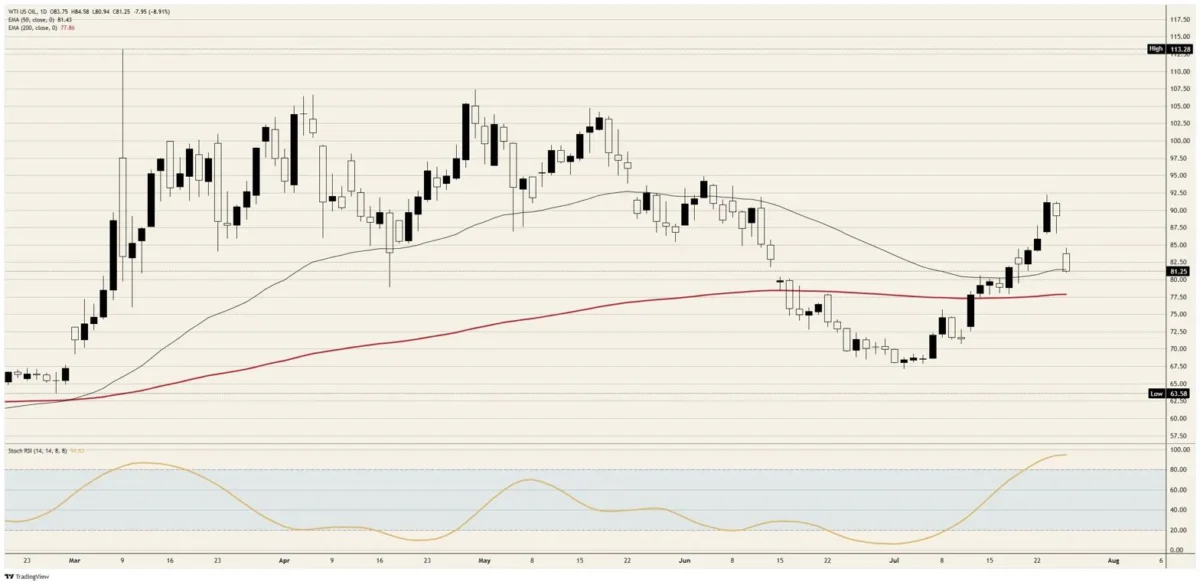
WTI Crude Oil registered a significant decline on Monday, trading just above $81.00, marking a substantial drop of nearly 9% from Friday’s close near $89.00. The session commenced with a gap of over $5.00 lower at the open, a deficit that only widened throughout the day rather than being repaired. Concurrently, Brent Crude broke decisively beneath the $90.00 handle, experiencing its steepest single-session decline since the April ceasefire. This abrupt market recalibration appears to be predicated on the perception of a fourth de-escalation in ongoing geopolitical tensions since spring, an interpretation notably lacking any official, verifiable signature from all involved parties.
The dramatic shift in oil prices reflects a market grappling with contradictory signals emanating from a complex geopolitical landscape, particularly concerning the Middle East. Traders appear to have priced in a "peace dividend" based on the suspension of American military strikes, yet the underlying physical supply chain remains largely unchanged, and diplomatic efforts are shrouded in ambiguity. This creates a significant divergence between the paper market’s sentiment and the tangible realities of global energy supply.
Ambiguous De-escalation: A Ceasefire with Disparate Interpretations
The primary catalyst for Monday’s oil market downturn was the cessation of U.S. strike campaigns in the region. After 13 consecutive nights of operations, Washington suspended its offensive over the weekend, leading to a third day without reported attacks by Monday. The American president, addressing reporters, indicated ample time for diplomatic engagement, expressing optimism for a potential deal and warning of a more forceful resumption of operations should negotiations fail. Crucially, he also stated that the pause was initiated at Tehran’s request, framing it as a direct diplomatic overture.
However, Tehran’s response on the same day offered a starkly different narrative. Iran’s foreign ministry categorically denied any ongoing negotiations with the United States, asserting that its only active diplomatic channel was with Oman, specifically concerning the future of the Strait of Hormuz. Despite this official denial, reports emerged of a meeting between the deputy foreign ministers of the two countries in Tehran over the weekend, where discussions reportedly centered on safe passage through the critical waterway. Iranian officials described these talks as having made progress, while simultaneously confirming that the status of maritime traffic through the Strait had not yet changed. Mediators, led by Qatar and Pakistan, are reportedly working towards restoring a "collapsed interim framework," a description that suggests aspiration rather than a concrete, agreed-upon deal. This juxtaposition of claims and counter-claims underscores the fragility and lack of transparency surrounding the supposed de-escalation, leaving market participants to speculate on its true nature and longevity.
The previous instances of de-escalation since the spring have similarly been characterized by rapid reversals, with the market’s initial optimism quickly dissipating as underlying issues persisted. These past episodes, occurring in April, May, and July, each saw a version of this "peace dividend" trade, only for the subsequent reversal to arrive with greater speed than the preceding rally. This historical pattern suggests that the market’s current repricing of nearly a tenth of crude oil’s value in a single session, based on such an unconfirmed de-escalation, carries inherent risks of a similar, swift correction.
The Strategic Imperative: Inventory Concerns and Conditional Pauses
The underlying rationale for the stand-down in military operations carries more weight than the mere fact of its occurrence. While publicly dismissed by the American president, intelligence reports attributed the U.S. decision, in part, to internal warnings from advisors. These warnings reportedly highlighted that the campaign was facing a dwindling supply of viable targets and drawing down munitions at an uncomfortably rapid pace. This "magazine depth" issue paints the current pause not as a genuine diplomatic breakthrough, but potentially as a strategic necessity – an inventory problem disguised as an agreement. Such a pause is inherently temporary, destined to conclude either when munitions are replenished or when either side perceives the other has ceased to engage meaningfully. The market, in its swift repricing, has seemingly failed to account for either of these critical conditions, betting heavily on diplomacy without a firm foundation.
Iran, for its part, has signaled its intention to hold fire only for as long as Washington refrains from attacks, without offering any confirmation that substantive negotiations are underway. This conditional truce, coupled with the U.S. internal logistics challenges, suggests a tactical lull rather than a fundamental shift in regional dynamics. For the global oil market, this implies that the current discount applied to the front end of the crude curve is a speculative wager on an unproven diplomatic resolution rather than a reflection of tangible shifts in supply or demand fundamentals. The volatility inherent in such a scenario, where the duration of the "agreement" is tied to logistical capabilities rather than political will, leaves oil prices susceptible to rapid fluctuations.
The Unmoved Reality: Physical Market Disconnect and Supply Chain Vulnerabilities
Crucially, Monday’s market movements occurred in isolation from any actual changes in physical supply constraints. Despite the significant drop in paper crude prices, the critical arteries of global oil transit remained under duress. The Strait of Hormuz, a choke point through which approximately a fifth of the world’s global oil supply flows, saw fewer than 10 commodity vessels transiting daily over the weekend. This is a stark contrast to normal traffic levels, underscoring persistent concerns about safe passage, even amidst supposed de-escalation.

Further exacerbating supply concerns, the Bab al-Mandeb strait remains effectively blocked by Yemen’s Houthi rebels. The Houthis continued to claim attacks on Saudi targets throughout the weekend, maintaining their disruption of shipping lanes. This ongoing blockade forces roughly 5 million barrels a day of Saudi crude cargoes onto the longer and more expensive route around the Cape of Good Hope, bypassing the Suez Canal. This rerouting adds significant time and cost to global shipping, impacting refiners and consumers alike, irrespective of speculative market sentiment.
The disconnect between paper and physical markets is further evidenced by retail pump prices in the United States. Over the weekend, the American average pump price reached $4.11 per gallon, an increase of about 11 cents on the week and approximately 38% higher than when the conflict began in late February. While paper crude oil has reaped a "peace dividend," physical crude oil has not been afforded a similar benefit. Until vessel counts recover to normal levels and the threats to maritime traffic subside, the discount currently being applied to the front of the crude curve represents a bet on a fragile diplomacy rather than a true reflection of abundant barrels entering the market. This divergence highlights a fundamental risk for market participants: a speculative rally can quickly unwind if the underlying physical supply situation remains tense and unresolved.
The Week Ahead: Macroeconomic Forces and Demand-Side Scrutiny
Beyond the geopolitical complexities, the macro calendar presents the market with a second set of critical factors to navigate. The Federal Reserve’s monetary policy decision on Wednesday at 18:00 GMT is a focal point, with consensus expecting a fourth consecutive hold at the current target rate of 3.75%. Notably, no Summary of Economic Projections will be attached to this meeting, but a significant minority of market participants are still pricing in a live possibility of a hike. Cheaper energy, if sustained, represents the most significant disinflationary input the Federal Open Market Committee (FOMC) has received throughout the summer. Consequently, Chair Jerome Powell’s commentary on energy prices and their impact on inflation will be the most instructive part of the press conference, scheduled half an hour after the decision. Any indication that the Fed views lower oil prices as a persistent disinflationary force could influence future policy guidance.
The economic data flow continues on Thursday at 12:30 GMT with the release of second-quarter growth figures, anticipated at 2.1%. Alongside this, core Personal Consumption Expenditures (PCE) are expected to show a 0.2% month-over-month increase and a 3.3% year-over-year rise. Core PCE is the Federal Reserve’s preferred measure of inflation, making these figures particularly impactful. Initial jobless claims are also due, projected to rebound to 204,000 from an unusually low 187,000, providing insight into the health of the labor market.
Friday’s economic docket adds further layers of detail. The Employment Cost Index is forecast at 0.8%, a key indicator of wage inflation. Chicago activity data, measured by the Purchasing Managers’ Index (PMI), is expected at 56, signaling continued expansion in manufacturing. The University of Michigan’s inflation expectation series will also be closely watched for consumer sentiment regarding future price trends. Globally, both Chinese official Purchasing Managers Index readings are due, with expectations for each to land precisely on the 50-line, indicating neither expansion nor contraction. The demand side of the crude oil market has often been overlooked throughout the year, overshadowed by supply-side concerns. A week of soft American growth prints, coupled with potentially flat Chinese economic indicators, could provide sellers with a more durable justification for lower prices than a mere rumor of de-escalation.
Crude Oil Levels and Market Outlook
From a technical perspective, the immediate rebound in WTI crude oil is capped by the session high near $84.50. Above this, the significant shelf near $90.00 marks the level where last week’s "war premium" was still intact. This level now acts as a strong resistance point.
On the support side, the $80.00 handle serves as the first line beneath the current spot price. A more critical level is the rising 200-day Exponential Moving Average (EMA), currently near $78.00. This EMA has historically underpinned every significant price flush since the spring, representing a key long-term trend indicator.
The current market bias remains bullish against the $78.00 level. The daily Stochastic Relative Strength Index (RSI) reading above 94, while appearing overbought, is largely a lagging artifact of the recent sharp sell-off rather than a definitive signal for further downside. The prevailing view among some analysts is that a market that has sold off dramatically due to a supply disruption that has not been fundamentally repaired presents a buying opportunity on weakness. This perspective holds that the market’s current valuation is based on an unconfirmed diplomatic success rather than actual shifts in supply or demand. However, this bullish outlook would be invalidated by a daily close beneath the 200-day EMA, which would signal a more significant shift in the underlying trend.
In conclusion, the global oil market is at a critical juncture, caught between the speculative optimism of a tentative geopolitical de-escalation and the enduring realities of physical supply chain vulnerabilities and looming macroeconomic uncertainties. The sharp sell-off in paper crude contrasts starkly with persistent high retail prices and ongoing disruptions to vital shipping lanes. As central banks deliberate on monetary policy and key economic data emerges, the coming days will likely determine whether the current "peace dividend" is a fleeting illusion or the precursor to a more sustained rebalancing of global energy markets.