Clara Shinta
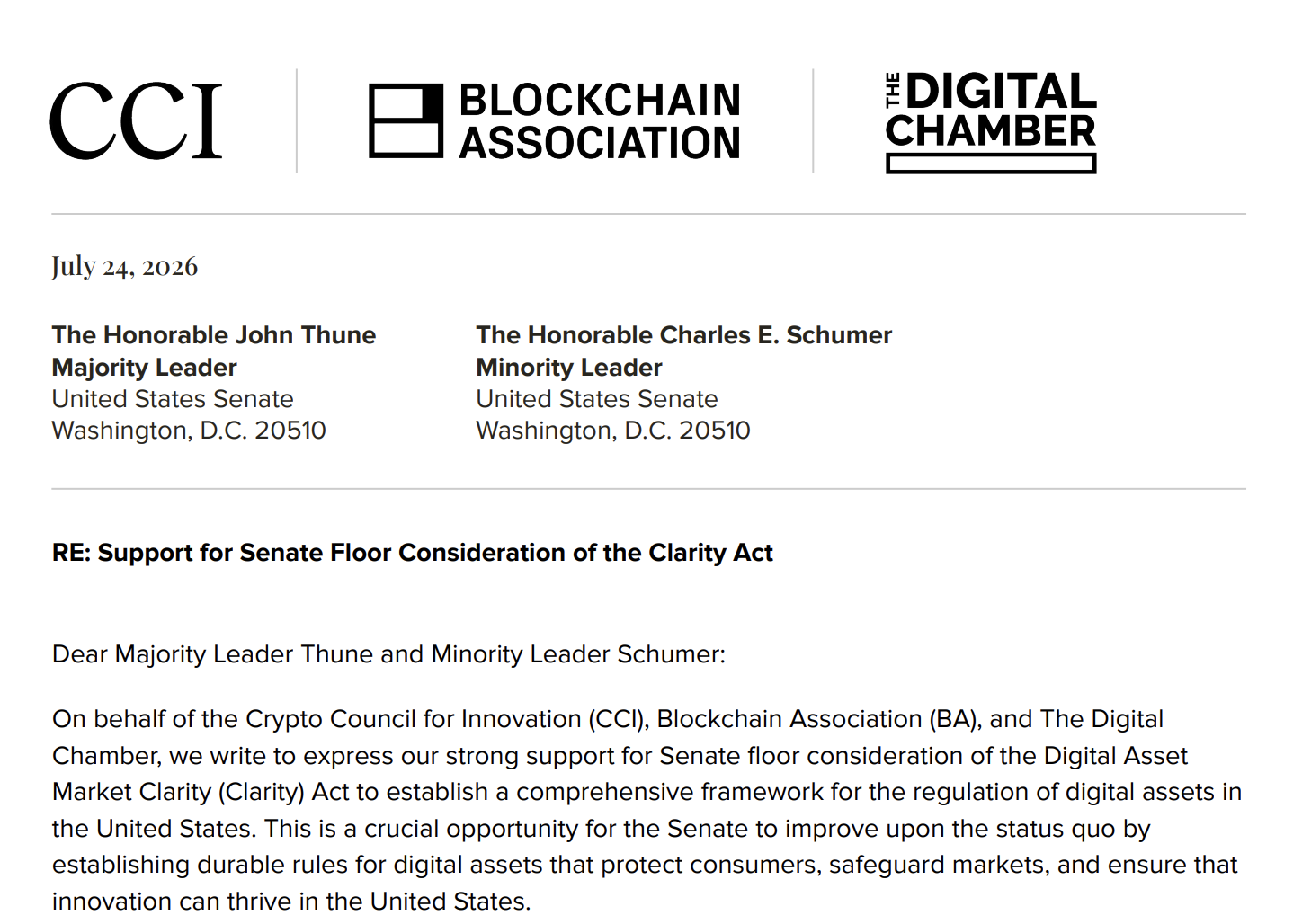
Three prominent cryptocurrency advocacy organizations—the Crypto Council for Innovation, the Digital Chamber, and the Blockchain Association—jointly appealed to United States Senate leaders on Friday, calling for the chamber to schedule "floor consideration" of the Digital Asset Market Clarity (CLARITY) Act. This urgent plea, conveyed in a letter addressed to Senate Majority Leader John Thune and Minority Leader Chuck Schumer, underscores the industry’s escalating demand for regulatory certainty as the legislative calendar dwindles ahead of the critical August recess. The groups emphasized the necessity of advancing the bipartisan bill, a measure Republican lawmakers have been pushing to bring to a vote before senators depart for state work periods, highlighting its potential to establish a foundational framework for the nascent digital asset ecosystem in the United States.
The Imperative for Clarity: A Stalled Legislative Push
The Friday letter serves as a potent reminder of the digital asset industry’s persistent call for clear regulatory guidelines in the U.S., a landscape currently characterized by a patchwork of state-level rules and enforcement actions from federal agencies rather than comprehensive legislation. The CLARITY Act, formally known as the Digital Asset Market Structure Clarity Act, is envisioned as a landmark piece of legislation designed to delineate regulatory responsibilities for various digital assets, distinguish between securities and commodities in the crypto space, and establish consumer protection safeguards. Its passage is widely considered essential for fostering innovation domestically and ensuring the U.S. remains competitive in the global digital economy.
Despite having navigated and advanced through key Senate committees, specifically the Senate Banking and Agriculture Committees, the bill’s path to a full floor vote has been obstructed by ongoing bipartisan negotiations. A primary sticking point centers on the adequacy of ethics provisions embedded within the legislation. While the advocacy groups acknowledged these "constructive bipartisan negotiations" and expressed appreciation for the "good-faith efforts of Senators on both sides of the aisle," the underlying disagreements are significant. Certain lawmakers, particularly from the Democratic side, have publicly stated their intention to withhold support until what they deem as crucial deficiencies in the ethics measures are adequately addressed. This impasse threatens to derail the bill’s progress, potentially delaying its consideration until a far more politically charged period later in the year.
Unpacking the CLARITY Act: Addressing the Regulatory Vacuum
The CLARITY Act represents a concerted effort to fill the substantial regulatory void that has plagued the U.S. digital asset market for years. The absence of a clear federal framework has been a source of significant frustration for industry participants, investors, and regulators alike. Currently, various federal agencies, including the Securities and Exchange Commission (SEC) and the Commodity Futures Trading Commission (CFTC), exert jurisdiction over different aspects of the digital asset market, often leading to overlapping mandates, jurisdictional disputes, and an unpredictable enforcement-led regulatory environment. This fragmented approach has been criticized for stifling innovation, driving legitimate businesses offshore, and failing to provide robust consumer protections.
Coinbase CEO Brian Armstrong articulated this sentiment in a recent social media post, stating, "The status quo in the US isn’t working." He elaborated that the lack of a federal framework has enabled "bad actors like FTX" to harm U.S. customers, resulting in much of the industry migrating overseas, beyond the purview of U.S. oversight. Armstrong firmly believes that the CLARITY Act offers a tangible solution by introducing "strong consumer protections, real tools for law enforcement, and a path for America to lead in this industry." The bill’s proponents argue that a clear regulatory structure would not only safeguard investors but also provide the legal certainty necessary for businesses to innovate and grow within the U.S., attracting capital and talent that might otherwise seek more hospitable jurisdictions.
Furthermore, the CLARITY Act seeks to address specific nuances of the decentralized finance (DeFi) sector. Orest Gavryliak, Chief Legal Officer of the DeFi platform 1inch, highlighted the bill’s potential to establish a recognized framework for non-custodial protocols. He argued against the current tendency of some regulators to "try to fit us into the custodial frameworks and make us use custodial solutions," which he described as "wrong" and inapplicable to the decentralized nature of many digital asset projects. Gavryliak stressed that CLARITY would be instrumental in moving away from a "regulating with enforcement" approach towards a more tailored and appropriate regulatory environment for non-custodial innovations, which do not hold customer funds directly. This distinction is critical for many DeFi projects, which operate on principles of self-custody and automated smart contracts, fundamentally differing from traditional financial intermediaries.

The Legislative Gauntlet: Navigating Senate Politics
For the CLARITY Act to pass the Senate, it requires a supermajority of 60 votes, a significant hurdle given the current political landscape. Republicans hold a narrow 52-47 majority over Democrats, meaning that bipartisan support is not merely desirable but absolutely essential for the bill’s success. This necessitates cooperation and compromise across the aisle, a challenge that has proven difficult for many legislative initiatives in recent years.
The core of the current impasse revolves around the ethics provisions intended to prevent conflicts of interest among public officials. Earlier this week, Republican lawmakers released the updated text of the market structure bill, which included specific ethics clauses. These provisions aimed to bar public officials from issuing or sponsoring cryptocurrencies, a measure intended to address concerns about potential undue influence or personal enrichment. However, many Democratic senators have voiced strong objections, arguing that these measures do not go far enough to prevent corruption or ensure true accountability.
Senator Ruben Gallego, a vocal critic of the proposed ethics framework, expressed his profound disappointment and frustration on Thursday, as reported by Politico. "Whatever piece of s*** they sent back to us, that was not a serious effort," Gallego reportedly stated, highlighting the deep chasm between the two parties on this critical issue. He further added, "After all the work that we’ve done with our Republican colleagues, that they would take the months and months of work and somehow interpret that and turn around and think what they offered was even remotely close." This stark assessment underscores the perception among some Democrats that the Republican counterproposal failed to genuinely address their concerns, effectively sidelining months of collaborative effort. The intensity of such remarks illustrates the political sensitivity surrounding ethical conduct in an emerging, often volatile, financial sector like digital assets.
The debate over ethics is not merely procedural; it reflects broader concerns about public trust and the integrity of legislative processes when dealing with new, high-value asset classes. Critics of the current provisions likely seek more stringent requirements, such as broader disclosure mandates, longer "cooling-off" periods for officials transitioning between public service and the crypto industry, or more comprehensive restrictions on the involvement of family members in crypto ventures. The difficulty in bridging this gap stems from differing philosophies on the appropriate level of government intervention and the perceived risks associated with digital assets.
Industry Voices Echo the Call for Action
Beyond the halls of Congress, industry leaders and experts continue to amplify the call for the CLARITY Act’s passage, underscoring the real-world impact of regulatory uncertainty. Brian Armstrong’s robust defense of the bill from Coinbase, a leading U.S.-based cryptocurrency exchange, highlights the operational challenges and competitive disadvantages faced by companies operating within the current regulatory vacuum. His argument that the bill would allow America to "lead in this industry" points to the strategic importance of establishing clear rules not just for domestic stability but for global leadership in a rapidly evolving technological frontier. Without a clear framework, U.S. firms risk falling behind jurisdictions like the European Union, which has already enacted comprehensive crypto regulations such as MiCA (Markets in Crypto-Assets).
Orest Gavryliak’s insights from 1inch, a prominent DeFi platform, further illustrate the bill’s specific relevance to innovative segments of the crypto market. His emphasis on distinguishing non-custodial protocols from traditional custodial entities underscores a fundamental difference in how these technologies operate and how they should be regulated. For DeFi projects, applying traditional financial regulations designed for centralized institutions can be akin to fitting a square peg into a round hole, potentially stifling innovation without genuinely enhancing consumer protection. The CLARITY Act, by recognizing these distinctions, could pave the way for a more nuanced and effective regulatory approach that fosters growth while mitigating risks unique to decentralized systems.
Even figures from more traditional financial institutions have acknowledged the necessity of such legislation. The CEO of Goldman Sachs, for instance, has publicly backed the CLARITY Act, albeit noting it is "not perfect." This broad-based support, extending from innovative DeFi projects to established Wall Street giants, signals a widespread consensus within the financial sector regarding the urgent need for a cohesive regulatory framework for digital assets in the U.S. The endorsement from a major investment bank like Goldman Sachs lends significant weight to the argument that regulatory clarity is not just a niche crypto issue but a critical component of modern financial infrastructure.
The August Deadline and Beyond: A Race Against Time
The approaching August recess for the Senate looms as a critical deadline for the CLARITY Act. If lawmakers are unable to secure a floor vote and pass the legislation before the recess, the bill’s consideration could be pushed into the weeks leading up to the 2026 U.S. midterms. This would undoubtedly complicate discussions significantly. Election cycles typically heighten political polarization, making bipartisan compromise even more challenging as senators become more focused on re-election campaigns and partisan messaging. Legislative efforts often slow down or become entangled in broader political maneuvering during such periods, risking the bill’s ultimate passage or forcing substantial concessions that could dilute its intended impact.
The uncertainty surrounding the bill’s immediate future is also reflected in prediction markets. As of Friday, Kalshi, an event contracts platform, indicated a 40.3% chance that the CLARITY Act would pass before the Senate’s August recess. This relatively low probability underscores the significant hurdles that remain, primarily the unresolved ethics provisions and the tight legislative schedule. The odds reflect the difficulty in achieving the necessary bipartisan consensus within the compressed timeframe. Should the bill be delayed, it would represent another setback for the digital asset industry’s long-standing quest for regulatory certainty in the United States.
The Broader Stakes: Regulatory Certainty, Innovation, and Global Competitiveness
The fate of the CLARITY Act carries profound implications not just for the cryptocurrency industry but for the broader U.S. economy and its position on the global stage. Regulatory certainty is paramount for attracting investment, fostering innovation, and ensuring consumer protection. Without clear rules, businesses face an unpredictable operating environment, deterring both domestic and international capital. This uncertainty can lead to a brain drain, with talented entrepreneurs and developers choosing to establish their ventures in jurisdictions with more defined regulatory landscapes.
The U.S. has historically been a leader in technological innovation. However, a prolonged regulatory vacuum in the digital asset space risks ceding this leadership to other nations. Countries like the United Kingdom, Japan, and especially the European Union with its Markets in Crypto-Assets (MiCA) regulation, have made significant strides in establishing comprehensive frameworks for digital assets. If the U.S. continues to lag, it could lose its competitive edge, impacting job creation, economic growth, and its strategic influence in the rapidly expanding digital economy.
Moreover, the struggle to pass the CLARITY Act highlights the broader challenges of legislating on emerging technologies in a deeply divided Congress. The complex nature of digital assets, coupled with concerns about market volatility, illicit finance, and consumer risks, requires a nuanced approach that transcends traditional partisan lines. The current impasse over ethics provisions underscores the difficulty in building trust and achieving consensus on foundational principles, even when there’s a shared understanding of the need for action. The outcome of the CLARITY Act will serve as a bellwether for the U.S.’s ability to adapt its regulatory frameworks to the demands of the 21st-century digital landscape, demonstrating whether it can effectively harness the potential of new technologies while mitigating their inherent risks. The call from advocacy groups is not merely for a bill, but for a clear direction, a path forward that ensures the U.S. remains at the forefront of digital innovation and responsible financial evolution.