Putri Inara

The Economic Reality of Digital Publishing
The modern "creator economy" is estimated to be worth over $250 billion, with expectations for that figure to double by 2027. However, within this vast market, the distribution of wealth remains heavily skewed. Analysis of survey data involving over 1,500 active bloggers reveals a stark "income pyramid" that mirrors many other entrepreneurial sectors.
In the most recent comprehensive survey of the blogging community, approximately 10% of respondents reported earning no income at all, while 28% earned less than 30 cents per day. A significant majority—63%—generate less than $3.50 daily. These figures highlight the fact that for the average participant, blogging remains a hobby or a very low-yield side hustle. Conversely, the data also identifies a robust upper tier: 4% of surveyed bloggers earn more than $10,000 per month, placing them in a high-income bracket that exceeds six figures annually. A further 9% generate over $1,000 per month, which represents a significant part-time or supplemental income.
This distribution suggests that while the barrier to entry for blogging is low, the barrier to professional-level profitability is exceptionally high. The "middle class" of blogging—those making a livable, full-time wage—is growing, but it requires a transition from content creation to business management.
A Chronology of Monetization: From 2002 to the Present
The trajectory of successful blogging has changed significantly since the early 2000s. In 2002, when the first wave of professional bloggers began to emerge, the primary monetization strategy was almost exclusively limited to display advertising, such as Google AdSense. As the internet matured, so did the financial infrastructure supporting independent publishers.
By 2010, the "Golden Age" of affiliate marketing and digital products began to take hold. Bloggers shifted from being mere "content producers" to becoming "influencers" and "educators." The timeline of a successful blog typically follows a slow-growth model:
- Year 1: Zero to negligible income; focus on audience building and niche definition.
- Year 2: Gradual increase in traffic; introduction of basic monetization (ads and affiliates).
- Year 3: Establishment of brand authority; potential for part-time income levels.
- Year 4 and Beyond: 85% of bloggers in the top income bracket (>$10,000/month) have been active for at least four years.
This chronology refutes the "get-rich-quick" myths often propagated by those selling "formulaic" success products. The data indicates that the primary indicator of financial success in blogging is not a specific secret strategy, but rather the ability to remain active and relevant over a multi-year period.
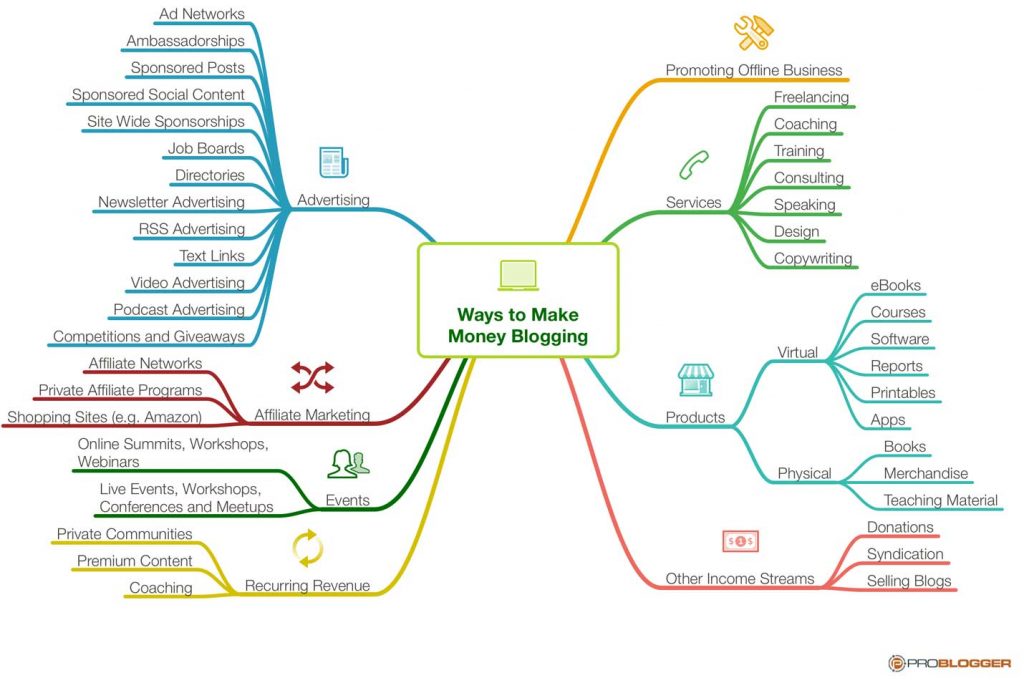
Diversification of Revenue Streams: The "Money Map"
One of the most critical findings for modern digital publishers is that there is no single "correct" way to monetize a blog. Unlike traditional media outlets that rely heavily on subscriptions or advertising, successful independent bloggers often employ a "Money Map" strategy—a multi-pronged approach to revenue.

Professional bloggers today typically utilize a combination of the following streams:
- Direct Advertising: Selling space to brands within a specific niche.
- Affiliate Marketing: Earning commissions by recommending third-party products.
- Digital Products: Creating and selling ebooks, online courses, or software.
- Memberships: Offering exclusive content or community access for a recurring fee.
- Services: Using the blog as a portfolio to sell consulting, speaking engagements, or freelance writing.
- Physical Goods: Expanding into e-commerce with branded merchandise or niche-specific tools.
Industry analysis shows that bloggers who rely on three or more revenue streams are significantly more resilient to market fluctuations, such as changes in search engine algorithms or shifts in the advertising market.
Niche Viability and Market Saturation
A common criticism of the blogging industry is the "echo chamber" effect, where it is assumed that the only people making money are those teaching others how to make money. However, empirical evidence suggests that "utility" niches—those providing specific, actionable information on everyday topics—are often more profitable and stable.
Case studies of high-earning bloggers reveal success in diverse fields:
- Specialized Hobbies: Woodworking (e.g., Ana White), photography (e.g., Digital Photography School), and home organization.
- Lifestyle and Wellness: Food blogs, health and fitness, and "simple living" (e.g., Tsh Oxenreider).
- Professional Skills: Finance, legal advice, and career coaching.
In many instances, the "meta-blogging" niche (blogging about blogging) is less profitable than high-traffic consumer niches. For example, Darren Rowse has noted that his photography-focused site has historically been significantly more profitable than his site dedicated to the business of blogging, primarily due to the larger addressable market and higher demand for specialized equipment and training in the photography sector.
The Four Pillars of Professional Blogging
To move from the bottom 60% of earners into the top 10%, industry experts identify four critical areas of operational focus. These are not merely suggestions but are considered the "pillars" of a sustainable digital publishing business.
1. Content Creation
Content remains the foundational asset. However, the standard has shifted from high-frequency posting to high-value posting. Successful blogs focus on original research, unique perspectives, and solving specific problems for their readers. In an era of AI-generated content, human expertise and "lived experience" have become premium commodities.
2. Audience Acquisition
Finding readers is no longer a matter of "build it and they will come." Professional bloggers must master SEO (Search Engine Optimization), social media distribution, and email marketing. The ability to diversify traffic sources is essential to protect the business from the volatility of platform-specific algorithm updates.
3. Community Engagement
The transition from a "reader" to a "fan" or "customer" happens through engagement. Successful bloggers prioritize building trust and rapport. This is often achieved through newsletters, comment sections, and social media interaction, turning a passive audience into an active community.
4. Strategic Monetization
The final pillar involves the sophisticated application of the "Money Map." This requires a deep understanding of the audience’s needs and a willingness to experiment with different products and services to see what resonates most effectively.
Analysis of Implications: The Future of Independent Media
The shift toward independent digital publishing has broader implications for the media industry at large. As traditional newsrooms and magazines face declining revenues and staff cuts, independent bloggers are filling the void by providing hyper-niche coverage that traditional media cannot afford to produce.
However, the rise of Artificial Intelligence (AI) presents a new set of challenges and opportunities. While AI can assist in content production and data analysis, it also threatens to saturate the market with low-quality, automated content. For human bloggers, the implication is clear: the path to profitability now requires a higher degree of transparency, brand authority, and "E-E-A-T" (Experience, Expertise, Authoritativeness, and Trustworthiness)—metrics that search engines like Google increasingly prioritize.
Furthermore, the data suggests that blogging is increasingly becoming a "winner-takes-most" game. As the market matures, the top performers continue to consolidate their lead by reinvesting profits into professional design, staff writers, and advanced marketing technology.
Conclusion: The Professionalization of the Blog
The evidence indicates that while the era of the "casual blogger" making easy money may be over, the era of the "professional digital publisher" is in full swing. Making a living from blogging is not a matter of luck or following a secret formula; it is the result of treating a digital platform as a legitimate business enterprise.
For those entering the field, the benchmarks are clear: expect a multi-year lead time, prepare for a high volume of uncompensated labor in the early stages, and focus on building a diversified revenue model. The 4% of bloggers earning six figures serve as proof of concept, but their success is anchored in longevity and a relentless focus on providing value to a specific audience. As the digital economy continues to expand, the opportunities for independent voices to monetize their expertise remain vast, provided they are willing to navigate the complexities of a professionalized landscape.