Putri Inara
The Landscape of the Modern Creator Economy
The transition of blogging from a hobbyist pursuit to a legitimate business sector began in the early 2000s. Since then, the industry has matured into a sophisticated ecosystem. According to market analysis, the global influencer marketing and content creation market is projected to continue its upward trajectory, yet the distribution of wealth within this sector remains heavily skewed. The reality of professional blogging sits between two ideological extremes: the marketing-driven narrative of "get-rich-quick" schemes and the cynical perspective that views the industry as a saturated field where only those teaching "how to blog" find success.
Professional blogging today functions as a branch of digital media publishing. Successful entities in this space operate not as mere journals, but as niche-specific information hubs. The diversification of income streams—ranging from programmatic advertising and affiliate marketing to the sale of proprietary digital products and professional services—has allowed the medium to survive the rise of social media platforms like Instagram and TikTok, which often compete for the same advertising expenditures.
Chronology of Industry Evolution and Professionalization
The trajectory of the blogging industry can be traced through the experiences of pioneers who entered the space during its formative years. In 2002, the digital landscape was significantly less crowded, allowing early adopters to secure high-authority domains and establish foundational audiences. However, the "early-mover advantage" has been replaced by a "quality-and-authority advantage."
Between 2005 and 2015, the industry saw the rise of the "pro-blogger," a term popularized to describe individuals who treated their websites as primary or secondary income sources. During this period, the introduction of Google AdSense and the expansion of the Amazon Associates program provided the first scalable monetization frameworks. By the early 2020s, the focus shifted toward "community-led growth" and "owned media," where bloggers prioritize email lists and direct product sales over a total reliance on third-party advertising platforms.
Statistical Analysis: The Income Distribution Gap
Data derived from industry surveys, including a comprehensive study of 1,500 digital publishers, provides a sobering look at the financial realities of the field. The findings indicate that the majority of bloggers are in the nascent stages of monetization, with a significant "long tail" of low earners.

The survey revealed the following distribution of monthly earnings:
- Zero Earnings: Approximately 10% of those attempting to monetize their platforms report no income.
- Minimal Income: 28% of respondents earn less than $0.30 per day, totaling less than $10 per month.
- Sub-Subsistence Levels: A combined 63% of bloggers earn less than $3.50 per day.
- Professional Tiers: Only 9% of bloggers earn more than $1,000 per month, a level considered a significant part-time or supplemental income.
- High Earners: A small elite of 4% (65 individuals out of 1,500) earn more than $10,000 per month, placing them in a high-income bracket exceeding six figures annually.
Analysis of these figures suggests a direct correlation between longevity and earning power. Among the top 4% of earners, 85% had been active in the industry for four years or more. This data reinforces the conclusion that blogging is a long-term investment rather than a short-term financial vehicle.
Diversification of Revenue Streams
One of the most critical findings in the study of professional blogging is the absence of a singular "formula" for success. Unlike traditional employment, blogging revenue is often a composite of several distinct channels.
Direct and Indirect Monetization
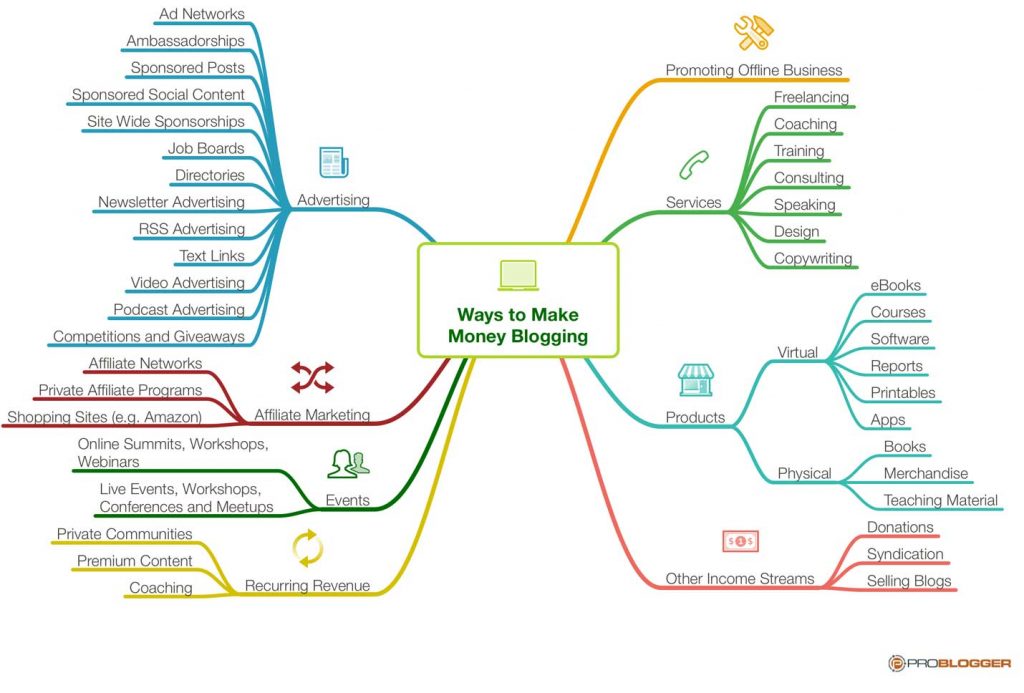
Professional bloggers typically utilize a "Money Map" approach, which includes:
- Advertising: Including display ads (via networks like Mediavine or AdThrive) and direct sponsorships.
- Affiliate Marketing: Earning commissions by referring readers to third-party products.
- Digital Products: Creating and selling ebooks, online courses, or software.
- Membership Models: Providing premium content or community access for a recurring fee.
- Services: Using the blog as a portfolio to secure speaking engagements, consulting contracts, or freelance writing opportunities.
Niche Performance and Profitability
Contrary to the myth that only "blogging about blogging" is profitable, the most lucrative segments of the industry are often found in "utility-based" niches. Photography, health and wellness, home renovation, and personal finance continue to show high profitability. For instance, photography-focused platforms have been reported to outperform "how-to-blog" sites by a factor of ten in terms of net profit, largely due to the high value of photography equipment and the demand for specialized technical tutorials.
Case Studies: Successful Market Entry and Sustainability
Several Australian and international bloggers serve as case studies for the diverse ways in which digital content can be monetized. Sarah Wilson, through her "I Quit Sugar" movement, demonstrated how a blog could transition into a global health phenomenon and a multi-million-dollar book and product empire. Similarly, Ana White transformed a blog about woodworking and DIY furniture plans into a massive digital resource that monetizes through both advertising and strategic partnerships.
These examples highlight a commonality: none of these high-earners focus on the mechanics of blogging itself. Instead, they provide high-value, original content that solves specific problems for their audience. Their success is built on four pillars of operation:
- Content Excellence: Producing original, helpful, and interesting material.
- Audience Acquisition: Utilizing SEO and social media to find new readers.
- Engagement: Building a loyal community that trusts the author’s recommendations.
- Strategic Monetization: Aligning revenue methods with the needs and expectations of the audience.
Implications for the Future of Digital Content
The professionalization of blogging has significant implications for the broader media landscape. As traditional journalism outlets face declining revenues, independent bloggers are increasingly filling the void in niche reporting and specialized information. This democratization of media allows for a wider range of voices but also places a higher burden of proof on the creator to establish credibility and authority (often referred to as E-E-A-T: Experience, Expertise, Authoritativeness, and Trustworthiness in the context of search engine algorithms).
Furthermore, the rise of Artificial Intelligence (AI) presents both a challenge and an opportunity. While AI can generate commoditized content, the "human element"—personal experience, unique perspectives, and community building—remains the primary differentiator for successful human bloggers. The industry is expected to move further away from "search engine bait" and toward "brand-driven" content.
Conclusion: The Professional Standard
The evidence confirms that while it is entirely possible to make a living through blogging, it is a feat achieved by a minority of practitioners who approach the medium with the discipline of a traditional business. The "overnight success" stories often cited in marketing materials frequently omit years of unpaid labor and strategic pivoting.
For the modern content creator, the transition from a "digital diary" to a "moneymaker" requires a shift in mindset. It demands a commitment to longevity—typically three to five years before reaching peak profitability—and a tireless focus on providing value to a specific demographic. As the digital space becomes increasingly crowded, the winners will be those who prioritize authenticity and utility over passive income myths. The blogging industry, while no longer the "easy" frontier it was once perceived to be, remains a viable and robust sector of the global digital economy for those willing to invest the necessary capital in time, creativity, and technical skill.