
 Clara Shinta
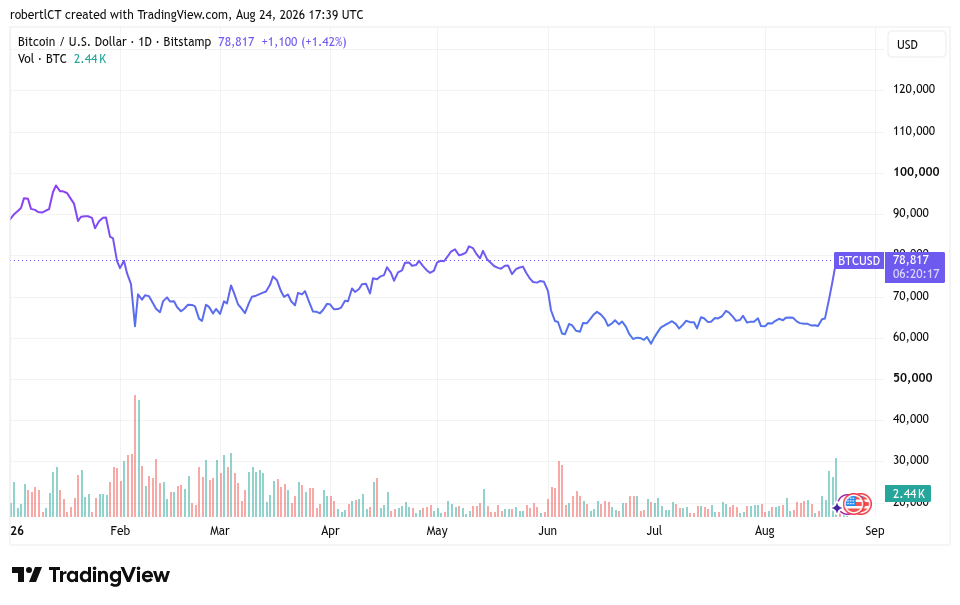
Bitcoin (BTC) dramatically breached the $80,000 mark on Monday, August 24, 2026, during the opening hours of Wall Street trading, marking the cryptocurrency’s return to a price level not seen since mid-May. This significant rally builds upon a week of strong performance, yet market analysts are sounding notes of caution, emphasizing that sustained higher levels are crucial to definitively challenge the prevailing bear-market narrative. The move has ignited a fresh wave of optimism among investors, simultaneously triggering substantial short liquidations across the cryptocurrency derivatives market, while also renewing scrutiny on the asset’s long-term trajectory.
The latest price surge saw BTC/USD climb another 3% on the day, briefly touching highs above $80,000 before experiencing a minor pullback following the close of European markets. Data from TradingView confirmed that this was the first time Bitcoin had crossed the $80,000 threshold since May 15, a hiatus of over 100 days that had tested the resilience of the crypto community. This rally culminates what has been an exceptionally strong August for Bitcoin, with month-to-date gains now exceeding 25%, marking its best August performance since 2017. Such a performance starkly contrasts with typical bear market behavior, prompting a reassessment of market sentiment.
A Deep Dive into Market Mechanics and Liquidation Cascades
The rapid ascent of Bitcoin’s price had immediate and profound effects on the derivatives market. Data from CoinGlass, a leading crypto analytics platform, revealed that over $220 million in crypto short positions were liquidated within the 24 hours leading up to the time of writing. Short liquidations occur when the price of an asset, in this case Bitcoin, rises sharply, forcing traders who had bet on its decline to close their positions at a loss. This process often involves automated selling of collateral, which can further fuel upward price momentum, creating a "short squeeze" effect. The scale of these liquidations underscores the speed and conviction of the recent bullish movement, catching many bearish traders off guard.
In the event of a potential downward reversal, market observers are closely watching a significant band of bid liquidity centered around the $76,700 level. This accumulation of buy orders represents a substantial support zone, indicating where buyers are prepared to step in and absorb selling pressure. Should Bitcoin’s price retreat, this level could act as a crucial psychological and technical barrier, potentially preventing a more precipitous decline. The presence of such robust bid support is often interpreted as a sign of underlying market strength, suggesting that institutional and large-scale retail investors are keen to accumulate Bitcoin at slightly lower valuations.
Analyst Perspectives: The Crucial Test of Sustained Strength
Despite the celebratory mood surrounding Bitcoin’s resurgence, a significant segment of the analytical community remains cautiously optimistic, emphasizing the need for sustained upward momentum to truly escape the shadow of a prolonged bear market. Rekt Capital, a prominent crypto trader and analyst, articulated this sentiment in a recent market commentary on X (formerly Twitter): "Bitcoin has Weekly Closed at the highs. Now starts the real test." The analyst further elaborated, "If this is a Bear Market Relief Rally, then Bitcoin could pullback as early as this week, or at least over the next few weeks. Now it’s all about Bitcoin proving sustained strength."

A key technical indicator highlighted by Rekt Capital is the 50-week exponential moving average (EMA), currently positioned at $77,251. Bitcoin’s recent weekly close above this EMA marks its first such achievement since November 2025. This particular trend line holds historical significance; during Bitcoin’s 2022 bear market, the asset managed two weekly closes above the 50-week EMA before ultimately succumbing to renewed selling pressure and plummeting to new cycle lows. This historical precedent serves as a potent reminder that a single breach of a key resistance level does not automatically signal a definitive trend reversal, necessitating vigilance from market participants. The concern among some traders, as previously reported, is that bearish historical patterns could still repeat, potentially leading to a re-emergence of downside pressure from September onward, culminating in a "final capitulation" to new macro lows.
Historical Context and Bitcoin’s Journey to $80,000
To fully appreciate the significance of Bitcoin’s latest achievement, it is essential to contextualize its journey through various market cycles. Bitcoin’s trajectory to reaching and surpassing $80,000 is a testament to its volatile yet ultimately upward-trending history. The cryptocurrency first garnered mainstream attention with its parabolic rise in 2017, culminating in a peak near $20,000. Following a subsequent bear market, it embarked on an even more aggressive bull run in late 2020 and 2021, fueled by institutional adoption, macroeconomic stimulus, and growing retail interest. During this period, Bitcoin shattered previous records, first crossing $50,000, then $60,000, and ultimately reaching an all-time high well above $70,000 in early 2021 before experiencing significant corrections later that year and throughout 2022.
The period between late 2021 and mid-2023 was largely characterized by a protracted bear market, with Bitcoin struggling to reclaim its previous highs amidst a challenging global economic landscape, rising interest rates, and several high-profile collapses within the crypto industry. The current surge to $80,000, therefore, represents not just a price milestone but also a potential psychological turning point, signaling a renewed appetite for risk assets and a growing confidence in Bitcoin’s long-term value proposition. The "best August performance since 2017" is particularly noteworthy, as 2017 was a year of unprecedented growth for Bitcoin, setting the stage for its global recognition.
Macroeconomic Tailwinds and Underlying Drivers
Several macroeconomic factors and underlying market dynamics are likely contributing to Bitcoin’s renewed strength in August 2026. Global economic conditions, particularly concerns over persistent inflation, continue to drive investors towards alternative assets perceived as hedges against currency debasement. While central banks have been navigating complex monetary policies, the prospect of interest rate cuts or a sustained pause in tightening cycles often makes risk assets like cryptocurrencies more appealing.
Beyond macroeconomics, the maturing landscape of institutional adoption plays a crucial role. The growing presence of Bitcoin Exchange-Traded Funds (ETFs) in various jurisdictions has provided traditional investors with easier, regulated access to the asset, channeling significant capital into the market. Furthermore, an increasing number of corporations are exploring or implementing Bitcoin on their balance sheets, while sovereign wealth funds are beginning to acknowledge its potential as a diversification tool. Technological advancements within the Bitcoin network, such as ongoing scalability improvements and broader integration into decentralized finance (DeFi) ecosystems, also contribute to its fundamental value proposition and utility. The anticipation of future Bitcoin halving events, which historically precede significant price appreciation due to supply shock, could also be influencing long-term investment strategies, prompting accumulation well in advance.
Broader Implications for the Cryptocurrency Ecosystem
Bitcoin’s performance invariably sets the tone for the broader cryptocurrency market. A robust Bitcoin rally often acts as a precursor or catalyst for an "altcoin season," where capital flows from Bitcoin into various alternative cryptocurrencies, leading to widespread gains. While the immediate focus remains on Bitcoin’s ability to maintain its newfound price levels, sustained strength above $80,000 could signal a broader market recovery, injecting renewed confidence into projects across the blockchain spectrum. The total cryptocurrency market capitalization, which had seen significant contractions during the bear market, would likely expand considerably, attracting new investors and potentially reigniting innovation and development within the space.
Conversely, a failure to sustain the $80,000 level and a subsequent retreat could temper enthusiasm, potentially dragging down altcoin prices and reinforcing the cautious stance of analysts. The market remains highly interconnected, and Bitcoin’s dominance often dictates the overall sentiment and liquidity flows across the entire crypto ecosystem.
Risks, Challenges, and the Road Ahead
Despite the current bullish momentum, inherent risks and challenges continue to loom over the cryptocurrency market. Bitcoin’s notorious volatility means that rapid price swings, both upwards and downwards, remain a constant feature. Geopolitical instability, unexpected shifts in global economic policy, or the emergence of new regulatory frameworks could quickly alter market sentiment. Regulatory scrutiny, particularly concerning stablecoins, DeFi, and central bank digital currencies (CBDCs), could introduce uncertainties that impact investor confidence.
Technically, while $80,000 is a significant milestone, the path forward will involve navigating further resistance levels. Market analysts will be closely monitoring price action for signs of exhaustion or renewed selling pressure. The ability of Bitcoin to consolidate above key support levels, such as the 50-week EMA and the $76,700 bid liquidity zone, will be critical. Failure to hold these levels could signal a weakening of the rally and potentially invite further downside corrections, validating the concerns of those who foresee a final capitulation.
Ultimately, the market is at a critical juncture. Bitcoin’s impressive surge past $80,000 has undeniably injected a much-needed dose of optimism and liquidity into the crypto space. However, as numerous analysts caution, this rally must prove its staying power. The coming weeks will be crucial in determining whether this is merely a powerful bear market relief rally, destined for a pullback, or the nascent stages of a more sustained recovery that can finally invalidate the lingering bear market thesis and propel Bitcoin towards new all-time highs. The focus remains on "sustained strength" as the ultimate arbiter of Bitcoin’s direction.
This article is produced in accordance with Cointelegraph’s Editorial Policy and is intended for informational purposes only. It does not constitute investment advice or recommendations. All investments and trades carry risk; readers are encouraged to conduct independent research.








