
 Clara Shinta
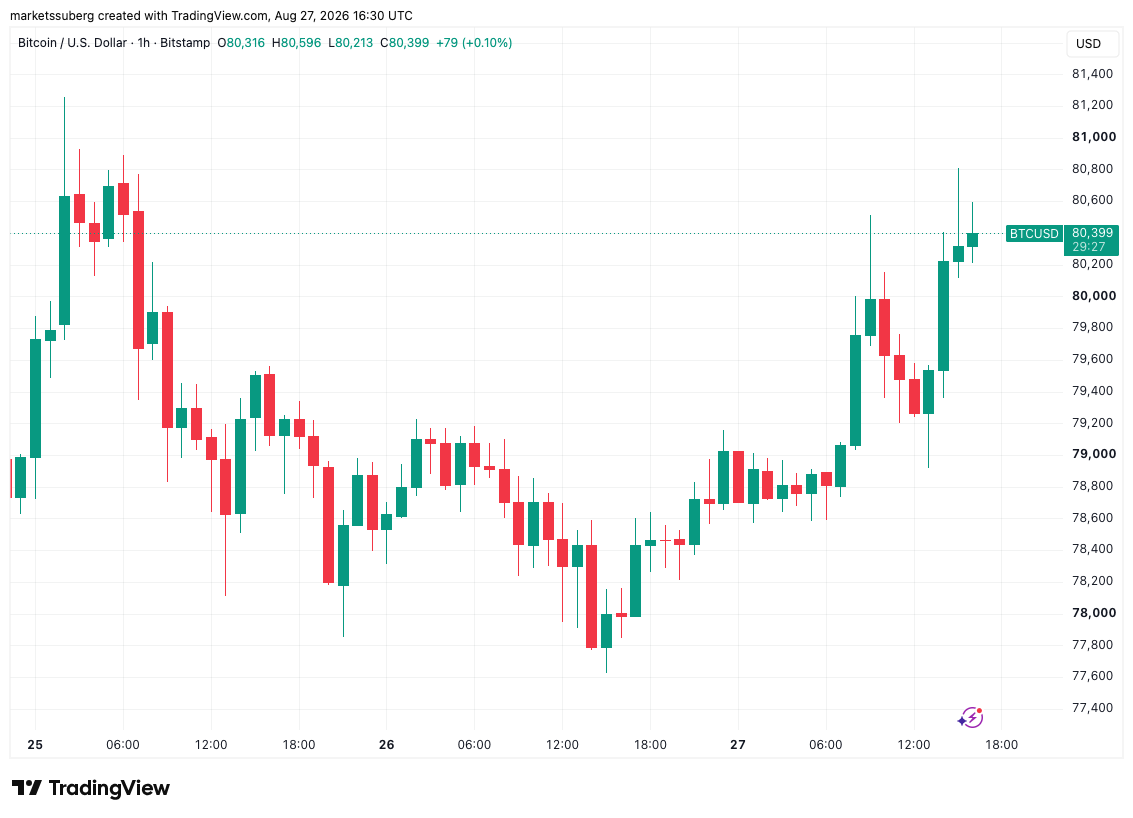
Bitcoin (BTC) experienced a significant rebound, pushing its value towards the $81,000 threshold on Thursday, coinciding with the opening of Wall Street trading. This upward momentum in the cryptocurrency market was largely attributed to the unexpectedly robust earnings report from semiconductor giant Nvidia, which simultaneously propelled U.S. equities higher. The leading digital asset achieved new local highs, touching $80,808, as market participants observed bulls striving to establish the $80,000 mark as a durable support level.
Nvidia’s Earnings Beat: A Powerful Catalyst for Global Markets
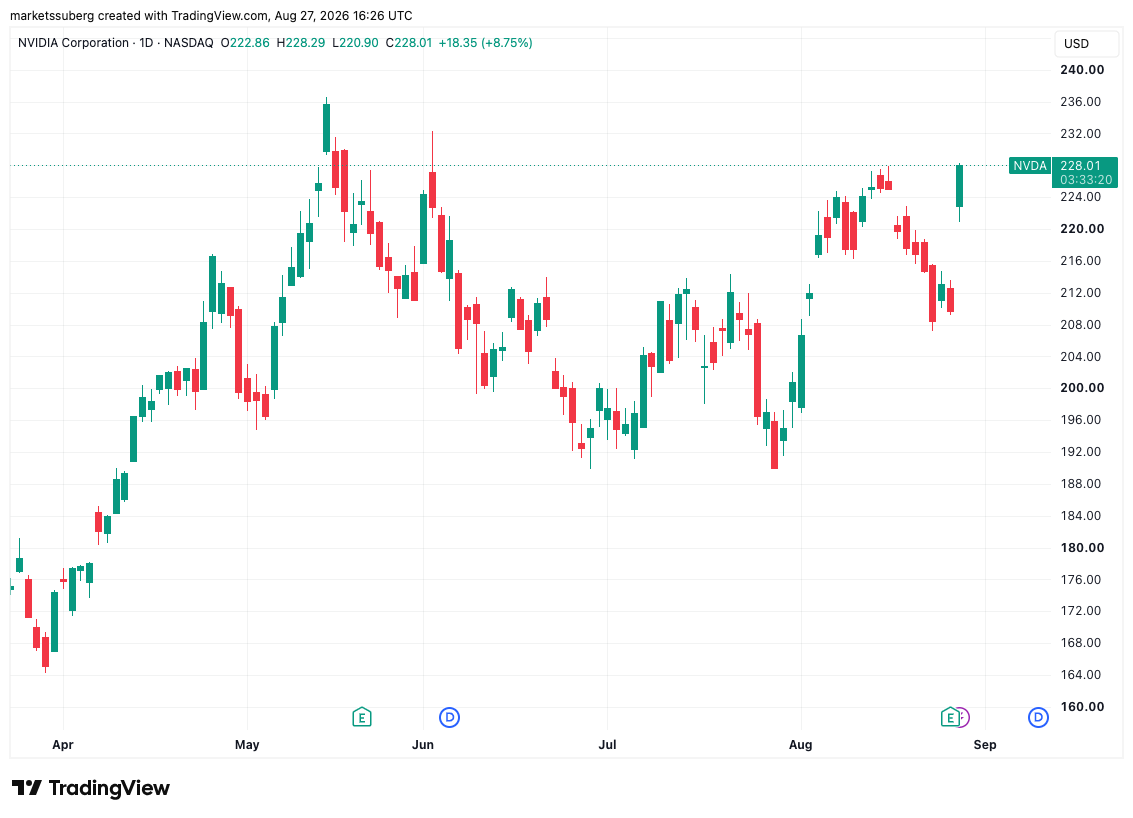
The catalyst for Thursday’s broad market rally was Nvidia’s exceptional second-quarter earnings report, released after the close of trading on Wednesday. The company reported a staggering $96.2 billion in revenue, surpassing analyst expectations by nearly $4 billion. This impressive performance underscored Nvidia’s dominant position in the rapidly expanding artificial intelligence (AI) and data center sectors, which have become critical drivers of technological advancement and economic growth.
Following the earnings announcement, Nvidia’s stock (NVDA) surged by more than 9% during Thursday’s trading session, adding over $400 billion to its market capitalization. This monumental gain positioned Nvidia for what trading resource The Kobeissi Letter described as potentially the "3rd largest single-day market cap gain by a stock in history," highlighting the sheer scale of investor enthusiasm. The ripple effect was immediate and widespread across the technology sector, with the tech-heavy Nasdaq Composite Index rising by 1% at the time of reporting. The broader market indices, including the S&P 500, also registered significant gains, reflecting a renewed appetite for growth-oriented assets.

Nvidia’s robust financial results are not merely a company-specific success story; they serve as a bellwether for the health and trajectory of the global technology industry, particularly in the burgeoning field of AI. The demand for Nvidia’s advanced graphics processing units (GPUs), essential for AI model training and deployment, has skyrocketed, leading to unprecedented revenue growth. This performance instills confidence across the tech ecosystem, suggesting strong underlying economic activity and continued innovation, which often translates into increased investor confidence in risk assets, including cryptocurrencies like Bitcoin.
Bitcoin’s Technical Landscape Amidst Renewed Optimism
The surge in Bitcoin’s price above $80,000 represented a critical psychological and technical milestone for the cryptocurrency. Data from TradingView confirmed the establishment of new local highs, with bulls actively working to solidify this level as a base. The ability of Bitcoin to maintain price levels above significant round numbers like $80,000 often signals strong market conviction and can attract further buying interest.
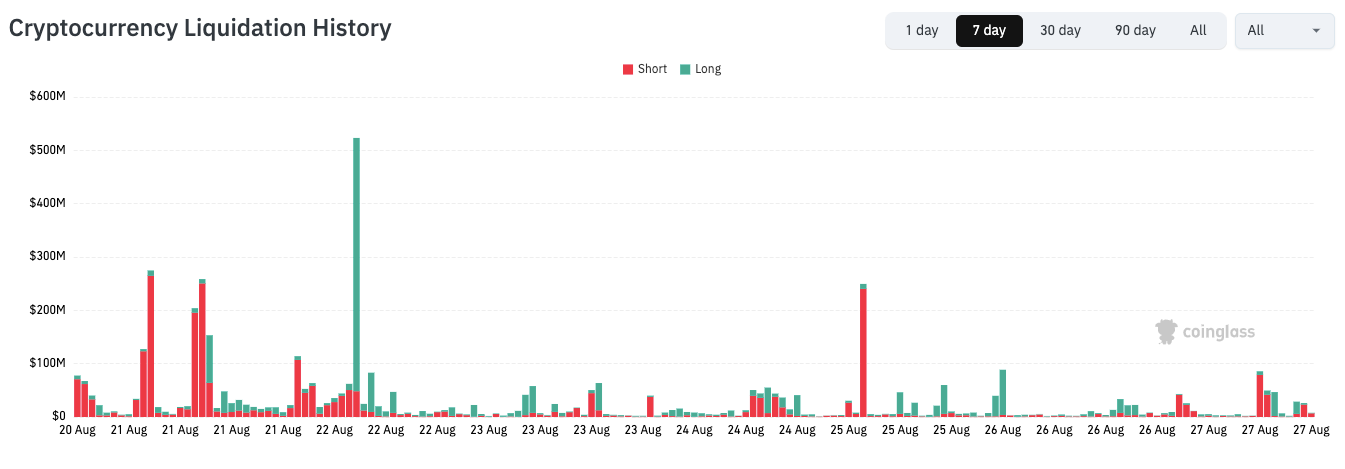
Accompanying Bitcoin’s price appreciation was a notable increase in crypto liquidations, totaling approximately $417 million over a 24-hour period, according to data from CoinGlass. This figure indicates that a substantial number of leveraged short positions were closed out as the market moved against them, further fueling the upward price movement. Liquidations, particularly of short positions, often act as a short-term accelerator for price rallies, as forced buying to cover positions adds to market demand.
Analysts have been closely monitoring Bitcoin’s order book dynamics, specifically the "sell wall" or area of significant ask liquidity that had previously created resistance for further price upside. Earlier reports indicated this zone extended up to $86,000, presenting a formidable barrier. However, recent market activity suggests a shift. David Eng, a prominent analyst, commented on the observed weakening of this liquidity wall. He conveyed to his X followers that "BTC is compressed under resistance just as the derivatives structure holding it there is about to weaken. Break $82K and the path to $85K+ gets much cleaner." This analysis implies that if Bitcoin can decisively break above the $82,000 mark, it could encounter significantly less selling pressure, paving the way for a rapid ascent towards the $85,000 level and potentially beyond.
The Looming Influence of Macroeconomic Factors: Jackson Hole Symposium
As global markets reacted to Nvidia’s earnings, attention also began to pivot towards the annual Jackson Hole Economic Symposium, which was already underway. This prestigious event, hosted by the Federal Reserve Bank of Kansas City, gathers central bankers, finance ministers, academics, and financial market participants from around the world to discuss long-term policy issues. Historically, speeches delivered by Federal Reserve officials at Jackson Hole have often provided crucial insights into future monetary policy directions, making it a closely watched event for investors across all asset classes.
The market’s immediate focus was on the highly anticipated keynote speech by Federal Reserve Chair Kevin Warsh, scheduled for Friday. While Warsh is known for his circumspect approach to discussing future policy shifts, market participants harbored hopes that his address would help to tame prevailing market uncertainty. This uncertainty has been fueled by a confluence of factors, including mixed U.S. inflation data and volatile government bond yields, which have kept investors on edge regarding the future trajectory of interest rates and economic growth.
Kathy Bostjancic, Chief U.S. Economist at Nationwide, emphasized the profound significance of the upcoming address, as quoted by CNBC. "Chairman Warsh’s address is poised to be extremely key given the jump in long-term interest rates and high uncertainty over the path of inflation and Fed’s reaction function going forward," Bostjancic stated. Her comments underscore the critical juncture at which the global economy finds itself, with central bank policy decisions having far-reaching implications for capital markets, including the volatile cryptocurrency sector. A hawkish stance could dampen enthusiasm for risk assets, while a more dovish or cautiously optimistic tone could further fuel the rally.
Derivatives Market: The Approaching Bitcoin Options Expiry
Adding another layer of potential volatility to the cryptocurrency market is the impending August options expiry event on crypto exchange Deribit, scheduled for Friday. This event is substantial, encompassing $6.58 billion worth of Bitcoin options, equivalent to approximately 81,700 BTC.
Bitcoin options expiry events occur when options contracts reach their predetermined expiration date, at which point traders must decide whether to exercise their right to buy or sell BTC at a specific strike price. Such events are known to spark increased market volatility, as participants adjust their positions, hedge existing exposures, or engage in strategies designed to influence the price towards favorable strike levels. The "max pain" theory, which posits that the price of the underlying asset tends to gravitate towards the strike price where the most options expire worthless, is often discussed in the lead-up to these events. The sheer volume of this particular expiry suggests that its impact could be significant, potentially creating short-term price swings or reinforcing existing trends depending on the dominant positions.
Interconnected Markets: The Growing Bitcoin-Tech Correlation
Thursday’s market movements provided a stark illustration of the increasingly intertwined nature of Bitcoin and traditional financial markets, particularly the technology sector. Bitcoin, often categorized as a "risk-on" asset, tends to perform well when investor sentiment is positive and there is a strong appetite for growth. Nvidia’s exceptional earnings served as a powerful signal of robust health within the tech industry, translating directly into heightened optimism for assets perceived as having high growth potential, including cryptocurrencies.
Historically, Bitcoin’s correlation with major tech indices like the Nasdaq Composite has grown, diverging from its earlier narrative as purely "digital gold" or an uncorrelated asset. This means that strong performance in the tech sector frequently spills over into the crypto market, and vice versa. Investors increasingly view Bitcoin as a high-beta play on the broader technology landscape, making it susceptible to the same macro-economic forces and sentiment shifts that influence publicly traded tech companies. This phenomenon underscores the maturation of the cryptocurrency market and its deeper integration into the global financial system.
Looking Ahead: Key Levels and Future Market Drivers
As the week draws to a close, market participants will continue to monitor several critical factors. For Bitcoin, maintaining support above $80,000 will be paramount for sustaining its current bullish momentum. A decisive break above $82,000, as suggested by analysts, could unlock significant upside potential towards $85,000 and beyond. Conversely, a failure to hold $80,000 could lead to a retest of lower support levels.
Beyond the immediate technicals and the derivatives market, the overarching narrative will be shaped by the outcomes of the Jackson Hole Symposium. Any clear signals regarding the Federal Reserve’s monetary policy stance, particularly concerning interest rates and inflation, will have profound implications for risk assets globally. Furthermore, ongoing developments in the AI sector, broader macroeconomic data releases, and regulatory movements within the cryptocurrency space will continue to serve as significant drivers for market sentiment and price action.
The confluence of a blockbuster earnings report from a tech titan like Nvidia, coupled with pivotal macroeconomic events and significant derivatives expiries, paints a complex yet dynamic picture for Bitcoin and the broader financial markets. While optimism is currently high, the inherent volatility of these markets necessitates a cautious and informed approach from all investors.








