Clara Shinta
Demand for US spot Bitcoin exchange-traded funds (ETFs) has surged dramatically over the past week, coinciding with a significant security breach affecting the popular Coldcard hardware wallet. This dual development has sparked considerable discussion within the cryptocurrency community, prompting speculation among market observers about whether some investors are re-evaluating the complexities and risks associated with self-custody in favor of regulated, institutionally managed investment products. The sustained influx of capital into these ETFs suggests a potential recalibration of risk perception among Bitcoin holders.
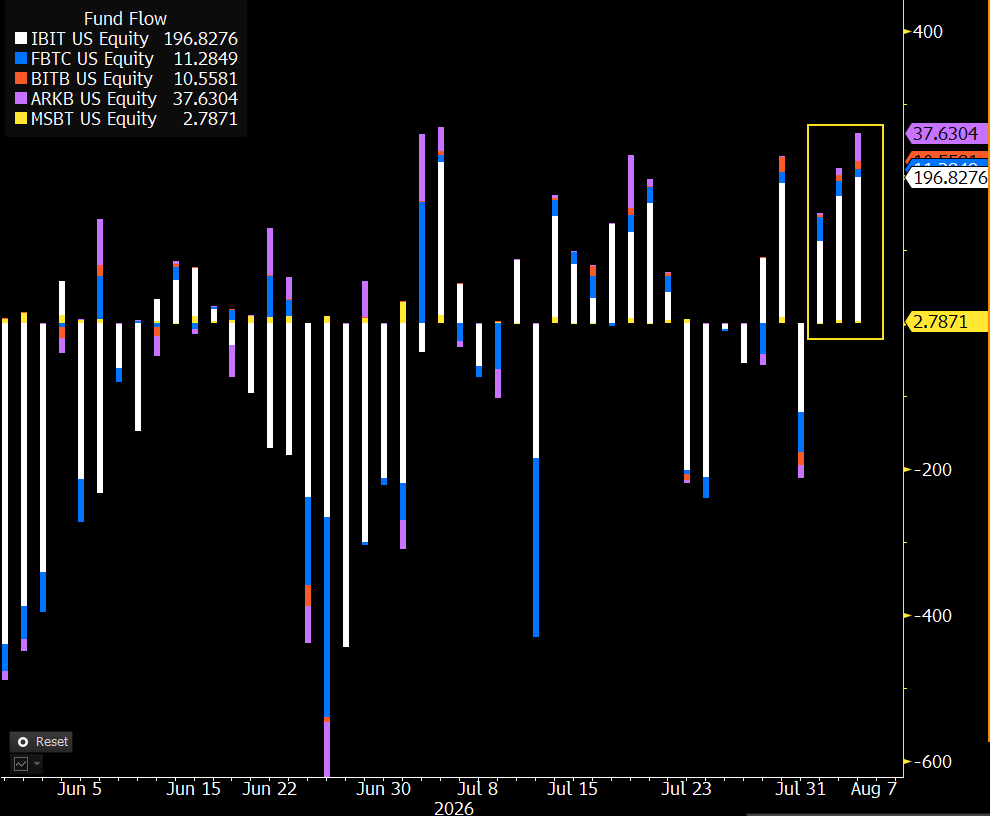
According to data compiled and analyzed by Bloomberg senior ETF analyst Eric Balchunas, several prominent spot Bitcoin ETFs have recorded consistent daily inflows since the weekend exploit. BlackRock’s iShares Bitcoin Trust (IBIT), Fidelity Wise Origin Bitcoin Fund (FBTC), Bitwise Bitcoin ETF (BITB), and ARK 21Shares Bitcoin ETF (ARKB) have all demonstrated robust performance in attracting new capital. Additionally, the Defiance Daily Target 2X Long MSTR ETF (MSBT), which offers leveraged exposure to MicroStrategy, a major Bitcoin corporate holder, also saw notable inflows. Cumulatively, these funds have attracted approximately $620 million in new investments over this period, a figure consistent with recent reports highlighting the escalating inflow streak. This sustained buying pressure underscores a growing appetite for Bitcoin exposure through regulated financial instruments.
The Coldcard Exploit: A Detailed Look at the Breach
The catalyst for this renewed debate and potential shift in investor behavior was the Coldcard exploit, a sophisticated attack that resulted in the draining of more than $116 million worth of Bitcoin from over 5,200 unique wallet addresses. Blockchain intelligence firm TRM Labs, which specializes in tracking illicit financial flows, provided these critical figures, underscoring the severity and widespread impact of the breach. Coldcard, a product of Coinkite, is widely recognized and highly regarded within the Bitcoin community for its robust security features, including advanced multi-signature capabilities and an air-gapped design aimed at isolating private keys from internet-connected devices. Its reputation as a bastion of secure self-custody made the exploit particularly jarring for many users who prioritize maximum control over their digital assets.
While the precise technical vector of the Coldcard exploit has not yet been fully detailed in a public post-mortem by Coinkite, the incident has been broadly attributed to firmware flaws or software vulnerabilities. Hardware wallets, despite their enhanced security architecture, are not entirely impervious to attack. Vulnerabilities can arise from intricate supply chain attacks, sophisticated side-channel attacks, or, as appears to be the case here, flaws within the device’s firmware or associated software libraries. The complexity of securing such devices, which often involves intricate cryptographic processes and interaction with various software components, means that even minute vulnerabilities can be exploited by highly skilled attackers. The incident has served as a stark reminder that even the most advanced self-custody solutions carry inherent operational risks, necessitating constant vigilance and rigorous security practices from both manufacturers and users.
Chronology of Events and Market Reactions
The sequence of events unfolded rapidly, beginning with the initial reports of the Coldcard exploit emerging over the recent weekend. As news of the breach spread through crypto news outlets and social media platforms, concerns about the efficacy of self-custody measures began to proliferate. Almost concurrently, starting from the first trading day following the reported exploit, a discernible acceleration in inflows into US spot Bitcoin ETFs was observed.

Eric Balchunas, while noting the compelling timing, maintained a cautious stance on definitively linking the two events. "I’m not saying it’s connected, we just don’t know," Balchunas stated in a post on X (formerly Twitter). However, he added a significant qualifier, acknowledging the long-term implications: "[Although] long-term I can’t imagine there aren’t some who migrate over." This nuanced perspective reflects the difficulty of drawing direct causal links in complex market dynamics while also recognizing the psychological impact such events can have on investor behavior. The market’s reaction, characterized by increased institutional product adoption, suggests that for a segment of investors, the perceived security and regulatory assurances offered by ETFs may now outweigh the purist ideal of absolute self-custody, particularly in the wake of a high-profile security failure.
Supporting Data: The Rise of Spot Bitcoin ETFs
The launch of spot Bitcoin ETFs in the United States in January 2024 marked a watershed moment for the cryptocurrency industry. These funds, approved by the U.S. Securities and Exchange Commission (SEC) after years of regulatory hurdles, allow investors to gain exposure to Bitcoin’s price movements without directly owning or managing the underlying asset. This innovation significantly broadened the accessibility of Bitcoin to a wider range of investors, including institutional players, traditional financial advisors, and retail investors who prefer regulated investment vehicles.
Since their inception, these ETFs have demonstrated remarkable growth, attracting billions of dollars in assets under management (AUM). BlackRock’s IBIT and Fidelity’s FBTC, in particular, quickly emerged as leaders, accumulating substantial Bitcoin holdings within months. The cumulative figure of $620 million in inflows over a single week, following the Coldcard incident, is indicative of the robust demand these products continue to command. This surge is not merely a reflection of Bitcoin’s price performance but also signals a deeper trend of capital flowing from traditional finance into the digital asset space through regulated channels. The convenience, liquidity, and professional custody services offered by these ETFs stand in stark contrast to the individual responsibility inherent in self-custody, a contrast sharply highlighted by recent security incidents.
Reignited Debate: Self-Custody vs. Centralized and Institutional Custody
The Coldcard exploit has thrust the perennial debate over self-custody versus centralized or institutional custody back into the spotlight. For years, the mantra "not your keys, not your coins" has been a foundational principle within the Bitcoin community, advocating for individuals to maintain direct control over their private keys to ensure true ownership and censorship resistance. Hardware wallets like Coldcard were considered the pinnacle of this philosophy, offering a secure, offline method for storing digital assets.
However, the incident has renewed concerns that even the most advanced hardware wallet users can be exposed to sophisticated firmware flaws and software vulnerabilities. This highlights the inherent operational risks and the high degree of technical proficiency required for truly secure self-custody. Users are responsible for everything from selecting reputable hardware and software, managing seed phrases, securing backup solutions, to understanding and mitigating various attack vectors. A single mistake or overlooked vulnerability can lead to irreversible loss.
In response to the evolving security landscape, prominent figures like Binance co-founder Changpeng "CZ" Zhao have weighed in, arguing that storing crypto on centralized exchanges (CEXs) may now be "statistically safer" than self-custody. CZ cited data from analyst Willy Woo, suggesting that cumulative Bitcoin losses from self-custody incidents have surpassed those from exchange hacks. "Hack data is easier to collect on the CEX side, usually major news. It is harder on the self-custody side, where hacks, lost coins, etc are often not reported," CZ explained.
While CZ’s perspective is controversial among staunch self-custody advocates, it underscores a critical point: the visibility and reporting of losses differ significantly between centralized platforms and individual users. Exchange hacks are often large-scale, widely reported events, whereas individual self-custody losses due to phishing, malware, or hardware failure might go unreported, leading to an underestimation of their cumulative impact. The argument for CEXs, or more broadly, institutional custodians like those supporting ETFs, rests on their dedicated security teams, multi-layered defenses, insurance policies, and regulatory oversight, which, for many, offer a more palatable risk profile than bearing the full burden of security themselves.
The Escalating Threat of AI-Assisted Cyberattacks
Adding another layer of complexity to the security landscape is the accelerating sophistication of cyberattacks, particularly those leveraging artificial intelligence (AI). The crypto industry, with its high-value targets and often public blockchain data, has become a prime target for advanced threat actors. The original article mentions a crucial development on this front: Bitcoin swap service Boltz suspended its non-custodial bridge, citing a steady rise in AI-assisted exploits. Boltz’s team reported that these AI-driven attacks were allowing malicious actors to identify and exploit vulnerabilities faster than the company’s security team could patch them.
This development is deeply concerning. AI can dramatically enhance an attacker’s capabilities by:
- Automated Vulnerability Discovery: AI algorithms can rapidly scan codebases, network configurations, and smart contracts for subtle flaws that human auditors might miss.
- Sophisticated Phishing and Social Engineering: AI can generate highly convincing phishing emails, deepfake videos, and personalized social engineering tactics, making it harder for users to detect scams.
- Real-time Exploit Adaptation: AI can analyze network traffic and system responses in real-time, allowing exploits to adapt and bypass defenses dynamically.
- Scaling Attacks: AI can orchestrate and manage large-scale, distributed attacks with greater efficiency and coordination.
The Boltz incident serves as a chilling preview of a future where cybersecurity becomes an arms race between AI-powered attackers and AI-augmented defenders. For individual self-custody users, this raises the bar significantly, demanding an even higher level of technical sophistication and awareness to counter increasingly intelligent adversaries. Institutional custodians, while better resourced, also face immense pressure to continually upgrade their defensive capabilities, often by integrating AI themselves to detect and respond to threats.
Broader Impact and Implications
The confluence of accelerating ETF inflows and a high-profile hardware wallet exploit carries several significant implications for the cryptocurrency ecosystem:
- Shift in Investor Demographics: The sustained demand for spot Bitcoin ETFs indicates a growing segment of investors who prioritize ease of access, regulatory compliance, and institutional security over the maximalist ideal of self-custody. This could lead to a demographic shift within the Bitcoin holder base, with a greater proportion of "trad-fi" participants.
- Validation of Institutional Custody Models: The incidents inadvertently strengthen the case for institutional custody solutions. For many, the perceived risks of managing private keys and securing hardware wallets against increasingly sophisticated threats now outweigh the benefits of absolute self-sovereignty, particularly for larger holdings or less technically adept individuals.
- Enhanced Scrutiny on Hardware Wallet Security: The Coldcard exploit will undoubtedly lead to increased scrutiny and demand for even more rigorous security audits, transparency, and bug bounty programs within the hardware wallet industry. Manufacturers will be pressured to innovate further and clearly communicate their security postures and incident response plans.
- Regulatory Ramifications: While not directly tied to ETF regulation, widespread security incidents can fuel calls for broader regulatory frameworks governing digital asset security, custody standards, and consumer protection across the entire crypto spectrum, including self-custody tools.
- Evolution of the "Not Your Keys, Not Your Coins" Mantra: The incident forces a re-evaluation of the absolute nature of "not your keys, not your coins." While the principle remains sound for maximal control, its practical application for the average investor is becoming increasingly complex. The debate will likely evolve to consider nuanced approaches, perhaps focusing on diversified strategies combining both self-custody for smaller amounts and institutional custody for larger holdings.
- The AI Cybersecurity Arms Race: The Boltz incident, alongside the Coldcard exploit, highlights that cybersecurity is a rapidly evolving field where AI is becoming a game-changer. Both individuals and institutions must adapt their security strategies to account for AI-powered threats, necessitating continuous education, investment in advanced security tools, and collaborative intelligence sharing within the industry.
In conclusion, the recent surge in US spot Bitcoin ETF inflows, juxtaposed with the significant Coldcard hardware wallet exploit, represents a pivotal moment in the ongoing evolution of how investors engage with Bitcoin. While the correlation between the two events remains speculative, the timing has undeniably reignited a critical debate about the trade-offs between self-custody and institutional security. As the digital asset landscape matures and cyber threats become more sophisticated, particularly with the advent of AI, the appeal of professionally managed and regulated investment products is likely to grow for a substantial portion of the investor base. This shift does not necessarily diminish the importance of self-custody but rather underscores the increasing complexity and demands placed upon individuals who choose to bear the full responsibility for their digital asset security. The path forward for the crypto industry will involve continuous innovation in both self-custody solutions and institutional offerings, striving for a balance that addresses the diverse needs and risk appetites of a global investor base.