Clara Shinta
Bitcoin (BTC) buyers are demonstrating significant resilience and "better absorption" at the $65,000 price level, a development closely following the largest single-day net outflow of BTC from Binance, the world’s leading cryptocurrency exchange, in almost two years. This substantial movement of Bitcoin off exchange platforms, particularly from a dominant player like Binance, is being closely monitored by market analysts as a potential indicator of shifting supply dynamics and investor sentiment in the broader cryptocurrency landscape.
The recent data, primarily highlighted by on-chain analytics platform CryptoQuant, underscores a notable trend where daily BTC withdrawals from Binance have begun to outpace inflows. This shift, culminating in a dramatic single-day outflow, suggests a potential easing of immediate selling pressure on the exchange, as a considerable volume of Bitcoin is being moved into self-custody or other secure storage solutions rather than being held on the exchange for potential liquidation. Such movements are often interpreted as a bullish signal by market participants, as they indicate a longer-term holding strategy by significant investors, reducing the readily available supply on exchanges.
Binance’s Pivotal Role and the Magnitude of the Outflow
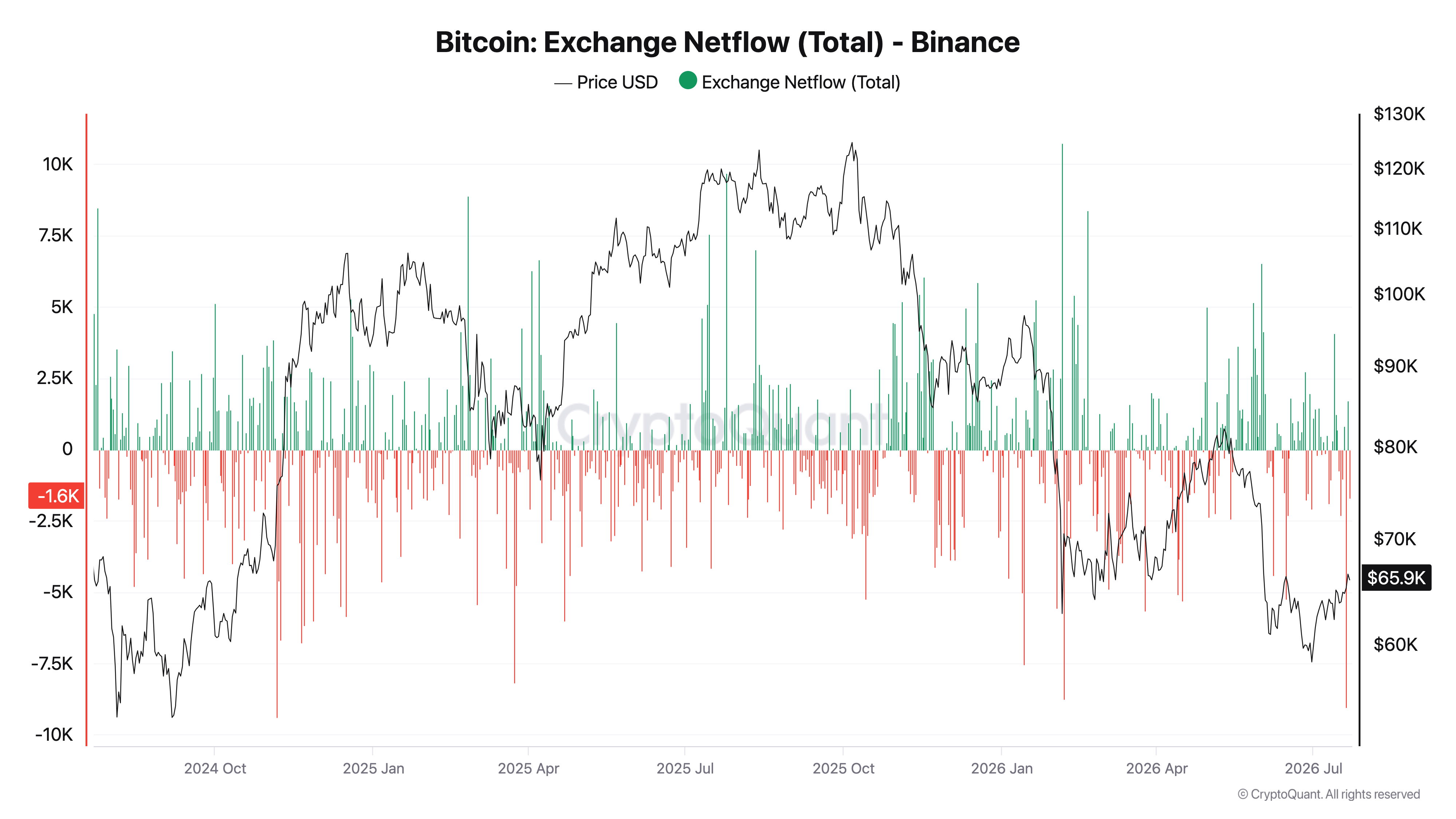
Binance stands as the undisputed titan in the cryptocurrency exchange ecosystem, commanding a significant share of global trading volume and user base. Its operational scale means that any substantial shift in its Bitcoin reserves or net flows carries considerable weight for market analysis. On Tuesday, the exchange registered a net outflow exceeding 9,000 BTC, marking the largest such event since November 2022. This figure is not merely a statistical anomaly but a crucial data point reflecting active decisions by large-scale Bitcoin holders.
According to research published by CryptoQuant, specifically from contributor Rei Researcher, the prevailing trend of daily BTC withdrawals surpassing inflows "usually reflects that short-term supply pressure on Binance is easing to some extent, as $BTC is not being sent to the exchange aggressively for potential selling." This statement captures the essence of why exchange netflows are a vital metric for discerning market sentiment and potential price movements. When coins are moved off exchanges, they are typically transferred to cold storage wallets or other forms of self-custody, indicating an intention to hold rather than trade or sell in the near term. This reduction in "exchange supply" can, under certain conditions, lead to an upward price impetus due to reduced liquidity for sellers.

Historical Context and the Significance of Self-Custody
The last time Binance experienced such a massive single-day outflow was in November 2022. This period was marked by extreme market volatility and a profound crisis of confidence following the collapse of FTX, then one of the largest cryptocurrency exchanges. In the wake of FTX’s implosion, many investors, shaken by the loss of funds held on a centralized platform, proactively moved their assets off exchanges into self-custody. This move was driven by a renewed emphasis on the core tenet of cryptocurrency: "not your keys, not your coin," highlighting the importance of direct control over one’s digital assets. The outflow in November 2022 was therefore largely a reaction to systemic risk and a flight to safety.
The current outflow, while similar in magnitude, occurs under different market conditions. While regulatory scrutiny remains a constant factor for centralized exchanges like Binance, the broader market sentiment is not characterized by the same level of existential panic seen in late 2022. Instead, this latest outflow appears to be a more deliberate, strategic move by investors who may be accumulating Bitcoin at current price levels with a long-term bullish outlook. As fellow CryptoQuant contributor Ruga Research commented in a separate post, "When outflows hit this size, someone is moving serious volume into self-custody. Coins off exchanges are coins that won’t be sold into the order book." This perspective suggests a sophisticated accumulation strategy rather than a reactive security measure.
The increasing trend towards self-custody reflects a maturation of the Bitcoin investor base. As institutions and sophisticated retail investors enter the market, they often prioritize security and direct control over their assets. Hardware wallets, multi-signature wallets, and other advanced self-custody solutions have become more accessible and trusted, empowering individuals and entities to hold their Bitcoin outside the purview of centralized exchanges. This not only enhances security but also removes a significant portion of the supply from immediate trading circulation, which can have profound effects on market dynamics over time.
Chronology of Binance Netflows and Market Momentum
Analysis of CryptoQuant data reveals that Binance’s netflows have experienced a fluctuating pattern. After a consistent streak of positive net inflows (more BTC entering than leaving the exchange) that concluded in early June, the trend shifted. Since then, daily netflows have toggled between positive and negative, indicating a period of indecision or balanced activity. However, the Tuesday outflow starkly broke this pattern, registering a definitive and substantial negative netflow.
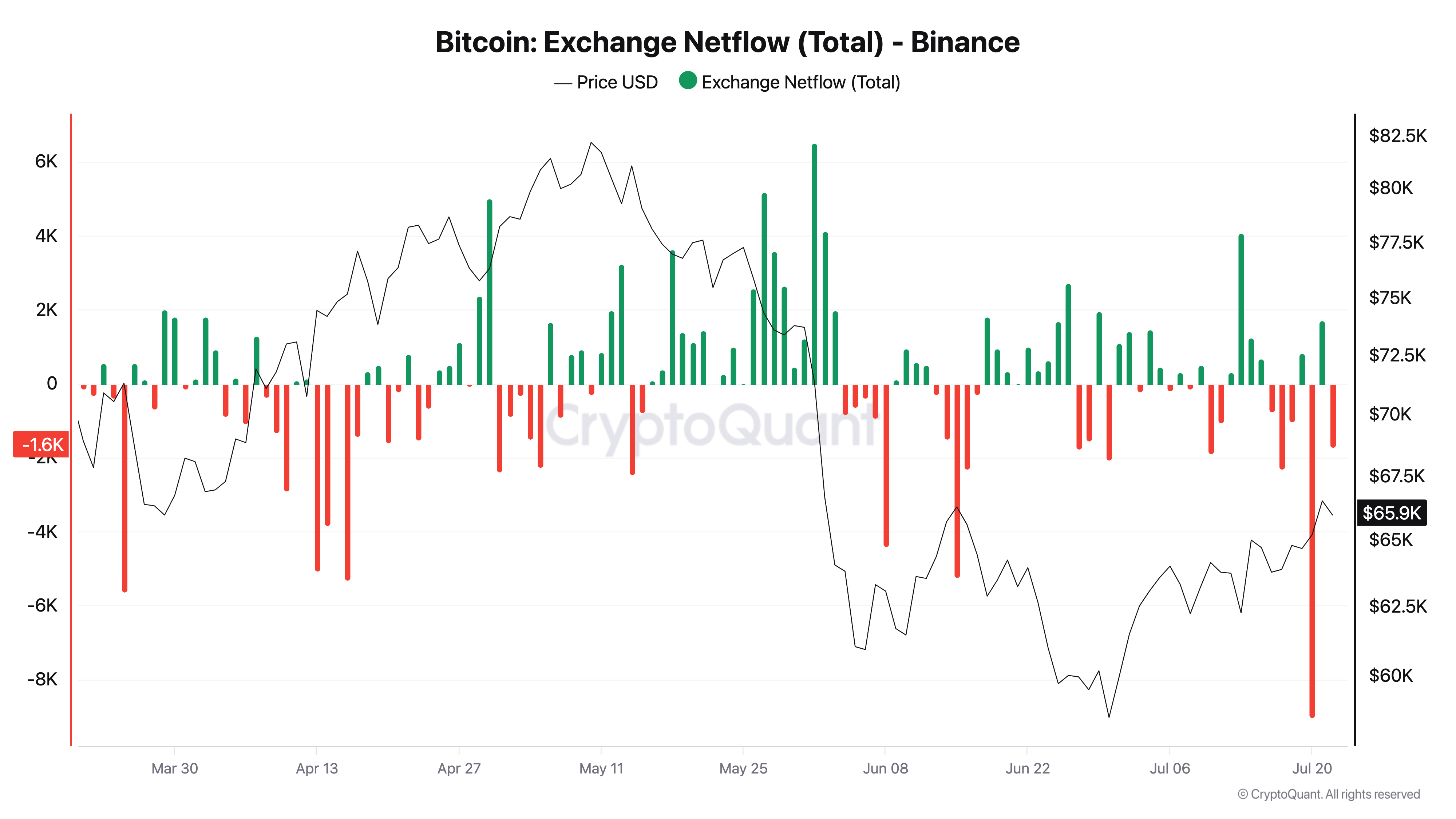
Ruga Research noted that on rolling 30-day time frames, netflows often repeat patterns of fluctuations, and while the latest spike is significant, its immediate reversal is not impossible. "Can this one fail? Absolutely. Momentum has been indecisive around the zero line for two weeks. It hasn’t committed. And what happens next, honestly, nobody knows," he wrote, acknowledging the inherent unpredictability of short-term market movements. Despite this caution, Ruga Research also pointed out a historically significant combination: "But someone just moved 9,030 BTC off the largest exchange while momentum recovers from extreme negative territory. That combination has historically resolved to the upside." This suggests that while short-term volatility remains, the underlying signal from such a large outflow, especially when market momentum is showing signs of recovery, has often preceded positive price action for Bitcoin.
The Concept of "Better Absorption" at $65,000
Rei Researcher’s analysis emphasizes that the negative netflow is particularly "notable" because it appeared "while $BTC price has recovered to around $65K-$66K." This confluence of factors leads to the interpretation of "better absorption" in the market. "Absorption" in this context refers to the market’s ability to effectively take on selling pressure without a significant price decline. When there is strong absorption, it means that buyers are stepping in to purchase Bitcoin at current price levels, effectively soaking up the available supply from sellers. The fact that this is happening around the $65,000-$66,000 range, a critical psychological and technical level for Bitcoin, suggests underlying strength in demand.
This implies that despite potential selling pressure or profit-taking by some market participants, there is sufficient buying interest to prevent a deeper price correction. The sustained interest at this price point, combined with large amounts of Bitcoin moving off exchanges, paints a picture of conviction among a segment of investors who believe Bitcoin’s long-term value remains robust, even if short-term price action is consolidating.
Broader Market Implications and Needed Catalysts
Despite the positive implications of the outflows and better price absorption, analysts are careful to avoid overly bullish predictions based solely on this data. Rei Researcher explicitly stated, "However, negative netflow does not automatically confirm a new uptrend. It needs to be accompanied by spot demand, volume, and a more stable price structure." This crucial caveat highlights that while reduced exchange supply is a supportive factor, it is not sufficient on its own to propel Bitcoin into a sustained bull run.
The current Bitcoin market environment is characterized by a persistent challenge: a perceived lack of sufficient spot demand to drive prices decisively higher. While derivatives markets have shown some signs of turnaround and increased activity, the underlying spot market, where actual Bitcoin is bought and sold for immediate delivery, has struggled to generate the momentum needed for a full bull-market rebound.
This dynamic is further evidenced by the performance of the US spot Bitcoin exchange-traded funds (ETFs). Following their groundbreaking approval in January, these ETFs initially saw massive inflows, attracting billions of dollars from institutional and retail investors. However, in recent months, their net inflows have become more sporadic, occasionally punctuated by periods of net outflows. While there have been recent days of positive inflows, as reported by platforms like Farside Investors, these have not been consistent enough to signal a robust resurgence of institutional spot demand. The performance of these ETFs is a key barometer for broader institutional interest and plays a significant role in overall spot market dynamics.
For Bitcoin to establish a new uptrend, several factors need to align. Sustained, strong spot demand from both retail and institutional investors is paramount. This would manifest as consistent net inflows into ETFs and an increase in overall trading volume on spot exchanges. A more stable price structure, characterized by higher lows and consistent breakouts above resistance levels, would also signal a healthier market. Furthermore, broader macroeconomic conditions, including interest rate policies from central banks and global liquidity trends, continue to exert significant influence on risk assets like Bitcoin.
In conclusion, the substantial Bitcoin outflow from Binance, coupled with the market’s demonstrated ability to absorb selling pressure around $65,000, offers a nuanced but generally positive signal for Bitcoin’s near-term future. It suggests that a significant portion of the supply is being moved into long-term holdings, potentially reducing immediate selling pressure. However, for a decisive new uptrend to emerge, these internal market dynamics must be complemented by a broader increase in spot demand and a more robust, stable price structure, indicating a renewed confidence from a wider spectrum of investors. The interplay of these factors will ultimately determine Bitcoin’s trajectory in the coming months, as market participants continue to scrutinize on-chain data, exchange flows, and macroeconomic indicators for definitive clues.